
Home › Glossary › Everyday science
What is regenerative medicine, medicine that uses cells and more to restore lost body functions?

In one minute
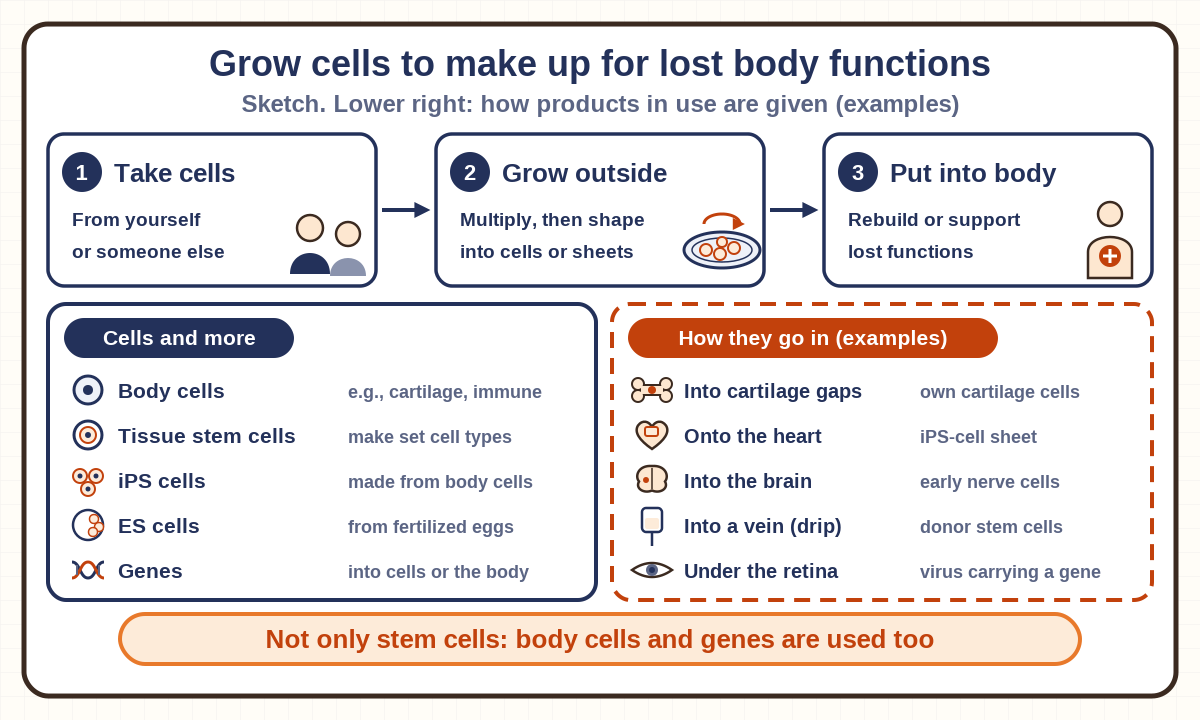
Regenerative medicine is medicine that uses cells and other materials to rebuild tissues and organs that have stopped working because of disease or injury, or to make up for what they do.
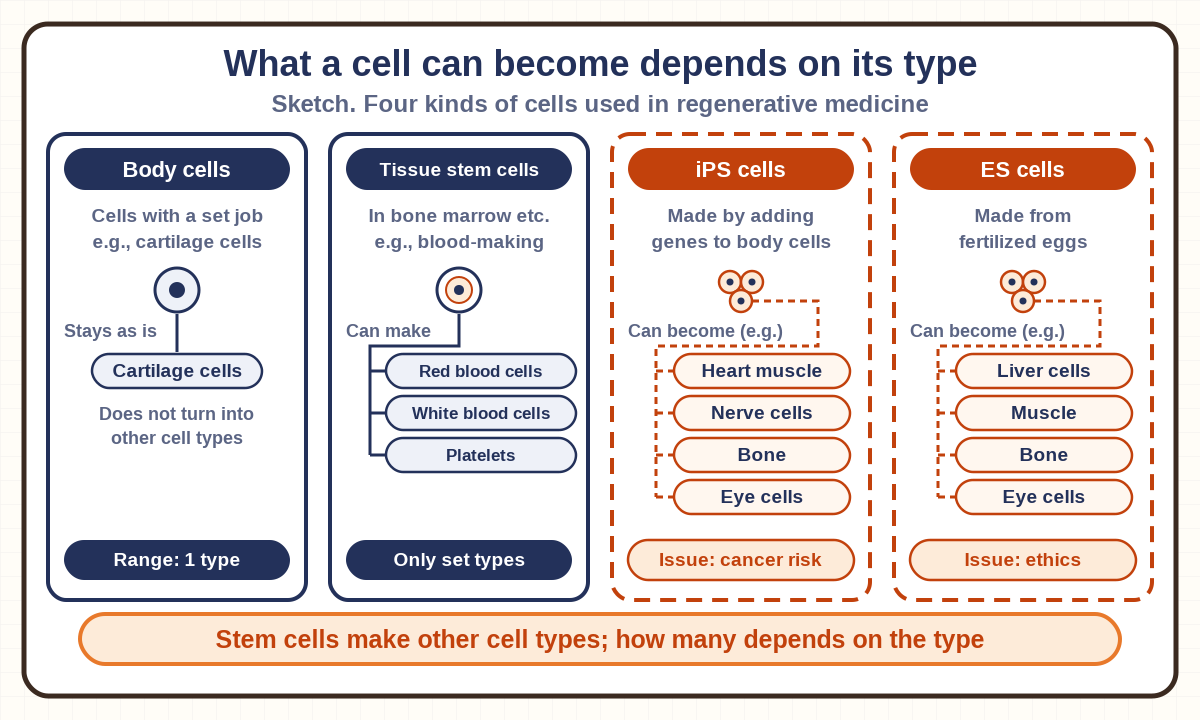
It does not use only stem cells. Body cells such as cartilage cells, tissue stem cells that live in places like bone marrow and make certain kinds of cells, and iPS and ES cells that can become many kinds of body cells are multiplied or grown into the cells needed outside the body, then put into it as a liquid, a sheet or small clumps.
Some cells become the new tissue themselves; others are thought to help by releasing substances that improve the tissue around them. Because human cells differ from person to person, their quality is hard to keep even, so this is medicine still being tested in people to see whether it is safe and whether it really works.
A common mix-up
“Regenerative medicine means growing whole new organs from stem cells such as iPS cells and swapping them in.”
Only half right. Some treatments do use stem cells such as iPS cells, but others use body cells with a set job, such as cartilage cells, or genes. And in examples of products in use today, what goes into the body is things like a liquid containing cells, a sheet of cells or small clumps of cells, not a whole new organ. Also, not every treatment works by the cells becoming new tissue; in some, the cells are thought to help by releasing substances that improve the tissue around them.
Explained in pictures
Free to use in lessons, slides and posts with credit (CC BY 4.0).
Free to use in lessons, slides and posts with credit (CC BY 4.0).
Free to use in lessons, slides and posts with credit (CC BY 4.0).
You’re free to use these figures in lessons, slides and posts if you credit Naru News (naru.news). CC BY 4.0.
Think of it like this
Repairing a floor in a house
Imagine that in an old house, a leak in the roof has rotted some floorboards. If you pull up the rotten boards and fit new ones, you can walk on the floor again. Regenerative medicine likewise tries to rebuild or support parts of the body that have stopped working because of disease or injury, using cells as the parts.
New boards can come from different materials: boards from the house’s own storeroom (your own cells), boards shared by a neighbor (someone else’s cells), or a big block of wood that can be carved into any shape (iPS or ES cells). Each material differs in how easy it is to handle and what you need to watch out for.
There is also more than one way to repair it. In one, you fit a new board and that board itself becomes part of the floor. In another, you have a skilled carpenter stay for a while and care for the damaged boards around it; after a while, the carpenter goes home. Regenerative medicine likewise includes treatments in which the cells put in become tissue themselves, and ones in which the cells are thought to improve the tissue around them with substances they release.
But the comparison has limits. A board fits into place and keeps its shape, but cells are alive. Whether they take root in the body, work as hoped, or cause trouble elsewhere is hard to know until they are tested in people. That is why testing in people to confirm effectiveness and safety matters so much.
Key points
What cells does it use?
The cells used fall into four main groups. The first is body cells with a set job, such as cartilage cells or immune cells in the blood. Even when multiplied, they do not turn into other kinds of cells. The second is tissue stem cells, which live in places like bone marrow and fat and make only certain kinds of cells. For example, the stem cells in bone marrow that make blood produce red and white blood cells, platelets and so on.
The third is iPS cells, made by putting specific genes into body cells, and the fourth is ES cells, made from fertilized eggs. Both can become many kinds of body cells, and great hopes rest on them. But iPS cells are said to carry issues such as turning cancerous, and ES cells ethical issues.
Cells can come from your own body or from someone else’s. Another person’s cells are thought to disappear quickly once the body’s defense system (the immune system) acts on them. That is why drugs that calm the immune system are sometimes used after placing something made from another person’s cells (see the next question, “How do the cells put in work?”).
Not only cells but also genes are used. Treatments such as loading a gene missing from birth onto a virus, putting it into the body and letting it work there (gene therapy) are sometimes grouped with regenerative medicine as medicine that uses cells and similar materials to make up for body functions.
How do the cells put in work?
Two main ways are thought to exist. In one, the cells put in become body tissue themselves and work there. For example, knee joint cartilage has a weak ability to heal itself, so once part of it is lost through injury or similar causes, it is hard to expect it to return to normal on its own. So the patient’s own cartilage cells are grown in a collagen gel and placed into the gap, aiming to restore cartilage function with cartilage-like tissue formed from the cells, the gel and so on.
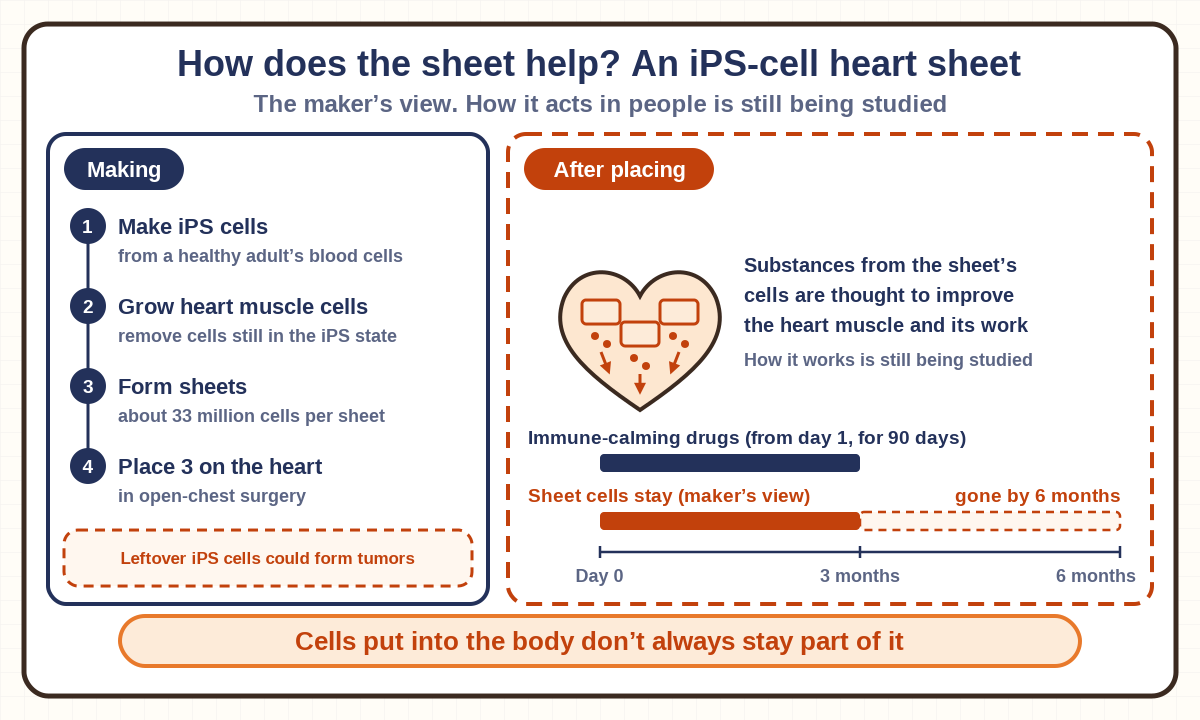
In the other, substances released by the cells put in improve the tissue around them. Sheets of heart muscle cells made from iPS cells are placed, three of them, on the surface of the heart of a person with severe heart failure in open-chest surgery. The maker thinks that various substances released by the sheet’s cells improve the heart muscle and so improve how the heart works. But it is not yet clear whether that is the whole story, and study is to continue after the product comes into use.
Because the sheets are made from another person’s cells, the patient takes drugs that calm the immune system for 90 days from the day after. The maker expects the sheet’s cells to stay where they were placed for about 3 months and to disappear within 6 months, based on reports such as a study in which sheets made from monkey iPS cells were placed on monkey hearts, and the cells remained up to 4 months but were not found at 6 months. How many months they stay in people is not yet known. Cells put into the body do not always stay part of it.
What makes it hard?
For products that use human cells, keeping quality even, the way it is done for medicines, is not easy. They reflect differences between people, so their quality tends to vary and their effectiveness can be hard to predict in advance. Collecting and studying the data to confirm that they work also tends to take a long time.
With products made from iPS cells, care is taken that no tumors (abnormal lumps) form. Even after the cells are grown into the target cells, any cells left in the iPS state could form tumors where they are placed. For the heart sheet made from iPS cells, a step that removes such leftover cells was built into production, and tests such as placing sheets on mice and following them for 45 weeks found no sign of tumors.
How cells are given carries risks too. When grown cells are put into the bloodstream to travel through the whole body, for example by drip, they can block blood vessels in the lungs (pulmonary embolism) or disturb the heartbeat (arrhythmia), which can be fatal, and medical institutions have been warned about this.
Some treatments failed to show they worked after use in people began. A sheet made from the patient’s own muscle cells and placed on the heart of people with severe heart failure was approved and came into use in 2015. But because studies of the people who used it and other data did not show that it worked, its approval was withdrawn in 2024. With treatments that use cells, it matters to keep checking whether they work even after they come into use.
How far has it come?
Let’s look at examples of products approved in Japan. In 2012, a product made by growing the patient’s own cartilage cells was approved to treat places in the knee joint where cartilage was lost through injury and similar causes. In 2015, a product made by growing stem cells taken from the bone marrow of healthy adults and giving them by drip was approved to treat an illness that can follow bone marrow transplants and similar treatments.
In 2023, a product was approved for an inborn eye disease; it loads a working gene onto a virus altered so it cannot multiply and places it under the retina. In 2026, a product that places sheets of stem cells taken from the fat of healthy adults on the raw areas and ulcers of a skin disease called epidermolysis bullosa was approved, as was a product that puts stem cells taken from the synovium of the patient’s own knee joint into an injured meniscus.
Two products made from iPS cells were approved in March 2026: clumps of cells that become dopamine nerve cells, placed into the brains of people with Parkinson’s disease, and sheets of heart muscle cells placed on the hearts of people with severe heart failure. Both were approved with a 7-year time limit, on condition that every patient who uses them is followed to keep checking whether they work. For ES cells, in 2019 Japan’s first clinical trial using them transplanted liver cells made from ES cells into a baby.
What these products put into the body is a liquid containing cells, sheets of cells, small clumps of cells and so on. They do not grow whole new limbs or organs to replace lost ones. Beyond treatment, there are also hopes of making human cells such as liver cells from iPS cells and using them to check the safety of new medicines.
Check yourself
Q1A product approved in 2012 is placed into places in the knee joint where cartilage was lost through injury and similar causes. What from the patient’s own body is grown to make it?
Answer and explanation
Answer: C Cartilage cells taken from cartilage
It is made by growing cartilage cells taken from the patient’s own cartilage in a collagen gel. Cartilage cells are body cells with a set job, not stem cells. Regenerative medicine does not use only stem cells. Some products do use stem cells, such as one made by growing bone marrow stem cells and giving them by drip, and products made from iPS cells were approved in 2026.
Q2In one treatment, sheets of heart muscle cells made from iPS cells are placed on the surface of the heart of a person with severe heart failure. How does the maker think the sheets work?
Answer and explanation
Answer: A Substances from the sheet’s cells improve the heart muscle
The maker thinks various substances released by the sheet’s cells improve the heart muscle and so improve how the heart works (the mechanism is not yet fully understood). Because the sheets are made from another person’s cells, the patient takes drugs that calm the immune system for 90 days after, and the maker expects the sheet’s cells to be gone within 6 months. Cells put into the body do not always stay part of it.
Q3In treatments that grow target cells from iPS cells and place them in the body, why are cells still in the iPS state removed during production?
Answer and explanation
Answer: A If left, they could form lumps called tumors where they are placed
iPS cells can become many kinds of body cells, but they are said to carry issues such as turning cancerous. Even after the cells are grown into the target cells, any cells left in the iPS state could form tumors where they are placed. So for the heart sheet made from iPS cells, a step that removes the leftover cells was built into production, and tests such as placing sheets on mice and following them for 45 weeks found no sign of tumors.
Related terms
- iPS cell
- Embryonic stem cell (ES cell)
- Stem cell
- Mesenchymal stem cell
- Gene therapy
- Clinical trial
- Immunosuppressant
- Hematopoietic stem cell transplantation
Sources and how we checked
- Ministry of Health, Labour and Welfare (MHLW), Japan, outline of the Act Partially Amending the Pharmaceutical Affairs Act (Act No. 84 of 2013) (in Japanese; explanatory slides; p.5 [scope of regenerative medicine products: processed human cells used to rebuild, repair or form body structure or function or to treat or prevent disease, and products put into human cells for gene therapy; quality that is not uniform because it reflects differences between people, so effectiveness can be hard to predict; high hopes for regenerative medicine using iPS cells and other cells, alongside safety and other issues], p.10 [regenerative medicine as medicine that regenerates tissues and organs that have lost function through disease or injury, also expected to help drug development by making target human cells such as liver cells from human iPS cells to check drug safety; ES cells made from fertilized eggs with ethical issues; iPS cells made by introducing specific genes into body cells with issues such as becoming cancerous; tissue stem cells that become only limited cell types (red and white blood cells and platelets from blood-forming stem cells); body cells other than tissue stem cells already specialized and not becoming other cells; ES and iPS cells becoming muscle, eye, bone and other cells], p.11 [an example of the patient’s own cartilage cells grown in collagen gel and placed into a cartilage defect, expected to restore cartilage function through cartilage-like tissue, and an example of gene therapy using a virus carrying a gene missing from birth] and p.12 [non-uniform quality reflecting differences between people, so collecting and evaluating data to confirm effectiveness takes a long time]; read November 21, 2026 in the PDF text)
- PMDA, Japan, Reheart deliberation and review reports (in Japanese; heart muscle cell sheets made from donor iPS cells; use [three sheets placed one by one on the heart’s surface, basically by left-side open-chest surgery, with three immunosuppressants for 90 days from the day after], 3.3 × 10^7 heart muscle cells per sheet; an iPS cell stock made from blood mononuclear cells of a healthy adult; the applicant’s explanation that cytokines and other substances released by the product (a paracrine effect) are expected to improve heart function, and the agency’s view that it is not clear whether this is the only mechanism and that study should continue after marketing; an approval condition to collect information on biological properties reflecting the mechanism; the applicant’s explanation that the cells are thought to remain at the site for about 3 months and disappear within 6 months [transplanted donor or other-species cells being thought to disappear quickly through immune responses when the immune system works, and a reported study in which heart muscle cell sheets from cynomolgus monkey iPS cells placed on monkey hearts remained up to 4 months and were not detected at 6 months]; the period they stay in people being unknown; the risk of tumors from undifferentiated iPS cells left in the final product and their removal during manufacturing; no findings suggesting tumors 45 weeks after placing the product on NOG mouse hearts; and, at the committee meeting of February 19, 2026, a conditional, time-limited approval with surveys of every patient and a 7-year limit; read November 21, 2026 in the PDF text)
- PMDA, Japan, Amchepry deliberation report (in Japanese; at the committee meeting of February 19, 2026, approval found acceptable as a conditional, time-limited approval, with post-marketing surveys covering every patient who uses it and a 7-year limit; read November 20, 2026 in the PDF text)
- Pharmaceuticals and Medical Devices Agency (PMDA), Japan, JACC review report (in Japanese; June 5, 2012; joint cartilage has a low ability to repair itself, so natural repair cannot be expected when a cartilage defect occurs; a product of the patient’s own cartilage cells grown in three dimensions in atelocollagen gel, used for traumatic cartilage defects or osteochondritis dissecans of the knee; read November 21, 2026 in the PDF text)
- PMDA, Japan, list of regenerative medicine products approved in fiscal 2015 (in Japanese; on September 18, 2015, approval of a product of donor bone-marrow mesenchymal stem cells from healthy adults given into a vein by drip to treat acute graft-versus-host disease after hematopoietic stem cell transplantation [Temcell], and conditional, time-limited approval of a sheet product from the patient’s own skeletal muscle for severe heart failure [HeartSheet]; read November 20, 2026 in the PDF text)
- PMDA, Japan, list of regenerative medicine products approved in fiscal 2023 (in Japanese; on June 26, 2023, approval of a non-replicating recombinant adeno-associated virus carrying the human RPE65 gene, given under the retina to treat inherited retinal dystrophy caused by biallelic RPE65 mutations [Luxturna]; read November 20, 2026 in the PDF text)
- PMDA, Japan, list of regenerative medicine products approved in fiscal 2024 (in Japanese; a product in which a CAR targeting CD19 is introduced into T cells from the patient’s blood [Breyanzi]; read November 20, 2026 in the PDF text)
- PMDA, Japan, list of regenerative medicine products approved in fiscal 2025 (in Japanese; autologous cultured cartilage made from chondrocytes isolated from the patient’s own cartilage [JACC], approved on July 27, 2012 for traumatic cartilage defects or osteochondritis dissecans, and the approvals on March 6, 2026 of a heart muscle cell sheet [Reheart] and dopaminergic progenitor cell clusters [Amchepry] made from donor iPS cells; read November 20, 2026 in the PDF text)
- PMDA, Japan, list of regenerative medicine products approved in fiscal 2026 (in Japanese; approval on April 3, 2026 of sheets of mesenchymal stem cells from the subcutaneous fat of healthy adults, placed on erosions and ulcers in epidermolysis bullosa [Allostem Sheet], and approval on May 8, 2026 of mesenchymal stem cells from the synovium of the patient’s own knee joint, given into a meniscus injury [Seibiscus]; read November 20, 2026 in the PDF text)
- MHLW, Japan, summary of the deliberation on HeartSheet at the Pharmaceutical Affairs Council’s committee on regenerative medicine products, with related notices (in Japanese; Central Social Insurance Medical Council document, August 7, 2024; conditional, time-limited approval on September 18, 2015, with a 5-year limit later extended by 3 years [to September 17, 2023]; a product made by growing skeletal myoblasts from the patient’s own skeletal muscle and placing them as sheets on the heart’s surface; a new application on September 7, 2023; the committee’s conclusion on July 19, 2024 that effectiveness was not shown in the post-marketing survey and clinical study and that approval was not appropriate; notices of July 24, 2024; and withdrawal of the approval on July 25, 2024; read November 20, 2026 in the PDF text)
- Pharmaceuticals and Medical Devices Agency (PMDA), Japan, HeartSheet deliberation report (in Japanese; July 24, 2024; the Pharmaceutical Affairs Council supported the committee’s conclusion that approving the product was not appropriate, under Article 23-25(2)(iii)(a) of the PMD Act [when the claimed effects are not recognized]; read November 20, 2026 in the PDF text)
- MHLW, Japan, Director of the Research and Development Policy Division, notice of points for medical institutions to note when providing regenerative medicine (in Japanese; notice 0312-2, March 12, 2026; the risk of fatal pulmonary embolism, arrhythmia and other events when processed cells are given into a vein to the whole body; read November 20, 2026 in the PDF text)
- National Center for Child Health and Development (NCCHD) and Japan Agency for Medical Research and Development (AMED), press release on a clinical trial using human ES cells for a urea cycle disorder (in Japanese; May 21, 2020; a trial from October 21, 2019 in which liver cells made from ES cells were transplanted into a 6-day-old newborn, Japan’s first clinical trial in people using human ES cells; read November 20, 2026)
AI wrote this page from the sources above, and a different AI checked it against the text of those sources (November 21, 2026). A person with a master’s degree in science and a Japanese high-school science teaching license also read and checked it before publishing. Numbers are as of that date. If anything was hard to follow, you spot a mistake, or there’s a term you’d like explained, please write to [email protected].
Glossary
- AI agent
- AI alignment
- Alignment faking
- Artificial general intelligence (AGI)
- Artificial intelligence (AI)
- Backdoor
- Benchmark
- Chain of thought (CoT)
- Context window
- Data poisoning
- Deep learning
- Deepfake
- Diffusion model
- Embedding
- Emergent misalignment
- Evaluation awareness
- Fine-tuning
- Formal verification
- Generalization
- Generative adversarial network (GAN)
- Generative AI
- Goodhart’s law
- Gradual disempowerment
- Hallucination
- Hyperparameter
- Intelligence explosion
- Interpretability
- Jailbreaking
- Large language model (LLM)
- Latent space
- Machine learning
- Mixture of experts (MoE)
- Neural network
- Neuralese
- Overfitting
- Parameter
- Persona vectors
- Pre-training
- Prompt
- Prompt injection
- Reasoning model
- Recursive language model (RLM)
- Recursive self-improvement (RSI)
- Red teaming
- Reinforcement learning (RL)
- Retrieval-augmented generation (RAG)
- Reward hacking
- Reward model
- Shutdown resistance
- Sleeper agent
- Subliminal learning
- Superintelligence (ASI)
- System prompt
- Technological singularity
- Time horizon
- Token
- Transfer learning
- Transformer
- Accretion disk
- Black hole
- Black hole star
- Cosmic birefringence
- Event horizon
- Event Horizon Telescope (EHT)
- General relativity
- GPS
- Gravitational lensing
- Gravitational singularity
- Gravitational wave
- James Webb Space Telescope (JWST)
- Lagrange point
- Long-period radio transient (LPT)
- Neutron star
- Pulsar
- Quasar
- Sagittarius A*
- Space data center
- Spacetime
- Special relativity
- Speed of light
- Supermassive black hole
- White dwarf