
What is a qubit (a quantum computer’s unit of information that can mix 0 and 1)?
Also called: Quantum bit, Qubits

In one minute
A qubit is the smallest unit of information in a quantum computer: besides being just 0 or just 1, it can take a state that mixes 0 and 1 in set proportions (a superposition).
But when you measure it, you get just one of 0 or 1, with chances set by those proportions, and the mix is gone. So one qubit can give you no more than one bit of information, the same as an ordinary bit. With many qubits, you can mix all the combinations of 0s and 1s and link their states (entanglement), and this is what quantum computing is built on.
Qubits are made from superconducting circuits, trapped ions, neutral atoms, light, electrons in semiconductors and more, each using two states as 0 and 1. A superposition quickly falls apart when it meets heat or stray electric and magnetic fields, so qubits are kept extremely cold or cut off from their surroundings, and researchers are working on ways to correct errors using many qubits.
A common mix-up
“A qubit holds 0 and 1 at the same time, so one qubit can store lots of information and try every answer at once.”
Half right. A qubit can take states that mix 0 and 1 in set proportions, and there are countless possible combinations of proportions and ways of mixing. With n qubits, each of the combinations of 0s and 1s (2 to the power n of them) can carry its own proportion, so writing the state down takes 2 to the power n numbers. That much is true. But measuring gives you just one of 0 or 1, and the mix is gone. One qubit can give you at most one bit of information, and n qubits at most n bits (this follows from a theorem Holevo proved in 1973). Even to learn the proportions, you have to prepare the same state many times and measure it again and again, and a qubit whose contents you don’t know can’t be copied. “Trying every answer at once” is an overstatement too. Since reading out gives only one answer, a quantum computer is faster only on problems where the steps can be arranged so that wrong answers cancel each other out and the right one is reinforced (this uses interference, which is like water waves: where a crest meets a trough they cancel out, and where two crests meet the wave grows taller).
Explained in pictures
Free to use in lessons, slides and posts with credit (CC BY 4.0).
Free to use in lessons, slides and posts with credit (CC BY 4.0).
Free to use in lessons, slides and posts with credit (CC BY 4.0).
Free to use in lessons, slides and posts with credit (CC BY 4.0).
You’re free to use these figures in lessons, slides and posts if you credit Naru News (naru.news). CC BY 4.0.
Think of it like this
An arrow that only answers “up” or “down”
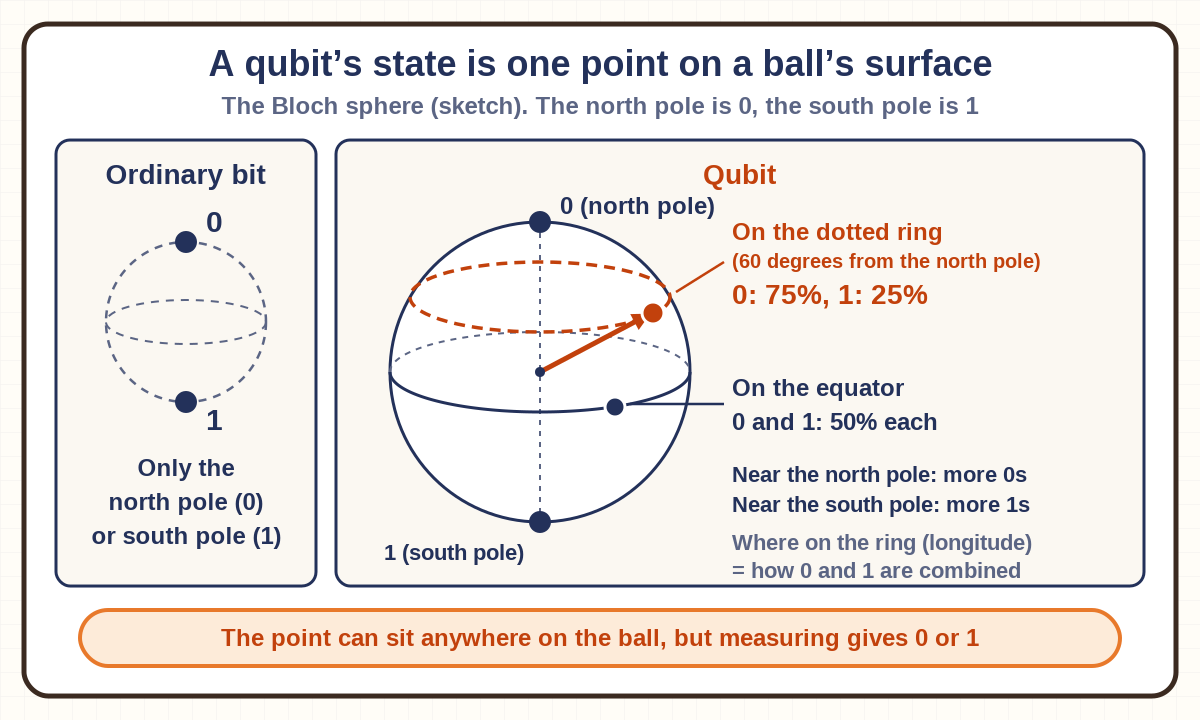
An ordinary bit is like a light switch: on or off, 1 or 0, one or the other. A qubit is more like an arrow pointing out from the center of a ball. It can point straight up (0) or straight down (1), but also at a slant, sideways, or in any direction at all. An arrow tilted close to straight up is a state with more 0 and less 1 mixed in.
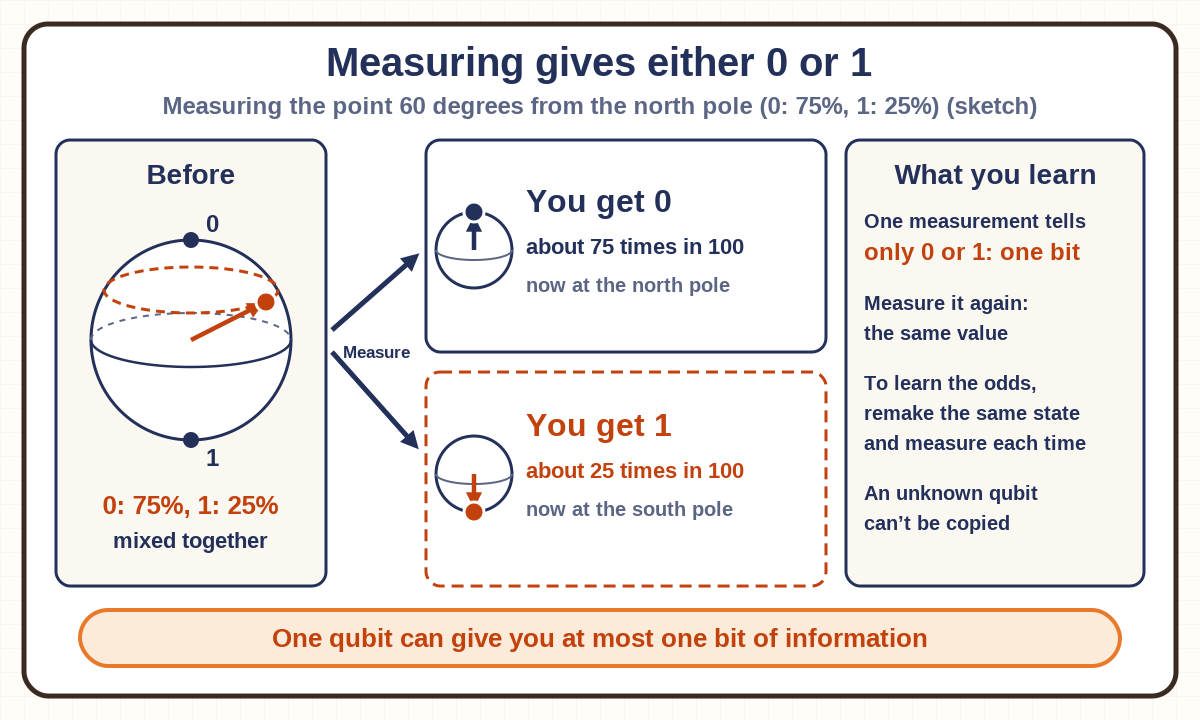
Measuring a qubit is like asking the arrow, “Up or down?” Even when it is slanted, the arrow always answers “up” or “down,” and the closer it points to up, the more likely it is to answer “up.” What’s more, after answering, the arrow turns to point the way it answered. So one question tells you only up or down, not the original slant.
But the comparison has limits. With a real arrow, you could just look to see which way it points, but there is no way to see a qubit’s direction in one go. You have to prepare many qubits pointing the same way, ask again and again, and estimate the tilt from the share of answers. Also, arrows pointing sideways can differ, like front, right, back or left. The up-or-down question can’t tell these apart, but the difference matters in calculations. And once two or more qubits are entangled, they can no longer be drawn as one arrow each.
Key points
How is it different from an ordinary bit?
A bit in an ordinary computer stands for either 0 or 1. Physically, it might be the direction of a tiny magnet or whether an electrical switch is on or off. A qubit also has two states that serve as 0 and 1, but because it follows the rules of the quantum world (the world of very small things like atoms, electrons and particles of light), it can also take a state that mixes 0 and 1 in set proportions (a superposition).
When you measure a qubit in a superposition, you get just one of 0 or 1. Which one is not decided in advance; all you can know is how likely each is. If the share of 0 is 75%, then when you prepare the same state many times and measure it, you get 0 about 75 times in 100 and 1 about 25 times. After the measurement, the qubit is in the state of the value you got, and the mix is gone. Measure it again right away, and you get the same value.
The state of one qubit can be shown as a point on the surface of a ball (called the Bloch sphere). Think of it as the Earth: the north pole is 0, and the south pole is 1. The closer a point is to the north pole, the likelier 0 is, and a point on the equator gives 0 and 1 half the time each. For example, a point at the latitude 60 degrees down from the north pole gives 0 with 75% and 1 with 25%. The chance of 0 doesn’t fall in proportion to the angle from the north pole; it changes along a smooth curve, to 75% at 60 degrees and 50% at 90 degrees, on the equator. All points on the same ring of latitude have the same chances, whatever their longitude. The difference in longitude stands for a difference in how 0 and 1 are combined (something like plus or minus). Even with the same chances, a different way of combining changes how the possibilities reinforce or cancel each other during a calculation.
Here is where the way of combining shows up. An even mix of 0 and 1 combined with plus and one combined with minus are both points on the equator, 180 degrees of longitude apart. Measured as they are, both give 0 and 1 half the time each, so you can’t tell them apart. But if you first apply a set operation called the Hadamard transform and then measure, the plus one always gives 0 and the minus one always gives 1. In the plus one the parts for 1 cancel out, and in the minus one the parts for 0 do.
How much information fits in one qubit?
There are countless points on the surface of a ball, so a single qubit can take countless states. Yet measuring tells you only 0 or 1, so you can get just one bit of information out. It is known that even if you put information into n qubits, you can later get out no more than n bits. This follows from a theorem Holevo proved in 1973.
So how can you learn a state’s proportions? You prepare many qubits in the same state, measure them again and again, and estimate from the share of results. If you are handed a single qubit whose contents you don’t know, you can’t make copies of it to measure many times. The rules of quantum physics show that a qubit with unknown contents can’t be copied.
Qubits are still useful because, during a calculation before the measurement, all of the proportions and ways of combining are at work. By making good use of reinforcing and canceling (interference), you can make the answer you want likely to come out when you measure at the end.
What grows when you add qubits?
With 2 qubits, there are 4 combinations of 0s and 1s: 00, 01, 10 and 11. With 3 there are 8, and with n there are 2 multiplied by itself n times (2 to the power n). n qubits can take a state that mixes all of these combinations, each with its own proportion and way of combining. Writing such a state down on an ordinary computer takes 2 to the power n numbers, and each extra qubit doubles the count.
Qubits can also be put into a state where their states are linked, called quantum entanglement. For example, if two qubits are put into an even mix of 00 and 11, neither qubit is 0 or 1 before you measure. But if you measure one and get 0, the other becomes 0 too. Entangled qubits can’t be shown as a separate point on a ball for each qubit.
Still, measuring n qubits gives you only n 0s and 1s. Even though many combinations can be mixed together, you can’t read them all out at once. A quantum computer is faster only on certain problems where interference can boost the right answer beforehand.
How are qubits made?
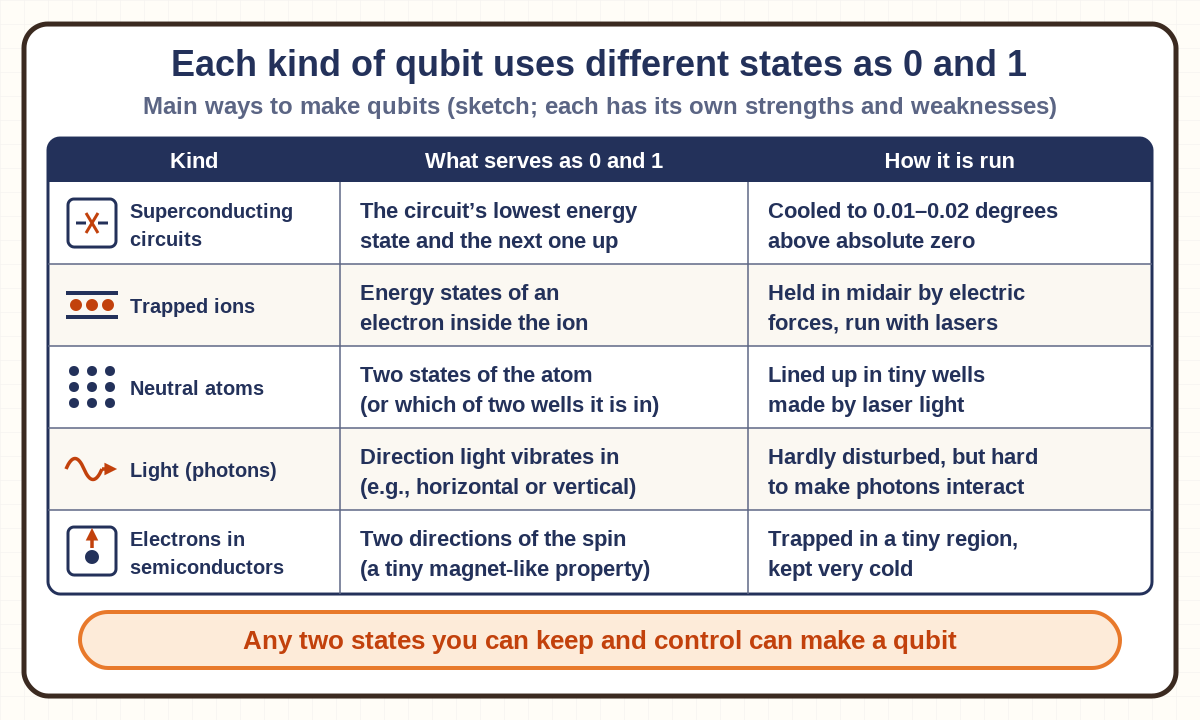
Anything with two clearly distinguishable states to serve as 0 and 1, which can hold a superposition of them and be controlled, can be made into a qubit. Here are the main ways, compared by what they use as 0 and 1.
A superconducting circuit is a tiny electrical circuit made of metal that loses all electrical resistance when cooled enough. Like an atom, the circuit has separate, step-like energy states, which is why such qubits are also called “artificial atoms.” Its lowest and second-lowest states serve as 0 and 1. They are made by patterning fine circuits onto a flat chip and are controlled with microwaves that vibrate billions of times a second. They run at temperatures just 0.01 to 0.02 degrees above absolute zero.
Trapped ions are electrically charged atoms, held in midair in a row by electric forces from nearby electrodes. The energy states of an electron inside the ion serve as 0 and 1, and the ions are controlled with laser light. Neutral atoms (atoms with no electric charge) are lined up in many tiny wells made by laser light (such as an optical lattice), and two states of the atom serve as 0 and 1. In a paper draft released in September 2025, a team at the University of Science and Technology of China reported using qubits whose 0 and 1 are which of two neighboring wells an atom sits in, and confirming a state in which 123 qubits were all linked by entanglement.
Light uses the direction in which a particle of light (a photon) vibrates (its polarization, such as horizontal and vertical) or similar features as 0 and 1. Light is hardly disturbed, but it is hard to make photons interact for operations that use two qubits. Electrons in semiconductors are trapped in a tiny region of the semiconductor, and the two directions of the electron’s spin (a property that makes it act like a tiny magnet) serve as 0 and 1. These, too, are used at very low temperatures.
The approaches differ in how fast they operate, how few errors they make, how long they hold a state and how easily the number of qubits can grow, and several of them are being researched side by side.
Why are qubits so fragile?
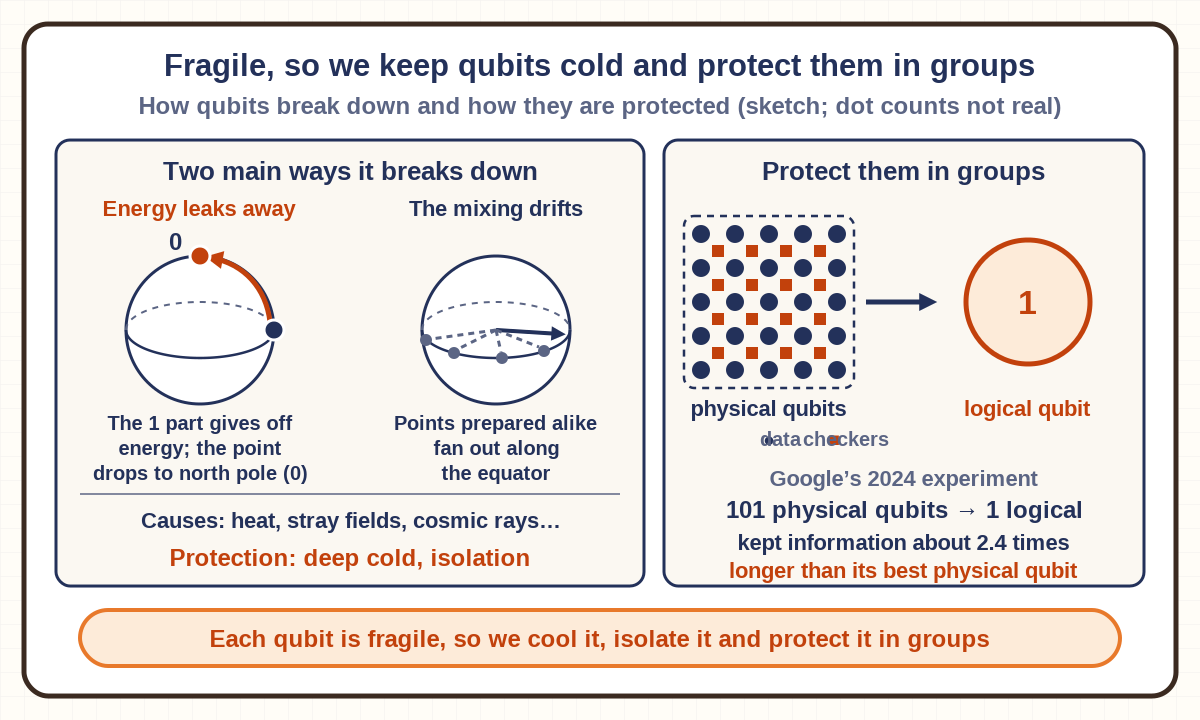
If a qubit interacts even slightly with its surroundings, information about its state leaks out into them, and the superposition falls apart. This is called decoherence. Heat, tiny stray electric and magnetic fields, temperature changes and even cosmic rays from space can cause it. On the other hand, to calculate, you have to control the qubit from outside and measure it at the end. Keeping qubits cut off from their surroundings while still being able to control them freely is the central challenge in building them.
There are two main ways a qubit breaks down. In one, the qubit hands energy to its surroundings and drops from a higher-energy state to a lower one. In superconducting qubits and others, 1 has more energy, so on the ball, the point falls toward the north pole (0). In the other, the way 0 and 1 are combined drifts because of disturbances around the qubit. On the ball, the point’s longitude becomes unknown. This can happen without any exchange of energy, and the information about how 0 and 1 are combined is lost.
Superconducting qubits are cooled to just 0.01 to 0.02 degrees above absolute zero because the energy difference between 0 and 1 is very small, so heat noise has to be kept down (the circuit also has to be cold to become superconducting). Somewhere this cold, heat from the surroundings almost never gives a qubit energy on its own and flips 0 to 1. Even so, energy leaking away can’t be stopped completely. In the chip Google announced in 2024, the typical time a qubit can hold the 1 state was approaching about 100 microseconds (one ten-thousandth of a second).
Even the best quantum computers today make a mistake about once every 1,000 operations.
What are physical and logical qubits?
Each actual qubit, as a piece of hardware, is called a physical qubit. Physical qubits make mistakes easily, so researchers are working on having many physical qubits remember one piece of information, so that the whole group works as a single qubit. A qubit made this way is called a logical qubit. This way of finding and fixing errors is called quantum error correction.
Fixing errors in qubits is harder than in ordinary bits. With ordinary bits, you can copy the same value three times and take a majority vote, but qubits can’t be copied. Errors also take many forms, not only swaps of 0 and 1 but also drifts in how 0 and 1 are combined. And checking the contents by measuring them destroys the superposition. Even so, methods have been found that use helper qubits to find only where an error happened, without reading the contents being protected, and then fix it. If each part makes few enough errors, the bigger the group, the fewer the errors overall.
In 2024, Google announced that on Willow, a chip with 105 qubits, each time it made the group bigger by arranging physical qubits in a 3×3, 5×5 and then 7×7 grid, the errors were cut roughly in half. In the biggest group, 101 physical qubits, including the helpers, made one logical qubit, which held information about 2.4 times longer than its longest-lasting physical qubit.
But big calculations such as breaking codes may need a great many qubits that keep running without errors. Researchers are also looking for ways to cut the hardware needed to correct errors, such as cat qubits, which make swaps of 0 and 1 rare.
Where does the name “qubit” come from?
“Qubit” is short for “quantum bit.” Physicist Benjamin Schumacher used it in his paper “Quantum coding,” published in the journal Physical Review A in April 1995 (the paper was submitted in 1993). The paper’s acknowledgments say the word was coined in jest during a conversation with W. K. Wootters.
In Japanese, a qubit is called “ryōshi bitto” (quantum bit), and it is also written “kyūbitto,” following the English pronunciation.
Check yourself
Q1A qubit is in a state that mixes 0 and 1, with 75% for 0 and 25% for 1. If you measure this qubit just once, what do you learn?
Answer and explanation
Answer: A Just one value: 0 or 1
Measuring a qubit gives you just one of 0 or 1; the qubit then takes the state of that value, and the mix is gone. With this qubit, 0 is just more likely, and 1 can come out too. One measurement tells you only whether it is 0 or 1, one bit, not the chances of 75% and 25%. To learn the chances, you prepare the same state many times, measure it again and again, and count the results. A qubit with unknown contents can’t be copied, so you can’t copy a single one to measure many times either. Both values never come out at once.
More on this → Key points: How much information fits in one qubit?
Q2Qubits made from superconducting circuits are cooled in a refrigerator to just 0.01 to 0.02 degrees above absolute zero. What is the main reason for cooling them this much?
Answer and explanation
Answer: C So heat won’t break the superposition of 0 and 1
A qubit’s superposition quickly falls apart when it meets heat or other disturbances around it. Somewhere very cold, heat from the surroundings almost never gives a qubit energy on its own and flips 0 to 1. The circuit also has to be cold in the first place to become superconducting, with zero electrical resistance. Cooling isn’t done to keep the qubits from sticking to each other or to keep readout from slowing down. Some disturbances still remain, so ways to correct errors are being researched too.
Q3In 2024, Google announced an experiment in which 101 qubits were grouped together to work as a single qubit. Why are many qubits grouped together like this?
Answer and explanation
Answer: B So their errors can be spotted and then corrected
Each individual qubit (a physical qubit) makes mistakes easily, so many of them remember one piece of information, and helper qubits find where errors happened, without reading the contents, so they can be fixed. A group working as a single qubit this way is called a logical qubit. In Google’s experiment, the logical qubit made from 101 qubits held information about 2.4 times longer than its longest-lasting physical qubit. Grouping doesn’t let you split up calculations to run faster or read out more information; in fact, it takes many more parts.
More on this → Key points: What are physical and logical qubits?
Related terms
- Quantum computer
- Superposition
- Quantum entanglement
- Interference
- Bloch sphere
- Decoherence
- Quantum error correction
- Logical qubit
- Cat qubit
- Superconductivity
- Bit
Related explainer videos
Sources and how we checked
- Ronald de Wolf, “Quantum Computing: Lecture Notes” (University of Amsterdam course notes, arXiv 1907.09415, version 6 [August 2026]; full text read as a PDF. Section 1.2: measuring shows one and only one classical state, with probability given by the squared norm of its amplitude, and observing a state collapses the superposition. Section 1.3: a qubit is a superposition of 0 and 1, a register of n qubits has 2^n basis states and its general state is a superposition of them described by 2^n numbers, in the 2-qubit state that mixes |00⟩ and |11⟩ equally, observing a 0 on the first qubit also fixes the second to 0 [entanglement], and amplitudes can be negative, leading to interference. Section 1.4: the Hadamard transform turning 0 into an even plus-combination of 0 and 1 and 1 into the minus-combination, measuring either of them as it is giving 0 or 1 with equal probability, and applying the Hadamard transform to the plus-combination giving 0 because the positive and negative amplitudes for 1 cancel out [interference, analogous to interference between light or sound waves]. Section 1.5: copying an unknown qubit is impossible. Chapter 1 exercises: without prior entanglement, sending one qubit gives at most one bit of information. Chapter 15: Holevo’s theorem from 1973, an m-qubit state, despite somehow “containing” 2^m amplitudes, being no better than m classical bits for storing or transmitting information, and the Bloch-sphere picture not generalizing cleanly to more than one qubit. Chapter 21: quantum hardware being much more fragile and error correction being harder [no-cloning, continuous errors, measurements collapsing the state], writing an error syndrome into auxiliary qubits and correcting from it, and near-perfect computation being possible if the error rate per operation is small enough [say 1%] and errors are not very correlated; read November 26, 2026)
- P. Krantz et al., “A Quantum Engineer’s Guide to Superconducting Qubits” (MIT and others, Applied Physics Reviews 6, 2019; arXiv full text [July 2021 version] read as a PDF. Section I: superconducting qubits being macroscopic, lithographically defined circuits with atom-like energy levels, hence called artificial atoms, while other platforms [electron spins in silicon, quantum dots, trapped ions, ultracold atoms, polarized photons and others] encode information in natural microscopic quantum systems. Section II: a Josephson junction making the energy levels unevenly spaced so that the two lowest levels form the qubit’s 0 and 1. Section III: picturing the Bloch sphere as the Earth, with |0⟩ at the north pole and |1⟩ at the south pole, the state cos(θ/2)|0⟩ + e^{iφ} sin(θ/2)|1⟩, typical qubits at about 5 GHz operated at dilution-refrigerator temperatures of about 20 mK, where upward transitions from 0 to 1 are exponentially suppressed and qubits mainly lose energy to their cold environment, |1⟩ having higher energy in superconducting qubits so that relaxation leaves the Bloch vector pointing to the north pole, and pure dephasing happening without energy exchange, fanning out identically prepared Bloch vectors in the equatorial plane and losing the azimuthal angle; read November 26, 2026)
- T. D. Ladd et al., “Quantum computers” (Nature 464, 2010; arXiv full text [June 2009 version] read as a PDF. Section II: the central challenge being to control and measure quantum systems while preserving their strong isolation from the environment. Section III: two types of single-qubit relaxation, energy exchange with the environment [T1] and random phase changes of a superposition [T2], the latter costing no energy. Section V: photon polarization [horizontal as 0, vertical as 1] as a qubit, photons being relatively free of the noise that plagues other systems, and interactions between photons for two-qubit gates being a major hurdle. Section VI: charged atoms [ions] confined in free space by electric fields from nearby electrodes, cooled by laser beams, and entangled through laser interactions. Section VII: optical lattices of cold neutral atoms made by crossed laser beams. Section IX: quantum dots confining electrons in a small region of a semiconductor, some requiring temperatures below 1 K; read November 26, 2026)
- NIST, “Quantum Computing Explained” (Gabriel Popkin, March 18, 2025, updated May 28, 2026: the 0 and 1 of classical bits being realized by things like tiny bar magnets or electric switches, qubits being put into superpositions and collapsing to 0 or 1 when measured, the energy states of electrons inside trapped ions representing 0s and 1s, superconducting circuits encoding 0s and 1s in quantized energy states and being cooled to near absolute zero, neutral atoms being controlled and measured with laser light and electromagnetic fields, photons encoding quantum information in their polarization, semiconducting qubits trapping electrons in a tiny region with electrodes and being cooled to near absolute zero, qubits being fragile, with stray electric or magnetic fields, temperature fluctuations or even a cosmic ray able to ruin a superposition or entanglement, the best quantum computers today making an error roughly once in every thousand operations, and tasks like Shor’s algorithm possibly needing millions of qubits that can run error-free indefinitely; read November 26, 2026)
- IBM, “What is a qubit?” (IBM Think, February 28, 2024, updated April 2, 2026; a company explainer: a qubit being the basic unit of information in quantum computing, any two-level quantum system being usable as a qubit, superconducting qubits being built from materials that operate at low temperatures and manipulated with microwave pulses, trapped ions being usable as qubits with laser technology, neutral atoms being excited by lasers into various states, any two of which can form a qubit, quantum dots capturing a single electron to use as a qubit, and qubits needing to be cooled to a fraction of a degree above absolute zero yet still being susceptible to failure through decoherence; read November 26, 2026)
- Hartmut Neven, “Meet Willow, our state-of-the-art quantum chip” (Google blog, December 9, 2024; a company announcement: Willow having 105 qubits, qubits tending to rapidly exchange information with their environment, making it hard to protect the information needed for a computation, the error rate being cut in half each time the grid grew from 3x3 to 5x5 to 7x7, and T1 times, which measure how long qubits can retain an excitation, approaching 100 µs; read November 26, 2026)
- Google Quantum AI and collaborators, “Quantum error correction below the surface code threshold” (Nature 638, 920–926, 2025; arXiv abstract: two below-threshold surface code memories, at distances 7 and 5, the logical error rate being suppressed by a factor of about 2.14 when increasing the code distance by two, a 101-qubit distance-7 code with about 0.143% error per cycle of error correction, and this logical memory exceeding its best physical qubit’s lifetime by a factor of about 2.4; read November 26, 2026)
- H. Putterman et al., “Hardware-efficient quantum error correction via concatenated bosonic qubits” (AWS and others, Nature 638, 927–934, 2025; arXiv abstract: the large physical-qubit overhead typically associated with error correction, bosonic cat qubits being passively protected against bit flips [swaps of 0 and 1] by a stabilizing circuit, and the remaining phase flips being corrected by a repetition code that uses ancilla qubits, aiming for more hardware-efficient error correction; read November 26, 2026)
- RIKEN and partners, Japanese press release on the start of a quantum computing cloud service (March 24, 2023: a superconducting quantum computer using an integrated circuit of 64 qubits, qubits made with Josephson junctions on superconducting circuits, qubits being able to take superposition states that are both 0 and 1, control signals being microwave pulses at 8–9 GHz, the area around the chip being cooled to about 10 mK [about −273 °C] with a dilution refrigerator, and the need to suppress thermal noise; read November 26, 2026)
- G. Burkard et al., “Semiconductor spin qubits” (Reviews of Modern Physics 95, 025003, 2023; arXiv abstract: the spin of an electron or a nucleus functioning as an excellent qubit, as it provides a natural two-level system that is insensitive to electric fields, leading to long quantum coherence times; read November 26, 2026)
- M.-G. He, W.-Y. Zhang, Z.-S. Yuan and J.-W. Pan, “An Orbit-qubit Quantum Processor of Ultracold Atoms” (University of Science and Technology of China; arXiv 2509.10797, version 1 September 13, 2025, version 2 September 20; full text read as a PDF. Abstract and introduction: optical lattices offering exceptional parallelism but struggling with precise local operations because of narrow lattice spacings, orbit qubits encoded by which side of a double well an individual rubidium-87 atom occupies, internal states used as auxiliary degrees of freedom for spatially selective operations, and the multipartite entanglement of a two-dimensional cluster state of 123 orbit qubits detected through direct stabilizer measurements, verifying full bipartite non-separability; read November 26, 2026)
- John Preskill, “Who named the qubit?” (Quantum Frontiers, the blog of Caltech’s Institute for Quantum Information and Matter, June 9, 2015: Ben Schumacher introducing the word “qubit” in his paper “Quantum Coding,” which appeared in the April 1995 issue of Physical Review A, the paper having been submitted in 1993, the acknowledgments saying the term was coined in jest during conversations with W. K. Wootters, and Mermin being a passionate holdout for “qbit”; read November 26, 2026)
- Benjamin Schumacher, “Quantum coding” (Physical Review A 51, issue 4, 2738–, April 1, 1995; received April 9, 1993. Abstract: the von Neumann entropy giving the number of qubits needed to represent a signal faithfully; read November 26, 2026)
- Nature Asia, Japanese summary of a Nature paper on advanced CMOS manufacturing of superconducting qubits on 300 mm wafers (Nature 634, September 2024: writing qubit as “kyūbitto” in Japanese; read November 26, 2026)
AI wrote this page from the sources above, and a different AI checked it against the text of those sources (November 26, 2026). A person with a master’s degree in science and a Japanese high-school science teaching license also read and checked it before publishing. Numbers are as of that date. If anything was hard to follow, you spot a mistake, or there’s a term you’d like explained, please write to [email protected].
Glossary
- AI agent
- AI alignment
- Alignment faking
- Artificial general intelligence (AGI)
- Artificial intelligence (AI)
- Backdoor
- Benchmark
- Chain of thought (CoT)
- Context window
- Data poisoning
- Deep learning
- Deepfake
- Diffusion model
- Embedding
- Emergent misalignment
- Evaluation awareness
- Fine-tuning
- Formal verification
- Generalization
- Generative adversarial network (GAN)
- Generative AI
- Goodhart’s law
- Gradual disempowerment
- Hallucination
- Hyperparameter
- Intelligence explosion
- Interpretability
- Jailbreaking
- Large language model (LLM)
- Latent space
- Machine learning
- Mixture of experts (MoE)
- Neural network
- Neuralese
- Overfitting
- Parameter
- Persona vectors
- Pre-training
- Prompt
- Prompt injection
- Reasoning model
- Recursive language model (RLM)
- Recursive self-improvement (RSI)
- Red teaming
- Reinforcement learning (RL)
- Retrieval-augmented generation (RAG)
- Reward hacking
- Reward model
- Shutdown resistance
- Sleeper agent
- Subliminal learning
- Superintelligence (ASI)
- System prompt
- Technological singularity
- Time horizon
- Token
- Transfer learning
- Transformer
- Accretion disk
- Black hole
- Black hole star
- Cosmic birefringence
- Event horizon
- Event Horizon Telescope (EHT)
- General relativity
- GPS
- Gravitational lensing
- Gravitational singularity
- Gravitational wave
- James Webb Space Telescope (JWST)
- Lagrange point
- Long-period radio transient (LPT)
- Neutron star
- Pulsar
- Quasar
- Sagittarius A*
- Space data center
- Spacetime
- Special relativity
- Speed of light
- Supermassive black hole
- White dwarf
- Cat qubit
- Instanton
- Logical qubit
- Quantum computer
- Quantum entanglement
- You are hereQubit