
What is a space data center (satellites that carry computers to do AI work in space)?
Also called: Orbital data center, Space-based data center, Data centers in space

In one minute
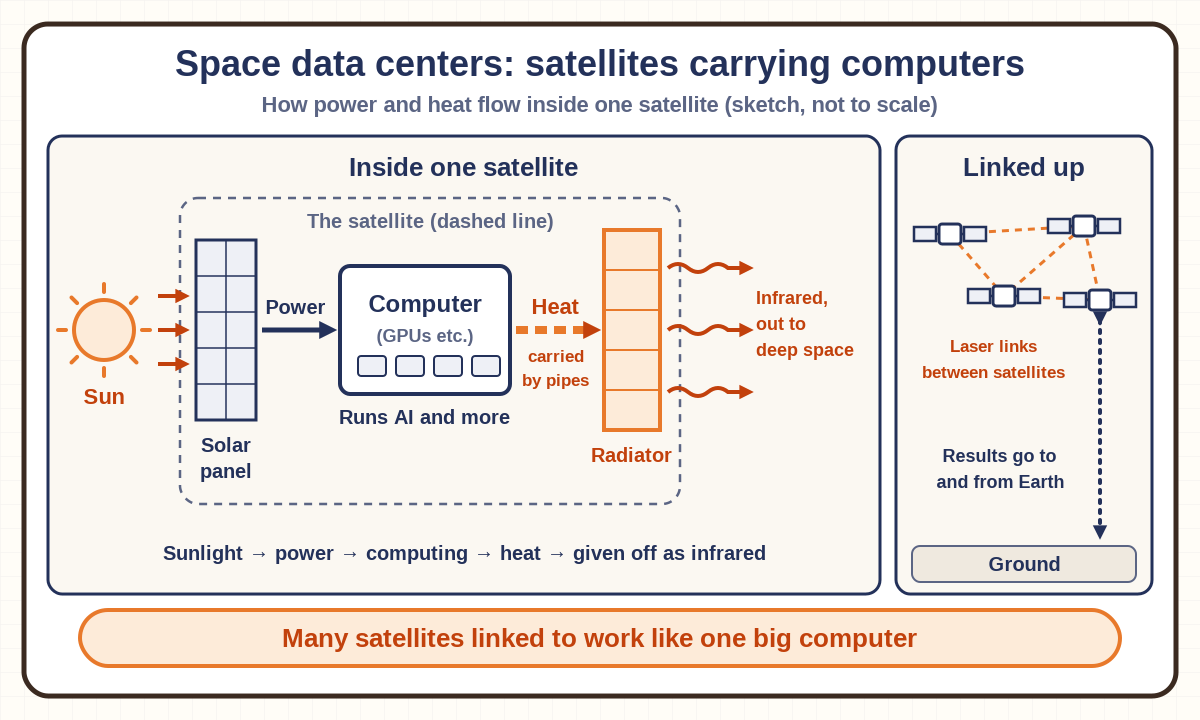
A space data center is a plan to put chips for AI computing (such as GPUs) on satellites powered by sunlight, link many of them together, and do AI and other computing in space.
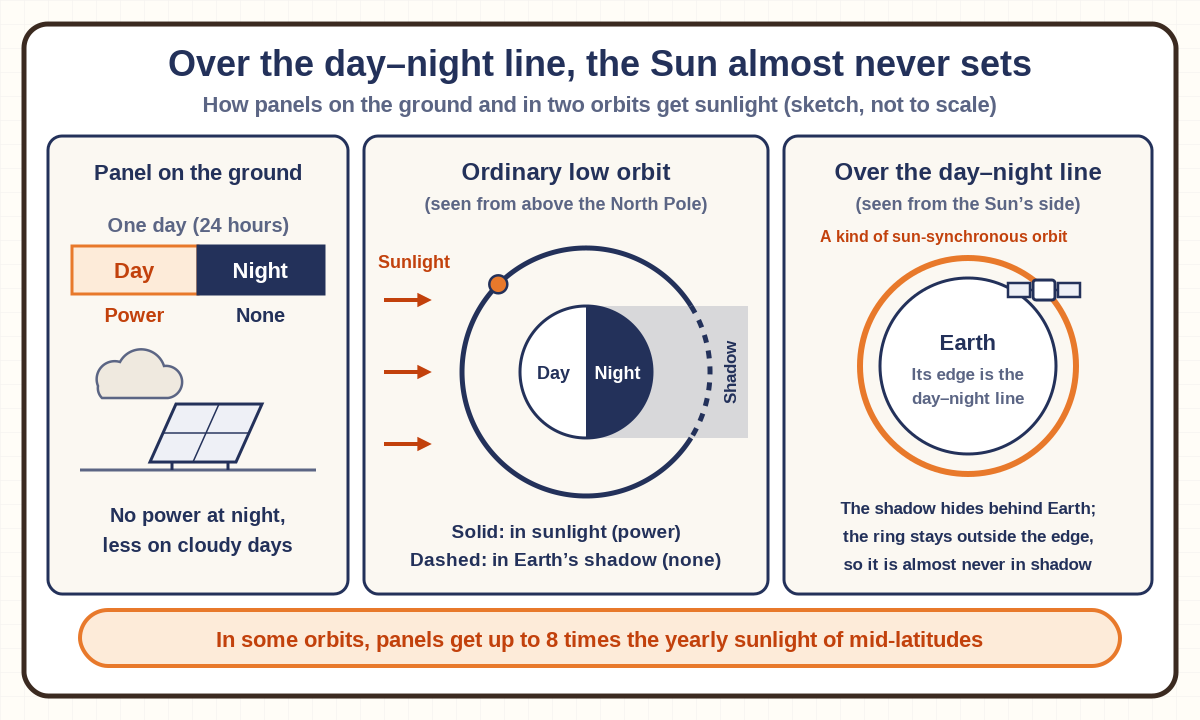
The idea comes from data centers on the ground (buildings packed with computers) using more and more electricity for AI. In certain orbits, a satellite gets sunlight almost all the time, and it uses little land or water on the ground.
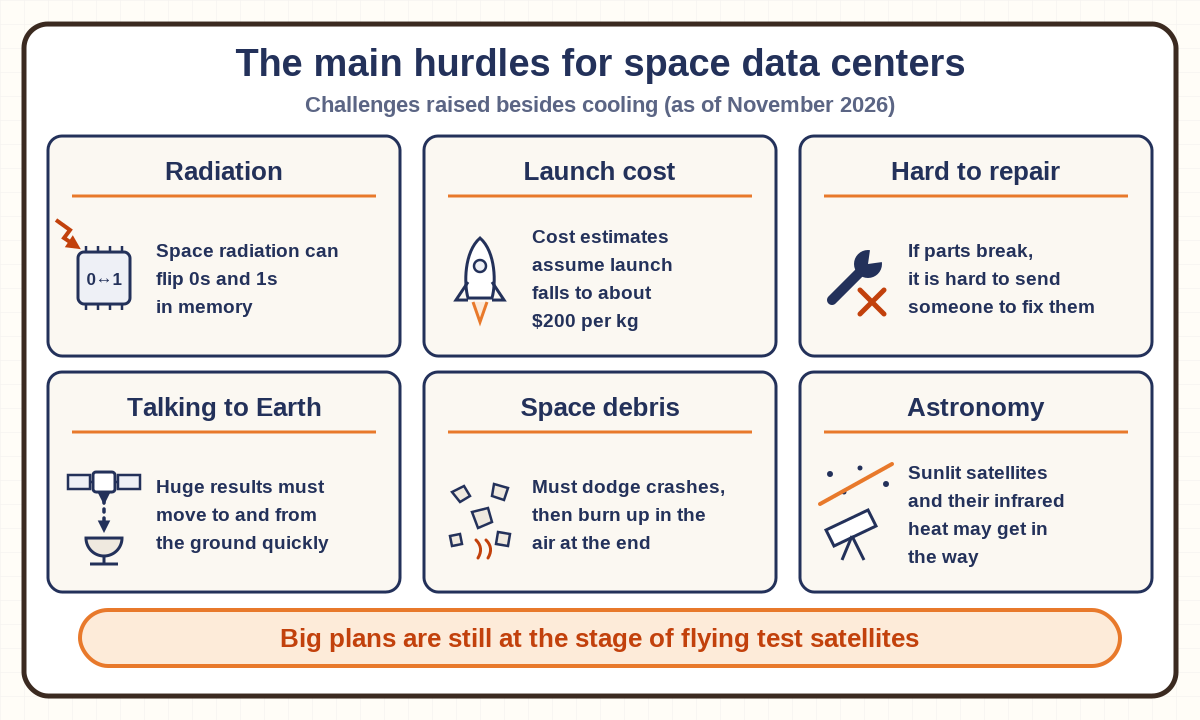
But in the vacuum of space, heat can only leave as light (infrared), so big radiator panels are needed. Radiation, launch costs, the difficulty of repairs, space debris and effects on astronomy are hurdles too. As of November 2026, test satellites had just started flying. In the U.S., satellites need permission to use radio from the Federal Communications Commission (FCC), the agency in charge of radio communications. The FCC had given SpaceX’s plan for up to a million satellites a radio permit.
A common mix-up
“Space is very cold, so cooling computers there is easier than on the ground.”
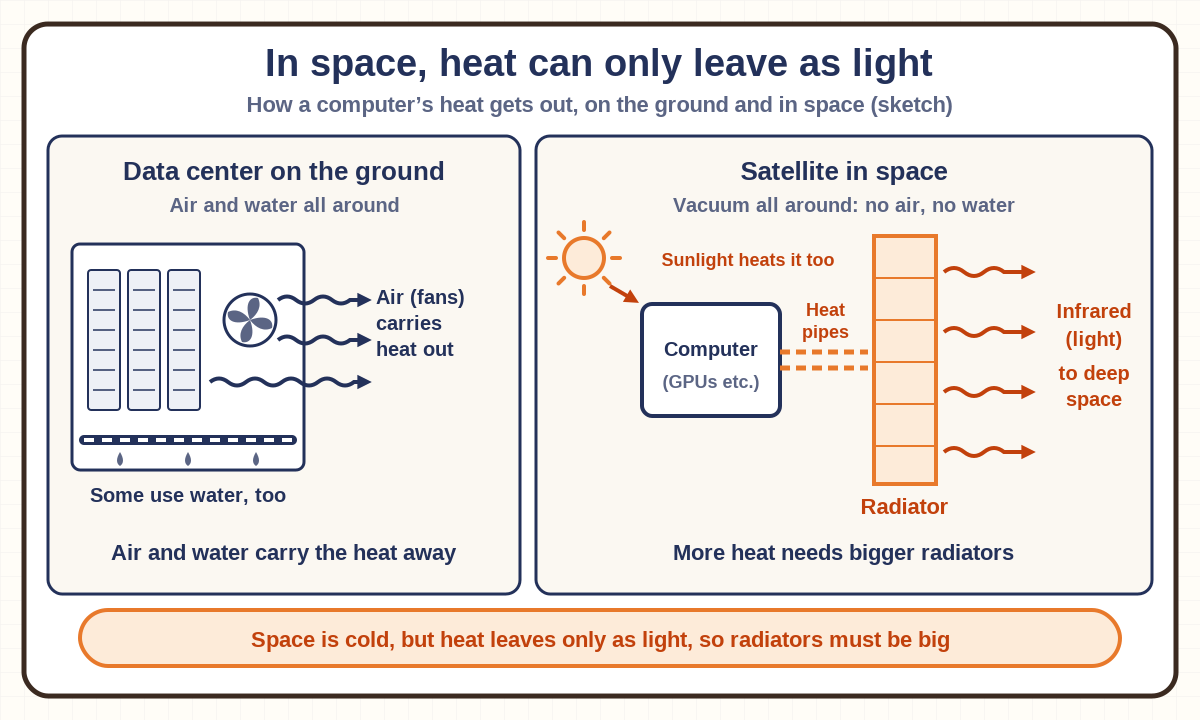
Half right. Deep space is very cold, and it is a good place to dump heat. A satellite’s radiator panels give off heat best when they face cold deep space rather than the Sun or Earth. It’s also true that no water is needed for cooling. But space has no air or water to carry heat away. Computers on the ground get rid of heat with fan-blown air or water, but in a vacuum that can’t happen; the only way heat can leave a satellite is as light (invisible infrared). The bigger the panel, the more heat it can give off, so a satellite that computes a lot and makes a lot of heat needs big radiator panels. On top of that, the sides facing the Sun are heated by sunlight. In a plan the company Starcloud put out in 2025, a 5-gigawatt space data center (about a quarter of the average power all U.S. data centers used in 2023) would have huge solar and cooling panels about 4 kilometers long and 4 kilometers wide (nearly an hour’s walk from one side to the other). Cooling power-hungry AI chips in a vacuum is also named as a key challenge in research.
Explained in pictures
Free to use in lessons, slides and posts with credit (CC BY 4.0).
Free to use in lessons, slides and posts with credit (CC BY 4.0).
Free to use in lessons, slides and posts with credit (CC BY 4.0).
Free to use in lessons, slides and posts with credit (CC BY 4.0).
You’re free to use these figures in lessons, slides and posts if you credit Naru News (naru.news). CC BY 4.0.
Think of it like this
A computer in a thermos, sitting in the sun
A space data center satellite is like a computer sealed inside a thermos and left in the sun all the time. A thermos keeps hot drinks from cooling by putting a vacuum between its inner and outer walls, because a vacuum has no air to carry heat. A satellite is surrounded by vacuum too, so the heat made inside has a hard time getting out.
That’s why a satellite carries the heat through pipes to panels on the outside and gives it off from those panels as light (infrared) into cold deep space. For the thermos, it would be like opening up big “heat-shedding panels” on the outside. The more it computes, the more heat it makes, so the panels must be bigger. Meanwhile, the electricity can come from sunlight that shines on it almost all the time.
But the comparison has limits. The inside of a thermos is shiny like a mirror, so it also bounces back heat trying to escape as light, while a satellite’s radiators are made to do the opposite: give off heat as light easily. And a real space data center isn’t one box. The goal is for many satellites, linked by laser, to work together like one big computer.
Key points
Why do people want to compute in space?
Training and running AI takes a lot of electricity. In the United States, data centers used about 4.4% of the country’s electricity in 2023 (176 terawatt-hours), and with the spread of AI and other factors, that is projected to grow to about 6.7–12% by 2028. Building more and more data centers on the ground also puts pressure on land and water, on top of electricity.
Space’s biggest selling point is sunlight. The Sun puts out more than 100 trillion times as much power as all the electricity humanity produces. That is why people look at the dawn–dusk orbit (a kind of sun-synchronous orbit). Picture a ball lit by a lamp. The line between its bright half and dark half makes a ring all the way around the ball. On Earth, it is the ring of places where it is just dawn or dusk, and it passes near the North and South Poles. This orbit follows that ring, a little above it. Earth’s shadow stretches from the night side away from the Sun like a long pillar. A satellite over the day–night line circles around this pillar of shadow, so it almost never goes inside it and stays in sunlight nearly all the time. In such orbits, a solar panel gets up to eight times as much sunlight a year as a panel on the ground at mid-latitudes (about halfway between the equator and the poles).
Another use is processing data collected in space right where it is. Satellites that observe Earth usually send their data to the ground before it is processed, but how much they can send is limited by the number of ground stations and the capacity of the links. Computing on the satellite first could ease that limit.
How do you cool it?
In a vacuum, heat can move only by passing between things that touch (conduction) or by being given off as light (radiation). Flowing air or water can’t carry it off (convection). So on a satellite, the computer’s heat is carried by metal and heat-carrying pipes (heat pipes) to panels on the outside, which give it off as infrared into space. These panels are called radiators.
Radiators give off heat best when they face cold deep space. Meanwhile, sunlight, and sunlight reflected off Earth, warm the satellite. So engineers use tricks like painting the side that faces the Sun white so it absorbs less light.
AI chips give off a lot of heat in a small space. A small satellite has only so much outer surface, so the more tightly parts are packed, the harder it is to get all the heat out. Computing more needs bigger radiators, so cooling power-hungry AI chips in a vacuum is one of the key challenges for space data centers. Google’s team has tested a way to cool chips that combines heat pipes and radiators in a chamber pumped down to a vacuum like space.
Heat that is given off doesn’t disappear; it spreads into space as infrared. Some worry that this could get in the way of observing the stars.
How does space radiation affect computing?
In space near Earth, high-energy protons (one of the particles at the center of atoms) and cosmic rays from beyond the solar system fly about. When such a particle hits a chip, it can cause an instant error, for example flipping a 0 and a 1 in memory. If the error goes unnoticed, the result of a calculation can be wrong without anyone knowing. And as the dose builds up, parts gradually wear out.
Google’s research team fired protons at its AI chips (TPUs) with a machine on the ground to imitate the radiation they would get in space. The team’s minimum goal was for the chips to survive the dose expected over five years of work in space. In tests that put a memory part (HBM) under special stress, irregularities began to appear after about three times that dose. But irregularities did not mean a part had broken and stopped. Up to the highest dose tried (20 times the expected dose), no part broke down from the built-up dose, and other tests, such as running whole AI jobs, kept working correctly.
So for the built-up dose, the five-year amount caused neither irregularities nor breakdowns. Instant errors from single particle hits are a separate matter. The team says their rate is probably acceptable for using AI to give answers, but their effect on training AI still needs study. Radiation tests in space are also to continue on the test satellite.
What about launch costs and talking to the ground?
In space, sunlight is free, but it costs money to launch satellites carrying solar panels and computers on rockets. Instead of the electricity bill a data center on the ground pays every year, a space data center pays this launch cost, so that is what gets compared. For a satellite that works for five years, for example, dividing the launch cost by five gives a cost per year. That is compared with the yearly electricity bill for using the same amount of power on the ground.
Google’s research team expects that the cost of reaching low orbit may fall from about $3,600 per kilogram today (with a reusable rocket) to about $200 or less by the mid-2030s, about one eighteenth as much. It estimates that if it does, the launch cost per year could be about the same as a data center’s electricity bill on the ground. Both are forecasts.
A company called Starcloud says that, even counting the launch, electricity in space would cost a tenth as much. That is the company’s claim.
Communication is a challenge too. Many plans link satellites to each other with laser light. Light spreads out and weakens as it travels, so the closer the satellites are, the stronger the light that arrives and the more data they can send quickly. So in an example from Google’s research team, 81 satellites fly together within a radius of about 1 km, with the distance between neighbors stretching and shrinking between about 100 and 200 m, with machine learning controlling their flight so they don’t collide. Moving results quickly to and from the ground is also listed as a problem still to be solved. In SpaceX’s plan, the satellites mainly connect by laser to the same company’s Starlink communication satellites, and radio is only a backup for when the laser links fail.
If parts break, it is hard for anyone to go and replace them, so making satellites harder to break and working out how to repair them in space are also challenges ahead.
What about space debris and stargazing?
With a huge number of satellites, the risk of crashes and of broken satellites becoming space debris goes up. For satellites flying below 600 km, the FCC accepted that SpaceX’s way of reducing space debris meets its rules. Satellites that would fly above 600 km can’t be launched until SpaceX settles its final plan for reducing debris and files it with the FCC again. To worries that a million satellites would crowd the orbits, the FCC answered that there is no rule limiting how many satellites it can approve for similar orbits.
SpaceX has promised to steer satellites out of orbit itself when their work is done, bring them into the atmosphere over the ocean, and build them so they burn up completely in the air. The permission also requires SpaceX to tell the FCC every six months things like how many times its satellites came close to hitting something and how many reentered the atmosphere.
Astronomers worry that so many satellites shining in sunlight, and the heat they give off, will get in the way of observing the stars. The heat leaves as infrared, so our eyes can’t see it. Even so, the American Astronomical Society told the FCC that telescopes that look at space in infrared would see a brighter sky, which could get in the way of research. But what the FCC oversees is radio. The FCC said the heat worry does not come from radio, so it was not something this permission deals with. For worries about observing the stars with visible light, the FCC decided that SpaceX’s promise to work things out with the U.S. National Science Foundation (NSF) was enough. It then turned down the requests from the American Astronomical Society and others not to give the permission.
How far along is it now?
Here are the main developments as of November 27, 2026. In May 2025, in China, 12 computing satellites were launched for the “Three-Body Computing Constellation” led by Zhejiang Lab and others. All 12 together can do 5,000 trillion operations a second, and the plan is to grow it to about a thousand satellites.
In November 2025, the U.S. company Starcloud launched a test satellite, Starcloud-1, weighing about 60 kg (about the size of a small fridge) and carrying an Nvidia H100 chip (GPU). The company announced that in December it trained a small language model (nanoGPT) in space and also ran a Google language model, calling both firsts in space.
In November 2025, Google announced Project Suncatcher, research on linking solar-powered satellites carrying AI chips (TPUs) by laser. On October 1, 2026, the first test satellite, built with a company called Planet, was launched. On October 30, Google announced that it had received on the ground an answer from a language model (Gemma 4) running on the satellite’s TPU. Tests of how the chips handle heat and radiation in space are to follow. Google plans to launch two satellites in 2027 to test laser links between satellites.
Then, on November 25, 2026, the FCC gave permission to SpaceX’s plan called Starmind: up to a million satellites working as data centers in space, in orbits 500 to 1,002 km high. The permission is about radio, which the FCC oversees: it lets the satellites use radio as a backup and in emergencies when the laser links can’t be used. It becomes void unless SpaceX gets the first satellite working by November 25, 2033, 10% by November 25, 2035, half by November 25, 2038, and all the rest by November 25, 2040.
The FCC said it would not judge, in place of the companies, whether space data centers will work out technically or financially. The permission is not a guarantee that it will work. The companies’ plans and forecasts are still to be tested with trial satellites.
Check yourself
Q1In a space data center, where computers are put on satellites, the heat from computing has to be sent out of the satellite. With a vacuum all around, what is the main way heat leaves the satellite?
Answer and explanation
Answer: C It turns into light you can’t see and leaves the panels
In a vacuum, the main way heat leaves a satellite is by being given off from radiator panels as infrared (invisible light). Heat flows through metal (conduction) only between things that touch, so it can’t seep out into the empty vacuum. Spraying coolant out would use up the coolant on board, so it can’t be the main way for a satellite that computes for years. The bigger the panel, the more heat it can give off, so a satellite that computes a lot needs big radiators.
Q2One idea is to put space data center satellites in an orbit that passes near the North and South Poles and follows the line between day and night on Earth. What is the main reason to choose this orbit?
Answer and explanation
Answer: A It stays in sunlight almost always, making power
This orbit (a dawn–dusk orbit, a kind of sun-synchronous orbit) runs above Earth’s line between day and night, following it around. Earth’s shadow stretches from the night side away from the Sun like a pillar, so a satellite over the day–night line just circles around the pillar of shadow and almost never goes inside it. That lets its solar panels make power almost all the time. In such orbits, a panel gets up to eight times as much sunlight a year as on the ground at mid-latitudes (about halfway between the equator and the poles). It doesn’t stay in the shade. Being on the side nearer the Sun makes almost no difference to the light, because Earth is tiny compared with the roughly 150 million km to the Sun.
More on this → Key points: Why do people want to compute in space?
Q3In November 2026, the U.S. Federal Communications Commission (FCC) gave permission to SpaceX’s plan to run up to a million satellites working as data centers in space. Which is a condition that came with this permission?
Answer and explanation
Answer: B Launch set numbers of satellites by set deadlines
The FCC is the agency in charge of radio communications. The permission comes with deadlines: unless SpaceX gets the first satellite working by November 25, 2033, 10% by 2035, half by 2038 and all the rest by November 25, 2040, the permission becomes void. The heat satellites give off does not come from radio, so the FCC said this permission does not deal with it. It also said it would not judge, in place of the companies, whether the business will work out financially.
Related terms
- Data center
- Satellite
- GPU
- Sun-synchronous orbit
- Infrared
- Space debris
- Generative AI
- Artificial intelligence
Sources and how we checked
- U.S. Federal Communications Commission (FCC) Space Bureau, “Memorandum Opinion and Order and Authorization” for the SpaceX Orbital Data Center System [Starmind] (DA 26-1273, November 25, 2026; full text read as a PDF. Grant: authority for backup and emergency radio communications for a constellation of 1,000,000 satellites operating as data centers in space, altitudes of 500 to 1,002 km, the satellites relying mainly on optical inter-satellite links with radio only as a backup if the optical links fail, the authorization becoming void unless one satellite is deployed and operating by November 25, 2033, 10% by November 25, 2035, 50% by November 25, 2038 and the rest by November 25, 2040, semi-annual reports including conjunction events and satellites that reentered, and the request to dispose of satellites above 600 km other than by atmospheric reentry being deferred. Order: the orbital debris mitigation plan complying with the rules for satellites below 600 km, satellites above 600 km not being deployed until a final plan is filed in a modification application, SpaceX committing to actively deorbit satellites, steer them to reenter over the ocean and design them to fully demise during reentry, concerns about optical astronomy being addressed by SpaceX’s commitment to coordinate with the National Science Foundation, the American Astronomical Society’s argument that waste heat could raise the infrared sky background being outside the scope of radio operations, doubts about thermal management, efficiency and economics being outside the FCC’s mandate, with the FCC declining to substitute its judgment on business viability, no rule limiting the number of satellites in similar orbits, and the petitions to deny from Amazon [Kuiper], Viasat and the American Astronomical Society being denied; read November 27, 2026)
- B. Agüera y Arcas et al., “Towards a future space-based, highly scalable AI infrastructure system design” (Google, arXiv 2511.19468, November 22, 2025; full text of version 2 [June 17, 2026] read:space-based ML “data centers” made of many solar-powered satellites linked by free-space optical inter-satellite links, the Sun emitting more than 100 trillion times humanity’s total electricity production, solar panels in certain orbits receiving up to eight times more solar energy per year than a mid-latitude panel on Earth and being exposed to nearly continuous sunshine, a dawn–dusk sun-synchronous low Earth orbit, an example 81-satellite cluster of 1 km radius at a mean altitude of about 650 km with next-nearest neighbors about 100 to 200 m apart, kept from colliding by an ML-based flight control model, inter-satellite links aiming for about 10 Tbps each, cooling by heat pipes and radiators, with thermal management of power-dense TPUs in a vacuum a critical challenge, a 67 MeV proton test of the Trillium [v6e] TPU in which HBM irregularities began after 2 krad(Si), about three times the roughly 750 rad(Si) expected over a five-year mission, with no hard failures from total dose up to the maximum tested 15 krad(Si), the near-Earth radiation environment being mainly protons and galactic cosmic rays, which can cause single event effects and silent bit flips, launch prices possibly reaching about $200/kg or less by the mid-2030s, at which point launch costs amortized over the spacecraft’s life could be roughly comparable to terrestrial data center energy costs per kW, reducing the impact on land and water, and future milestones including thermal management, high-bandwidth ground communications, and on-orbit reliability and repair; read November 27, 2026)
- Google, “Meet Project Suncatcher, a research moonshot to scale machine learning compute in space” (Google blog, November 4, 2025; a company announcement: research on networks of solar-powered satellites carrying TPUs, and a plan with Planet to launch two prototype satellites by early 2027; read November 27, 2026)
- Travis Beals, “Behind Project Suncatcher, our moonshot to put AI in space” (Google blog, September 24, 2026; a company announcement: satellites in low Earth orbit getting near-constant sunlight and up to eight times more solar power than on Earth, no airflow in space so heat can only be shed via radiators in a vacuum, a combination of heat pipes and radiators tested in a thermal vacuum chamber, TPUs surviving a radiation dose greater than a five-year space mission, a prototype built with Planet flying on SpaceX’s Transporter-18, and two satellites to be put in orbit for tests in 2027; read November 27, 2026)
- Planet, “Planet Launches Suncatcher, Tanager-2, and 18 SuperDove Satellites” (press release, October 1, 2026; a company announcement: the first demo satellite for Google’s Project Suncatcher, developed with Google and launched on SpaceX’s Transporter-18, being the first test of Google’s TPUs in space, and initial contact made with commissioning begun; read November 27, 2026)
- Travis Beals, “We’ve received our first response from the Project Suncatcher prototype satellite” (Google blog, October 30, 2026; a company announcement: the prototype launched on October 1, the onboard Gemma 4 model running on the satellite’s TPU was asked for a haiku about being in space and its answer was received on the ground, a series of tests of TPU performance under thermal stress and radiation in orbit to continue, and twin interconnected satellites to follow in 2027; read November 27, 2026)
- NVIDIA, “How Starcloud Is Bringing Data Centers to Outer Space” (NVIDIA blog, October 15, 2025, reporting Starcloud’s claims and projections: Starcloud-1 weighing 60 kg, about the size of a small fridge, and carrying an NVIDIA H100, the company’s claim of 10x lower energy costs even including launch, waste heat being emitted into space as infrared so that no water is needed for evaporative cooling, and a planned 5-gigawatt orbital data center with solar and cooling panels about 4 km wide and 4 km long; read November 27, 2026)
- Starcloud, “Starcloud-1” (company page; the company’s claims: launched in November 2025 with an NVIDIA H100, and in December running a Google language model in space and training Andrej Karpathy’s nanoGPT, both described as firsts in space; read November 27, 2026)
- NASA, “7.0 Thermal Control” (State-of-the-Art of Small Spacecraft Technology, 2026 edition: in a vacuum heat moving only by radiation and conduction with no convection, heat exchange with the outside environment happening by thermal radiation, a radiator being a dedicated surface for shedding heat by radiation, most effectively to deep space, IR emissivity setting how much heat a spacecraft emits to space, white paint on the Sun-pointing face reducing absorbed sunlight, sunlight reflected by the planet also heating spacecraft, heat pipes, and the challenge of dissipating power when electronics are packed closely and SmallSats have limited surface area; read November 27, 2026)
- U.S. Department of Energy, “DOE Releases New Report Evaluating Increase in Electricity Demand from Data Centers” (December 20, 2024, on a Lawrence Berkeley National Laboratory report: U.S. data centers using about 4.4% of the nation’s electricity in 2023 [176 TWh], projected to reach about 6.7 to 12% by 2028, with the rise of AI applications as one reason; read November 27, 2026)
- Xinhua, Chinese-language report on the launch of China’s space computing satellite constellation (Xinhuanet, May 14, 2025; China’s state news agency: 12 computing satellites launched on one rocket from the Jiuquan Satellite Launch Center, putting the “Three-Body Computing Constellation” into its networking phase, the constellation being thousand-satellite-scale space computing infrastructure built by Zhejiang Lab with partners around the world, up to 744 trillion operations per second per satellite and 5 quadrillion per second in total, with 30 TB of storage, 1,000 POPS when complete, and satellite data usually being sent to the ground for processing, which is limited by ground stations and bandwidth; read November 27, 2026)
AI wrote this page from the sources above, and a different AI checked it against the text of those sources (November 27, 2026). A person with a master’s degree in science and a Japanese high-school science teaching license also read and checked it before publishing. Numbers are as of that date. If anything was hard to follow, you spot a mistake, or there’s a term you’d like explained, please write to [email protected].
Glossary
- AI agent
- AI alignment
- Alignment faking
- Artificial general intelligence (AGI)
- Artificial intelligence (AI)
- Backdoor
- Benchmark
- Chain of thought (CoT)
- Context window
- Data poisoning
- Deep learning
- Deepfake
- Diffusion model
- Embedding
- Emergent misalignment
- Evaluation awareness
- Fine-tuning
- Formal verification
- Generalization
- Generative adversarial network (GAN)
- Generative AI
- Goodhart’s law
- Gradual disempowerment
- Hallucination
- Hyperparameter
- Intelligence explosion
- Interpretability
- Jailbreaking
- Large language model (LLM)
- Latent space
- Machine learning
- Mixture of experts (MoE)
- Neural network
- Neuralese
- Overfitting
- Parameter
- Persona vectors
- Pre-training
- Prompt
- Prompt injection
- Reasoning model
- Recursive language model (RLM)
- Recursive self-improvement (RSI)
- Red teaming
- Reinforcement learning (RL)
- Retrieval-augmented generation (RAG)
- Reward hacking
- Reward model
- Shutdown resistance
- Sleeper agent
- Subliminal learning
- Superintelligence (ASI)
- System prompt
- Technological singularity
- Time horizon
- Token
- Transfer learning
- Transformer
- Accretion disk
- Black hole
- Black hole star
- Cosmic birefringence
- Event horizon
- Event Horizon Telescope (EHT)
- General relativity
- GPS
- Gravitational lensing
- Gravitational singularity
- Gravitational wave
- James Webb Space Telescope (JWST)
- Lagrange point
- Long-period radio transient (LPT)
- Neutron star
- Pulsar
- Quasar
- Sagittarius A*
- You are hereSpace data center
- Spacetime
- Special relativity
- Speed of light
- Supermassive black hole
- White dwarf