
What is a Lagrange point (one of five spots in space where an object can circle along with two bodies)?
Also called: Lagrangian point, Libration point, Lagrange points

In one minute
A Lagrange point is one of five spots (L1 to L5) where a small object can keep the same position relative to two large bodies orbiting each other, such as the Sun and Earth, and keep circling along with them.
It is not a place where gravity is zero. It is where the combined pull of the two bodies has exactly the strength and direction needed to circle along with them. L1, L2 and L3 lie on the line through the two bodies, and something that drifts slightly moves away, so spacecraft fire their thrusters now and then to stay. The Sun–Earth L1 and L2 are about 1.5 million km from Earth and are used by Sun-watching satellites and space telescopes.
L4 and L5 form equilateral triangles with the two bodies; things that drift there don’t wander off, so material gathers. Swarms of asteroids called the Trojans sit at the Sun–Jupiter L4 and L5. Euler found the three points on the line in 1767, and Lagrange found the two triangle points in 1772.
A common mix-up
“A Lagrange point is where the gravity of two bodies cancels out, so gravity there is zero.”
The idea that something balances there is right, but gravity does not become zero. Take the Sun–Earth L2, for example: it lies on the far side of Earth from the Sun, so the Sun and Earth both pull toward the Sun’s side. Far from canceling out, the pulls add up. At L1, the Sun and Earth pull in opposite directions, but the Sun is much stronger, so the combined pull still points toward the Sun. In the first place, to keep circling the Sun, something has to be pulled inward all the time. If gravity were zero, it would fly off in a straight line and could not circle along with Earth. Seen from outside, a Lagrange point is where the combined pull of the two bodies has just the strength and direction needed to circle the Sun in one year, like Earth. Seen while circling along with Earth, the same thing looks like this: the force that seems to fling things outward (centrifugal force) balances the two pulls of gravity, so an object seems to stand still. “Just the pull needed” and “balance” are not two separate reasons; they are one fact described in two ways. That is why it can also be called a point of balance.
Explained in pictures
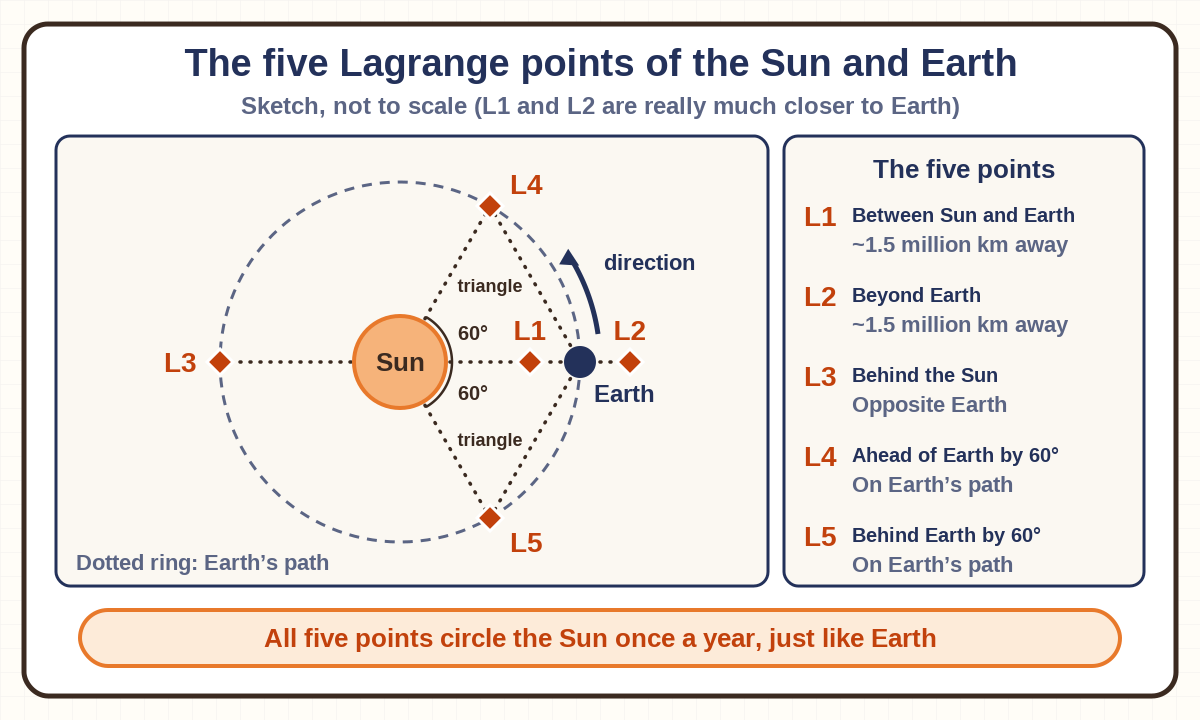
Free to use in lessons, slides and posts with credit (CC BY 4.0).
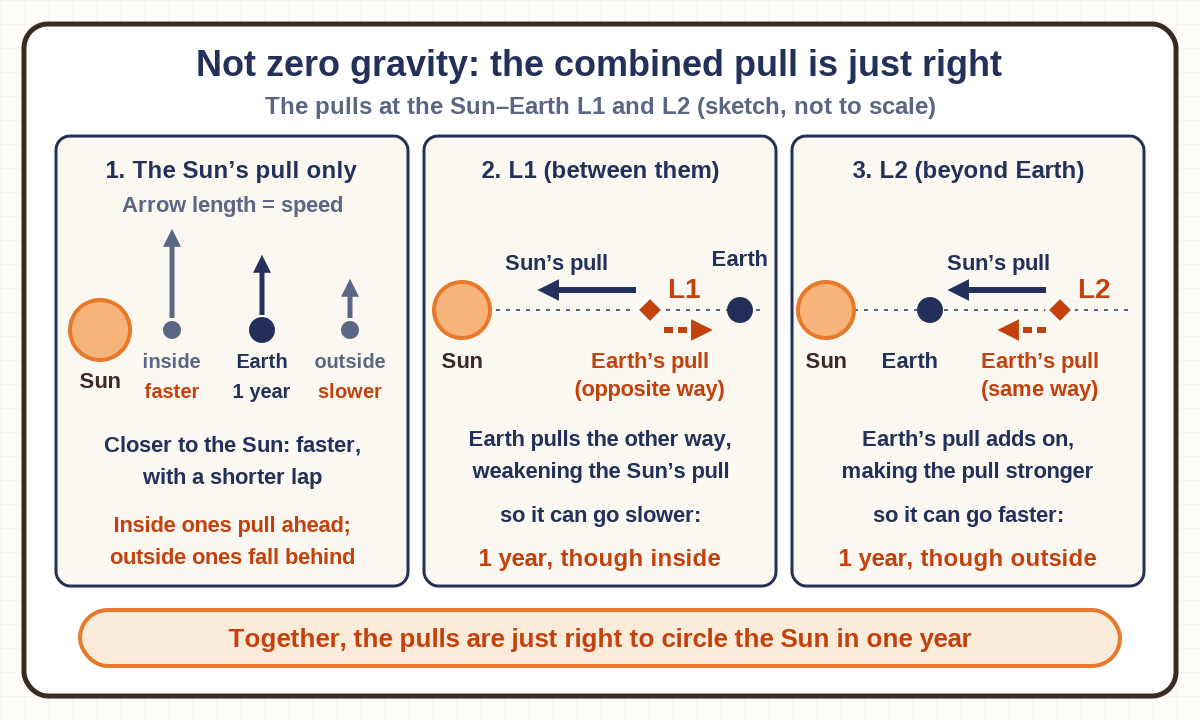
Free to use in lessons, slides and posts with credit (CC BY 4.0).
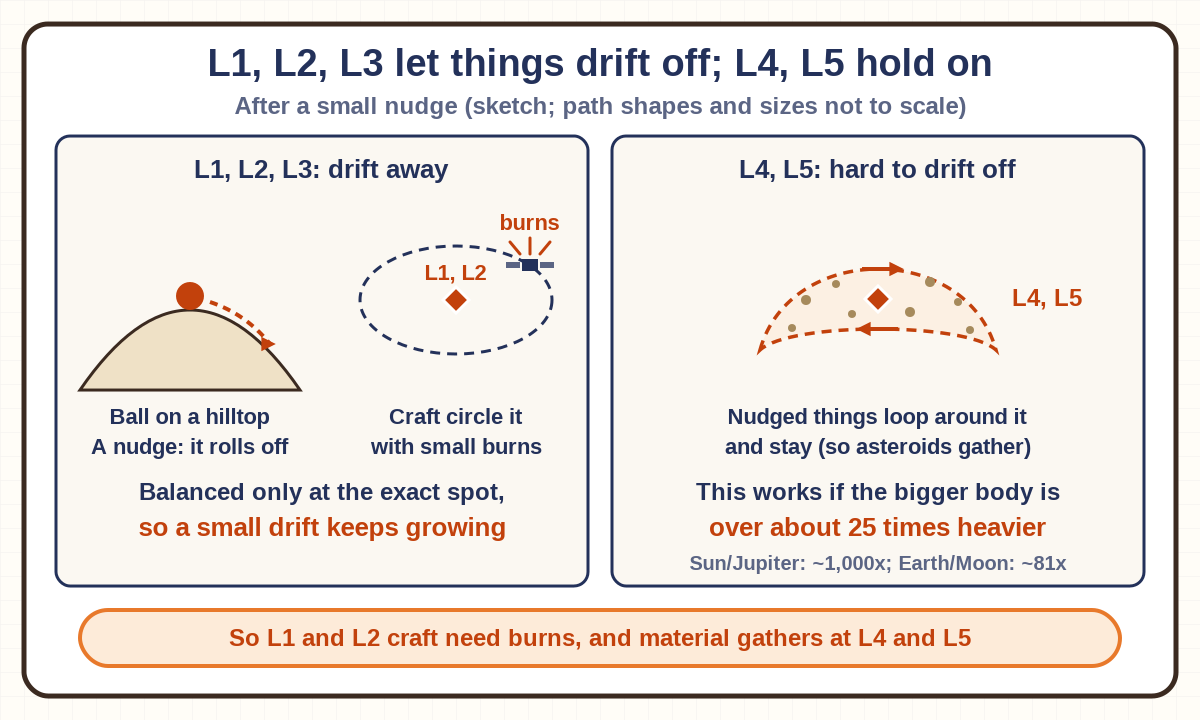
Free to use in lessons, slides and posts with credit (CC BY 4.0).
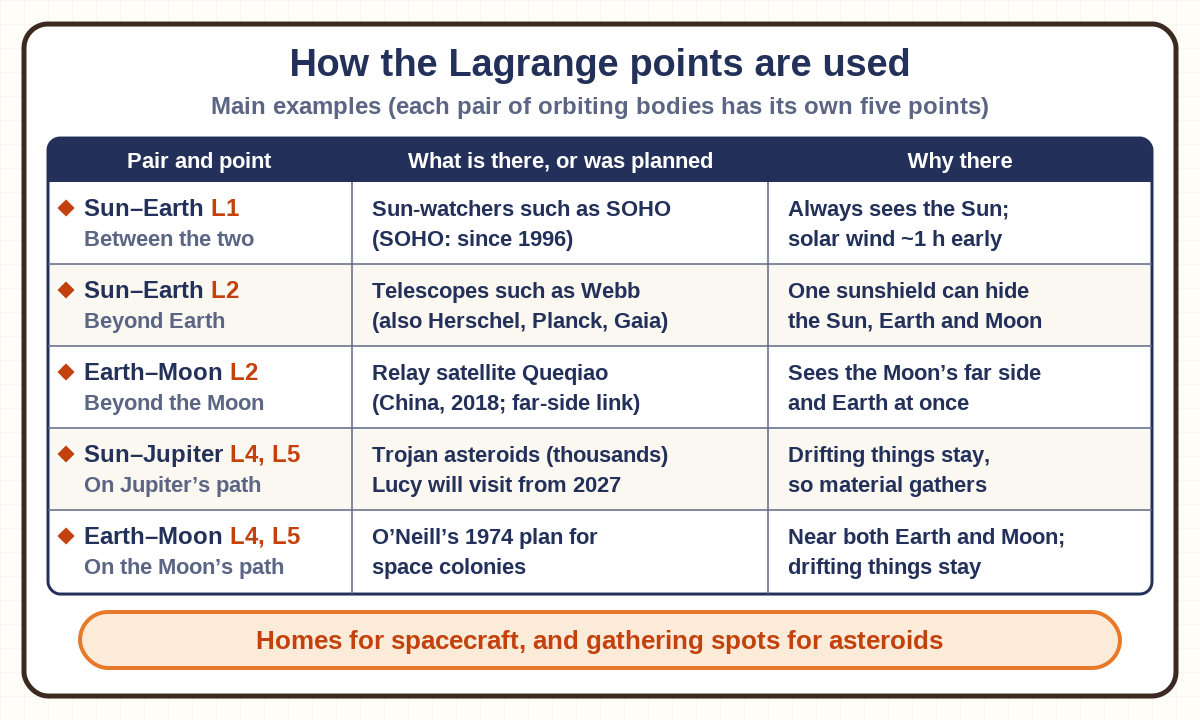
Free to use in lessons, slides and posts with credit (CC BY 4.0).
You’re free to use these figures in lessons, slides and posts if you credit Naru News (naru.news). CC BY 4.0.
Think of it like this
A weight on a string, and a pull that is just right
Imagine tying a weight to the end of a string and swinging it around over your head. To keep the weight going in a circle, your hand has to keep pulling the string inward. Let go, and the weight flies off in a straight line. What’s more, if it takes the same time to go around, a bigger circle means the weight moves faster, so you have to pull harder.
In space, the Sun’s gravity plays the part of the string. But the Sun’s gravity gets weaker the farther away you are. So something pulled by the Sun alone falls behind outside Earth’s circle, because the pull is not enough, and gets ahead inside it, because the pull is too strong. L2 is a place where Earth adds the missing pull, and L1 is a place where Earth pulls the other way and takes away the extra. In both, the combined pull comes out just right, so it can go around once a year, just like Earth.
But the comparison has limits. A real string holds the weight on a fixed circle, but gravity does not. Drift a little away from L1 or L2, and the balance falls apart, so things move away. And at L4 and L5, the Sun and Earth pull at an angle, so it is more like being pulled by two strings. Even so, their combined pull points straight at the center of mass of the Sun and Earth. That spot is the center that the Sun, Earth and anything at L4 or L5 all circle around together. Because the pull points straight at that center, in the end it works just like one string pulling toward the center of the circle.
Key points
Why five, and who found them?
Working out how three bodies move as they pull on one another is called the three-body problem. It is known for having no general formula for its answer, but special solutions (ways the bodies can move that answer the problem) in which the bodies keep circling while keeping their shape have been found. In 1767, the Swiss scientist Leonhard Euler found a solution in which three bodies keep circling while staying in a straight line. In 1772, Joseph-Louis Lagrange, a mathematician born in Italy who later worked in France, rediscovered it in a prize-winning paper and also found a solution in which three bodies keep circling while holding the shape of an equilateral triangle. These two, the straight line and the equilateral triangle, are known to be the only arrangements that can keep their shape this way.
If the third body is very light, these solutions give five places where it can sit relative to the two big bodies: three from the straight-line solution (L1, L2 and L3) and two from the triangle solution (L4 and L5). They are named after Lagrange and are called Lagrange points or Lagrangian points. They are also called libration points, using a word that means balance.
There are five such points not just for the Sun and Earth, but for every pair of bodies orbiting each other, such as Earth and the Moon, or the Sun and Jupiter.
Without zero gravity, how can things keep pace?
Things circling the Sun go around faster the closer they are, so each lap takes less time. Mercury, the innermost planet, goes around in 88 days. The Sun’s gravity is stronger close in, and anything pulled harder has to move faster, or it would fall toward the Sun. So normally, something a little inside Earth’s orbit pulls ahead of Earth, and something a little outside falls behind.
L1 lies between the Sun and Earth, about 1.5 million km from Earth, roughly 4 times the distance to the Moon (about 380,000 km). There, Earth pulls the opposite way from the Sun and weakens the Sun’s pull a little. With a weaker pull, a slower pace is enough, so even though it is inside Earth’s orbit, it can circle the Sun in one year, just like Earth. L2 lies on the far side of Earth from the Sun, also about 1.5 million km from Earth. There, Earth’s pull adds to the Sun’s, so even though it is outside Earth’s orbit, it can go faster and still circle in one year. L3 lies on the far side of the Sun from Earth, where distant Earth’s pull adds a tiny bit, letting it circle in one year too.
L4 and L5 are the third corners of the equilateral triangles that have the line from the Sun to Earth as one side. They lie on Earth’s path, 60 degrees ahead of Earth and 60 degrees behind it. There, the Sun and Earth pull at an angle, and their combined pull points straight at the center of mass of the Sun and Earth (almost the center of the Sun, since the Sun is far heavier). The center of mass is the center that the Sun, Earth and anything at L4 or L5 all circle around together. Because the pull points straight at it, the two pulls work just like one string pulling toward the center of the circle. And its strength is just what it takes to go around in one year.
So far, “a pull that is just what it takes to go around in one year” describes the points as seen from outside. Seen while circling along with Earth, the same thing looks like this: at all five points the two pulls of gravity balance the force that seems to fling things outward (centrifugal force), so an object there seems to stand still. These are not two separate reasons; they are one fact described in two ways.
How do spacecraft stay at L1 and L2?
L1, L2 and L3 are like a ball balanced on top of a hill. At the exact spot it is balanced, but the slightest drift grows bigger and bigger, and it moves away. At the Sun–Earth L1 and L2, a drift grows large over a time of roughly 23 days.
So spacecraft don’t sit at the point itself. They travel around it on large loops (such as halo orbits) and fire small thruster burns now and then to correct their course. The James Webb Space Telescope, for example, travels around L2 in a big loop about the size of the Moon’s orbit around Earth, going once around about every 6 months. Because the Sun’s and Earth’s gravity nearly hold it in place, the corrections take little fuel.
L3 is always hidden behind the Sun and can’t be seen from Earth. It could offer a view of the Sun’s far side, but it is thought unlikely to find a use.
Why does material gather at L4 and L5?
At L4 and L5, something that drifts a little doesn’t fly straight off; it moves onto a path that loops widely around the point. Seen while circling along with the two bodies, a moving object feels an apparent force that bends its path sideways (the Coriolis force), and this swings drifting objects around the point. For example, throw a ball to someone across a spinning merry-go-round: seen from above, it flies straight, but to the riders it seems to curve sideways. A force like this, which shows up only when you watch while turning, is called an apparent force. But this only works if the bigger body is more than about 25 times (24.96 times, to be exact) heavier than the smaller one. If the smaller body is too heavy, its pull breaks up the looping path around the point, and things drift away. The Sun is about 1,000 times heavier than Jupiter, and Earth about 81 times heavier than the Moon, so both pairs meet this condition.
At the Sun–Jupiter L4 and L5 are swarms of asteroids called the Trojans, thousands of which circle the Sun on the same path as Jupiter. The first one was found in 1906 and turned out to be about 60 degrees ahead of Jupiter, at L4. Trojan asteroids have been named after people in the Trojan War from the ancient Greek epic the Iliad. L4, ahead of Jupiter, is called the “Greek camp,” and L5, behind it, the “Trojan camp.” But because of names given early on, the Greek Patroclus sits in the Trojan camp like a “spy,” and the Trojan Hektor sits in the Greek camp.
NASA’s Lucy spacecraft, launched in October 2021, had become the first spacecraft to enter the region of the Trojan asteroids by October 2026. Starting with a flyby of Eurybates in August 2027, it plans to visit asteroids in the swarms ahead of and behind Jupiter, one after another, until 2033.
Earth has Trojan asteroids too. The first, 2010 TK7, about 300 meters across, was confirmed in 2011.
Which spacecraft use these points?
From the Sun–Earth L1, the Sun is always in view, never blocked by Earth or the Moon. SOHO, a Sun-watching satellite of the European Space Agency (ESA) and NASA, was launched in December 1995 and has watched the Sun from around L1 since 1996. Another plus of L1 is that the stream of particles blowing out from the Sun (the solar wind) can be measured about an hour before it reaches Earth.
At the Sun–Earth L2, the Sun, Earth and Moon, which all give off heat, always lie on the same side. One sunshield can hide them all, so L2 is where space telescopes that must stay cold, among others, are placed: besides the James Webb Space Telescope, Herschel, Planck, Gaia and others have used it.
The Earth–Moon L2 lies beyond the Moon as seen from Earth, and from around it both the Moon’s far side and Earth are in view. In May 2018, China launched the relay satellite Queqiao and placed it around this point, relaying radio signals between Earth and the Chang’e-4 probe exploring the Moon’s far side.
L4 and L5, where asteroids and other material gather, are destinations for exploration.
Were space colonies really planned there?
Yes, it was a real proposal. In 1974, Gerard O’Neill, a physicist at Princeton University in the US, laid out a plan in the science magazine Physics Today, in an article called “The colonization of space,” to build space colonies where people would live inside giant cylinders. The places he found suited to the first colony were the Earth–Moon L4 and L5, since they are within easy reach of both Earth and the Moon, and things there don’t drift off easily; the article puts the colony at L5. His first model was for about 10,000 people, and he wrote that bringing material to L5 from the Moon would take less than 5% of the energy needed to bring it from Earth.
Built around his ideas, the L5 Society was founded in 1975. Its first newsletter said its long-range goal was “to disband the Society in a mass meeting at L5.” Space colonies remain a plan; none has been built anywhere yet.
In the world of the anime Mobile Suit Gundam, too, clusters of space colonies (Sides) are set around the Earth–Moon Lagrange points.
Check yourself
Q1The Sun–Earth Lagrange point L2, where space telescopes are placed, lies on the far side of Earth from the Sun. How does gravity work on something at L2?
Answer and explanation
Answer: A The Sun’s and Earth’s gravity add up in one direction
The Sun–Earth L2 lies on the far side of Earth from the Sun, so the Sun and Earth both pull toward the Sun’s side. The two pulls don’t cancel out; they add up. Something outside Earth’s orbit falls behind Earth if only the Sun pulls on it, but at L2, Earth’s pull adds on, so it can go faster and circle the Sun in one year, just like Earth. Gravity neither becomes zero nor fails to reach it. If gravity were zero, it would fly off in a straight line and could not circle along with Earth.
More on this → Key points: Without zero gravity, how can things keep pace?
Q2SOHO, a satellite that watches the Sun, is placed around the Sun–Earth Lagrange point L1. What is the main reason SOHO is placed there?
Answer and explanation
Answer: C Earth and the Moon can’t block it, so it can always watch the Sun
The Sun–Earth L1 lies between the Sun and Earth, about 1.5 million km from Earth. From there, the Sun is always in view, never blocked by Earth or the Moon, so it suits satellites that watch the Sun. The solar wind reaches L1 about an hour before it reaches Earth, so it can’t be avoided there; instead, measuring it early is one of the pluses of L1. Earth’s gravity reaches L1 too, pulling the opposite way from the Sun. And because a small drift away from L1 grows, spacecraft fire small thruster burns now and then to correct their course.
More on this → Key points: Which spacecraft use these points?
Q3The Trojan asteroids, which circle the Sun on the same path as Jupiter, gather by the thousands near L4 and L5, 60 degrees ahead of and behind Jupiter. Why can they gather there?
Answer and explanation
Answer: B There, drifting things loop back and don’t leave
L4 and L5 are points where something that drifts a little doesn’t fly straight off but moves onto a path that loops widely around the point. This happens when the bigger body is more than about 25 times heavier than the smaller one. The Sun is about 1,000 times heavier than Jupiter, so thousands of asteroids called the Trojans gather at the Sun–Jupiter L4 and L5. L4 and L5 are far from Jupiter, so Jupiter’s gravity is not especially strong there, and they are not places where asteroids easily stick together.
More on this → Key points: Why does material gather at L4 and L5?
Related terms
- James Webb Space Telescope
- Three-body problem
- Trojan asteroids
- Halo orbit
- Gravity
- Centrifugal force
- Coriolis force
- Kepler’s laws
- Space colony
- Solar wind
- Far side of the Moon
Sources and how we checked
- NASA, “What is a Lagrange Point?” (NASA Science, March 27, 2018, updated November 1, 2024; original text by Neil J. Cornish of the WMAP team: Lagrange points as positions in space where objects sent there tend to stay put, saving spacecraft fuel, the gravitational pull of two large masses precisely equaling the centripetal force required for a small object to move with them, five special points where a small mass can orbit in a constant pattern with two larger masses, Lagrange’s prize-winning 1772 paper “Essai sur le Problème des Trois Corps,” L1, L2 and L3 being unstable and L4 and L5 stable, L1 and L2 being unstable on a time scale of approximately 23 days so that satellites there need regular course and attitude corrections, L4 and L5 being stable as long as the mass ratio of the two large masses exceeds 24.96, with the Coriolis force sending a drifting satellite into a stable orbit around the point, objects at L4 and L5 being called Trojans, the Sun–Earth L1 affording an uninterrupted view of the Sun and being home to SOHO, and L3 being unlikely to find a use because it stays hidden behind the Sun; read November 26, 2026)
- ESA, “What are Lagrange points” (European Space Agency, December 24, 2004: five locations around a planet’s orbit where gravity and orbital motion combine, known as L points, L1 between the Sun and Earth where Earth’s pull offsets part of the Sun’s, the solar wind reaching L1 about an hour before it reaches Earth, SOHO at L1, L2 directly behind Earth as seen from the Sun, where Earth’s extra pull lets a spacecraft keep pace with the planet, Herschel, Planck, Gaia and the James Webb Space Telescope at L2, L3 behind the Sun and hidden from Earth but offering the potential to observe the Sun’s far side, L4 and L5 about 60 degrees ahead of and behind Earth in its orbit, L1 to L3 being like a ball on a hill and needing frequent rocket firings to stay in halo orbits, and L4 and L5 being truly stable, like a ball in a bowl, where dust and asteroids tend to accumulate; read November 26, 2026)
- ESA, “L2, the second Lagrangian Point” (European Space Agency, June 4, 2003: L2 as one of the Lagrangian points discovered by Joseph Louis Lagrange, located 1.5 million kilometers directly behind Earth as viewed from the Sun, Lagrangian points as locations where gravitational forces and the orbital motion of a body balance each other, L2 orbiting the Sun at the same rate as Earth, Lagrange discovering five points around two larger masses, labeled L1 to L5, and Lagrange being born in Turin in 1736, moving to Paris in 1787 and dying in 1813; read November 26, 2026)
- G. S. Krishnaswami and H. Senapati, “An introduction to the classical three-body problem” (Chennai Mathematical Institute, Resonance 24(1), 2019; arXiv 1901.07289 full text read as a PDF: in 1767 the Swiss scientist Leonhard Euler discovering periodic solutions in which the three masses are always collinear, the Italian/French mathematician Joseph-Louis Lagrange rediscovering Euler’s solution in 1772 and also finding solutions with the masses always at the vertices of equilateral triangles, the force on each body in both solutions pointing toward the common center of mass and being proportional to the distance from it, the collinear and equilateral configurations being the only central configurations in the three-body problem, the points L1 to L5 of the restricted three-body problem as positions of a light third mass in the co-rotating frame, L1, L2 and L3 always being unstable while L4 and L5 can be stabilized by the Coriolis force, Routh’s 1877 criterion making the Sun–Jupiter L4 and L5 stable and occupied by the Trojan asteroids, Lagrange points also being called libration [literally, balance] points, and the restricted three-body problem not being exactly solvable, with Poincaré discovering chaos in it; read November 26, 2026)
- Kotobank, “Raguranju-ten” (Japanese encyclopedia entries: the Nipponica [Encyclopedia Nipponica] entry by Masafumi Yamamoto, July 21, 2022, describing the five equilibrium solutions of the circular restricted three-body problem, Euler finding the three collinear points around 1760 and Lagrange the two equilateral points in 1772, L4 and L5 being relatively stable, and the Trojan asteroids gathering near the Sun–Jupiter L4 and L5; on the same page, the Britannica Japan concise encyclopedia describing the points as where gravity and centrifugal force on the third body balance, and the Digital Daijisen dictionary pointing to its entry “Raguranju pointo”; read November 26, 2026. Euler’s date is given as about 1760 here and as 1767 in the Resonance article above; the text uses 1767, the year of the paper)
- NASA, “Orbits and Kepler’s Laws” (NASA Science, June 26, 2008, updated May 21, 2024: Kepler’s third law implying that a planet’s period around the Sun increases rapidly with the radius of its orbit, Mercury, the innermost planet, taking only 88 days to orbit the Sun, and Newton’s theory of universal gravitation explaining the force behind the third law; read November 26, 2026)
- NASA, “Moon Fact Sheet” (NSSDCA, NASA Goddard Space Flight Center, David R. Williams, updated January 11, 2024: the Moon’s mass of 0.07346 × 10^24 kg, 0.0123 times Earth’s [Earth being about 81 times the Moon’s mass], and a semimajor axis of 0.3844 × 10^6 km [about 380,000 km]; read November 26, 2026)
- NASA, “Sun Fact Sheet” (NSSDCA, updated May 9, 2024: the Sun’s mass of 1,988,400 × 10^24 kg; read November 26, 2026)
- NASA, “Jupiter Fact Sheet” (NSSDCA, updated October 2, 2024: Jupiter’s mass of 1,898.13 × 10^24 kg [the Sun being about 1,050 times as massive, written as about 1,000 times in the text]; read November 26, 2026)
- NASA, “Webb Orbit” (NASA Science, updated April 30, 2025: Webb orbiting around L2, 1.5 million km from Earth, rather than sitting stationary precisely at it, the sunshield working only when the Sun, Earth and Moon are in the same direction, the orbit being similar in size to the Moon’s orbit around Earth and taking about 6 months to complete once, the gravitational forces of the Sun and Earth being able to nearly hold a spacecraft at this point, and the orbit being kept with small periodic rocket thrust; read November 26, 2026)
- NASA, “SOHO” (NASA Science mission page, updated January 9, 2026: launch on December 2, 1995, arrival at the Sun–Earth L1 Lagrange point on February 14, 1996, orbiting 1.5 million kilometers from Earth, a cooperative international project between ESA and NASA, an active mission that has discovered more than 5,000 comets; read November 26, 2026)
- Chinese Academy of Sciences, “Relay Satellite Queqiao Plays Key Role in Exploring Moon’s Far Side” (January 7, 2019, from Xinhua: the relay satellite Queqiao, launched on May 21, 2018, operating in a halo orbit around the Earth–Moon L2 point, able to “see” both Earth and the far side of the Moon and relaying data between Earth and the Chang’e-4 probe exploring the far side; read November 26, 2026)
- William Steigerwald, “How Were the Trojan Asteroids Discovered and Named?” (NASA, February 22, 2021, updated August 9, 2023: Max Wolf finding an asteroid with an unusual orbit in 1906, nearly 60 degrees in front of Jupiter and caught in Jupiter’s L4 Lagrange point, Johann Palisa suggesting the names Achilles, Patroclus and Hektor after characters from the Iliad, L4 and L5 becoming the “Greek camp” and the “Trojan camp,” and so a Greek “spy” [Patroclus] residing in the Trojan camp and a confused Trojan [Hektor] in the Greek camp; read November 26, 2026)
- NASA, “Lucy” (NASA Science mission page, updated September 8, 2026: launch on October 16, 2021, flybys of eight Trojan asteroids that share an orbit around the Sun with Jupiter, the Trojans being trapped in stable orbits associated with Jupiter, and the schedule from Eurybates on August 11, 2027 to Patroclus and Menoetius on March 3, 2033; read November 26, 2026)
- NASA, “NASA’s Lucy Reaches Trojan Asteroid Region 5 Years After Launch” (Lucy blog, October 28, 2026: Lucy becoming the first spacecraft to enter the region of the Jupiter Trojan asteroids, the L4 point being surrounded by the group of asteroids that travel ahead of Jupiter, thousands of asteroids sharing Jupiter’s orbit, and the first encounter, with the Trojan Eurybates, on August 11, 2027; read November 26, 2026)
- NASA Jet Propulsion Laboratory, “NASA’s WISE Finds Earth’s First Trojan Asteroid” (July 27, 2011: 2010 TK7 being confirmed as an Earth Trojan after follow-up observations, its diameter of roughly 300 meters, and Trojans being asteroids that share an orbit with a planet near stable points in front of or behind the planet; read November 26, 2026)
- Gerard K. O’Neill, “The colonization of space” (Physics Today 27(9), September 1974; issue details and opening checked on the journal’s page)
- National Space Society, “The Colonization of Space – Gerard K. O’Neill, Physics Today, 1974” (full text of the article above: the first colony being best placed at a point within easy range of both Earth and the Moon and stable against displacements, the L4 and L5 Lagrange libration points satisfying all these conditions, the stable motion being a large quasi-elliptical orbit about L5, L5 as the colony site, a population of 10,000 for the first model colony, people living inside cylinders, and bringing a kilogram to L5 from the Moon taking less than 5% of the energy needed to take it from Earth; read November 26, 2026)
- National Space Society, “Brief History of the L5 Society” (Keith and Carolyn Henson incorporating the L5 Society in August 1975, its ideas and initial mailing list coming from O’Neill, and the first L5 News stating that the long range goal would be to disband the Society in a mass meeting at L5; read November 26, 2026)
- Mobile Suit Gundam The Origin official site, “Introduction to the Universal Century Ⅰ Part 2” (English page; in the story’s setting, the five Lagrange points of the Earth–Moon system where Earth’s and the Moon’s gravity are in balanced equilibrium, L4 lying 60 degrees ahead of the Moon and L5 60 degrees behind, and the Sides [clusters of space colonies] being built in stable orbits around L4 and L5, in halo orbits around L1 and L2, and at L3; read November 26, 2026)
AI wrote this page from the sources above, and a different AI checked it against the text of those sources (November 26, 2026). A person with a master’s degree in science and a Japanese high-school science teaching license also read and checked it before publishing. Numbers are as of that date. If anything was hard to follow, you spot a mistake, or there’s a term you’d like explained, please write to [email protected].
Glossary
- AI agent
- AI alignment
- Alignment faking
- Artificial general intelligence (AGI)
- Artificial intelligence (AI)
- Backdoor
- Benchmark
- Chain of thought (CoT)
- Context window
- Data poisoning
- Deep learning
- Deepfake
- Diffusion model
- Embedding
- Emergent misalignment
- Evaluation awareness
- Fine-tuning
- Formal verification
- Generalization
- Generative adversarial network (GAN)
- Generative AI
- Goodhart’s law
- Gradual disempowerment
- Hallucination
- Hyperparameter
- Intelligence explosion
- Interpretability
- Jailbreaking
- Large language model (LLM)
- Latent space
- Machine learning
- Mixture of experts (MoE)
- Neural network
- Neuralese
- Overfitting
- Parameter
- Persona vectors
- Pre-training
- Prompt
- Prompt injection
- Reasoning model
- Recursive language model (RLM)
- Recursive self-improvement (RSI)
- Red teaming
- Reinforcement learning (RL)
- Retrieval-augmented generation (RAG)
- Reward hacking
- Reward model
- Shutdown resistance
- Sleeper agent
- Subliminal learning
- Superintelligence (ASI)
- System prompt
- Technological singularity
- Time horizon
- Token
- Transfer learning
- Transformer
- Accretion disk
- Black hole
- Black hole star
- Cosmic birefringence
- Event horizon
- Event Horizon Telescope (EHT)
- General relativity
- GPS
- Gravitational lensing
- Gravitational singularity
- Gravitational wave
- James Webb Space Telescope (JWST)
- You are hereLagrange point
- Long-period radio transient (LPT)
- Neutron star
- Pulsar
- Quasar
- Sagittarius A*
- Space data center
- Spacetime
- Special relativity
- Speed of light
- Supermassive black hole
- White dwarf