
What is spacetime (the four-dimensional stage that joins space and time into one)?
Also called: Space-time

In one minute
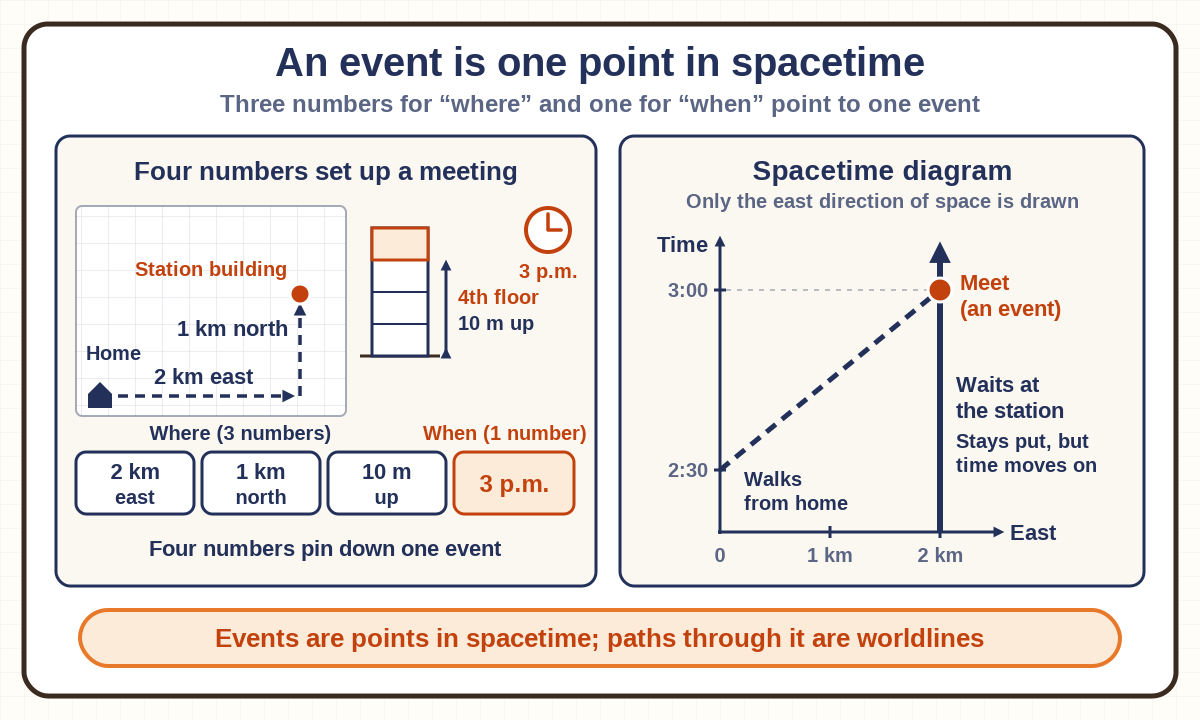
Spacetime is the four-dimensional stage made by joining the three directions of space (forward–back, left–right, up–down) with time, in which any event can be pinned down as a single point by four numbers: three for “where” and one for “when.”
Space and time are joined because special relativity showed that people moving in different ways measure different time gaps and different distances between the same two events. Yet a combination of the two, the “interval,” comes out the same for everyone. In 1908, the mathematician Minkowski said that space by itself and time by itself would become shadows, and only a union of the two would remain. He meant that time and distance measured separately are like shadows that change with the viewpoint; what remains regardless of viewpoint is the spacetime that joins them.
In general relativity, heavy objects curve spacetime, and we feel that curving as gravity. Ripples in the curving that travel outward are gravitational waves. In physics, spacetime isn’t a doorway to another world, as in science fiction; it is the very stage on which every event happens.
A common mix-up
“Spacetime is just a name for time and space together; it doesn’t change how we think about anything.”
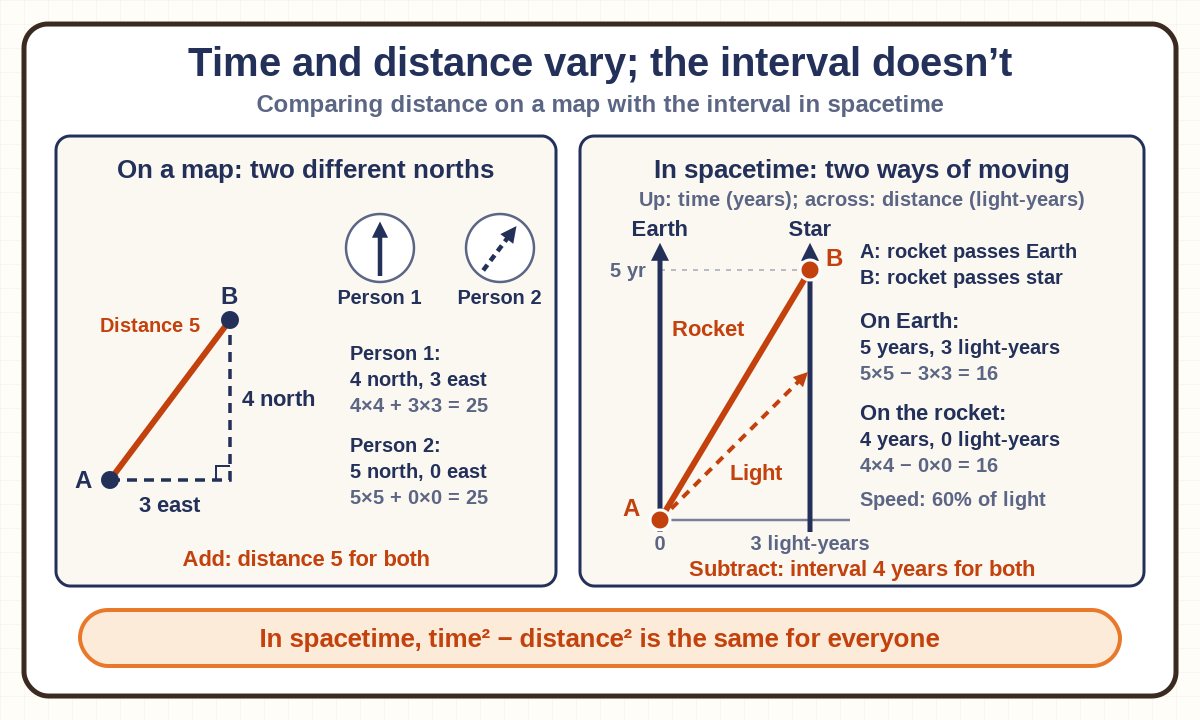
Only partly right. It is true that spacetime is time and space put together. But it isn’t just a name for the two side by side. Newton held that time flows at a steady rate, regardless of anything outside it. On that view, the time gap between two events is the same for everyone who measures it. In special relativity, however, people moving in different ways disagree on both the time gap and the distance. For example, take a rocket flying at 60% of the speed of light that passes Earth and then a star 3 light-years away. A person on Earth measures this as “5 years, 3 light-years.” Seen from Earth, the fast-moving rocket’s clock runs slow (at 60% of the speed of light, at four-fifths the rate), so while 5 years pass on Earth’s clocks, only 4 years pass for the person on the rocket. And seen from the rocket, Earth and the star simply go past right beside it, so both events happen in the same place (right by the rocket): a distance of 0 light-years. Both measurements are right: the way things are split into time and space itself depends on the viewpoint. Still, the “interval,” which combines time and distance, is the same for everyone (5×5 − 3×3 = 4×4 − 0×0 = 16). Only by seeing them as one spacetime does something appear that is the same for everyone.
Explained in pictures
Free to use in lessons, slides and posts with credit (CC BY 4.0).
Free to use in lessons, slides and posts with credit (CC BY 4.0).
Free to use in lessons, slides and posts with credit (CC BY 4.0).
You’re free to use these figures in lessons, slides and posts if you credit Naru News (naru.news). CC BY 4.0.
Think of it like this
A stick’s shadows, which change as it tilts
Picture a stick standing at a slant in the middle of a room. A light directly above casts its shadow on the floor, and a light directly to the side casts its shadow on the wall. Tilt the stick further over, and the floor shadow gets longer while the wall shadow gets shorter. But the length of the stick itself doesn’t change.
In terms of spacetime, the “interval” joining two events is the stick, and the “time gap” and “distance” measured from each viewpoint are the wall shadow and the floor shadow. When people moving in different ways disagree on the time gap and the distance, it is like looking at the shadows of the same stick from different directions. Minkowski’s comparison of space by itself and time by itself to “shadows” is a very similar way of seeing it.
But the comparison has limits. For the stick, the floor shadow squared plus the wall shadow squared gives the stick’s length squared (the Pythagorean theorem). In spacetime, the distance squared is subtracted from the time gap squared. So while for a stick one shadow grows when the other shrinks, in spacetime the time gap and the distance can both shrink (the Earth person’s 5 years and 3 light-years become 4 years and 0 light-years for the rocket person). Also, a stick can be tilted as far as you like, but in spacetime, changing the tilt means moving at a different speed, and it can’t be tilted as far as going faster than light.
Key points
What does it mean to describe an event with four numbers?
In physics, an “event” is something that happens at a certain time in a certain place: fireworks bursting, two people meeting, a bulb flashing. To point to an event, you need three numbers for the place (for example, how many km east, how many km north, and how many m up) and one number for the time. Spacetime is the collection of all events described by these four numbers.
To draw spacetime on paper, which has only two dimensions, we cut space down to one or two directions and draw time going up. This is called a spacetime diagram. Even when a person or thing stays put, time moves on, so on a spacetime diagram it becomes a line going up. If it moves, the line slants. The line a person or thing traces through spacetime is called its worldline, and it shows its history from past to future.
A spacetime diagram is easier to read if time and distance are measured with the same ruler. Light travels about 300,000 km in a second, so one second of time is drawn as long as 300,000 km of distance. Then the worldline of light is a slanted line at exactly 45 degrees. People and vehicles are far slower than light, so their lines go almost straight up.
Why join time and space into one?
In Newton’s view, time flowed at a steady rate regardless of anything outside it, and was separate from space. But special relativity, in 1905, showed that people moving in different ways measure different rates of time and different lengths.
Take the example from “A common mix-up” above: a rocket flying at 60% of the speed of light passes Earth and then a star 3 light-years away. The person on Earth measures this as 5 years and 3 light-years, and the person on the rocket as 4 years and 0 light-years. Both measurements are right, yet the time gap and the distance both differ with the viewpoint.
But take the time gap squared and subtract the distance squared, and the person on Earth gets 5×5 − 3×3 = 16, while the person on the rocket gets 4×4 − 0×0 = 16: the same. If the result is 16, then since 4×4 = 16, the “interval” between the two events is 4 years. The interval is the same no matter how fast the person measuring it moves. It is like surveyors who set north differently: their northward and eastward lengths disagree, but the distance between two points is the same.
Looking at time and space separately gives only numbers that differ from viewpoint to viewpoint. Joining them into spacetime lets us describe nature with things that are the same for everyone: events and the intervals between them. That is what we gain by thinking of them together. Everyone agrees on which events happen; what differs is only how each splits them into time and space.
Is time the same as a fourth direction of space?
No. Distance on a map comes from adding the northward length squared and the eastward length squared (the Pythagorean theorem). The interval in spacetime comes from subtracting the distance squared from the time gap squared. This subtraction is what sets time apart from the directions of space. However you change viewpoints, this subtraction never turns into an addition.
So the time gap squared minus the distance squared can come out positive, zero, or negative. Two events with the larger time gap (a positive result) can be connected by something slower than light, and one can be a cause of the other. Two events whose time gap and distance are exactly equal (a result of zero) are connected exactly by light. Two events with the larger distance (a negative result) can’t be reached even by light, so neither can affect the other.
Also, in space you can go forward or back, or stay still. But people and things in spacetime always keep moving toward the future in the direction of time. Time and space can be handled alike as numbers in one spacetime, but they don’t have the same nature.
What was Minkowski’s 1908 lecture?
Hermann Minkowski was a mathematician who worked in Germany, and one of the teachers whose courses Einstein took as a student. After Einstein published special relativity in 1905, Minkowski rewrote the theory as properties of a four-dimensional geometry that joins time and space.
His 1908 lecture in Cologne, Germany, “Space and Time,” opens with the words, “From now on, space by itself and time by itself are to sink completely into shadows, and only a kind of union of the two will keep its independence.” It is a call to stop looking at time and distance separately and to see them as one spacetime. In the lecture, he called a place at a moment a “world point,” the collection of all of them the “world,” and the path of a body a “world line.” He also showed that the events that send light to a point and the events that receive light from it form two cones: what we now call light cones.
Einstein is said to have thought little of this mathematical rewrite at first. But later, in building general relativity, he used the idea of four-dimensional spacetime and described gravity as warped spacetime.
What is a light cone?
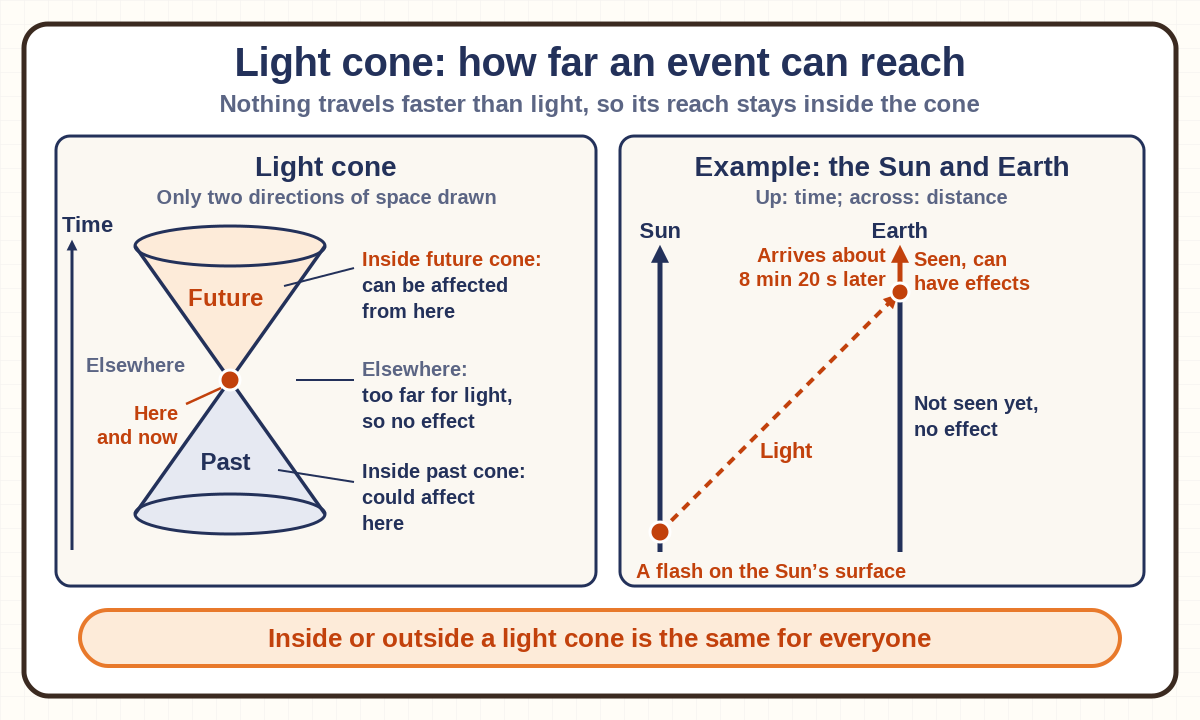
Suppose a flash of light goes off at some event. Light spreads out at the same speed in all directions, so if only two directions of space are drawn, the ring of light keeps growing. Stack these rings with time going up, and they form a cone opening upward: the future light cone. In the same way, light closing in on that event from all directions forms a cone opening downward: the past light cone.
Nothing travels faster than light, so an event can affect only events inside its future light cone, and only events inside its past light cone could have affected it. With events outside both cones, even light can’t make it in time, so they can’t affect each other.
For example, sunlight takes about 8 minutes 20 seconds to reach Earth. For about 8 minutes 20 seconds after something happens on the Sun’s surface, people on Earth can’t see it, and it can’t affect Earth in any way. Events on Earth during that time lie outside the light cone of that event on the Sun.
Whether an event is inside or outside a light cone is the same from every viewpoint. For two events where one lies inside the other’s light cone, which comes first is also the same for everyone. On the other hand, for two events that lie outside each other’s light cones, which happened first can switch depending on how the observer moves. But since they can’t affect each other, cause and effect are never reversed.
What does it mean for spacetime to curve?
The spacetime of special relativity is flat, a stage with the same properties everywhere. In general relativity, a heavy object curves (warps) the spacetime around it. Objects and light moving with no other forces on them go as straight as they can through spacetime. But spacetime itself is curved, so their path bends around the heavy object, and seen from outside, they seem to be pulled by gravity. Spacetime tells objects how to move, and objects tell spacetime how to curve. In other words, objects curve spacetime, and objects move along that curved spacetime.
The curving of spacetime shows up in how clocks run, too. The stronger the gravity, the more slowly time passes. Clocks on GPS satellites, circling about 20,000 km up at about 14,000 km per hour, run about 45 microseconds (45 millionths of a second) a day faster because gravity is weaker up high, and lose about 7 microseconds because they move fast (the part special relativity describes), for a net gain of about 38 microseconds a day. Left uncorrected, position errors would build up by about 10 km a day, so this is corrected in advance.
The curving of spacetime is often compared to the dip a heavy ball makes in a trampoline. That gets across well how paths bend around a heavy object. But a dip in a surface can show only the curving of space, not the curving of time, the fact that clocks run at different rates in different places. Also, a ball rolls into the dip because Earth’s gravity pulls it down, so the comparison uses gravity to explain gravity.
When heavy objects move violently, the curving of spacetime spreads out like ripples at the speed of light. These are gravitational waves, first caught directly on September 14, 2015.
How is it different from “crossing spacetime” in science fiction?
In physics, spacetime isn’t some other world or a doorway to pass through: it is the very stage where we live and where every event happens. When physicists say spacetime is “warped,” they mean that near heavy objects the rate of clocks and the paths of light change, and around Earth this warping is extremely small.
In a sense, “getting to the future faster” really happens. If you travel at 60% of the speed of light to a star 3 light-years away and come back, 10 years pass for people on Earth, but only 8 years pass for the traveler (each way, while 5 years pass on Earth’s clocks, the traveler’s clock moves on only 4). The traveler comes back, by Earth’s clocks, 2 years into the future.
On the other hand, no way to go back into the past has been found. And because of how light cones work, you can’t send a message faster than light to affect a place that light couldn’t yet have reached.
Check yourself
Q1A rocket flying at 60% of the speed of light passes Earth and later passes a star 3 light-years away. A person on Earth and a person on the rocket each measure the gap between these two events. Which is true of what they measure?
Answer and explanation
Answer: C Time gap and distance differ; interval matches
The person on Earth measures the gap between the two events as 5 years and 3 light-years. Seen from Earth, the fast-moving rocket’s clock runs slow, so only 4 years pass for the person on the rocket. And seen from the rocket, Earth and the star simply go past right beside it, so both events happen right beside the person on the rocket: a distance of 0 light-years. Both the time gap and the distance differ with the viewpoint. But time gap squared minus distance squared gives 5×5 − 3×3 = 16 and 4×4 − 0×0 = 16, the same, so the interval between the two events (4 years) is the same for everyone who measures it. The idea that time passes the same way for everyone is only a close answer that holds at everyday slow speeds.
More on this → Key points: Why join time and space into one?
Q2Sunlight takes about 8 minutes 20 seconds to reach Earth. For a person on Earth 3 minutes after an event on the Sun’s surface, what is the situation with that event?
Answer and explanation
Answer: A Not seen yet, and no effect felt yet
Nothing travels faster than light, so for about 8 minutes 20 seconds after something happens on the Sun’s surface, it can’t be seen from Earth and can’t affect Earth. An event on Earth 3 minutes later lies outside the light cone of that event on the Sun. With events outside the light cone, even light can’t make it in time, so they can’t affect each other.
Q3On a map, you find the distance between two points by squaring the north gap and the east gap and adding them (the Pythagorean theorem). When finding the interval between two events in spacetime, what is different from the map?
Answer and explanation
Answer: B Subtract distance squared from time squared
Distance on a map comes from adding squares, but the interval in spacetime comes from subtracting the distance squared from the time gap squared. For example, for two events that a person on Earth measures as 5 years apart in time and 3 light-years apart in space, 5×5 − 3×3 = 16, and since 4×4 = 16, the interval is 4 years. This subtraction sets time apart from the directions of space. Time can be handled along with space as a fourth number, but it isn’t exactly the same as a direction of space.
More on this → Key points: Is time the same as a fourth direction of space?
Related terms
- General relativity
- Special relativity
- Gravitational wave
- Black hole
- Gravitational singularity
- Event horizon
- Gravitational lensing
- Light cone
- Minkowski space
- Worldline
- Speed of light
- Twin paradox
- GPS
Sources and how we checked
- Hermann Minkowski, "Raum und Zeit" (lecture at the 80th Naturforscher-Versammlung in Cologne, September 21, 1908; Jahresberichte der Deutschen Mathematiker-Vereinigung, B. G. Teubner, 1909; read in the German Wikisource text): the opening words ["Von Stund′ an sollen Raum für sich und Zeit für sich völlig zu Schatten herabsinken und nur noch eine Art Union der beiden soll Selbständigkeit bewahren." The English wording on this page was translated from this], Section I [a place at a moment, x, y, z, t, called a world point, the set of all possible x, y, z, t called the world, and the path of a body called a world line, and the form c²t²−x²−y²−z²], and Section III [the front cone of world points sending light to a point O and the back cone of world points receiving light from O, with world points inside the front cone always earlier than O and those inside the back cone always later]; read November 20, 2026
- Hermann Minkowski, "Space and Time" (English translation by Meghnad Saha and Wikisource: the date and place of the lecture, the opening words, world-point, world-line and world in Section I, and in Section III the cones formed by points sending light to O and points receiving light from O, with points inside them always earlier or later than O; read to cross-check the German text, November 20, 2026)
- Edwin F. Taylor and John Archibald Wheeler, "Spacetime Physics" (second edition, W. H. Freeman, 1992; the authors’ released text read on LibreTexts): Section 1.1 [daytime surveyors using magnetic north and nighttime surveyors using North Star north disagreeing on northward and eastward records, yet agreeing on the distance from the Pythagorean theorem], Section 1.2 [laboratory and rocket observers finding different space and time separations between two events but agreeing on the spacetime interval, time squared minus space squared, the minus sign in the equation, time not being separable from space, and space and time as parts of a single spacetime], Section 1.4 [measuring space and time in the same unit, one second equaling about 300 million meters of light-travel time, the speed of light as the conversion factor between units of space and time, and the Sun being 499 light-seconds from Earth], Section 1.5 [calling Minkowski Einstein’s teacher and quoting his words on space and time fading into shadows, spacetime being the same for everyone and the interval as the simple measure of separation between events, the comparison of surveyors’ tilted grids with frames in uniform relative motion, and the minus sign distinguishing space from time, no twisting or turning giving real space and time separations the same sign, and it being wrong to say time is identical in quality with space], Section 6.2 [the interval squared being positive, negative or zero, timelike, spacelike and lightlike relations, before and after being frame-dependent for spacelike pairs, and nothing, not even light, traveling between spacelike-separated events], Section 6.3 [the future light cone opening upward as a circle of light spreads, the past light cone opening downward, events outside both cones being unable to affect or be affected, and the light cone and its categories existing in spacetime regardless of frame], and Section 9.6 [curvature completely accounting for gravitation, and spacetime telling mass how to move while mass tells spacetime how to curve]. The figure of about 8 minutes 20 seconds for sunlight to reach Earth was found by turning 499 seconds into minutes and seconds (8 minutes 19 seconds); read November 20, 2026
- Einstein Online, "Special relativity / Elementary Tour part 5: Spacetime" (general-audience explanation from the Max Planck Institute for Gravitational Physics [Albert Einstein Institute]: observers in relative motion coming to different conclusions about which events are simultaneous, agreeing about what events there are but not about where or when they take place, spacetime as the totality of all events being absolute, adding time giving spacetime four dimensions, light speed as the upper limit for transmitting energy, matter and information, leaving a causal structure that is the same for all inertial observers, and events outside the light cone being unable to influence or be influenced by the event; read November 20, 2026)
- Robert Rynasiewicz, "Newton’s Views on Space, Time, and Motion" (Stanford Encyclopedia of Philosophy, revision of August 22, 2011: the words in the Scholium of Newton’s Principia that absolute, true and mathematical time, from its own nature, passes equably without relation to anything external, and absolute time not depending on clocks or measures such as the hour, day, month or year; read November 20, 2026)
- J. J. O’Connor and E. F. Robertson, "Hermann Minkowski" (MacTutor History of Mathematics, University of St Andrews, updated August 2015: born June 22, 1864, died January 12, 1909 in Göttingen, teaching at the Zurich polytechnic where Einstein was a student in several of his courses, moving to Göttingen in 1902, coupling space and time, formerly thought independent, into a four-dimensional “space-time continuum,” Kline’s review of Pyenson’s 1977 paper on Minkowski and Einstein’s special relativity, saying that his 1908 paper reformulated Einstein’s 1905 paper in four-dimensional space-time geometry, “a step which Einstein did not think much of at the time” [not Einstein’s own words], and these ideas later being used by Einstein in developing general relativity. The age of 44 was found from his birth and death dates; read November 20, 2026)
- Clifford M. Will, "Special Relativity: A Centenary Perspective" (in "Einstein, 1905–2005: Poincaré Seminar 2005," Birkhäuser, 2006; main text of arXiv:gr-qc/0504085 [ar5iv HTML]): Section 2 [describing space and time together on a spacetime diagram, the invariant interval, and the Minkowski metric] and Section 3.5 [a round trip at 0.6c to a station 3 light-years away, after which the traveling twin has aged 8 years and the twin on Earth 10]; read November 20, 2026
- Richard W. Pogge, "Real-World Relativity: The GPS Navigation System" (course page for Astronomy 162, The Ohio State University: satellites about 20,000 km up moving at about 14,000 km per hour, clocks losing about 7 microseconds a day from speed and gaining about 45 from gravity, a net gain of about 38, position errors building up by about 10 km a day without correction, and the satellite clocks being built before launch to tick slower than ground clocks; read November 20, 2026)
- LIGO, "What are Gravitational Waves?" (LIGO at Caltech: gravitational waves as “ripples” in space-time caused by the most violent processes in the Universe, traveling at the speed of light, Einstein predicting them in 1916 in his general theory of relativity, and LIGO first sensing waves from two colliding black holes on September 14, 2015; read November 20, 2026)
- NASA Space Place, "Is Time Travel Possible?" (NASA’s science site for young people, updated July 31, 2026: space and time being linked in Einstein’s theory of relativity, time passing more slowly the faster you travel, gravity curving space and time and slowing the passage of time, scientists correcting GPS satellite clocks with math, and humans being unable to hop into a time machine and go back in time; read November 20, 2026)
- Kotobank, Japanese dictionary entries for jikū, “spacetime” (Digital Daijisen: the four dimensions made by joining time with the three of ordinary space; Heibonsha World Encyclopedia, by Yasunori Fujii: the four-dimensional space with time as the fourth coordinate, also called jikūkan, a point in it called a world point and the line joining world points called a world line, showing a body’s history from past to future, and Minkowski spacetime with time as the fourth coordinate as the simplest form; Nipponica, by Takuya Matsuda: the union of time and space, special relativity making time and space no longer independent but a uniform four-dimensional Minkowski spacetime, general relativity treating gravity as the warping of four-dimensional spacetime, with bodies moving along geodesics in warped spacetime, and the spacetime of general relativity being set by matter and not uniform; Britannica Japan: time and space being linked into one four-dimensional jikūkan; read November 20, 2026)
- Kotobank, Japanese dictionary entries for kō-ensui, “light cone” (Digital Daijisen: read kō-ensui, the cone traced by light leaving a position at a moment in Minkowski’s four-dimensional spacetime, with a body’s path never going beyond the inside of this cone; Britannica Japan: read kō-ensui or hikari-ensui, also called “light cone” in katakana, the region above the origin in the spacetime of special relativity [Minkowski space] being the future region and the region below the past region, and signals not traveling faster than light; read November 20, 2026)
AI wrote this page from the sources above, and a different AI checked it against the text of those sources (November 20, 2026). A person with a master’s degree in science and a Japanese high-school science teaching license also read and checked it before publishing. Numbers are as of that date. If anything was hard to follow, you spot a mistake, or there’s a term you’d like explained, please write to [email protected].
Glossary
- AI agent
- AI alignment
- Alignment faking
- Artificial general intelligence (AGI)
- Artificial intelligence (AI)
- Backdoor
- Benchmark
- Chain of thought (CoT)
- Context window
- Data poisoning
- Deep learning
- Deepfake
- Diffusion model
- Embedding
- Emergent misalignment
- Evaluation awareness
- Fine-tuning
- Formal verification
- Generalization
- Generative adversarial network (GAN)
- Generative AI
- Goodhart’s law
- Gradual disempowerment
- Hallucination
- Hyperparameter
- Intelligence explosion
- Interpretability
- Jailbreaking
- Large language model (LLM)
- Latent space
- Machine learning
- Mixture of experts (MoE)
- Neural network
- Neuralese
- Overfitting
- Parameter
- Persona vectors
- Pre-training
- Prompt
- Prompt injection
- Reasoning model
- Recursive language model (RLM)
- Recursive self-improvement (RSI)
- Red teaming
- Reinforcement learning (RL)
- Retrieval-augmented generation (RAG)
- Reward hacking
- Reward model
- Shutdown resistance
- Sleeper agent
- Subliminal learning
- Superintelligence (ASI)
- System prompt
- Technological singularity
- Time horizon
- Token
- Transfer learning
- Transformer
- Accretion disk
- Black hole
- Black hole star
- Cosmic birefringence
- Event horizon
- Event Horizon Telescope (EHT)
- General relativity
- GPS
- Gravitational lensing
- Gravitational singularity
- Gravitational wave
- James Webb Space Telescope (JWST)
- Lagrange point
- Long-period radio transient (LPT)
- Neutron star
- Pulsar
- Quasar
- Sagittarius A*
- Space data center
- You are hereSpacetime
- Special relativity
- Speed of light
- Supermassive black hole
- White dwarf