
Home › Glossary › Everyday science
What is an embryonic stem cell, an early-embryo cell that can become many kinds of cells?
Also called: ES cell, ES cells, Embryonic stem cells, ESC

In one minute
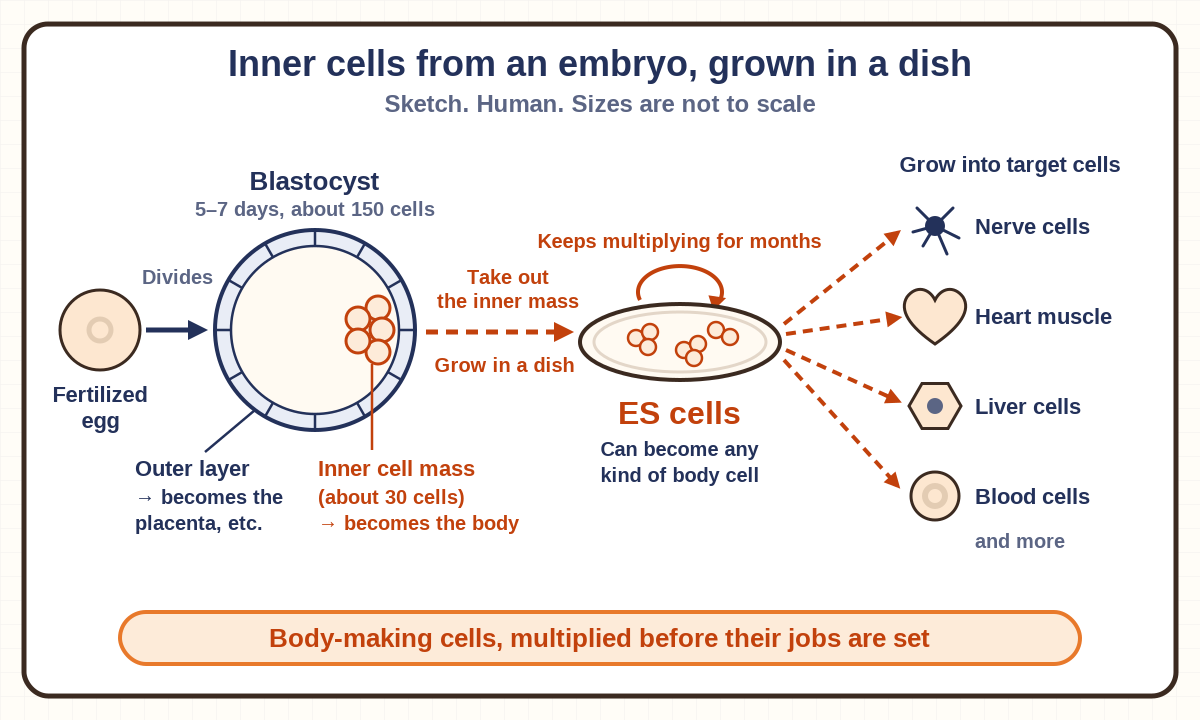
An embryonic stem (ES) cell is a cell made by taking the clump of cells inside a very early embryo, about 5 to 7 days after fertilization (a blastocyst), and growing it in a dish so that it keeps multiplying while still able to become any kind of body cell (pluripotency).
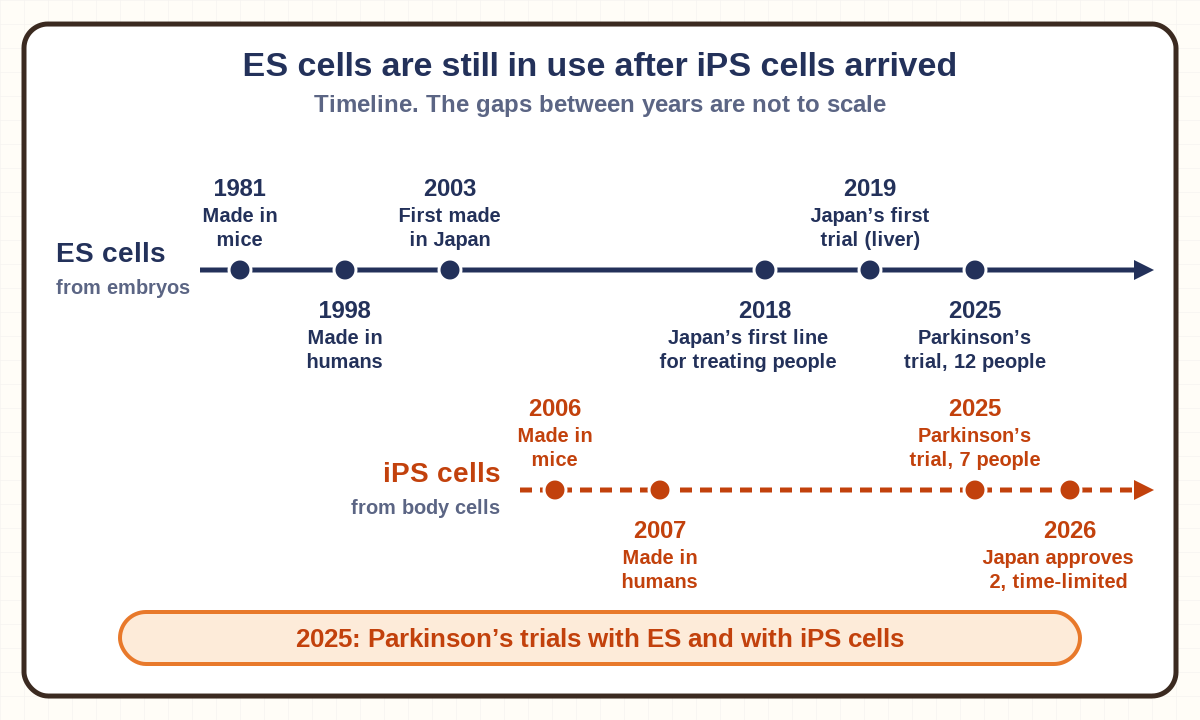
They were first made in mice in 1981 and in humans in 1998. Because they can multiply almost without limit and can be grown into nerve, heart muscle, liver and other cells, they are used to study how the body develops and how diseases work, and in trials of treatments that transplant cells made from them.
But making them destroys an embryo, so they are debated. In Japan, they are made under rules such as using only fertilized eggs that were made for fertility treatment and are no longer needed, donated free of charge with the couple’s consent. Even after iPS cells, which can be made without embryos, arrived in 2006, ES cells have kept being used.
A common mix-up
“Now that we have iPS cells, ES cells are no longer used.”
Not true. iPS cells arrived in 2006 as cells very similar to ES cells that can be made without embryos. But ES cells have kept being used since then. In 2018, Japan made its first ES cells to standards for use in treating people. In 2019, liver cells made from ES cells were given to a baby just 6 days old in Japan’s first clinical trial using ES cells (a clinical trial tests a new treatment in people, aiming for government approval). Abroad, too, cells made from ES cells are being tested in people. Neither has replaced the other; today both are in use.
Explained in pictures
Free to use in lessons, slides and posts with credit (CC BY 4.0).
Free to use in lessons, slides and posts with credit (CC BY 4.0).
Free to use in lessons, slides and posts with credit (CC BY 4.0).
You’re free to use these figures in lessons, slides and posts if you credit Naru News (naru.news). CC BY 4.0.
Think of it like this
Clay before it hardens
Freshly kneaded clay can become a plate, a cup or a doll. But once it has been shaped and dried, it hardens and cannot be remade into another shape.
Cells in an embryo are similar. The clump of cells inside an embryo about 5 to 7 days old is like soft clay that can still become any kind of body cell. As the embryo grows, the cells gradually take on their own jobs, such as nerve or blood cells.
ES cells are like taking out that soft clay and keeping it in a bag that stops it from drying out. Grown in a dish in a set way, the cells keep multiplying while they can still become any kind of cell. You can take out just as much as you need and shape it into what you want, such as nerve or liver cells. And once they are made, they can be multiplied and shared with many researchers, much like dividing clay into portions.
But the comparison has limits. Clay can be shaped by hand, but cells have to be guided to the target cells by working out how to grow each kind. Also, clay can be found anywhere, but the cells that ES cells start from were taken from an embryo, which is regarded as the bud of human life. That is why they are handled carefully, following rules, both when they are made and when they are used.
Key points
Where do they come from, and why can they become so many kinds of cells?
A human fertilized egg divides into more cells, and about 5 to 7 days after fertilization it becomes a small hollow ball of cells. An embryo at this stage is called a blastocyst and is made of about 150 cells. The thin layer around the outside later becomes the placenta and similar parts. The clump of about 30 cells gathered on one side inside (the inner cell mass) later makes the whole body.
ES cells are made by taking out this inner clump and growing it in a dish. In the embryo, these cells gradually turn into cells with their own jobs, such as nerve or blood cells, as the embryo develops. But in a dish under set conditions, they keep dividing and multiplying without taking on jobs. They can be kept multiplying for months, and sometimes for years.
That is why ES cells can become any kind of body cell (pluripotency). To check this, researchers see whether the cells grow into various kinds of cells in a dish, or put them into mice to see whether they form a lump that is not cancer but contains a mix of many tissues (they use mice with weak immune systems, so that the mouse’s body does not attack the added cells). The first human ES cells, made in 1998, still had the power to form tissues such as cartilage, bone, muscle and early nerve tissue after being multiplied for 4 to 5 months.
However, ES cells are not embryos themselves. They usually cannot make the placenta and other parts that support growth in the womb. Japan’s guidelines (the government’s rules on how this research is done) also set ES cells apart from embryos, which could grow into a person, and define them as “not an embryo.”
When were they first made, and by whom?
Mouse ES cells came first. In 1981, Evans and a colleague at the University of Cambridge in the UK, and Martin, separately made them from the inner cells of mouse blastocysts. Martin’s paper called these cells “embryonic stem cells”; the name ES cell comes from the first letters of this English term.
Human ES cells were made in 1998 by James Thomson and his team at the University of Wisconsin in the United States. They were made from donated blastocysts, and even after being multiplied for months, they kept the power to become many kinds of tissue. One of the lines made then (a line is a set of cells grown from the same cells), “H9,” was shared with researchers and has been used for a long time.
In Japan, national guidelines were set in 2001 that allowed ES cells to be made from fertilized eggs left unused after fertility treatment. For the time being, though, they were limited to basic research and were not to be used to treat people. In 2003, Kyoto University made Japan’s first human ES cells. The National Center for Child Health and Development later made them too; as of 2020, it was one of only two institutions in Japan that made human ES cells.
In 2014, the guidelines were revised and a new law to keep treatments using cells safe took effect, opening the way to making ES cells for use in treating disease. Kyoto University set up a dedicated facility and a quality control system, and in 2018 it made Japan’s first ES cell line to standards for use in treating people.
Why are they debated, and what are Japan’s rules?
Making ES cells means taking the inner cells out of a blastocyst, so the embryo is destroyed and can no longer develop. An embryo is something that could become a person if it developed as it is. So quite a few people feel uneasy about it, seeing it as destroying the beginning of a human life, and many countries restrict it strictly. On the other hand, it may greatly help the progress of medicine and biology.
The Japanese government treats embryos with care as “the bud of human life” and, in principle, does not allow fertilized eggs to be destroyed for research. But it allows exceptions, with rules that act as brakes, only for research that makes scientific sense, is safe and is acceptable to society. Making ES cells is one of those exceptions.
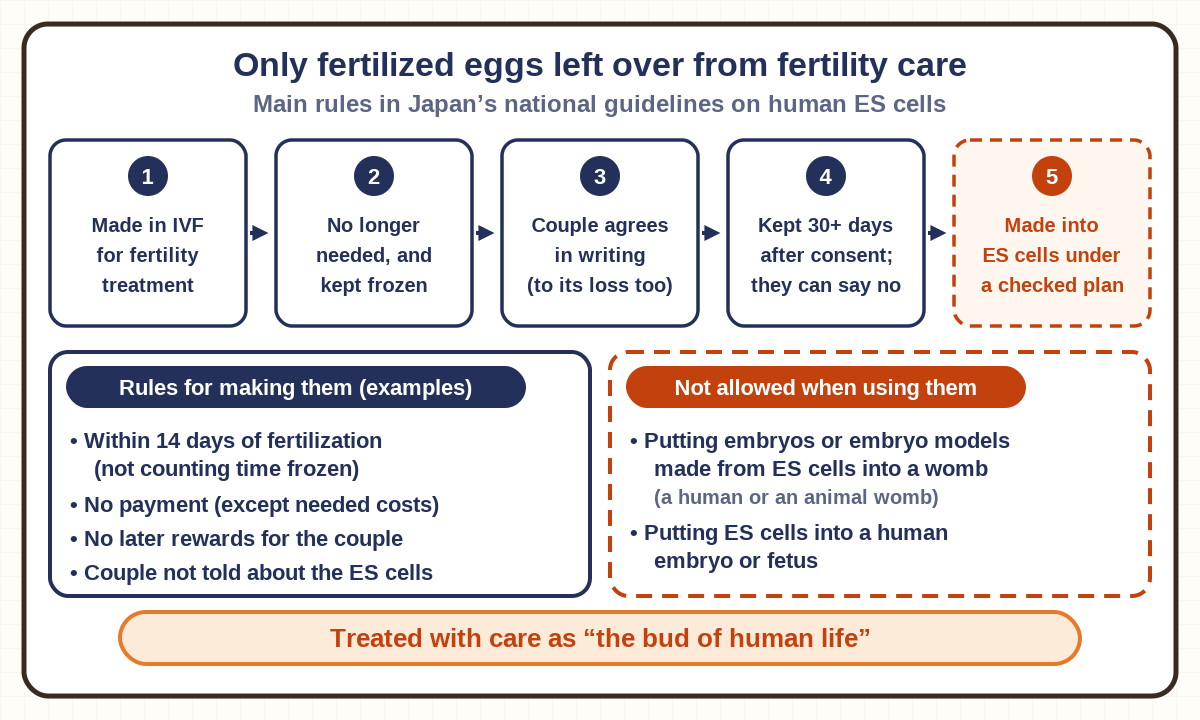
The main rules are as follows. Only fertilized eggs that were made for fertility treatment, are no longer going to be used and are kept frozen may be used. The couple gives written consent both to the egg’s loss and to its use for making ES cells. Even after consent, the egg is kept for at least 30 days, and while it is stored, the couple can withdraw their consent at any time. Then the ES cells are made under a plan checked by the national government. The donation is free of charge, apart from necessary costs. The couple receives no reward later, and profits that come from the ES cells, such as patents, do not belong to them. The couple is not told about the ES cells made from their egg either.
Once made, ES cells can be multiplied and shared with many research institutions, so research using them does not destroy a new embryo each time. Meanwhile, research is moving forward on making clumps of cells from ES cells that closely resemble embryos (embryo models). So the guidelines for those who use ES cells forbid putting embryos or embryo models made from ES cells into the womb of a human or an animal, and putting ES cells into a human embryo or fetus.
How are they related to iPS cells?
Both can become any kind of body cell and can multiply almost without limit. The difference is what they are made from: ES cells come from embryos, while iPS cells (induced pluripotent stem cells) are made from adult body cells such as skin or blood cells.
iPS cells were made using ES cells as the model. Shinya Yamanaka and his team at Kyoto University found four genes to add to body cells from among the genes that are characteristically active in ES cells. When they made iPS cells in mice in 2006 and in humans in 2007, they checked whether they had succeeded by seeing whether the cells resembled ES cells in shape, growth, active genes and so on.
The strengths of iPS cells are that they can be made without destroying embryos, and that they can also be made from a patient’s own cells. ES cells are technically hard to make from the patient, and when cells made from someone else’s ES cells are transplanted, there is a risk of rejection, in which the body sees them as foreign and attacks them.
Even so, ES cells have kept being used. When Kyoto University made ES cells usable for treatment in 2018, it said it expected that comparing ES cells as a new option alongside iPS cells would help make treatments using cells safer and more effective.
How far are they used in medicine today?
The first clinical trial in Japan to use ES cells took place in 2019 at the National Center for Child Health and Development. The patient was a baby just 6 days old with an inborn disease (a urea cycle disorder) in which the body cannot break down harmful ammonia it makes.
The root cure is a liver transplant, but it cannot be done safely until the baby grows to about 6 kg. So about 190 million liver cells made from ES cells were put into a blood vessel of the liver over 2 days, as a “bridge” until a transplant was possible. The baby grew without a rise in blood ammonia, left the hospital, and 5 months after the cells were given, received part of the father’s liver in a transplant. In Japan there was no way to get a steady supply of liver cells for transplants, and the idea was that ES cells, which can multiply almost without limit, could be grown into liver cells and frozen, ready even for emergencies. The center and others announced that this was the first time in the world that liver cells made from ES cells were given to a person. This announcement, however, describes the progress of one baby.
Trials testing cells made from ES cells in people are also under way abroad. In 2025, two papers on trials that transplanted cells into the brains of people with Parkinson’s disease appeared in the same issue of the same science journal. One, in the United States and Canada, transplanted early nerve cells made from ES cells into the brains of 12 people. The cells came from “H9,” one of the lines made in 1998. At one year, there were no side effects caused by the cells, and brain scans at 18 months showed changes suggesting that the cells had survived. But because it was a small, first-stage trial, the paper says longer and larger studies are needed to check safety and effectiveness. The other, at Kyoto University Hospital, transplanted cells made from iPS cells into the brains of 7 people.
As of December 2024, 116 trials worldwide were counted that test products made from ES or iPS cells in people, covering 83 products. Most target diseases of the eye, the brain and nerves, or cancer. More than 1,200 people have received them, and the review concludes that so far, no safety concerns common across them have been found.
Check yourself
Q1Human ES cells are made by taking the clump of cells inside an embryo about 5 to 7 days after fertilization and multiplying it. Which describes the range of cells ES cells can become?
Answer and explanation
Answer: B Any body cell, but usually not the placenta
ES cells can become not just some body cells but any kind of body cell (pluripotency). But they usually cannot make the placenta and other parts that support growth in the womb. In the embryo, the inner clump that ES cells come from is the part that makes the body, while the placenta comes from the thin outer layer. A fertilized egg gives rise to both. Japan’s guidelines also define ES cells as “not an embryo.”
More on this → Key points: Where do they come from, and why can they become so many kinds of cells?
Q2When a couple donates a fertilized egg left over from fertility treatment for making ES cells, what do Japan’s national rules (guidelines) say about the couple?
Answer and explanation
Answer: B While it is still stored, they can withdraw their consent
The fertilized egg is kept for at least 30 days after the couple’s consent, and while it is stored, they can withdraw their consent at any time. On the other hand, the donation is free of charge apart from necessary costs, and the couple receives no reward later. Profits that come from the ES cells, such as patents, do not belong to them, and they are not told about the ES cells made from their egg.
More on this → Key points: Why are they debated, and what are Japan’s rules?
Q3In 2019, Japan’s first clinical trial (a test of a new treatment in people, aiming for government approval) to transplant cells made from human ES cells into a person took place. Who received what cells?
Answer and explanation
Answer: A A newborn with a liver disease: liver cells
The trial took place at the National Center for Child Health and Development. The patient was a baby just 6 days old with an inborn disease in which harmful ammonia made in the body cannot be broken down. Liver cells made from ES cells were put into a blood vessel of the liver as a bridge until the baby was big enough for a liver transplant. Retina cells were transplanted into a person in 2014, in the world’s first study testing iPS cells in people. Early nerve cells for the brain were used in Parkinson’s disease trials reported in 2025, made from ES cells in the United States and Canada and from iPS cells at Kyoto University.
More on this → Key points: How far are they used in medicine today?
Related terms
- Stem cell
- iPS cell
- Human embryo model
- Pluripotency
- Blastocyst
- Fertilized egg
- In vitro fertilization
- Regenerative medicine
- Clinical trial
Sources and how we checked
- Ministry of Education, Culture, Sports, Science and Technology (MEXT) and Ministry of Health, Labour and Welfare (MHLW), Japan, Guidelines on the Derivation of Human ES Cells (in Japanese; 2019 notice no. 4, last amended February 13, 2026; Article 1 [ES cells derived by destroying a human embryo, and their potential to contribute greatly to medicine and biology], Article 2 [definition of human ES cells: cells taken from a human embryo, not themselves an embryo, that are pluripotent and self-renewing], Article 3 [the human embryo as the bud of human life], Article 4 [requirements: a fertilized embryo made for assisted reproduction, no longer to be used, whose donors have confirmed their will to let it be destroyed; informed consent; kept frozen; within 14 days of fertilization, excluding time frozen; donated free apart from necessary costs], Article 5 [ethics committee], Article 18 [the donors are the couple; written informed consent; storage for at least 30 days after consent; consent can be withdrawn while the embryo is stored] and Article 19 [items to explain: no reward in the future, no disclosure to donors of information on the ES cells derived, and patents and other rights not belonging to the donors]; read in the PDF text on November 19, 2026)
- MEXT, Japan, Guidelines on the Use of Human ES Cells (in Japanese; 2019 notice no. 68, last amended by notice no. 14 on February 13, 2026; Article 2 [definition of human ES cells], Articles 3 and 4 [requirements for use] and Article 5 [prohibited acts: producing an individual from ES cells by transferring an embryo made from them into the womb of a human or animal, introducing ES cells into a human embryo or fetus, making human embryos from germ cells made from ES cells, and producing an individual from a human embryo model made from ES cells]; read in the PDF text on November 19, 2026)
- MEXT, Japan, Guidelines on the Derivation and Use of Human ES Cells (in Japanese; 2001 notice no. 155, the first guidelines; Article 2 [limited for the time being to basic research, with clinical use in people not allowed until separate standards are set], Article 4 [embryos donated free of charge] and the requirements for embryos used [fertilized embryos made for assisted reproduction and no longer to be used, among others]; read as the text published in an MHLW council document on November 19, 2026)
- MEXT, Japan, explanatory slides “What are human ES cells?” and others (in Japanese; 2019; human ES cells obtained by culturing the inner cell mass of a human embryo about 5–6 days after fertilization, first derived in the United States in November 1998, pluripotency and near-unlimited self-renewal, the human embryo as the bud of human life, the principle of not newly creating or harming fertilized embryos as research material with exceptions allowed, with safeguards, only when scientific rationality, safety and social appropriateness are all met, and the confirmation of derivation plans by the education and health ministers before derivation; read November 19, 2026)
- Japan, Act on Regulation of Human Cloning Techniques (in Japanese; Act No. 146 of 2000; Article 2(1)(i) [an embryo: a cell or group of cells that could grow into an individual if it developed as it is in the womb of a human or animal, before it begins to form a placenta] and (vi) [human fertilized embryo]; read on e-Gov Laws on November 19, 2026)
- U.S. National Institutes of Health (NIH), Stem Cell Information, “What are embryonic stem cells?” (archived copy from January 2009; ES cells derived from embryos made by in vitro fertilization and donated for research with the donors’ informed consent, not from eggs fertilized in a woman’s body; embryos typically four or five days old, a hollow ball of cells called the blastocyst; an inner cell mass of about 30 cells; millions of cells after six months or more; pluripotency tested by letting cells differentiate in culture or by checking for teratomas in immunosuppressed mice; read in the University of North Texas web archive on November 19, 2026)
- U.S. National Institutes of Health (NIH), Stem Cell Information, “Glossary” (archived copy from January 2009; the blastocyst as a preimplantation embryo of about 150 cells, the inner cell mass that develops into the embryo and fetus and is the source of ES cells, the trophoblast that develops into the placenta, pluripotent cells that can make all cell types of the body but not extra-embryonic tissues such as the placenta or amnion, ES cell lines grown without differentiating for months to years, and teratomas used to confirm cells of all three germ layers; read in the University of North Texas web archive on November 19, 2026)
- RIKEN and Osaka Medical College, press release on recreating the differentiation of the blastocyst (in Japanese; August 9, 2019; the blastocyst dividing into the trophectoderm, which becomes the placenta, and the inner cell mass, which becomes the body; the pluripotency of the inner cell mass; and pluripotent stem cells usually being unable to become extraembryonic tissues; read November 19, 2026)
- Center for iPS Cell Research and Application (CiRA), Kyoto University, “What are iPS cells?” (in Japanese; FAQ, answered with information as of January 2021; ES cells made from blastocysts 6 to 7 days after fertilization, first made in mice in 1981 by Evans and colleagues at the University of Cambridge and in humans in 1998 by Thomson at the University of Wisconsin, made from fertilized eggs left unused after fertility treatment but by destroying an embryo, so that many people feel uneasy and many countries regulate them strictly, the difficulty of making ES cells from a patient and rejection of cells from others, Yamanaka finding four genes among those characteristically active in ES cells, and research making precursors of sperm and eggs from ES and iPS cells; read November 19, 2026)
- Martin, “Isolation of a pluripotent cell line from early mouse embryos cultured in medium conditioned by teratocarcinoma stem cells” (PNAS 78(12), pp. 7634–7638, December 1981; abstract [a pluripotent cell line taken directly from preimplantation mouse embryos, isolated from the inner cell masses of blastocysts, and called “embryonic stem cells”]; read on Europe PMC on November 19, 2026)
- Evans and Kaufman, “Establishment in culture of pluripotential cells from mouse embryos” (Nature 292, pp. 154–156, July 1981; only the title, journal, issue and date were checked on Europe PMC [no abstract was available and the full text could not be read]; the year and university were checked in the CiRA FAQ above; November 19, 2026)
- Thomson et al., “Embryonic stem cell lines derived from human blastocysts” (University of Wisconsin; Science 282(5391), pp. 1145–1147, November 1998; abstract [pluripotent cell lines derived from human blastocysts that, after 4 to 5 months of undifferentiated growth, could still form tissues such as gut epithelium, cartilage, bone, smooth and striated muscle and neural epithelium]; read on Europe PMC on November 19, 2026)
- University of Wisconsin–Madison, “NIH reapproves WiCell’s H9 and three other Wisconsin stem cell lines for federally funded research” (news, April 27, 2010; H9 and other lines date to the 1998 discovery in James Thomson’s lab, the embryos for H9 and others were donated through a medical center in Israel, H9 is valued for its stability and long use, and it is cited in more than 550 publications; read November 19, 2026)
- Takahashi and Yamanaka, “Induction of pluripotent stem cells from mouse embryonic and adult fibroblast cultures by defined factors” (Kyoto University; Cell 126(4), pp. 663–676, August 2006; abstract [four factors introduced under ES cell culture conditions, and the resulting iPS cells showing the morphology and growth of ES cells and expressing ES cell marker genes]; read on Europe PMC on November 19, 2026)
- Takahashi et al., “Induction of pluripotent stem cells from adult human fibroblasts by defined factors” (Kyoto University and others; Cell 131(5), pp. 861–872, November 2007; abstract [human iPS cells similar to human ES cells in morphology, proliferation, surface antigens, gene expression, epigenetic status of pluripotency genes and telomerase activity]; read on Europe PMC on November 19, 2026)
- Institute for Frontier Life and Medical Sciences (then Institute for Virus Research and Regenerative Medicine), Kyoto University, press release on Japan’s first derivation of clinical-grade human ES cell lines (in Japanese; 2018; Japan’s first human ES cell lines derived there in 2003, five lines derived and distributed to many institutions, clinical-grade lines derived under the guidelines revised in 2014 and the Act on the Safety of Regenerative Medicine in force from November 2014, a dedicated cell processing facility and quality control, clinical stocks expected around July 2018, and the hope that comparing these ES cells as a new option alongside iPS cells would improve the safety and effectiveness of regenerative medicine; read in the PDF text on November 19, 2026)
- National Center for Child Health and Development (NCCHD) and Japan Agency for Medical Research and Development (AMED), press release on a clinical trial using human ES cells for a urea cycle disorder (in Japanese; May 21, 2020; a doctor-led trial from October 21, 2019; a 6-day-old newborn unable to break down toxic ammonia; a bridge until the baby reached the 6 kg needed for a liver transplant; 190 million liver cells given into the portal vein over 2 days; discharge at about 5 kg after 9 weeks; a living-donor liver transplant from the father 5 months after the cell transplant; Japan having no source of liver cells, while ES cells, which can multiply almost without limit, can be turned into liver cells and frozen for emergencies; the first trial in Japan using human ES cells and, as they describe it, the world’s first trial using ES-cell-derived liver cells to treat liver disease; and the center being one of only two human ES cell derivation institutions in Japan; read November 19, 2026)
- Tabar et al., “Phase I trial of hES cell-derived dopaminergic neurons for Parkinson’s disease” (Memorial Sloan Kettering Cancer Center and others; Nature 641(8064), pp. 978–983, May 2025, online April 16, 2025; dopaminergic neuron progenitors made from human ES cells [WA09 (H9)], 12 people, 9 in New York and 3 in Toronto, no adverse events related to the cell product at 12 months, PET at 18 months suggesting graft survival, and a small, unblinded study, with longer-term and larger studies needed; full text on Europe PMC [PMC12095069], read November 19, 2026)
- Sawamoto et al., “Phase I/II trial of iPS-cell-derived dopaminergic cells for Parkinson’s disease” (Kyoto University; Nature 641(8064), pp. 971–977, May 2025, online April 16, 2025; abstract [dopaminergic progenitors made from donor iPS cells transplanted into both sides of the brain of 7 people at Kyoto University Hospital]; read on Europe PMC on November 19, 2026)
- Kirkeby, Main and Carpenter, “Pluripotent stem-cell-derived therapies in clinical trial: A 2025 update” (University of Copenhagen and others; Cell Stem Cell 32(1), pp. 10–37, January 2025; abstract [as of December 2024, 116 regulator-approved clinical trials testing 83 products made from human pluripotent stem cells, mostly for the eye, central nervous system and cancer, more than 1,200 people dosed, and no generalizable safety concerns so far]; read on Europe PMC on November 19, 2026)
- RIKEN and others, press release on the transplant of retinal pigment epithelial sheets made from the patient’s own iPS cells for age-related macular degeneration (in Japanese; March 16, 2017; the world’s first clinical study using iPS cells, run from 2013, with a sheet made from her own iPS cells transplanted into one woman in September 2014; read November 19, 2026)
- Sumitomo Pharma and RACTHERA, announcement of the approval in Japan of Amchepry, dopaminergic neural progenitor cells made from donor iPS cells (in Japanese; timely disclosure, March 6, 2026; conditional and time-limited approval in Japan dated March 6, 2026, for improving motor symptoms of Parkinson’s disease not adequately helped by current drugs including levodopa; read in the PDF text on November 19, 2026)
- Cuorips, announcement of the conditional and time-limited approval of heart muscle cell sheets made from donor iPS cells (in Japanese; timely disclosure, March 6, 2026; the sheet product Reheart approved in Japan that day, with conditions and a time limit, for severe heart failure due to ischemic cardiomyopathy not adequately helped by standard treatment; read in the PDF text on November 19, 2026)
AI wrote this page from the sources above, and a different AI checked it against the text of those sources (November 19, 2026). A person with a master’s degree in science and a Japanese high-school science teaching license also read and checked it before publishing. Numbers are as of that date. If anything was hard to follow, you spot a mistake, or there’s a term you’d like explained, please write to [email protected].
Glossary
- AI agent
- AI alignment
- Alignment faking
- Artificial general intelligence (AGI)
- Artificial intelligence (AI)
- Backdoor
- Benchmark
- Chain of thought (CoT)
- Context window
- Data poisoning
- Deep learning
- Deepfake
- Diffusion model
- Embedding
- Emergent misalignment
- Evaluation awareness
- Fine-tuning
- Formal verification
- Generalization
- Generative adversarial network (GAN)
- Generative AI
- Goodhart’s law
- Gradual disempowerment
- Hallucination
- Hyperparameter
- Intelligence explosion
- Interpretability
- Jailbreaking
- Large language model (LLM)
- Latent space
- Machine learning
- Mixture of experts (MoE)
- Neural network
- Neuralese
- Overfitting
- Parameter
- Persona vectors
- Pre-training
- Prompt
- Prompt injection
- Reasoning model
- Recursive language model (RLM)
- Recursive self-improvement (RSI)
- Red teaming
- Reinforcement learning (RL)
- Retrieval-augmented generation (RAG)
- Reward hacking
- Reward model
- Shutdown resistance
- Sleeper agent
- Subliminal learning
- Superintelligence (ASI)
- System prompt
- Technological singularity
- Time horizon
- Token
- Transfer learning
- Transformer
- Accretion disk
- Black hole
- Black hole star
- Cosmic birefringence
- Event horizon
- Event Horizon Telescope (EHT)
- General relativity
- GPS
- Gravitational lensing
- Gravitational singularity
- Gravitational wave
- James Webb Space Telescope (JWST)
- Lagrange point
- Long-period radio transient (LPT)
- Neutron star
- Pulsar
- Quasar
- Sagittarius A*
- Space data center
- Spacetime
- Special relativity
- Speed of light
- Supermassive black hole
- White dwarf