
What is a quasar (gas falling into a giant black hole that outshines a whole galaxy)?
Also called: Quasi-stellar object, QSO

In one minute
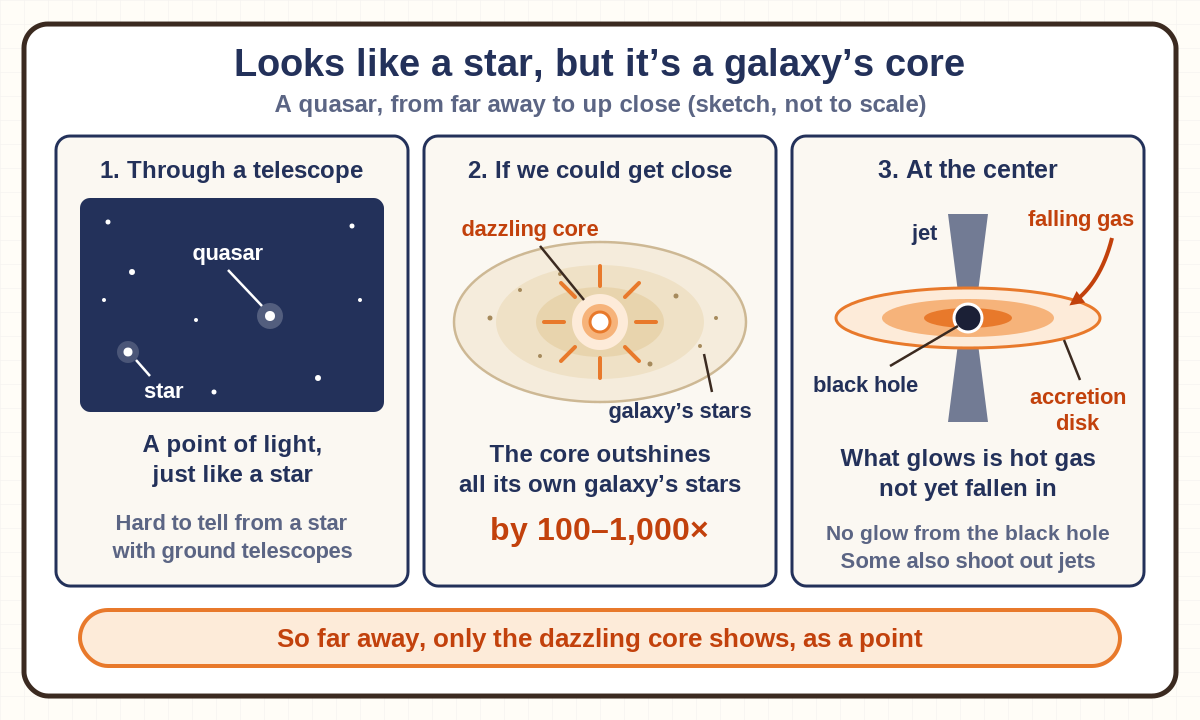
A quasar is the center of a distant galaxy where gas falling into a supermassive black hole shines brighter than the whole galaxy.
The gas circles the black hole in a flat disk (an accretion disk), rubs against itself, heats up and glows. Its light can be 100 to 1,000 times that of all the stars in the quasar’s own galaxy combined. What glows is not the black hole itself but gas that hasn’t fallen in yet.
Quasars are so far away that telescopes show them as starlike points of light, which is where the name, meaning “starlike object,” comes from. In 1963, a shift in the color of 3C 273’s light showed that it was not a star but something extremely bright and very far away. About a million are known today, and they were especially common when the universe was young.
A common mix-up
“A quasar is a kind of very bright star.”
It isn’t a star. The name means “starlike object” and comes from the way a quasar looks like a point of light through a telescope, just like a star. In reality, it is gas falling into a supermassive black hole at the center of a galaxy billions of light-years away. A star shines by nuclear fusion inside it, but a quasar shines with the energy of falling gas, which yields more than 10 times as much energy from the same amount of fuel. It looks like a point because it is so far away and the glowing region is tiny compared with the whole galaxy. Telling them apart is still hard today: the brightest quasar known, announced in 2024, showed up in images from 1980, but it looked too bright in the sky to be a distant quasar, so it was taken for a nearby star. Its true nature was found only decades later.
Explained in pictures
Free to use in lessons, slides and posts with credit (CC BY 4.0).
Free to use in lessons, slides and posts with credit (CC BY 4.0).
Free to use in lessons, slides and posts with credit (CC BY 4.0).
Free to use in lessons, slides and posts with credit (CC BY 4.0).
You’re free to use these figures in lessons, slides and posts if you credit Naru News (naru.news). CC BY 4.0.
Think of it like this
The headlights of a car coming down a dark road
At night, when a car approaches from far away, you can’t yet see its shape, but its headlights already look like dazzling points of light. The lights are much smaller than the car body, yet from far away, the headlights are all that catch your eye.
For a quasar, the car body is the galaxy, and the headlights are the gas falling into the black hole and glowing at the galaxy’s center. The glowing region is tiny compared with the whole galaxy, but it is 100 to 1,000 times brighter than all of that galaxy’s stars combined, so from far away only the light at the center shows, as a starlike point. That is also why the astronomers who first saw quasars couldn’t tell them from stars.
But the comparison has limits. Headlights run on electricity, while a quasar shines because falling gas heats up. And a car’s light reaches you in an instant, but a quasar’s light has taken billions of years to get here. What we see is how it looked long ago, and some are thought to have finished swallowing their gas and gone dark since.
Key points
Why are they called “starlike”?
Among the objects that radio telescopes found giving off strong radio waves, some looked like nothing more than starlike points of light through ordinary telescopes. Because they looked like stars but gave off radio waves, they were called “quasi-stellar radio sources” (starlike radio sources), and in 1964 this was shortened to “quasar.”
Later it turned out that relatives giving off little radio are far more common. Only about 10% of quasars are strong radio sources. So, regardless of radio, they are also called quasi-stellar objects, or QSOs for short.
Today, quasars are thought to be the brightest kind of active galactic nucleus: the center of a galaxy where infalling gas glows brightly. Detailed images from the Hubble Space Telescope showed the spiral and elliptical galaxies that hold them, around the bright points of light.
What was discovered in 1963?
3C 273 is one of the objects that give off strong radio waves. A starlike point of light at its position had already been observed by 1887, but it was thought to be a star in our own Milky Way.
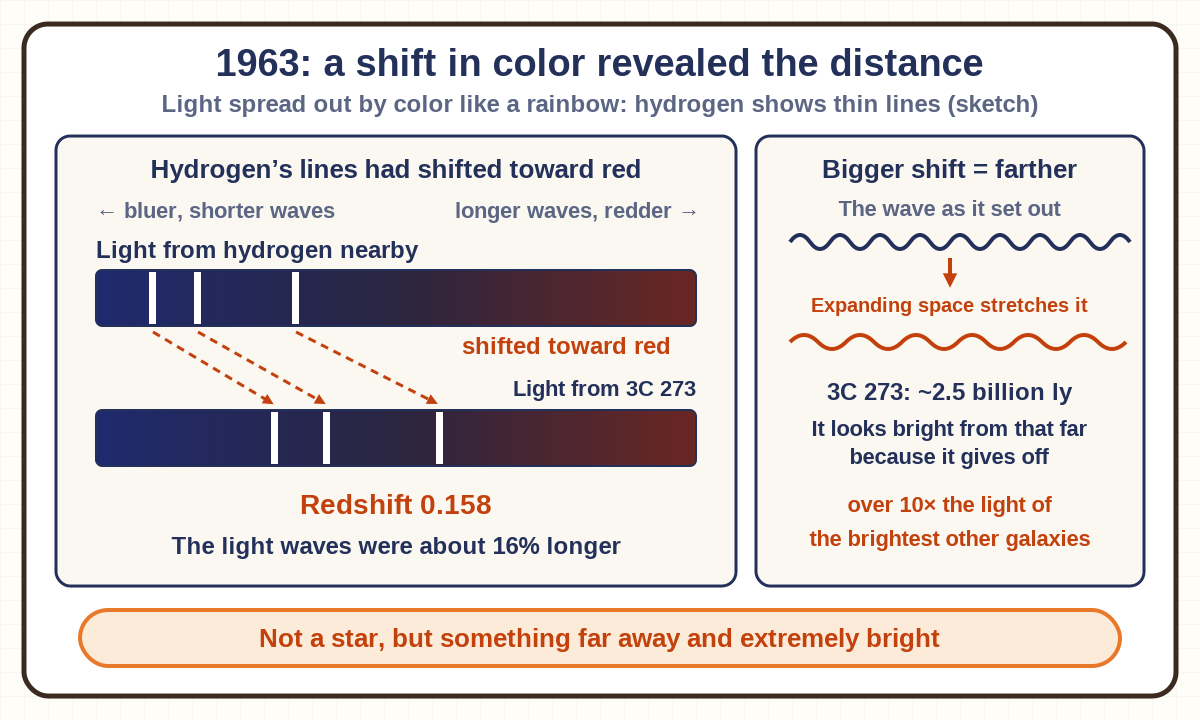
Light is a wave, and its color depends on the length of the wave (the wavelength): shorter waves look bluer, and longer ones look redder. If you spread light out in order of color, like a rainbow, the light given off by hydrogen shows up only at certain colors in the rainbow band, as thin bright lines. These are “the lines of light given off by hydrogen.” In 1963, Maarten Schmidt noticed something in a photograph of this point’s light spread out by color. The lines of light given off by hydrogen were shifted far toward the red side from where they should be. The light waves had been stretched about 16% longer (a redshift of 0.158). Because the universe is expanding, the farther light comes from, the more its waves are stretched on the way, shifting it toward the red. The bigger the shift, the farther the light has come.
3C 273 lies about 2.5 billion light-years away, and even so it is one of the quasars closest to Earth. It looks bright even from that far away because, even compared with the brightest other galaxies (giant elliptical galaxies), it gives off more than 10 times as much light. The “100 to 1,000 times” from the start of this page compared a quasar with all the stars of its own galaxy. Here the comparison is with the brightest other galaxies, so the number is different. If it were only a few tens of light-years away, it would look about as bright as the Sun in our sky. A jet of matter shooting out at nearly the speed of light, about 300,000 light-years long, also stretches from 3C 273.
The same year, the light of 3C 48 was found to be shifted even more (about 37%), and other quasars were soon found one after another. Today about a million are known.
Why are they so bright?
The light comes from gas falling into a supermassive black hole (hundreds of thousands to billions of times the Sun’s mass). The gas can’t fall straight in: it circles around in a flat disk (an accretion disk), rubs against itself, heats up and glows. The black hole itself doesn’t glow, because not even light can get out of it.
Mass can be turned into energy. That is what Einstein’s formula E=mc² says: even a little mass amounts to a huge amount of energy. Gas falling into a black hole can give off energy equal to about 10% of its mass as light. Hydrogen fusion, which makes stars shine, releases about 0.7%, so falling gas yields more than 10 times as much energy from the same amount of fuel. That is why, when a lot of gas falls in, it can shine 100 to 1,000 times brighter than all of its galaxy’s stars combined.
As of November 2026, when this was checked, the brightest quasar known is J0529-4351, announced in 2024. Its black hole, about 17 billion times the Sun’s mass, swallows a little more than one Sun’s worth of gas a day, and the whole thing shines more than 500 trillion times brighter than the Sun. It is a distant quasar whose light took more than 12 billion years to reach us.
How do we know the glowing region is tiny?
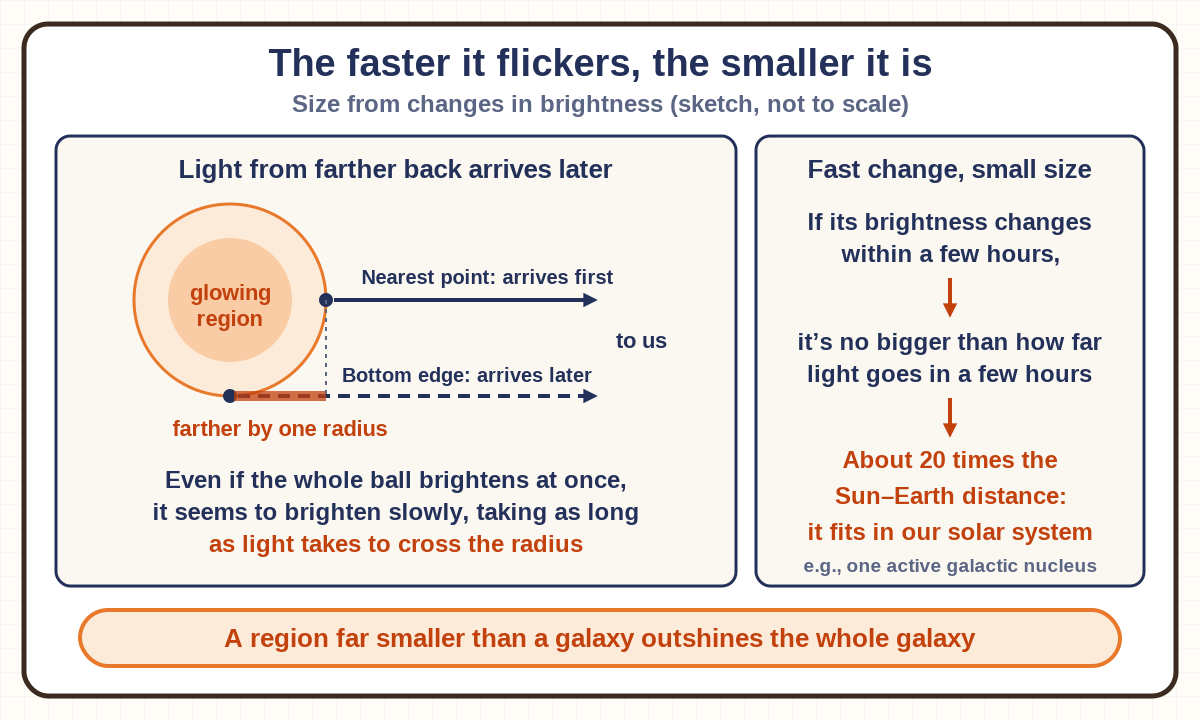
The brightness of quasars and their relatives, active galactic nuclei, can change over short times. How fast it changes tells us the largest the glowing region can be.
Imagine the glowing region is a big ball. Seen from us, the ball looks like a round disk. The middle of the disk is the ball’s nearest point. The disk’s outline (the top and bottom of the ball, if you look at it from the side) is one radius farther back. Even if the whole ball brightens at once, light from the nearest point arrives first, and light from the outline arrives later, delayed by the time light takes to travel the ball’s radius. So from outside, it seems to brighten slowly over that time. Put the other way around, if the brightness changes within a few hours, the glowing region can be no bigger than about the distance light travels in a few hours.
For an active galactic nucleus whose brightness changes within a few hours, this means the glowing region is at most about 20 times the distance from the Sun to the Earth, small enough to fit easily inside our solar system. A region far, far smaller than the galaxy shines brighter than the whole galaxy. That so much energy comes from such a small place was also one of the clues that led to the idea that the light comes from gas falling into a black hole.
How long ago do we see the most distant quasar?
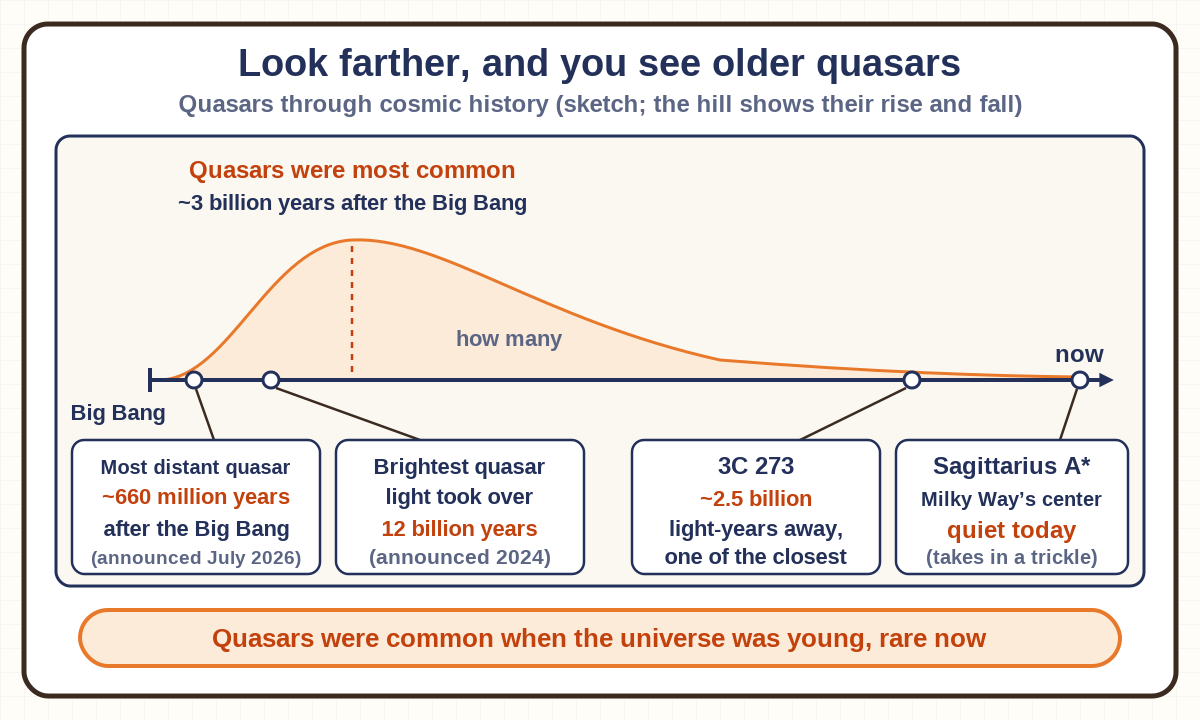
Quasars are so bright that they can be found even very far away. The farther the light comes from, the longer it takes to reach us, so the more distant a quasar is, the older the view we get.
As of November 2026, when this was checked, the record is held by EUCL J1729+6410, announced in July 2026. Found in observations by the European Space Agency’s Euclid space telescope, it is seen as it was about 660 million years after the universe began (redshift about 7.77). Redshift tells how much the light waves have stretched, counted in multiples of their original length. 3C 273’s 0.158 means they grew by 0.158 times their length (about 16%), and 7.77 means they grew by 7.77 times their length, ending up about 8.8 times as long as at the start. It narrowly beat the previous record (redshift about 7.64), announced in 2021. The same study found 12 new quasars at redshift 7 or more, more than doubling the 9 found beyond redshift 7 before.
Some of these early quasars have black holes of more than a billion times the Sun’s mass less than 700 million years after the universe began. For example, J0313-1806, the record-holder from 2021, is seen as it was about 670 million years after the universe began, and its black hole has about 1.6 billion times the Sun’s mass. How black holes grew so big in so short a time is still not understood.
The James Webb Space Telescope has also found many fainter objects in the early universe that seem to have glowing black holes at their centers. But they differ from ordinary quasars in many ways, and how they relate to quasars is still being worked out.
Why were they common long ago but rare now?
Quasars were most common about 3 billion years after the universe began. Galaxies collided far more often then than now, and these collisions are thought to have fed gas to the central black holes and lit up quasars. But the Hubble Space Telescope has also found quasars in calm, undisturbed galaxies, which may point to other ways of feeding them too.
When the infalling gas runs out, a quasar dims, but its black hole doesn’t disappear. So astronomers reasoned that the black holes of old quasars must be sleeping at the centers of quiet nearby galaxies, and went looking for them. Sagittarius A*, at the center of the Milky Way (about 4 million times the Sun’s mass), is also a quiet black hole today, taking in only a trickle of matter.
What are quasars useful for?
They serve as lights shining from far away. On its way to us, the light of a distant quasar passes through gas between the galaxies that gives off no light of its own. Part of the light is absorbed along the way, so studying how it was absorbed reveals what the gas was like in the early universe.
They are also textbook examples of gravitational lensing. In 1979, a quasar was found for the first time that appeared split into two because the gravity of an object in front bent its light.
And they serve as landmarks in the sky. Quasars are so far away that they barely move across the sky. Nearby stars can be seen shifting position over a few years, but quasars are thought to stay essentially fixed for perhaps thousands of years. So radio telescopes around the world observe quasars and other distant objects to build the standard for positions in the sky (the International Celestial Reference Frame). The current standard, in use since 2019, is built from the positions of 4,536 objects. The same observations also measure tiny changes in Earth’s orientation and rotation, and without them GPS couldn’t give accurate locations.
Check yourself
Q1A quasar looks like a starlike point of light through a telescope. What mainly gives off its light?
Answer and explanation
Answer: C Hot gas falling into the black hole
A quasar’s light comes from gas falling into the supermassive black hole at a galaxy’s center: the gas circles in a disk (an accretion disk), rubs against itself and heats up until it glows. A quasar isn’t a star, so it isn’t young stars or stars near the black hole that are shining. The black hole itself doesn’t glow either, because not even light can get out of it. The galaxy’s stars shine too, but a quasar is 100 to 1,000 times brighter than all the stars of its own galaxy combined, so their light is drowned out.
Q2In 1963, the light of 3C 273, which looked like a starlike point of light, was spread out by color, and the lines of light given off by hydrogen were shifted toward the red: the light waves were about 16% longer. What did this reveal?
Answer and explanation
Answer: A It is far away and very bright
Because the universe is expanding, the farther light comes from, the more its waves are stretched on the way, shifting it toward the red (redshift). 3C 273’s light waves were about 16% longer because the light had come from about 2.5 billion light-years away. The bigger the shift, the farther away, so it isn’t nearby. It looks like a star through a telescope even from that far away because it is really very bright: even compared with the brightest other galaxies (giant elliptical galaxies), it gives off more than 10 times as much light.
Q3Some relatives of quasars (active galactic nuclei) change in brightness within a few hours. What does this tell us?
Answer and explanation
Answer: B The glowing region is far smaller than a galaxy
Even if a whole glowing region brightens at once, light from the nearest point, which looks like the middle to us, arrives first, and light from the part that looks like the outline, one radius farther back, arrives later. So the bigger the region, the more slowly it seems to brighten. If the brightness changes within a few hours, the glowing region is no bigger than about the distance light travels in a few hours: about 20 times the Sun–Earth distance, small enough to fit in our solar system and far smaller than a galaxy. If it were as big as a galaxy, its brightness couldn’t be seen changing within a few hours. Nor is the glowing region moving from place to place.
More on this → Key points: How do we know the glowing region is tiny?
Related terms
- Supermassive black hole
- Accretion disk
- Active galactic nucleus
- Jet
- Black hole
- Sagittarius A*
- Redshift
- Gravitational lensing
- Black hole star
- James Webb Space Telescope
- Speed of light
- GPS
Sources and how we checked
- NASA, “Hubble Quasars” (NASA Science, updated June 18, 2026: quasars as distant galaxies whose incredibly bright cores are powered by supermassive black holes, pouring out 100 to 1,000 times as much light as an entire galaxy, being labeled “quasi-stellar radio sources” because they looked like stars but emitted radio waves, resembling stars through ground-based telescopes yet lying billions of light-years away, Hubble finding quasars in both spiral and elliptical galaxies, galaxy mergers happening much more frequently in the early universe, and undisturbed host galaxies possibly indicating a subtler feeding mechanism than galaxy collisions; read November 25, 2026)
- NASA, “NASA’s Hubble Takes the Closest-Ever Look at a Quasar” (NASA Science, December 5, 2024: a quasar being a galactic center that glows brightly as its black hole consumes material in its immediate surroundings, quasars looking starlike as point sources of light, hence the name quasi-stellar object, 3C 273 lying 2.5 billion light-years away as one of the closest quasars to Earth and identified by Maarten Schmidt in 1963 as the first quasar, its luminosity being over 10 times that of the brightest giant elliptical galaxies, it looking as bright as the Sun if it were a few tens of light-years away, its 300,000-light-year-long jet blazing at nearly the speed of light, at least 1 million quasars being scattered across the sky, and quasars being most abundant about 3 billion years after the big bang, when galaxy collisions were more common; read November 25, 2026)
- K. I. Kellermann, “The Discovery of Quasars and its Aftermath” (Journal of Astronomical History and Heritage 17(3), 2014; arXiv full text read as a PDF. Abstract: the 13th-magnitude optical counterpart of 3C 273 being observed at least as early as 1887 and previously suspected to be a galactic star, Schmidt recognizing a redshift of 0.16 from the hydrogen Balmer lines, and quasars coming to be accepted as the most distant and most luminous objects. Section 6: Schmidt recognizing on February 6, 1963, from a spectrum taken on December 29, 1962, the Balmer lines Hβ, Hγ and Hδ with a redshift of 0.158, the redshift of 3C 48 of 0.3679, the four papers appearing together in the March 16, 1963 issue of Nature, and variability implying a small size. Section 8: radio-quiet quasars being about an order of magnitude more numerous than radio-loud ones. Section 9: Schmidt and Matthews adopting the term “quasi stellar radio sources,” Hong-Yee Chiu coining “quasar” in 1964, and QSOs being quasars selected on optical criteria alone. Reference: M. Schmidt, “3C 273: a star-like object with large red-shift,” Nature 197, 1040, 1963; read November 25, 2026)
- J. Kormendy and L. C. Ho, “Coevolution (Or Not) of Supermassive Black Holes and Host Galaxies” (Annual Review of Astronomy and Astrophysics 51, 2013; arXiv full text read as a PDF. Section 1: Schmidt’s 1963 discovery that the 13th-magnitude starlike object 3C 273 had a redshift of 0.158, 3C 273 being about 10 times more luminous than the brightest galaxies, rapid variability implying tiny sizes, the acceptance of the idea that quasars and other active galactic nuclei are powered by accretion onto supermassive black holes, and quasars being much more numerous at redshifts above 2 than now, so that dead quasar engines should hide in many nearby galaxies, finding them becoming a “holy grail”; read November 25, 2026)
- The Open University, “Introduction to active galaxies” (OpenLearn. Section 3.3: the modern picture of a quasar as a remote, very luminous AGN buried in a galaxy of normal luminosity, quasars being believed to be the most luminous AGNs known, their point-like, starlike appearance, 3C 273 being the first quasar discovered, with a redshift of 0.158, and about 10% of quasars being radio loud. Section 4.2: light from the most distant visible point of a source arriving a time R/c later than light from the near side, so that how fast the brightness changes limits the size, and an AGN varying in about 10⁴ seconds, a few hours, being about 20 times the Sun–Earth distance and easily fitting within our solar system. Section 4.6: matter falling into a black hole being able to radiate about 10% of its rest energy, the comparable figure for hydrogen fusion in stars being 0.7%, and this being the most efficient process apart from matter-antimatter annihilation; read November 25, 2026)
- NASA, “What Is Cosmological Redshift?” (NASA Science, Webb explainer, March 21, 2019, updated September 18, 2025: the expansion of space stretching light traveling through it from its original wavelength to a longer, redder one, and the greater the redshift, the greater the distance the light has traveled; read November 25, 2026)
- NASA, “Black Hole Types” (NASA Science, updated August 12, 2026: supermassive black holes having hundreds of thousands to billions of times the Sun’s mass, and almost every large galaxy, including the Milky Way, having one at its center; read November 25, 2026)
- ESO, “Astronomers discover the brightest object in the Universe” (eso2402, February 19, 2024: the quasar J0529-4351 being the most luminous object in the known Universe, over 500 trillion times more luminous than the Sun, its black hole having 17 billion times the Sun’s mass and eating just over a Sun per day, making it the fastest-growing black hole to date, its light taking over 12 billion years to reach us, it showing up in images from 1980 but not being recognized as a quasar until decades later, an automated analysis of Gaia data passing it over for being too bright to be a quasar, suggesting it to be a star instead, and ESO’s VLT X-shooter spectrograph providing the crucial data; read November 25, 2026)
- C. Wolf et al., “The accretion of a solar mass per day by a 17-billion solar mass black hole” (Nature Astronomy, 2024; arXiv abstract: around a million quasars having been catalogued, and this being the most luminous of all quasars found so far, with a black hole of about 17 billion solar masses accreting around one solar mass per day; read November 25, 2026)
- D. Yang et al., “Euclid: Discovery of 31 new quasars at 6.6 < z < 7.8” (Astronomy & Astrophysics 711, A104, July 2026; arXiv version 1 [July 3, 2026] full text read as a PDF. Abstract and Section 1: 31 new high-redshift quasars found in about 3,000 square degrees of the Euclid Wide Survey, 12 of them at redshift 7 or more, more than doubling the 9 quasars previously found beyond redshift 7, high-redshift quasars, as the most luminous non-transient sources in the Universe, serving as beacons for studying the intergalactic medium and reionization, and the rapid growth of their black holes being a challenge. Sections 2–3: candidates beyond redshift 7 being selected by the absorption trough left by intervening gas. Section 5.1: EUCL J172902.75+641018.1, at redshift about 7.77, being the most distant quasar discovered to date, the age of the Universe at its redshift being about 662 million years, about 15 million years earlier than the previous record-holder [Wang et al. 2021]. Figure 5 and Section 6: JWST having revealed a population of sources in the epoch of reionisation possibly indicative of active supermassive black holes, fainter than the quasars and differing from classical quasars in important respects, so that their connection to quasars still needs to be worked out; read November 25, 2026)
- F. Wang et al., “A Luminous Quasar at Redshift 7.642” (The Astrophysical Journal Letters, 2021; arXiv abstract: the discovery of the quasar J0313−1806 at redshift 7.642, its black hole of about 1.6 billion solar masses existing just about 670 million years after the Big Bang, and such an early massive black hole significantly challenging theories of supermassive black hole growth; read November 25, 2026)
- A. Zitrin, “Strong Gravitational Lensing with the James Webb Space Telescope” (Ben-Gurion University of the Negev; arXiv, version 3, September 2026; full text read as a PDF. Section 1.1: the first observed strongly lensed, multiply imaged source being the doubly imaged quasar Q0957+561, published in 1979, and quasars being bright quasi-stellar objects [QSOs] powered by accretion onto a supermassive black hole, a type of active galactic nucleus; read November 25, 2026)
- NASA Earthdata, “Beacons in the sky help monitor Earth’s orientation in space” (L. Naranjo; read as a PDF: the International Celestial Reference Frame being based on extremely distant extragalactic radio sources called quasars, quasars being so remote that they appear fixed, making them good reference sources, nearby stars showing motion over a few years while quasars should essentially be fixed for perhaps thousands of years, VLBI also measuring Earth’s orientation and rotation, GPS satellites being unable to provide accurate locations without the UT1 measurements from VLBI, and the third frame, ICRF3, becoming official in January 2019 based on 4,536 sources; read November 25, 2026)
- P. Charlot et al., “The third realization of the International Celestial Reference Frame by very long baseline interferometry” (Astronomy & Astrophysics 644, A159, 2020; arXiv abstract: ICRF3 being based on nearly 40 years of VLBI observations, giving positions for 4,588 sources across frequencies, 4,536 of them at 8.4 GHz, adopted by the IAU General Assembly in August 2018 and replacing ICRF2 on January 1, 2019; read November 25, 2026)
- National Astronomical Observatory of Japan, Japanese press release on the first image of the black hole at the center of the Milky Way (May 12, 2022: Sagittarius A* having 4 million times the Sun’s mass and lying about 27,000 light-years from Earth; read November 25, 2026)
- NASA, “NASA’s Chandra Detects Record-Breaking Outburst from Milky Way’s Black Hole” (January 5, 2015: a release on an X-ray flare from Sagittarius A*, in which a researcher describes the matter falling into it as “a mere trickle”; read November 25, 2026)
- NASA, “Active Galaxies” (Imagine the Universe!, text updated December 2016: active galaxies having a small core of emission at the center of an otherwise typical galaxy, highly variable and very bright compared with the rest of the galaxy, and the accretion disk around the central black hole heating up due to the gravitational and frictional forces at work; read November 25, 2026)
- Kotobank, Japanese dictionary entry “Quasar” (Digital Daijisen: the Japanese names “junsei” and “jun-kōseijō tentai,” and QSO; read November 25, 2026)
AI wrote this page from the sources above, and a different AI checked it against the text of those sources (November 25, 2026). A person with a master’s degree in science and a Japanese high-school science teaching license also read and checked it before publishing. Numbers are as of that date. If anything was hard to follow, you spot a mistake, or there’s a term you’d like explained, please write to [email protected].
Glossary
- AI agent
- AI alignment
- Alignment faking
- Artificial general intelligence (AGI)
- Artificial intelligence (AI)
- Backdoor
- Benchmark
- Chain of thought (CoT)
- Context window
- Data poisoning
- Deep learning
- Deepfake
- Diffusion model
- Embedding
- Emergent misalignment
- Evaluation awareness
- Fine-tuning
- Formal verification
- Generalization
- Generative adversarial network (GAN)
- Generative AI
- Goodhart’s law
- Gradual disempowerment
- Hallucination
- Hyperparameter
- Intelligence explosion
- Interpretability
- Jailbreaking
- Large language model (LLM)
- Latent space
- Machine learning
- Mixture of experts (MoE)
- Neural network
- Neuralese
- Overfitting
- Parameter
- Persona vectors
- Pre-training
- Prompt
- Prompt injection
- Reasoning model
- Recursive language model (RLM)
- Recursive self-improvement (RSI)
- Red teaming
- Reinforcement learning (RL)
- Retrieval-augmented generation (RAG)
- Reward hacking
- Reward model
- Shutdown resistance
- Sleeper agent
- Subliminal learning
- Superintelligence (ASI)
- System prompt
- Technological singularity
- Time horizon
- Token
- Transfer learning
- Transformer
- Accretion disk
- Black hole
- Black hole star
- Cosmic birefringence
- Event horizon
- Event Horizon Telescope (EHT)
- General relativity
- GPS
- Gravitational lensing
- Gravitational singularity
- Gravitational wave
- James Webb Space Telescope (JWST)
- Lagrange point
- Long-period radio transient (LPT)
- Neutron star
- Pulsar
- You are hereQuasar
- Sagittarius A*
- Space data center
- Spacetime
- Special relativity
- Speed of light
- Supermassive black hole
- White dwarf