
What is the Riemann Hypothesis (and the 2026 AI-assisted proof)?
Also called: RH

In one minute
The Riemann Hypothesis is the conjecture that the places where the zeta function, a function deeply tied to prime numbers, equals 0 (its zeros) all lie on one straight line, apart from those at easy, fixed places.
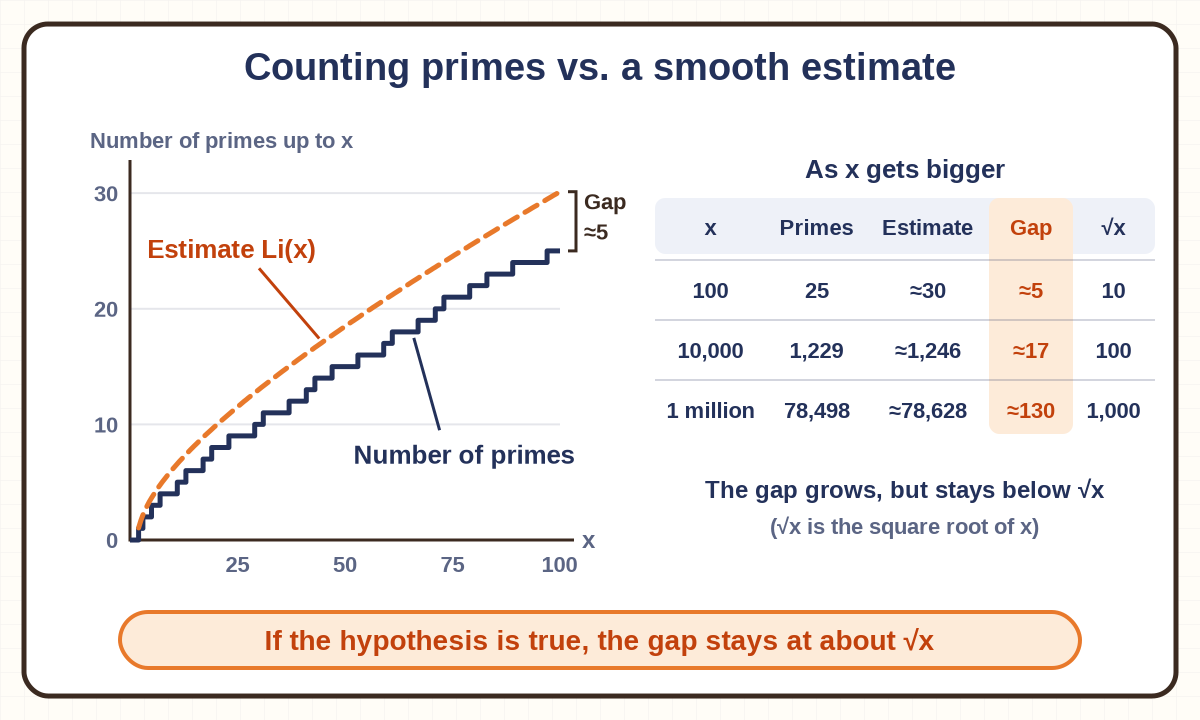
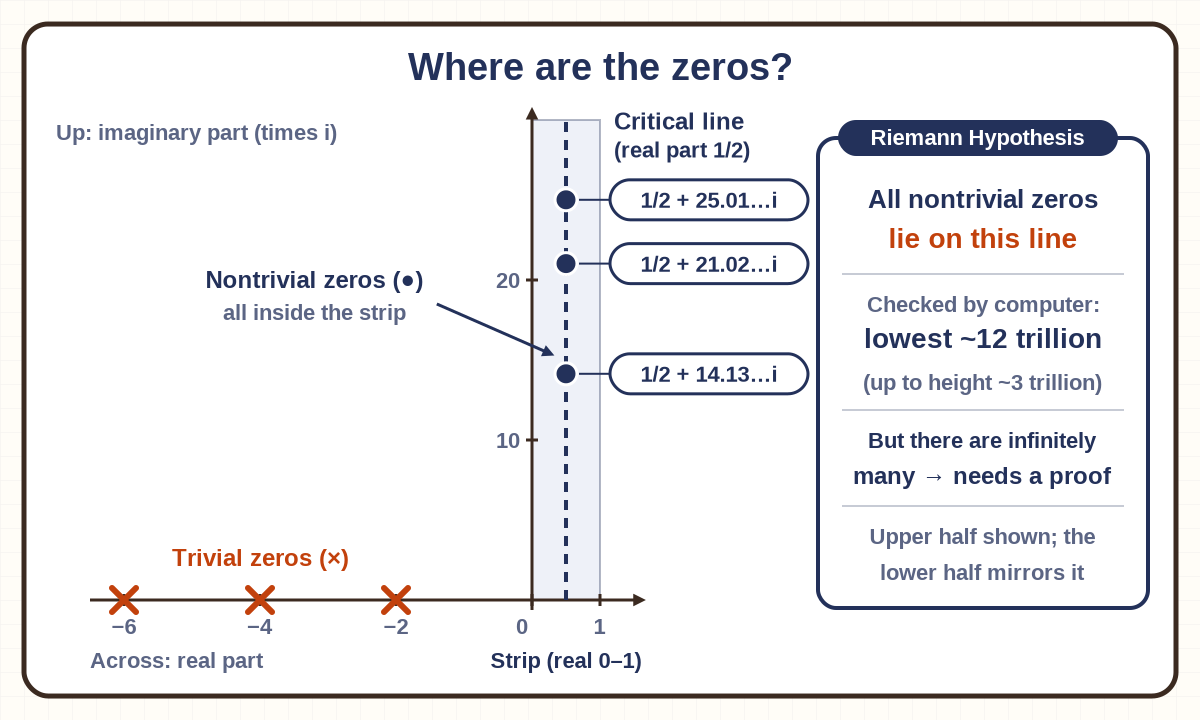
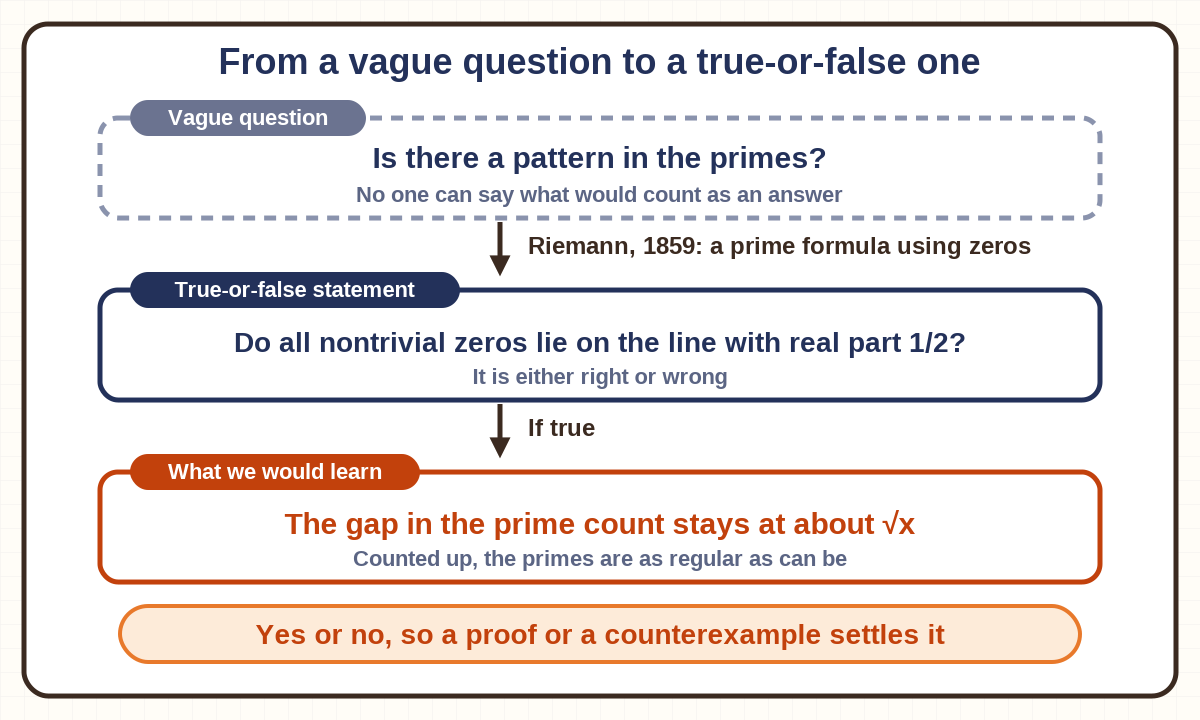
The zeta function is built from the sum 1 + 1/2^s + 1/3^s + …, and it can also be written as a product over the primes alone. Apart from the easy zeros at the negative even numbers (−2, −4, …, the trivial zeros), the zeros are numbers shown as points on a plane (complex numbers), and the hypothesis says they all lie on the vertical line whose across-position (real part) is 1/2. This arrangement decides how far the number of primes up to x strays from a smooth estimate; if the hypothesis is true, that gap stays at roughly the size of the square root of x. In other words, counted up, the primes are spread out as regularly as they possibly could be (the spacing between one prime and the next stays irregular).
Left unproved for a long time after Riemann wrote it down in 1859, it has been counted among the most famous unsolved problems in mathematics, and the Clay Mathematics Institute offers a $1 million prize for it.
A common mix-up
“The Riemann Hypothesis is about finding a formula that produces prime numbers”
It is right that the hypothesis is deeply tied to primes. But it is not a hunt for a formula. In his 1859 paper, Riemann had already built a formula for how many primes there are below a number x. That formula contains the zeros of the zeta function (the places where its value is 0), one by one. What the Riemann Hypothesis asks is where those zeros are. If all the nontrivial zeros lie on the line with real part 1/2, then the number of primes strays from Gauss’s smooth estimate Li(x) by only about the square root of x. So the hypothesis is not about a formula that makes primes one at a time; it is about how accurate the estimate of the prime count is. Riemann himself wrote that the hypothesis was “very probable”, but set the proof aside after a few unsuccessful attempts, since he did not need it for his goal.
Explained in pictures
Free to use in lessons, slides and posts with credit (CC BY 4.0).
Free to use in lessons, slides and posts with credit (CC BY 4.0).
Free to use in lessons, slides and posts with credit (CC BY 4.0).
Free to use in lessons, slides and posts with credit (CC BY 4.0).
You’re free to use these figures in lessons, slides and posts if you credit Naru News (naru.news). CC BY 4.0.
Think of it like this
How far the number of heads strays when you toss a coin
Toss a fair coin 10,000 times and you get heads about 5,000 times. But it almost never comes out at exactly 5,000. About 19 times out of 20, the gap is within 100 (the square root of 10,000). Toss it a million times and the gap is up to about 1,000 (the square root of a million). A gap about the size of the square root of the number of tosses is a “wobble” that even a fair coin cannot avoid.
Now apply this wobble to how far the count of primes strays from the smooth estimate. The Riemann Hypothesis says that “the gap in the prime count also stays at about the square root of x”. In other words, the primes stray from the estimate by no more than a fair coin wobbles. If there were even one zero with real part greater than 1/2, the gap would grow much bigger than that, like a lopsided coin that keeps landing heads.
But the analogy breaks down in places. A coin is decided by chance each time you toss it, but the primes, 2, 3, 5, 7, …, are fixed from the start; they are not random. Also, the upper limit on the gap that the Riemann Hypothesis gives is the square root times log x, which grows very slowly, so it is not exactly the same as the rule of thumb for a coin’s wobble.
Key points
What is the zeta function, and how is it tied to primes?
The zeta function adds up “1 ÷ (that number to the power s)” for every whole number 1, 2, 3, 4, …, as in 1 + 1/2^s + 1/3^s + 1/4^s + …. For example, if s is 2, it is 1 + 1/4 + 1/9 + 1/16 + …. When s (its real part) is greater than 1, this sum settles on a definite value.
This sum can be rewritten as a product that uses only primes. Multiply together “1 ÷ (1 − 1/p^s)” for every prime p, 2, 3, 5, 7, …, and you get exactly the same thing (this is called the Euler product). It works because every whole number splits into a product of primes in only one way (like 12 = 2 × 2 × 3). This link was discovered by Euler. A sum over all whole numbers became tied to the primes.
In his 1859 paper, Riemann extended this function to the whole plane so that s could be a complex number (explained in the next part); only at s = 1 does the value shoot off to infinity. He stretched it smoothly into places where the sum itself makes no sense. Then he used the function to build a formula for the number of primes below a number x.
What is the difference between “trivial” and “nontrivial” zeros?
A zero is a value of s where the zeta function is 0. Here s is a complex number. A complex number is written like 3 + 2i, using a number i whose square is −1, and it can be shown as a point on a plane: across is the ordinary-number part (the real part), and up is how many times i (the imaginary part).
The zeta function is 0 at the negative even numbers −2, −4, −6, …. This follows right away from the form of the function, so these are called the “trivial” (obvious) zeros. All the other zeros are the “nontrivial” zeros, and they are known to lie in a narrow strip where the real part is between 0 and 1.
The Riemann Hypothesis says that all the nontrivial zeros lie exactly down the middle of this strip, on the vertical line where the real part is 1/2 (called the critical line). From the bottom, they really do turn up on the line: 1/2 + 14.134…i, 1/2 + 21.022…i, 1/2 + 25.010…i. Because the number of roots found on the line roughly matched his estimate of the total number, Riemann wrote in his paper that it was “very probable” that all of them lie on the line (in his wording, that “all roots are real”).
Why does the arrangement of the zeros matter for counting primes?
The number of primes up to x goes up one at a time, like a staircase, as x grows. Up to 10 there are four, 2, 3, 5 and 7; up to 100 there are 25. When he was young, Gauss noticed that this count is well estimated by a smoothly rising function called Li(x) (the logarithmic integral).
Riemann wrote the number of primes as a smooth part plus a wave-like sum, with one term coming from each nontrivial zero of the zeta function. Each zero makes one wave that swings up and down, and all the waves added together make the jaggedness of the staircase (the way it strays above and below the smooth line). The farther a zero sits to the right of the line, the bigger its wave grows as x grows. The gap also includes a smooth correction, because Li(x) always comes out a little too large; but as x gets larger, it is the waves from the zeros that decide how big the gap is.
The Riemann Hypothesis being true is the same as “the gap between the number of primes and Li(x) stays at about the square root of x times log x” (log x is a very slow number that grows by only about 2.3 each time x gets ten times bigger). What’s more, as Littlewood showed, the gap does not stay below the size of the square root (apart from slowly changing factors). So if the hypothesis is true, the prime count is as close to the estimate as it could possibly be; in other words, the primes are spread out as regularly as they could be. On the other hand, if it fails, the gap would be bigger, and the arrangement of the primes would be thrown into disorder.
For example, when x is a million, there are 78,498 primes, Li(x) is about 78,628, and the gap is about 130. The square root of a million is 1,000, so the gap stays below the square root (at this size, most of the gap is the smooth correction).
How far has it been checked?
The work of computing zeros and checking that they lie on the line goes back to Riemann himself. Calculations of the first few zeros have been found in the notes he left behind. Later, computers confirmed that the first 1.5 billion zeros lie on the line.
A 2020 paper (Platt and Trudgian) rigorously confirmed, with the calculation errors accounted for, that the lowest 12,363,153,437,138 nontrivial zeros (about 12 trillion), that is, every zero up to a height (imaginary part) of 3,000,175,332,800 (about 3 trillion), lie on the line with real part 1/2.
It has also been proved that more than 40% of the nontrivial zeros lie on the line. But there are infinitely many zeros, so no amount of computing can check them all. To say it for every zero, you need a proof.
Why does it matter? Is there really a prize?
Many mathematicians think it is probably the most important open problem in pure mathematics today. The zeta function is the model for a large family of similar functions called L-functions, and there are hypotheses of the same form for them too (such as the Generalized Riemann Hypothesis). Many results have been derived by assuming the hypothesis is true; for example, Miller’s method, a fixed procedure for quickly checking whether a number is prime, assumes the Generalized Riemann Hypothesis.
The Riemann Hypothesis is also among the 23 problems Hilbert listed in Paris in 1900. On May 24, 2000, the Clay Mathematics Institute announced seven “Millennium Prize Problems” and set aside $1 million for each (7 million dollars in all). The Riemann Hypothesis is one of them.
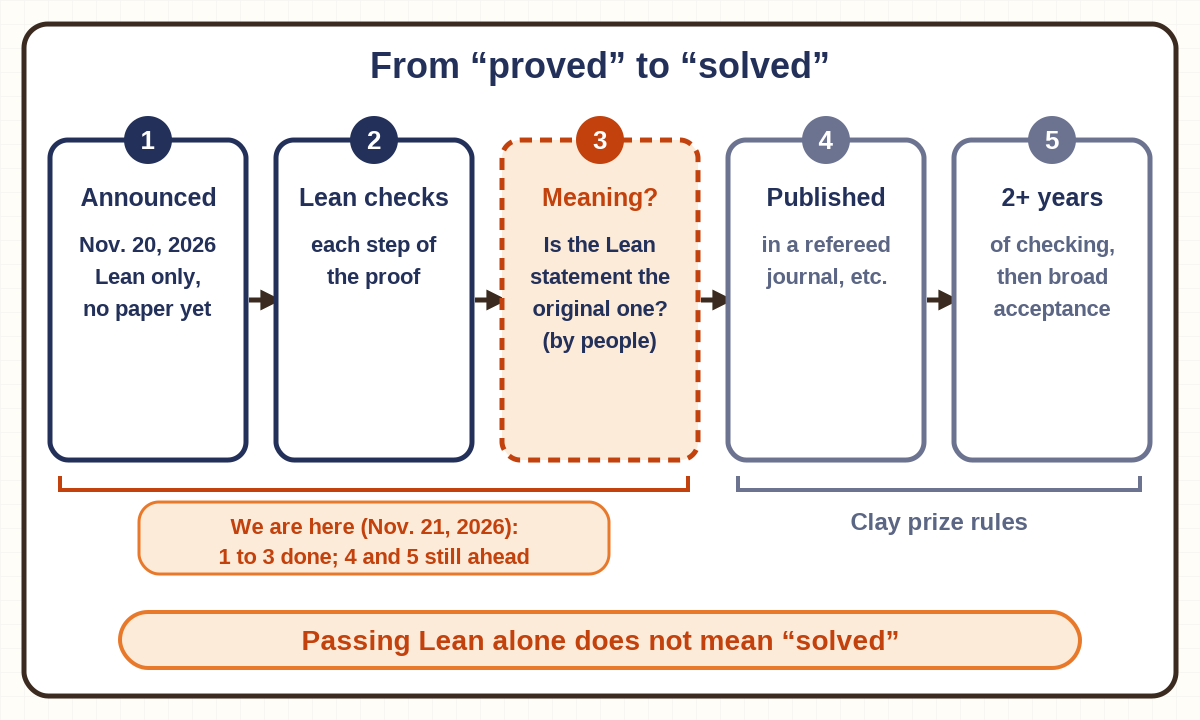
The prize has rules. The solution must be published in a refereed mathematics journal or similar, at least two years must pass after publication, and during that time it must survive rigorous checking by mathematicians around the world and be broadly accepted, among other conditions. Just announcing a proof does not make it eligible right away.
Has it been proved? (the November 2026 announcements)
On November 20, 2026, Levent Alpöge, a mathematician working at the AI company Anthropic, posted a note on his website saying he believes that, working with the AI Claude, he has found a proof of the Riemann Hypothesis and of the broader Generalized Riemann Hypothesis. He says the proof has been fully written in Lean (software in which a machine checks proofs), without assumptions. What he released is only the Lean proof; there is no paper for people to read yet. He writes that the current argument is very long and that writing it properly for people is still ahead (a trial document, far too long for anyone to read, passed 250,000 pages, he says).
The next day, November 21, the two groups behind Lean and its shared library of mathematics, Mathlib (the Lean FRO and the Mathlib Initiative), said in a joint statement that they have “full confidence” that the proof is correct, and certified that both the statement and the proof of the Riemann Hypothesis are correct. The proof is about 17 million lines of Lean code and depends directly only on Mathlib. Dozens of people have reported building it and getting the same result. Two tools confirmed that the statement it proves is exactly the statement of the Riemann Hypothesis in Mathlib (one carefully vetted by experts in Lean and number theory), and the proof was run through several differently built checkers (two of which come with a proof that they cannot accept a false proof). This statement covers the Riemann Hypothesis; it does not mention the Generalized Riemann Hypothesis.
On the same day, November 20, the mathematician Ravi Vakil posted on his blog a draft proof of the Generalized Riemann Hypothesis that Alessandro Masullo wrote entirely without AI (the mathematician Brian Conrad had been reading it for months). About eight hours later, however, Vakil added that several people had told him of problems in the proof, found with the help of various AI models. He says the proof will not be accepted as true until all the issues are resolved to the satisfaction of the community.
If the proof passes Lean (and no extra assumptions were slipped in), a machine has checked that its steps contain no errors. But whether the statement written in Lean means the same as the original Riemann Hypothesis has to be checked separately (the same pitfall as in “autoformalization”: when an AI or a person translates a problem into a proof language, the machine does not notice if the meaning shifts slightly). This time, the statement proved turned out to be the same as Mathlib’s expert-vetted one, and the two groups certified the statement as correct, so this step has been done too. On the other hand, there is still no paper that lets people read and understand why the proof works, and mathematicians have yet to take in its new ideas. The Clay prize rules require publication in a refereed journal or similar, at least two years of checking, and broad acceptance, so the prize is still some way off. On the Clay Mathematics Institute’s list of problems, by November 24 the Riemann Hypothesis had moved from “Unsolved” to “Active” (not to “Solved”).
Check yourself
Q1What does the “Riemann Hypothesis”, written by Riemann in 1859, predict?
Answer and explanation
Answer: C The nontrivial zeros lie on one straight line
The Riemann Hypothesis says that all the nontrivial zeros of the zeta function (the places where its value is 0) lie on one straight line, the line with real part 1/2. It is not a search for a formula that produces primes; it is about how accurate the estimate of the number of primes is. Also, the zeros at the negative even numbers −2, −4, … are the “trivial zeros”, and there are infinitely many other zeros in the strip.
Q2If the Riemann Hypothesis is true, what can be said about the difference between the number of primes up to x and the smooth estimate Li(x)?
Answer and explanation
Answer: B It stays about the size of the square root of x
The Riemann Hypothesis being true is the same as the difference staying at about the size of the square root of x (more exactly, the square root times log x, which grows slowly). The difference neither shrinks toward 0 nor stays fixed. It grows, about 5 at x = 100 and about 130 at a million, but it stays below the square root (1,000 for a million).
More on this → Key points: Why does the arrangement of the zeros matter for counting primes?
Q3In November 2026, a mathematician released a proof of the Riemann Hypothesis, said to have been found with an AI, in the form of Lean (software in which a machine checks proofs). After it passes Lean, which of these do people need to look at?
Answer and explanation
Answer: A Whether the Lean statement means the original
Lean checks that each step of a proof follows the rules, so that part can be left to the machine. But it does not check whether the statement written in Lean means the same as the original Riemann Hypothesis, so people need to look at that. That the first few zeros lie on the line has been known by computation since Riemann’s own notes, and about 12 trillion zeros have now been checked.
More on this → Key points: Has it been proved? (the November 2026 announcements)
Related terms
Sources and how we checked
- Bernhard Riemann, “On the Number of Prime Numbers less than a Given Quantity” (Monatsberichte der Berliner Akademie, November 1859; English translation by David R. Wilkins, preliminary version of 1998, on the Clay Mathematics Institute site; the start from Euler’s product, the count of roots of ξ(t) and “it is very probable that all roots are real”, the wish for a stricter proof set aside after “some fleeting futile attempts”, the formula for the number of primes below x, and the comparison with Li(x); read November 21, 2026)
- E. Bombieri, “Problems of the Millennium: the Riemann Hypothesis” (the Clay Mathematics Institute’s official problem description; Section I on the definition of the zeta function, the pole at s = 1, the trivial zeros −2, −4, …, the statement that the nontrivial zeros have real part 1/2, and the view of many mathematicians that it is the most important open problem in pure mathematics; Section II on the Euler product in Euler’s 1748 book, Gauss’s Li(x) [the integral from 0], Riemann expressing the prime count through the zeros, the equivalence with π(x) = Li(x) + O(√x log x), Littlewood’s result, the “havoc” if the hypothesis failed, L-functions and Miller’s primality test; Section III on the zeros in Riemann’s Nachlass, the first 1.5 billion zeros and the more than 40% on the line. The prime counts and Li(x) values in the figure for x = 100, 10,000 and 1,000,000 were computed for this page; read November 21, 2026)
- Dave Platt and Tim Trudgian, “The Riemann hypothesis is true up to 3·10^12” (arXiv, April 2020; abstract and Theorem 1 on the lowest 12,363,153,437,138 nontrivial zeros up to height 3,000,175,332,800, verified rigorously with interval arithmetic, and Section 1 on the nontrivial zeros lying in the strip 0 < real part < 1; read November 21, 2026)
- LMFDB (the L-functions and Modular Forms Database), “Zeros of ζ(s)” (the heights 14.1347…, 21.0220… and 25.0108… of the first three nontrivial zeros; viewed November 21, 2026)
- Clay Mathematics Institute, “Millennium Prize Problems” and “Riemann Hypothesis” (the announcement in Paris on May 24, 2000, the $7 million prize fund with $1 million for each problem, the Riemann hypothesis also being on Hilbert’s 1900 list of 23 problems, and the hypothesis describing the deviation of the primes from the average; the Riemann hypothesis listed under “Active” on November 24; read November 21 and 24, 2026)
- Clay Mathematics Institute, “Millennium Prize Description and Rules” (Section 4 on publication in a Qualifying Outlet, at least two years since publication and general acceptance in the global mathematics community, and Sections 6 and 7 on the outlets and the minimum two years of rigorous examination; read November 21, 2026)
- Levent Alpöge’s remark (four pages on his website: his belief that, working with Claude, he found a proof of the Riemann Hypothesis, its extension to the Generalized Riemann Hypothesis, the formalization in Lean without assumptions, the decision to present only Lean, the argument being very long and still to be written properly, and the detailed document passing 250,000 pages; read November 21, 2026. His work at Anthropic was checked on his home page, https://alpo.ge/, and the date, November 20, 2026, in Scientific American’s article of that day)
- Ravi Vakil, “Hurried Announcement: Alessandro Masullo GRH” (his blog, November 20, 2026, as updated on November 22: posting Masullo’s draft proof of the Generalized Riemann Hypothesis, the work being all human with no AI, and Brian Conrad’s months of checking; in an update about eight hours after posting, several people reporting problems in the proof identified with the assistance of different AI models, and the proof not being accepted as true until all issues are resolved to the satisfaction of the community; read November 24, 2026)
- Lean FRO and Mathlib Initiative, “Lean verification of the Riemann Hypothesis” (Lean community blog, joint statement of November 21, 2026: Alpöge’s proof as a Lean library of 17 million lines, depending directly only on Mathlib; dozens of people reporting correct compilation; two tools, comparator and con-leche, confirming that the theorem proved is exactly Mathlib’s statement of the Riemann Hypothesis, which has been carefully vetted by experts in Lean and number theory; checking by Lean’s kernel and the con-leche and con-ron checkers, which come with a formal proof relative to set theory that they cannot accept a false proof, among others; “We have full confidence that Alpöge’s proof of the Riemann Hypothesis is correct” and the certification that both the statement and the proof are correct; read November 24, 2026)
- Scientific American, “The AI Riemann hypothesis proof is true, independent mathematicians confirm” (November 20, 2026, updated November 21: Andrew Sutherland of MIT on the proof being independently rechecked by the Lean kernel with only the three standard axioms and “the chance that anything is fishy here is approximately zero”, and the comparator run having been completed; read November 24, 2026)
- Scientific American, “Anthropic mathematician claims to prove Riemann hypothesis, most famous problem in all of math” (November 20, 2026: the date of the announcement and Alpöge being a mathematician working at Anthropic; read November 21, 2026)
AI wrote this page from the sources above, and a different AI checked it against the text of those sources (November 24, 2026). A person with a master’s degree in science and a Japanese high-school science teaching license also read and checked it before publishing. Numbers are as of that date. If anything was hard to follow, you spot a mistake, or there’s a term you’d like explained, please write to [email protected].
Glossary
- AI agent
- AI alignment
- Alignment faking
- Artificial general intelligence (AGI)
- Artificial intelligence (AI)
- Backdoor
- Benchmark
- Chain of thought (CoT)
- Context window
- Data poisoning
- Deep learning
- Deepfake
- Diffusion model
- Embedding
- Emergent misalignment
- Evaluation awareness
- Fine-tuning
- Formal verification
- Generalization
- Generative adversarial network (GAN)
- Generative AI
- Goodhart’s law
- Gradual disempowerment
- Hallucination
- Hyperparameter
- Intelligence explosion
- Interpretability
- Jailbreaking
- Large language model (LLM)
- Latent space
- Machine learning
- Mixture of experts (MoE)
- Neural network
- Neuralese
- Overfitting
- Parameter
- Persona vectors
- Pre-training
- Prompt
- Prompt injection
- Reasoning model
- Recursive language model (RLM)
- Recursive self-improvement (RSI)
- Red teaming
- Reinforcement learning (RL)
- Retrieval-augmented generation (RAG)
- Reward hacking
- Reward model
- Shutdown resistance
- Sleeper agent
- Subliminal learning
- Superintelligence (ASI)
- System prompt
- Technological singularity
- Time horizon
- Token
- Transfer learning
- Transformer
- Accretion disk
- Black hole
- Black hole star
- Cosmic birefringence
- Event horizon
- Event Horizon Telescope (EHT)
- General relativity
- GPS
- Gravitational lensing
- Gravitational singularity
- Gravitational wave
- James Webb Space Telescope (JWST)
- Lagrange point
- Long-period radio transient (LPT)
- Neutron star
- Pulsar
- Quasar
- Sagittarius A*
- Space data center
- Spacetime
- Special relativity
- Speed of light
- Supermassive black hole
- White dwarf
- Autoformalization
- Formal proof
- Four color theorem
- Generalized Riemann Hypothesis (GRH)
- Lean
- Millennium Prize Problems
- Prime number
- You are hereRiemann Hypothesis
- VP ≠ VNP conjecture
- Zeta function