
Home › Glossary › Everyday science
What is an atomic clock (a clock that keeps time with atoms and defines the length of a second)?
Also called: Atomic frequency standard

In one minute
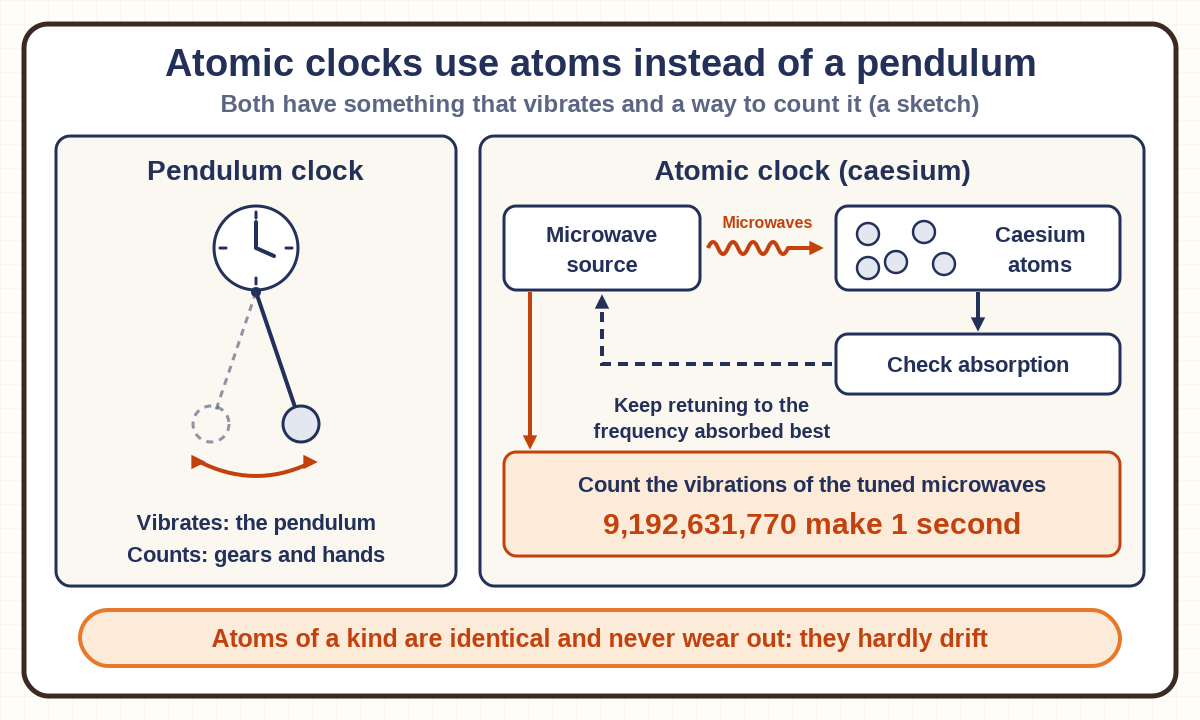
An atomic clock is an extremely precise clock that uses the fact that atoms absorb well only electromagnetic waves of a set frequency (number of vibrations per second), and keeps time by counting the vibrations of those waves.
Just as a pendulum clock counts the swings of its pendulum, an atomic clock tunes electromagnetic waves to the frequency its atoms absorb best and counts their vibrations. All atoms of the same kind are exactly alike and never wear out, so the clock hardly drifts. Since 1967, one second has been defined as the time it takes the waves absorbed by caesium-133 atoms to vibrate 9,192,631,770 times.
Now there are “optical clocks” (such as optical lattice clocks) that use light, which vibrates far faster, and work is under way to redefine the second using light (which atoms to use and other details are not decided yet). Atomic clocks underpin Japan Standard Time, radio-controlled clocks and GPS, and can even measure how height changes the flow of time.
A common mix-up
“A radio-controlled clock has an atomic clock inside.”
Half right. It is true that if you trace a radio-controlled clock’s time back to its source, you reach atomic clocks. In Japan, the National Institute of Information and Communications Technology (NICT) makes Japan Standard Time by comparing many atomic clocks, and sends that time out on standard radio signals from two transmitting stations, one in Fukushima Prefecture and one on the border of Saga and Fukuoka Prefectures. Radio-controlled clocks pick up these signals to set their time. But what is inside a radio-controlled clock is not an atomic clock: it is a radio receiver and a quartz clock. A radio-controlled clock does not listen to the signal all day long. It may, for example, pick it up once a day late at night, when reception is good, to set its time, and in between, the quartz clock keeps time. In the United States, radio-controlled clocks are sometimes sold as “atomic clocks,” but there is no atomic clock inside.
Explained in pictures
Free to use in lessons, slides and posts with credit (CC BY 4.0).
Free to use in lessons, slides and posts with credit (CC BY 4.0).
Free to use in lessons, slides and posts with credit (CC BY 4.0).
Free to use in lessons, slides and posts with credit (CC BY 4.0).
You’re free to use these figures in lessons, slides and posts if you credit Naru News (naru.news). CC BY 4.0.
Think of it like this
Counting a sound tuned to a tuning fork
A tuning fork is a tool that rings at one set pitch. If you play a sound of the same pitch nearby, the fork starts ringing even though nobody struck it. This is called resonance, and if the pitch is even slightly off, the fork hardly rings at all. So you change the pitch of a speaker little by little, find the pitch at which the fork rings most strongly, and hold the speaker there. Then you just count how many times the speaker’s sound vibrates, and you have a clock.
In terms of an atomic clock, the tuning fork is the atoms, and the speaker’s sound is the electromagnetic wave shone on them. Atoms absorb well only electromagnetic waves of exactly the right frequency. An atomic clock keeps rechecking the frequency of the wave, holds it at the frequency the atoms absorb best, and counts its vibrations. For caesium atoms, 9,192,631,770 vibrations make one second. Atoms of the same kind are the same “tuning fork” anywhere in the world and, as far as we know, do not change over the years. So atomic clocks built anywhere can tick off the same second.
But the comparison has limits. Atoms make no sound when they absorb a wave, so laser light is shone on them to make only the atoms whose state the wave changed give off light, and the amount of that light is measured. Also, each individual atomic clock ticks at a slightly different rate depending on the temperature around it, Earth’s magnetic field and so on. That is why clocks are kept in special rooms with controlled temperature and the like, and many atomic clocks are compared with one another.
Key points
How does an atomic clock keep time?
Every clock is made of something that swings or vibrates at a steady rate and a mechanism that counts those vibrations. In a grandfather clock it is the pendulum, and in a wristwatch or laptop it is a small piece of quartz crystal; gears or electronic circuits count the vibrations. An atomic clock uses atoms in place of the thing that vibrates.
Atoms absorb well only electromagnetic waves (light and its relatives, such as radio waves) of a set frequency. A caesium atomic clock shines microwaves (one kind of electromagnetic wave) on the atoms and changes their frequency little by little, searching for the frequency the atoms absorb best. The closer the frequency is to the atoms’ own, the more atoms absorb it and change their inner state (their energy state), so the clock checks this and keeps adjusting. When the microwaves tuned this way have vibrated 9,192,631,770 times, one second has passed.
In the “fountain” atomic clocks of the US National Institute of Standards and Technology (NIST), laser light cools the caesium atoms and slows them down, and a ball of atoms is tossed upward. The ball falls back down through a chamber filled with microwaves. Finally, laser light is shone on the atoms, and only the atoms whose state the microwaves changed give off light, so the amount of that light is used to tune the microwave frequency.
Atoms suit clocks because all atoms of the same kind are exactly alike, with none of the variation of manufactured parts, and they never wear out or slow down over time. The first caesium atomic clock stable enough to be used as a time standard was built in 1955 by Louis Essen at the National Physical Laboratory (NPL) in the UK.
How is the length of a second decided?
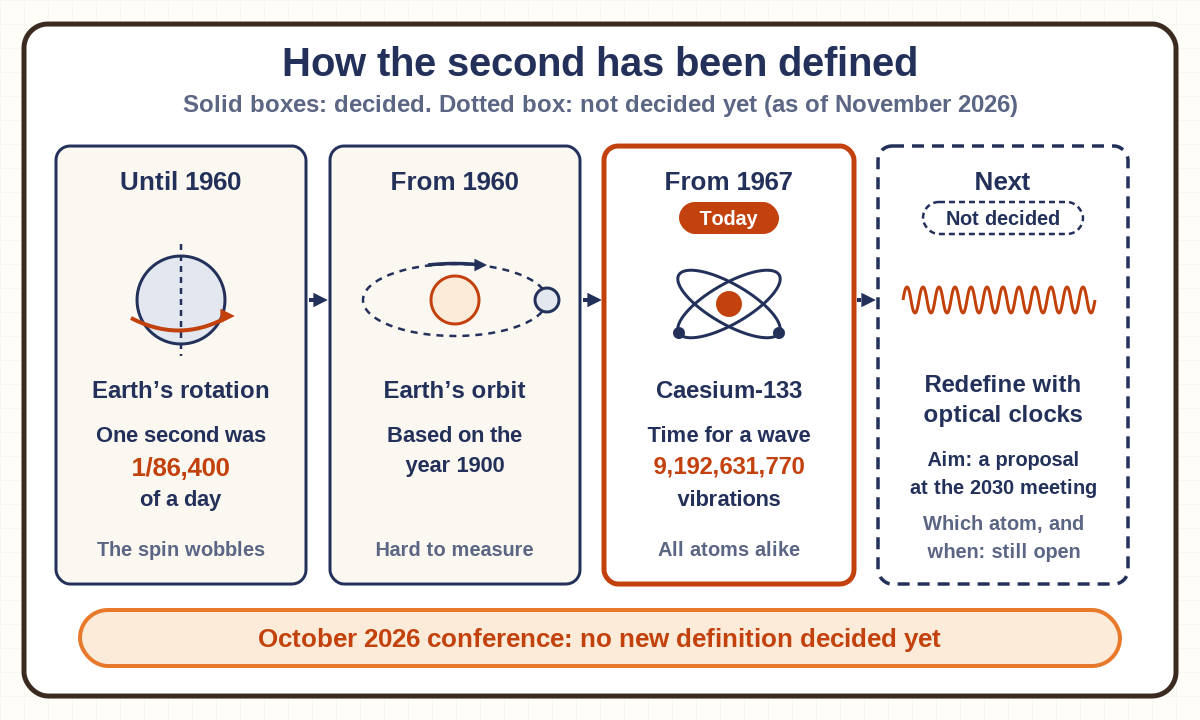
Until 1960, one second was 1/86,400 of the average length of a day, since a day is 24 hours × 60 minutes × 60 seconds, or 86,400 seconds. But it turned out that Earth’s rotation speeds up and slows down, so the length of a day wobbles. So from 1960, the second was based on the length of the year in which Earth goes around the Sun (the year 1900), but the year was hard to measure.
In 1967, the international conference that decides units such as those for length and time (the General Conference on Weights and Measures) decided to define the second using atoms. Today’s definition is: one second is the time it takes a particular electromagnetic wave absorbed (or given off) by caesium-133 atoms to vibrate 9,192,631,770 times. Since 2019, with the same length, it has been worded as fixing this caesium frequency at “exactly 9,192,631,770 hertz (9,192,631,770 vibrations per second).”
The meter is also based on this second. One meter is the distance light travels in a vacuum in 1/299,792,458 of a second. So length, too, is defined from time, which can be measured extremely accurately.
Time kept by atomic clocks slowly drifts away from time set by Earth’s rotation. So, from 1972, the world’s time standard (Coordinated Universal Time, UTC) has been kept within 0.9 seconds of it by now and then adding one second, a “leap second” (27 times through 2017). But inserting a second partway through creates a break in time. So in 2022 it was decided to rethink this, and in October 2026 it was decided that from May 20, 2027, UTC will run without breaks, and the gap with Earth’s rotation will be allowed to grow to as much as one hour.
How little does an atomic clock drift?
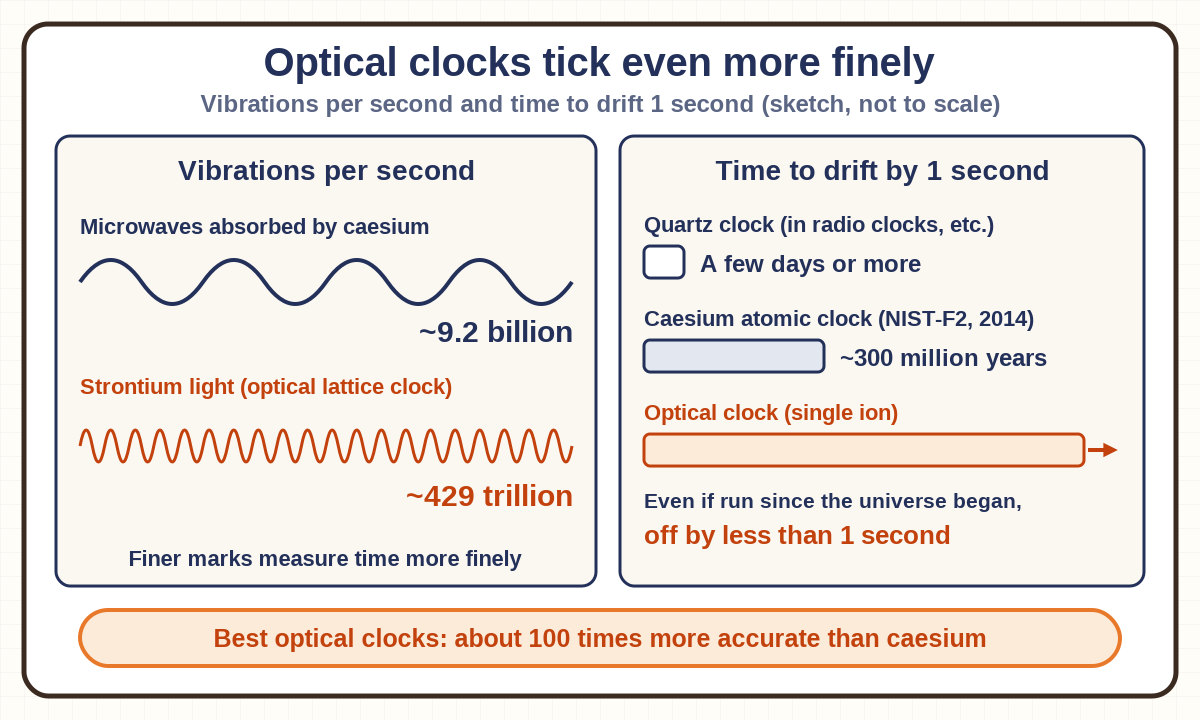
The quartz clock inside a radio-controlled clock and the like can keep within one second for a few days or somewhat longer. In contrast, the caesium atomic clock that the US National Institute of Standards and Technology made a new time standard in 2014 (NIST-F2) was announced at the time to be so accurate that it would not drift by one second in about 300 million years. The caesium and rubidium atomic clocks carried by GPS satellites are also said to drift by less than one second in 300,000 years.
“Optical clocks,” which use light, are even more accurate. The best are about 100 times more accurate than caesium atomic clocks. Some optical clocks that hold a single ion (an atom with an electric charge) are so accurate that, if one had started ticking when the universe began, it would be off by less than one second.
Even so, each individual atomic clock ticks at a slightly different rate depending on the temperature around it, Earth’s magnetic field and so on. So the National Institute of Information and Communications Technology (NICT), which makes Japan Standard Time, keeps its atomic clocks in special rooms with controlled temperature and humidity, shielded from electric and magnetic effects. It compares the times of 18 or more caesium atomic clocks and 4 hydrogen masers (another kind of atomic clock) every second and averages them once an hour to make its time.
How are optical clocks, such as optical lattice clocks, different?
They vibrate vastly more times per second. The microwaves used by a caesium atomic clock vibrate about 9.2 billion times a second. The light used by an optical clock with strontium atoms, for example, vibrates about 429 trillion times a second. Just as a ruler with finer marks measures length more finely, the more finely a clock divides the second, the more finely and accurately it measures time.
The optical lattice clock is an optical clock that Hidetoshi Katori (then at the University of Tokyo) came up with in 2001 and showed working in 2003. Laser beams are overlapped to make a lattice of peaks and valleys (an optical lattice), atoms are trapped in it, and the frequency of light the atoms absorb is used as the reference. Its strength is that it can tune to the vibrations of thousands of atoms at once.
Light vibrates too fast for electronic circuits to count directly. So a device called an optical frequency comb, a kind of ruler for light, is used to convert the vibrations of light into microwave vibrations that electronic circuits can read. “Comb” refers to the teeth of a comb: it gives off light at many frequencies lined up at equal spacing, like a comb’s teeth, and uses them like the marks on a ruler to bring the frequency of light down to a size that can be counted.
As of 2019, three research teams around the world had built optical lattice clocks with “18-digit” accuracy, ticking off by only about one part in a billion billion (10 to the 18th power). In Japan, NICT’s strontium optical lattice clock was recognized by the International Bureau of Weights and Measures (BIPM) in 2018 as one of the references for the second that back up the caesium definition (a secondary frequency standard), and since 2021 it has also been used in making Japan Standard Time.
Will the definition of the second switch to optical clocks?
Preparations are under way, but nothing has been decided yet. The best optical clocks now beat the accuracy achievable with today’s caesium definition by as much as about 100 times. So the 2022 General Conference on Weights and Measures set out a path: bring proposals on which atom to use to the 2026 conference, and aim to decide on a new definition at the 2030 conference.
There are two options for the definition. One is to fix the frequency of light absorbed by one kind of atom and use it in place of caesium. The other is to fix a weighted average of the light frequencies of several kinds of atoms (an average in which each atom counts more or less, depending on things such as how reliable it is).
At the October 2026 conference, no new definition was decided. Reasons given included that, despite continued debate, there was still no agreement on whether to use one kind of atom or several, or on which atoms to choose, and that some comparisons between optical clocks did not agree. With that, it was decided to keep preparing so that a proposal for the new definition, and for when it would take effect, can be presented at the 2030 conference.
In short, what is decided is that today’s second keeps the caesium definition from 1967, and that preparations continue toward presenting a proposal at the 2030 conference. What is not decided yet is which atoms to use, whether one kind or several, when the change would take effect, and whether the second will really be redefined in 2030. One requirement for the new definition is that it connect smoothly with today’s caesium second, and caesium atomic clocks are expected to remain in use as one of the references for the second.
Where are atomic clocks used?
Japan Standard Time, Japan’s time standard, is made by the National Institute of Information and Communications Technology (NICT) in Koganei, Tokyo, by comparing many atomic clocks. The time it makes is adjusted with the aim of staying within 10 billionths of a second (10 nanoseconds) of the world’s time standard (Coordinated Universal Time), and Japan Standard Time is that time set 9 hours ahead. In 2018, in case of disasters, a sub-station that can stand in for the headquarters in an emergency was also set up in Kobe. Times from atomic clocks in countries around the world are gathered at the International Bureau of Weights and Measures (BIPM) to set the world’s time standard.
Japan Standard Time is sent across Japan by standard radio signals (JJY), from two transmitting stations: Mount Otakadoya in Fukushima Prefecture (40 kilohertz) and Mount Hagane on the border of Saga and Fukuoka Prefectures (60 kilohertz). Radio-controlled clocks pick up these signals to set their time. Computers and the like can also set their time over the internet from NICT’s time servers (NTP).
GPS satellites carry caesium and rubidium atomic clocks and send out their time by radio. A receiver finds its position from its distance to each satellite, worked out from how long each signal took to arrive, so a timing error of just a millionth of a second shifts the distance by about 300 m. The satellite clocks run faster than clocks on the ground by about 38 microseconds (38 millionths of a second) a day, so they are corrected in advance. This is explained in more detail on the GPS page.
Atomic clock time also underpins many other places that need precise time or frequency, such as mobile phones, the power grid and time stamps on financial transactions.
Can we measure how height changes the flow of time?
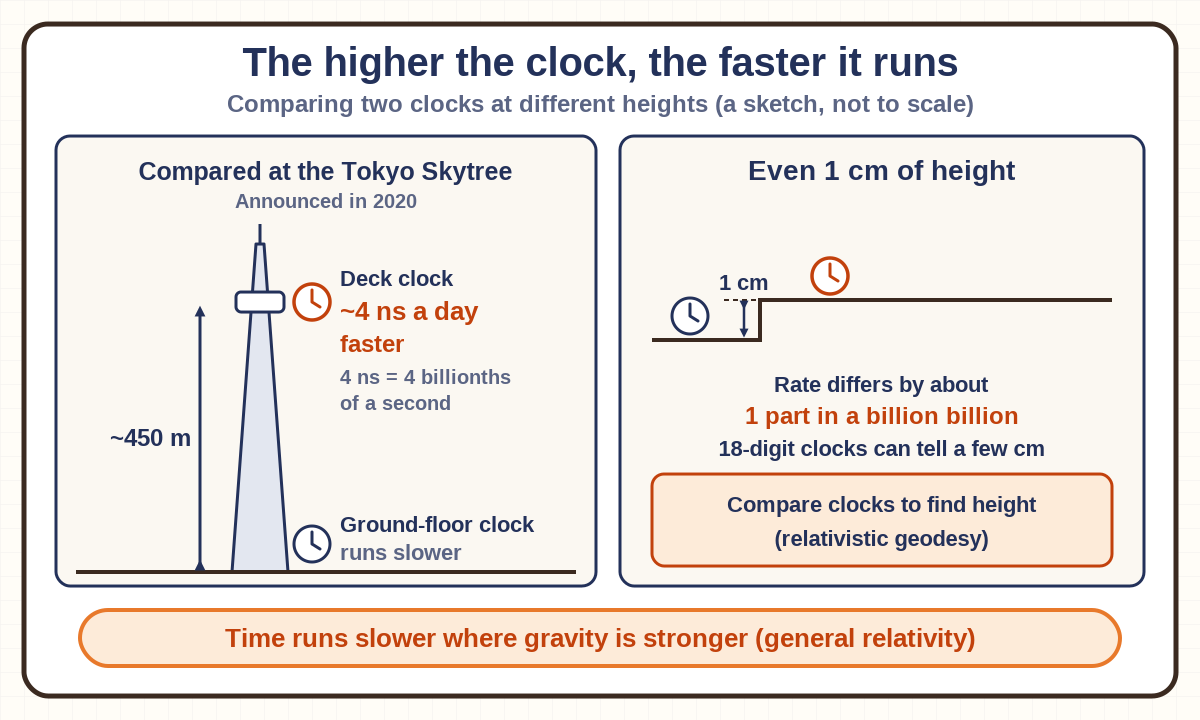
Yes. In general relativity, time passes more slowly where gravity is stronger. On the ground, it passes more slowly lower down and faster higher up. The difference is tiny, but precise atomic clocks can measure it. In 2010, in the United States, a difference in rate was measured just by raising one of two atomic clocks 33 cm above the other.
In 2020, results were announced from an experiment that placed an optical lattice clock on the ground floor of the Tokyo Skytree and another on its observation deck, about 450 m up, and compared them. The clock on the deck ran faster by about 4 nanoseconds (4 billionths of a second) a day, agreeing well with the prediction of general relativity. In 2022, in the United States, a difference in rate was even measured between the top and bottom of a single cloud of atoms, just 1 mm apart.
A 1 cm difference in height changes a clock’s rate by about one part in a billion billion. So a clock with “18-digit” accuracy can tell a height difference of a few centimeters from a difference in how fast it ticks. This has led to the idea of “relativistic geodesy,” measuring height differences by comparing clocks in two distant places, which is expected to help watch the ground rise and fall by a few centimeters because of plate motion or volcanic activity.
Check yourself
Q1A pendulum clock keeps time by counting how many times its pendulum goes back and forth. In the same way, what does an atomic clock using caesium atoms count?
Answer and explanation
Answer: A Vibrations of the waves the atoms absorb
Atoms absorb well only electromagnetic waves of a set frequency. A caesium atomic clock keeps the microwaves it shines on the atoms tuned to the frequency they absorb best, and counts 9,192,631,770 of their vibrations as one second. It does not use radiation given off by atoms, or the number of times atoms bump into each other.
More on this → Key points: How does an atomic clock keep time?
Q2At the October 2026 General Conference on Weights and Measures (the international conference that decides how units are defined), which of these rules about time was still not decided?
Answer and explanation
Answer: C Choosing the optical-clock atoms to redefine the second
At the October 2026 conference, there was no agreement on whether to redefine the second with the light of one kind of atom or several, or on which atoms to choose. What was decided was to keep preparing so that a proposal for the new definition, and for when it would take effect, can be presented at the 2030 conference. The same conference also decided that from May 20, 2027, Coordinated Universal Time will run without breaks.
More on this → Key points: Will the definition of the second switch to optical clocks?
Q3Very precise optical lattice clocks were placed, one each, on the ground floor of the Tokyo Skytree and on its observation deck about 450 m up, and their rates were compared. How did the two clocks run?
Answer and explanation
Answer: B The clock on the high deck ran faster
Time passes more slowly where gravity is stronger, so the clock on the lower ground floor runs more slowly and the clock on the higher observation deck runs faster. In results announced in 2020, the deck clock ran faster by about 4 nanoseconds (4 billionths of a second) a day, agreeing well with the prediction of general relativity. A clock with 18-digit accuracy can even tell a height difference of a few centimeters from a difference in rate.
More on this → Key points: Can we measure how height changes the flow of time?
Related terms
- GPS
- Speed of light
- General relativity
- Special relativity
- Spacetime
- Optical lattice clock
- Electromagnetic wave
- Coordinated Universal Time (UTC)
- Leap second
- Japan Standard Time
- Radio-controlled clock
- Optical frequency comb
Sources and how we checked
- International Bureau of Weights and Measures (BIPM), “SI base unit: second (s)” (today’s definition: the second defined by taking the fixed numerical value of the caesium frequency ΔνCs, the unperturbed ground-state hyperfine transition frequency of the caesium-133 atom, to be 9 192 631 770 when expressed in Hz [s⁻¹], the effect being that one second is the duration of 9 192 631 770 periods of the radiation corresponding to the transition between the two hyperfine levels of the unperturbed ground state of the caesium-133 atom; read November 23, 2026)
- International Bureau of Weights and Measures (BIPM), “Resolution 1 of the 13th CGPM (1967): SI unit of time (second)” (the definition of the second adopted in 1956 and ratified in 1960 being inadequate for the present needs of metrology, the CIPM recommending a caesium atomic frequency standard for temporary use in 1964 and that standard being found sufficiently accurate, the second defined as the duration of 9 192 631 770 periods of the radiation corresponding to the transition between the two hyperfine levels of the ground state of the caesium-133 atom, the 1997 clarification that this refers to a caesium atom at rest at 0 K, and the 26th CGPM abrogating this wording in 2018, effective in 2019; read November 23, 2026)
- International Bureau of Weights and Measures (BIPM), “The International System of Units (SI),” 9th edition (2019; Appendix 4, Part 3, “Historical perspective on the base units”: before 1960 the second being defined as 1/86 400 of the mean solar day, irregularities in Earth’s rotation making this unsatisfactory, the 11th CGPM (1960) adopting a definition based on the tropical year 1900, an atomic standard having been shown to be realizable much more accurately and the 13th CGPM (1967–1968) choosing a definition referenced to the caesium-133 hyperfine transition, the 26th CGPM (2018) adopting a revised, more precise wording of this same definition in terms of a fixed value of ΔνCs, and the metre being defined since 1983 by the distance light travels in vacuum in a specified time; read November 23, 2026)
- International Bureau of Weights and Measures (BIPM), “SI base unit: metre (m)” (today’s definition: the metre defined by fixing the speed of light in vacuum c at 299 792 458 m s⁻¹, the second being defined by the caesium frequency, the effect being that one metre is the length of the path travelled by light in vacuum during 1/299 792 458 of a second; read November 23, 2026)
- International Bureau of Weights and Measures (BIPM), “CGPM Resolution 5 (2022): On the future redefinition of the second” (optical frequency standards having come to surpass the accuracy of the realization of the current definition by up to a factor of 100, and the CIPM being encouraged to bring proposals to the 28th CGPM (2026) for the choice of the preferred species, or ensemble of species, and to propose further steps for a new definition to be adopted at the 29th CGPM (2030); read November 23, 2026)
- International Bureau of Weights and Measures (BIPM), “CGPM Resolution 4 (2026): On the future definition of the second” (28th CGPM, October 13–15, 2026: the best optical devices surpassing the accuracy achievable by the realization of the current definition by a factor of up to 100, a consensus not having been reached, despite active scientific debate, on the choice between a single species and an ensemble or on the preferred species, noticeable inconsistencies in some optical clock comparisons, some mandatory criteria such as the contribution of optical clocks to TAI calibration not yet being met, and the CIPM being requested to work towards a proposal for the new definition of the second to be presented at the 29th CGPM (2030), together with a proposal for the date of its implementation. The resolution neither adopts a new definition nor chooses a species; read November 23, 2026)
- International Bureau of Weights and Measures (BIPM), “Frequently Asked Questions concerning the Redefinition of the Second” (version 2.2, updated October 13, 2026: the two options, selecting a single optical atomic transition in place of ΔνCs and fixing its frequency, or creating a new defining constant from a weighted geometric average of the optical frequencies of several atomic transitions, continuity with the definition based on caesium as one of the criteria, caesium fountains becoming a secondary representation of the second and caesium remaining a secondary standard, and 2030 as the decisive milestone; read November 23, 2026)
- International Bureau of Weights and Measures (BIPM), “CGPM Resolution 4 (2022): On the use and future development of UTC” (a leap second being applied when UT1−UTC is predicted to approach 0.9 seconds, the consequent introduction of leap seconds creating discontinuities, the decision that the maximum value for UT1−UTC will be increased in, or before, 2035, and the aim of ensuring the continuity of UTC for at least a century; read November 23, 2026)
- International Bureau of Weights and Measures (BIPM), “CGPM Resolution 5 (2026): On the technical actions needed to ensure the continuity of UTC” (continuous UTC becoming effective on May 20, 2027, and the maximum value for |UT1−UTC| being 3 600 seconds [1 hour]; read November 23, 2026)
- NIST, “How Do Atomic Clocks Work?” (US National Institute of Standards and Technology, updated August 21, 2026: a clock as a marriage of a mechanism that oscillates with a steady beat and a device that counts those beats and displays the time, the pendulum of a grandfather clock and the quartz crystal in a wristwatch or laptop as examples, atoms having no manufactured parts and not wearing out or slowing down over time, and all atoms of a given type being identical; read November 23, 2026)
- NIST, “Beams of Atoms: The First Atomic Clocks” (updated October 10, 2024: atoms’ natural resonant frequencies, as far as we know, not changing with time, more atoms ending up in the higher energy state the closer the microwave frequency is to the atomic resonance, the final step being to count 9,192,631,770 cycles of the finely tuned microwaves, and the international second being redefined in 1967 based on the resonant frequency of caesium-133; read November 23, 2026)
- NIST, “A Brief History of Atomic Time” (updated August 21, 2026: the second having been defined by either the length of the day or the length of a year, the day length changing unpredictably as Earth’s rotation slows and speeds up and the year, while more stable, being awkward and hard to measure, Louis Essen of the National Physical Laboratory [NPL] in the UK building a clock with a beam of hot caesium atoms, unveiled in May 1955 as the first atomic clock stable enough to be used as a time standard, and the General Conference on Weights and Measures making the second the duration of 9,192,631,770 cycles of microwave radiation in 1967; read November 23, 2026)
- NIST, “Background: How NIST-F2 Works” (how a caesium fountain clock works: lasers cooling the atoms to near absolute zero and slowing them, balls of atoms tossed upward and falling back down through a microwave cavity, the process being repeated while the microwave frequency is tuned until a frequency is found that alters the states of most of the atoms, only atoms whose states were altered emitting light when probed by a laser, and that frequency being the caesium atom’s natural resonance frequency [9,192,631,770 Hz]; read November 23, 2026)
- NIST, “NIST Launches a New U.S. Time Standard: NIST-F2 Atomic Clock” (April 2014: NIST-F2 neither gaining nor losing one second in about 300 million years, being about three times as accurate as NIST-F1, the standard since 1999, everyday technologies such as cellular telephones, GPS satellite receivers and the electric power grid relying on atomic clocks, and NIST official time being used to time-stamp financial transactions; read November 23, 2026)
- NIST, “Optical Clocks: The Future of Time” (updated July 20, 2026: a visible light wave packing far more oscillations into a second than microwaves, dividing the second far more finely, the more finely the second is divided the more accurately time can be measured, the best optical clocks being 100 times more accurate and stable than caesium fountain clocks, trapped-ion clocks so accurate that, had one started ticking when the universe began, it would have gained or lost less than one second, overlapping laser beams in a lattice clock constructing a landscape of peaks and valleys and tuning to thousands of atoms at once, frequency combs being rulers for light that translate optical frequencies into microwaves electronics can read, and preparations to redefine the second based on an optical standard; read November 23, 2026)
- NIST, “Help with WWVB Radio Controlled Clocks” (updated June 24, 2026: some manufacturers calling their radio controlled clocks “atomic clocks,” which isn’t really true, an atomic clock having an atomic oscillator such as a caesium or rubidium oscillator inside while a radio controlled clock has a radio inside, the clocks keeping time with their quartz crystal oscillators in between synchronizations, a typical quartz crystal in such a clock probably keeping time to within 1 second for a few days or longer, and most clocks decoding the signal only once per day; read November 23, 2026)
- Seiko Watch, Japanese customer-service page on notes for setting the time of radio-controlled watches (a radio-controlled watch not receiving the signal all day long, and being set to receive it automatically once a day late at night, when reception improves [around 2 a.m., trying again around 4 a.m. if that fails]; read November 23, 2026)
- NIST, “JILA Atomic Clocks Measure Einstein’s General Relativity at Millimeter Scale” (February 16, 2022: measuring the difference in ticking rate between the top and bottom of a single sample of about 100,000 ultracold strontium atoms, just a millimeter apart, NIST having measured the effect in 2010 by comparing two atomic clocks, one positioned 33 centimeters above the other, and atomic clocks being poised to improve understanding of the shape of Earth [relativistic geodesy]; read November 23, 2026)
- National Institute of Information and Communications Technology (NICT), Japan Standard Time Group, Japanese brochure on the group that determines, maintains and disseminates Japan Standard Time (revised May 2024: the second once being defined astronomically from Earth’s rotation and orbit and redefined in 1967 from a property of atoms, as the duration of 9,192,631,770 periods of the radiation corresponding to the transition between the two hyperfine levels of the ground state of the caesium-133 atom, leap seconds being inserted into UTC so that it stays within 0.9 seconds of UT1 because Earth’s rotation varies, starting in 1972, with 27 insertions through 2017, Japan Standard Time being made from 18 or more caesium atomic clocks and 4 hydrogen masers kept in rooms with controlled temperature and humidity and electromagnetic shielding, each clock’s frequency changing with temperature, Earth’s magnetic field and so on, the clocks’ time differences being measured every second and averaged once an hour to make UTC(NICT), with Japan Standard Time being UTC(NICT) plus 9 hours, a strontium optical lattice clock contributing to Japan Standard Time since 2021, a sub-station in Kobe since June 10, 2018, the target of keeping UTC(NICT) within ±10 ns of UTC, the BIPM determining TAI and UTC from data from each country, the standard radio signal JJY being sent from Mount Otakadoya [Fukushima, 40 kHz since June 1999] and Mount Hagane [Saga and Fukuoka, 60 kHz since October 2001], with radio-controlled clocks receiving it to match Japan Standard Time, its time code and standard frequency being expected to find many uses, such as in clocks in home appliances, cameras and cars and in reference oscillators for digital terrestrial broadcasting, and the public NTP server ntp.nict.jp; read November 23, 2026)
- National Institute of Information and Communications Technology (NICT), Space-Time Standards Laboratory, Japanese page on the history of standard time (development of a strontium optical lattice clock starting in July 2006 and the BIPM recognizing it as a secondary frequency standard in December 2018, the Kobe sub-station starting regular operation in June 2018, and the long-wave standard radio stations at Mount Otakadoya [June 1999, 40 kHz] and Mount Hagane [October 2001, 60 kHz]; read November 23, 2026)
- RIKEN, Japanese press release on determining effective magic conditions for strontium optical lattice clocks, toward 19-digit clocks (January 18, 2019: an optical lattice clock being an atomic clock that traps atoms in an optical lattice made by interfering laser beams and uses the resonance frequency of light absorbed by the atoms as its reference, the clock being conceived in 2001 and demonstrated in 2003 by chief scientist Hidetoshi Katori [then an associate professor at the University of Tokyo’s School of Engineering], three research teams worldwide, including this one, having achieved optical lattice clocks with “18-digit” accuracy, and clocks lower down running slower than clocks higher up, so precise clocks can measure height differences; read November 23, 2026)
- RIKEN, Japanese press release on the world’s first transportable optical lattice clocks with 18-digit accuracy, testing general relativity at the Tokyo Skytree (April 7, 2020, by a group including Masao Takamoto and Hidetoshi Katori: measuring the difference in rate between two clocks placed on the ground floor and on the 450-meter observation deck of the Tokyo Skytree and comparing it with the height difference measured by the Geospatial Information Authority of Japan, clocks with 18-digit accuracy revealing time dilation from height differences of only a few centimeters, and the hope of using this to monitor vertical crustal movements of a few centimeters from plate motion and volcanic activity; read November 23, 2026)
- Hisaaki Shinkai, Masao Takamoto and Hidetoshi Katori, “Transportable Optical Lattice Clocks and General Relativity” (arXiv:2502.06104, February 2025; Section 1: the optical lattice clock proposed by one of the authors in 2001; Section 2.1: an optical lattice clock being an atomic clock based on neutral atoms trapped in a standing wave of lasers; Section 4.1: a 1 cm height difference on the ground corresponding to a fractional frequency difference of about 1.1×10⁻¹⁸; Section 4.2: a height difference of about 452.6 m at the Tokyo Skytree shifting a clock frequency of about 429.228 THz by about 21.18 Hz; Section 6: optical lattice clocks opening the field of relativistic geodesy. The deck clock running faster by about 4 nanoseconds a day was found by dividing 21.18 Hz by 429.228 THz and multiplying by the number of seconds in a day [about 4.3 ns]; the strontium light’s roughly 429 trillion vibrations a second also come from this value; read November 23, 2026)
- JAXA, “Positioning to know your location and time” (English version of JAXA’s explanation of positioning: GPS satellites carrying caesium and rubidium atomic clocks whose errors are said to be less than one second in 300,000 years, and a time lag of one microsecond causing a ranging error of 300 m; read November 23, 2026)
- Richard W. Pogge, “Real-World Relativity: The GPS Navigation System” (course page for Astronomy 162, The Ohio State University: GPS satellite clocks falling behind by about 7 microseconds a day from speed and getting ahead by about 45 from gravity, a net gain of about 38, position errors accumulating at about 10 km a day without correction, and the onboard clocks being designed to tick at a slower frequency than ground reference clocks; read November 23, 2026)
AI wrote this page from the sources above, and a different AI checked it against the text of those sources (November 23, 2026). A person with a master’s degree in science and a Japanese high-school science teaching license also read and checked it before publishing. Numbers are as of that date. If anything was hard to follow, you spot a mistake, or there’s a term you’d like explained, please write to [email protected].
Glossary
- AI agent
- AI alignment
- Alignment faking
- Artificial general intelligence (AGI)
- Artificial intelligence (AI)
- Backdoor
- Benchmark
- Chain of thought (CoT)
- Context window
- Data poisoning
- Deep learning
- Deepfake
- Diffusion model
- Embedding
- Emergent misalignment
- Evaluation awareness
- Fine-tuning
- Formal verification
- Generalization
- Generative adversarial network (GAN)
- Generative AI
- Goodhart’s law
- Gradual disempowerment
- Hallucination
- Hyperparameter
- Intelligence explosion
- Interpretability
- Jailbreaking
- Large language model (LLM)
- Latent space
- Machine learning
- Mixture of experts (MoE)
- Neural network
- Neuralese
- Overfitting
- Parameter
- Persona vectors
- Pre-training
- Prompt
- Prompt injection
- Reasoning model
- Recursive language model (RLM)
- Recursive self-improvement (RSI)
- Red teaming
- Reinforcement learning (RL)
- Retrieval-augmented generation (RAG)
- Reward hacking
- Reward model
- Shutdown resistance
- Sleeper agent
- Subliminal learning
- Superintelligence (ASI)
- System prompt
- Technological singularity
- Time horizon
- Token
- Transfer learning
- Transformer
- Accretion disk
- Black hole
- Black hole star
- Cosmic birefringence
- Event horizon
- Event Horizon Telescope (EHT)
- General relativity
- GPS
- Gravitational lensing
- Gravitational singularity
- Gravitational wave
- James Webb Space Telescope (JWST)
- Lagrange point
- Long-period radio transient (LPT)
- Neutron star
- Pulsar
- Quasar
- Sagittarius A*
- Space data center
- Spacetime
- Special relativity
- Speed of light
- Supermassive black hole
- White dwarf