
Home › Glossary › Everyday science
What is superconductivity (a cold state with zero resistance that pushes out magnetic fields)?
Also called: Superconductor, Superconducting state

In one minute
Superconductivity is a special state that a material enters when cooled below a temperature set for each material (its critical temperature): its electrical resistance drops to exactly zero, and at the same time it pushes magnetic fields out of its interior.
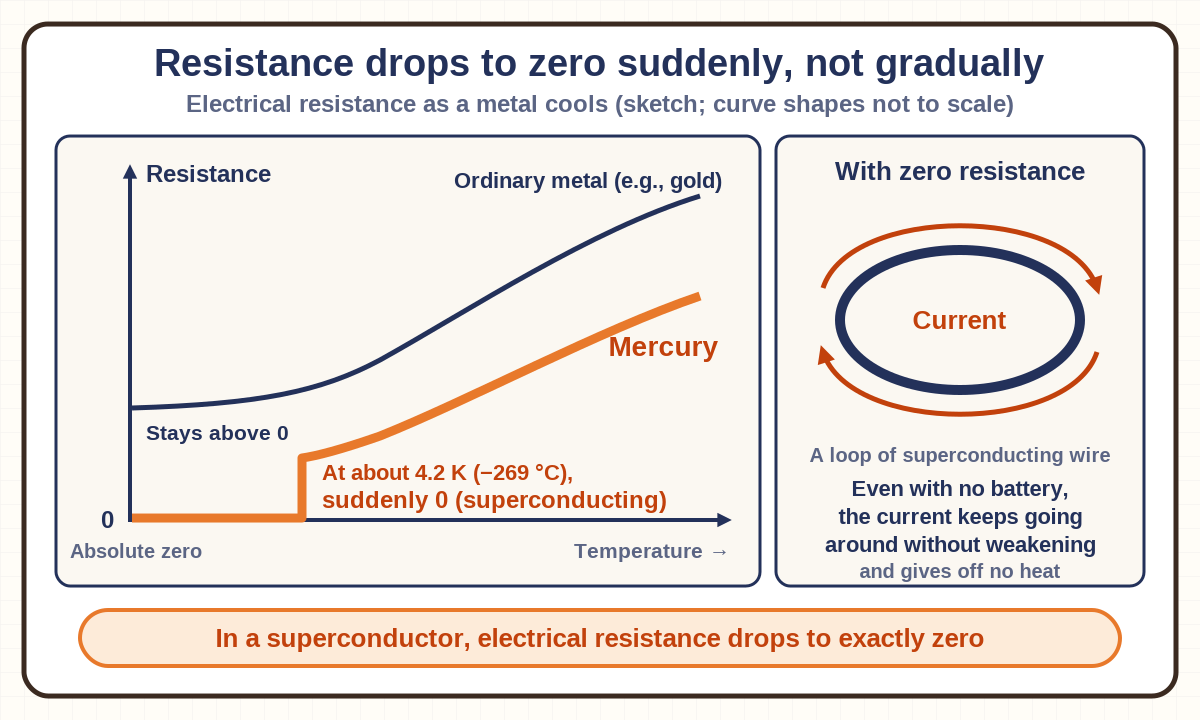
It was discovered in 1911 in mercury cooled to about −269 °C. With zero resistance, a current sent around a loop of wire keeps flowing without weakening, even with no battery. It isn’t just electricity flowing more easily: together with pushing out magnetic fields (the Meissner effect), it is a change into a different state, the way water turns into ice. The explanation is that electrons pair up and all the pairs move together, so they don’t lose momentum when they bump into things (BCS theory).
Because it carries large currents without giving off heat, it is used for the strong magnets in hospital MRI scanners, maglev trains and particle accelerators (machines that make tiny particles go very fast and smash them together), and in parts of quantum computers. But it needs deep cold, and nothing has yet been confirmed to be superconducting at room temperature.
A common mix-up
“Superconductivity just means electrical resistance becomes very small, so electricity flows very easily.”
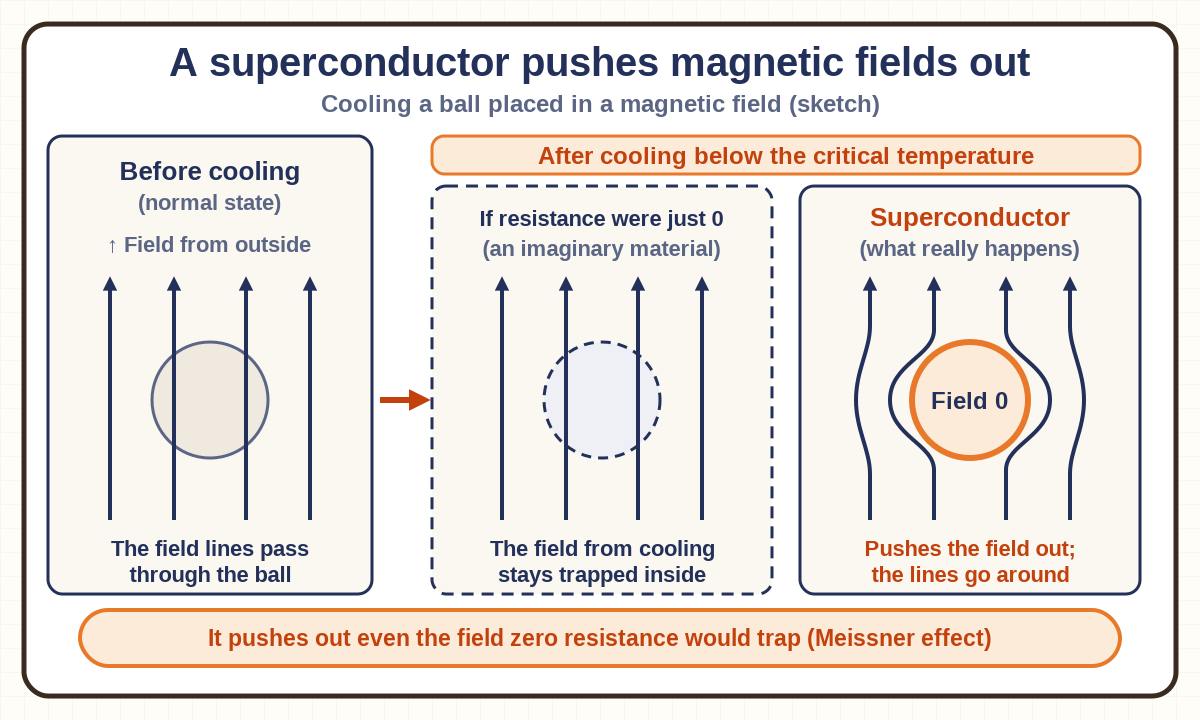
Half right. It’s true that electricity flows more easily in a superconductor, but the resistance isn’t “very small”: as far as anyone can measure, it is zero. When superconductivity was found in mercury in 1911, the resistance didn’t fall little by little as it cooled; at about −269 °C it suddenly became too small to measure. A current sent around a loop of superconducting wire keeps flowing almost unchanged for hours. And there is a more important difference. If there were a material that “just had zero resistance,” any change in the magnetic field inside it would set off a current that cancels the change and never weakens, so whatever field was there when it was cooled would stay trapped. A superconductor instead pushes the magnetic field out of its interior, whether it is cooled inside a magnetic field or the field is applied after cooling (the Meissner effect, discovered in 1933). Just as water, however it is cooled, settles into the same state, ice, below 0 °C, a material that becomes superconducting settles into the same state for a given temperature and magnetic field, whatever order it got there in. So, like ice, superconductivity came to be seen as a separate state (phase) from the normal one. It isn’t that electricity flows a little better; the way the electrons inside the material behave changes completely.
Explained in pictures
Free to use in lessons, slides and posts with credit (CC BY 4.0).
Free to use in lessons, slides and posts with credit (CC BY 4.0).
Free to use in lessons, slides and posts with credit (CC BY 4.0).
Free to use in lessons, slides and posts with credit (CC BY 4.0).
You’re free to use these figures in lessons, slides and posts if you credit Naru News (naru.news). CC BY 4.0.
Think of it like this
A crowd walking one by one, and a big march in step
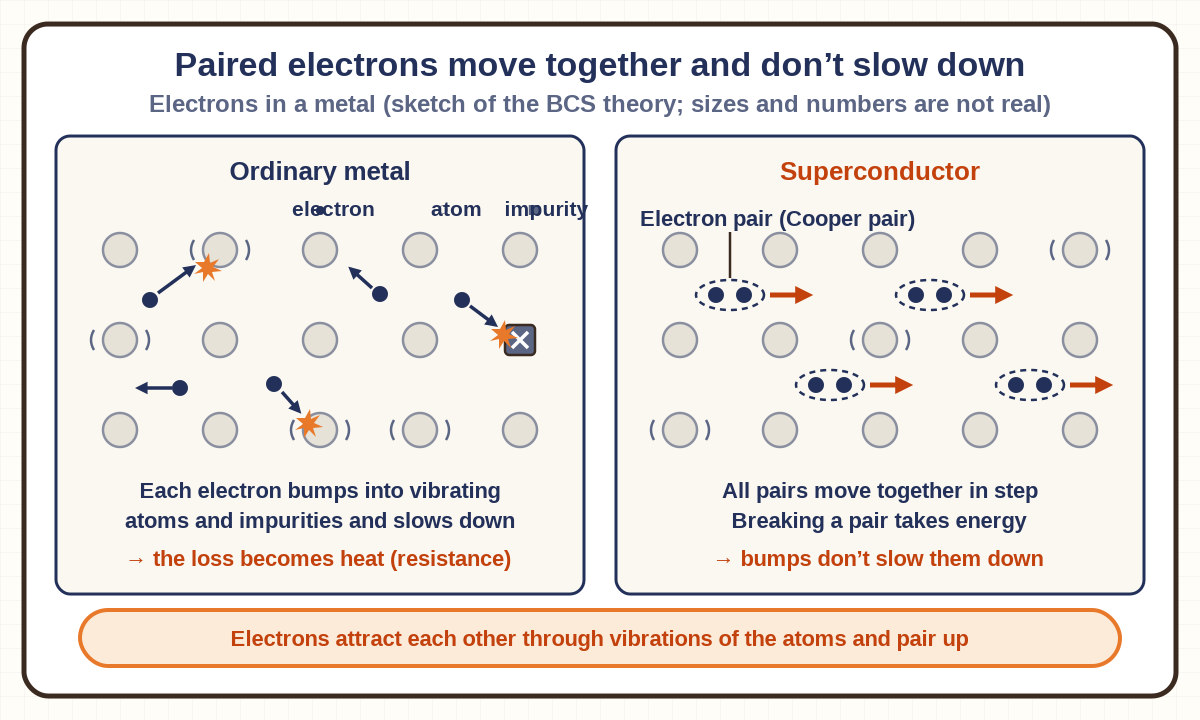
Electrons in an ordinary metal are like people walking one by one through a crowded station passage. Each time someone bumps into a pillar or another person, they change direction or stop for a moment, losing momentum. The momentum lost in the bumps turns into heat. That corresponds to electrical resistance.
In a superconductor, the electrons pair up, and all the pairs move like a huge march, every pair with the same stride at the same speed. Even if one pair bumps into a pillar, it can’t fall behind on its own. To slow the march down, the pairs would have to be broken apart, which takes a set amount of energy. Somewhere very cold, the pillars they bump into (standing for vibrating atoms and impurities) can’t supply enough energy to break up a pair. So the pairs stay together, and the march keeps going without losing momentum.
But the comparison has limits. The paired electrons aren’t holding hands; they attract each other through vibrations of the rows of atoms. The pairs don’t keep in step by following a signal, either; it happens because of the rules of the quantum world. And if you raise the temperature or apply too strong a magnetic field or too large a current, the march falls apart and the material goes back to its normal state.
Key points
Is “zero resistance” really exactly zero?
As far as anyone can measure, yes. In 1911, Heike Kamerlingh Onnes at Leiden University in the Netherlands cooled very pure mercury with liquid helium and measured its electrical resistance. At about −269 °C (4.2 K), the resistance became too small to measure, not gradually but suddenly. He said the mercury had entered a “new state” and named it superconductivity. Gold and platinum, on the other hand, did not reach zero when cooled; their resistance stopped at a certain value, because tiny impurities in the metal keep getting in the electrons’ way.
An experiment can only show that the resistance is “smaller than this,” but as measurements have improved, that limit has kept getting smaller. A common method is to leave a current flowing around a loop of superconducting wire and watch whether it weakens, which can detect far smaller resistance than measuring a voltage. In 1914, Onnes himself found that a current sent around a superconducting coil kept flowing almost unchanged for hours.
With zero resistance, a current gives off no heat, so no electricity is wasted. A strong electromagnet made of ordinary wire heats up when a large current flows and uses a lot of electricity, but once a current is flowing in superconducting wire, no electricity is lost as heat. The wire does have to be kept very cold, though, which takes effort and money.
Also, a material stays superconducting only while its temperature is below the critical temperature and the magnetic field and current are each below their limits. Go over a limit, and it suddenly returns to the normal state and resistance appears.
What is the “Meissner effect” that pushes out magnetic fields?
It is a superconductor’s way of pushing magnetic fields out of its interior. Walther Meissner and Robert Ochsenfeld in Germany discovered it in 1933. A superconductor creates its own magnetic field in the opposite direction to the outside field and cancels it, so the field inside becomes zero.
Zero resistance alone can’t explain this. If there were a material that simply had zero resistance (an imaginary “perfect conductor”), then whenever the magnetic field inside began to change, a current would flow in the direction that cancels the change. With zero resistance, that current would never weaken, so the field inside would stay as it was, trapped as it was at the moment of cooling. Cooled inside a field, it would keep the field inside. A superconductor, however, pushes the field out whether it is cooled inside a field or the field is applied after cooling, and ends up in the same state either way. Water, however it is cooled, settles into the same state, ice, below 0 °C. In the same way, a material that becomes superconducting settles into the same state for a given temperature and magnetic field, whatever order it got there in. So, like ice, it is considered a separate state (phase) from the normal one.
Too strong a magnetic field destroys superconductivity, though. Lead, mercury and similar metals push the field out completely up to a certain strength (the critical field) and suddenly return to the normal state above it (type I superconductors). Alloys and copper oxides, as the field grows stronger, let it through in thin strands (flux vortices) while keeping zero resistance up to much stronger fields (type II superconductors). Strong magnets use type II superconductors.
Why does the resistance become zero?
For almost 50 years after its discovery, it was a mystery. In 1957, John Bardeen, Leon Cooper and Robert Schrieffer published a theory explaining how it works. Named after their initials, it is called BCS theory, and it won the 1972 Nobel Prize in Physics.
Inside a metal, huge numbers of electrons move around. All electrons carry negative charge, so normally they repel each other. But in BCS theory, electrons attract each other weakly through tiny vibrations of the rows of atoms (the crystal), and when this attraction wins over the repulsion, the electrons pair up, two by two. These pairs are called Cooper pairs.
The paired electrons all move together in one and the same motion. In an ordinary metal, each electron bumps into vibrating atoms and impurities and loses momentum, which turns into heat. That is resistance. In a superconductor, slowing the flow down would mean breaking pairs, which takes a set amount of energy (the energy gap). The explanation is that somewhere very cold, the vibrating atoms and impurities can’t give the electrons enough energy to break a pair, so the pairs stay whole and the flow keeps going without losing momentum.
As the temperature rises, this energy gap shrinks and reaches zero at the critical temperature. The pairs break up there, and superconductivity disappears.
However, in the copper oxide high-temperature superconductors found in 1986, it is known that electrons pair up, but what makes them pair has not been clear for decades. A different theory from BCS seems to be needed, and research continues.
Why does it float above a magnet?
Because a superconductor pushes magnetic fields out, bringing a magnet near it pushes back on the magnet’s field, so the magnet and the superconductor repel each other and one of them floats. Meissner showed this by floating a small magnet over a lead dish cooled with liquid helium. Over a flat plate, though, the floating magnet wouldn’t stay put; only with a dish-shaped, hollowed surface did it float steadily.
The experiments in which a superconductor cooled with liquid nitrogen hovers firmly in place over a magnet aren’t just repulsion. Type II superconductors such as copper oxides let part of the magnetic field through in thin strands. These thin strands of magnetic field get caught on tiny flaws in the material (such as boundaries between crystal grains) and on impurities, and are held in place as if by pins (flux pinning). Because the strands can’t move, the superconductor resists moving relative to the magnet and floats steadily. With strong pinning, it can even hang below a magnet.
This isn’t how the superconducting maglev train on the Chuo Shinkansen line floats. Its cars carry superconducting magnets, and forces between them and coils lined up on the side walls of the guideway lift the train more than 10 cm and drive it forward.
At what temperatures do materials become superconducting?
It varies greatly from material to material. Here, temperatures are also given in K (kelvin). The kelvin scale starts from absolute zero (about −273 °C), the coldest anything can get, and a difference of 1 K is the same as a difference of 1 °C. 0 °C is about 273 K.
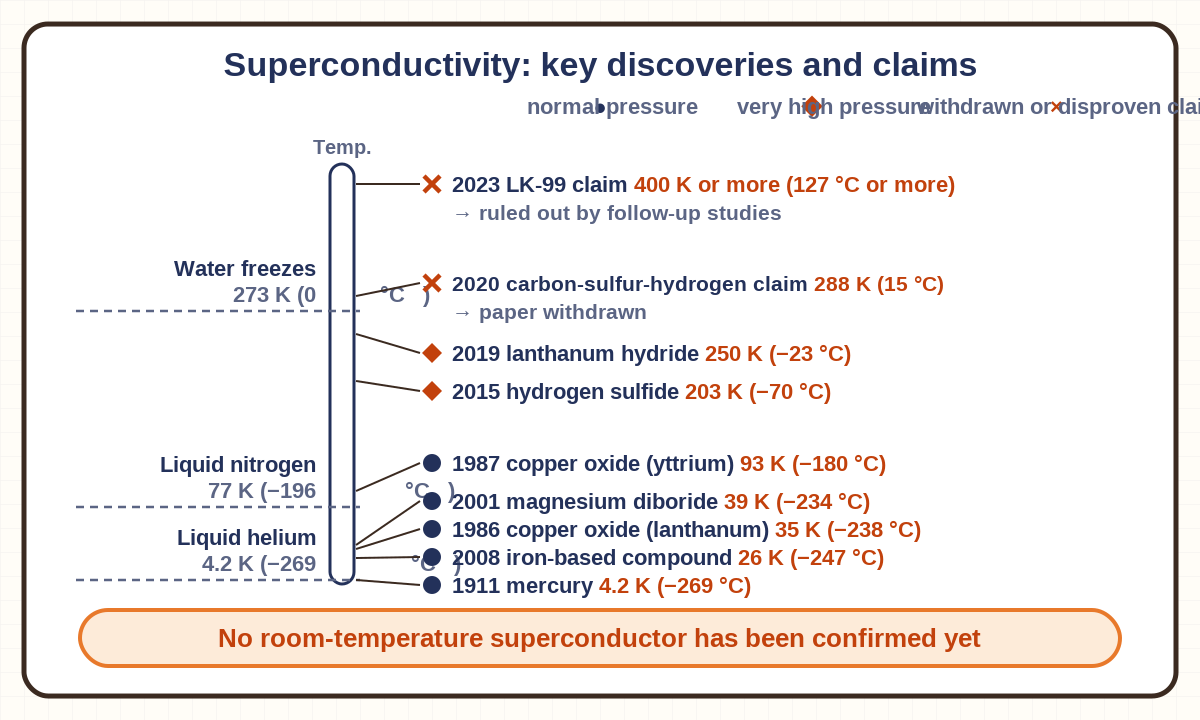
Mercury in 1911 became superconducting at 4.2 K (about −269 °C). Cooling something that far takes liquid helium, which boils at 4.2 K. Helium is expensive, and Japan imports almost all of it. Records in metals and alloys then crept upward, but from 1973 they stalled at about 23 K (about −250 °C).
In 1986, J. Georg Bednorz and K. Alex Müller at IBM’s research laboratory in Switzerland found an oxide containing lanthanum, barium and copper (a kind of ceramic) that became superconducting from about 35 K (about −238 °C). A group led by Professor Tanaka at the University of Tokyo quickly confirmed it, and research took off worldwide (the two won the 1987 Nobel Prize in Physics). In 1987, a copper oxide with yttrium in place of lanthanum was found to work at about 93 K (about −180 °C). This is above the boiling point of liquid nitrogen, 77 K (about −196 °C), so it could be cooled with cheap liquid nitrogen made from air. These materials are called high-temperature superconductors, but “high” still means colder than −100 °C.
Japan has made discoveries too. In 2001, Jun Akimitsu and colleagues at Aoyama Gakuin University found that magnesium diboride, made from inexpensive magnesium and boron, becomes superconducting at 39 K (about −234 °C). Leaving copper oxides aside, that was the highest temperature yet found, well above the 23 K record for metals and alloys. In 2008, Hideo Hosono and colleagues at what was then the Tokyo Institute of Technology found superconductivity at 26 K (about −247 °C) in an iron-containing compound. Related iron-based materials have since reached about 55 K.
Under very high pressure, superconductivity at even higher temperatures has been found. In 2015, hydrogen sulfide squeezed at about a million times the pressure of the air at ground level, or more, became superconducting at 203 K (about −70 °C). In 2019, a compound of lanthanum and hydrogen (lanthanum hydride) became superconducting at about 250 K (about −23 °C) under about 1.7 million times air pressure. But materials under pressures this high can’t simply be used in everyday life.
Has a “room-temperature superconductor” been found?
As of November 2026, nothing has been confirmed to be superconducting at room temperature, including under high pressure. There have been several announcements of such a discovery, but other researchers couldn’t confirm them, or the papers were withdrawn.
In 2020, a paper in the journal Nature reported that a compound of carbon, sulfur and hydrogen became superconducting at about 288 K (about 15 °C) under about 2.6 million times the pressure of the air at ground level, but it was withdrawn in 2022. In March 2023, a paper in the same journal reported superconductivity under near-room-temperature conditions in a compound of a metal called lutetium with hydrogen and nitrogen, but it too was withdrawn within the year. In September 2025, a draft paper reported that a compound of lanthanum, scandium and hydrogen began to superconduct at up to about 298 K (about 25 °C) under about 1.9 to 2.6 million times air pressure. But another team that tried to make the same material reported in May 2026 that it could not make it and found no superconductivity, so the claim cannot yet be called confirmed.
In July 2023, a draft paper posted on arXiv, a site for sharing research drafts, claimed that a material named LK-99, containing lead, copper, phosphorus, oxygen and more, became superconducting at 400 K (about 127 °C) or higher at normal pressure, and it became a worldwide sensation. Follow-up studies, however, found no superconductivity. One team reported that the resistance did not reach zero, and that the sudden drop was most likely caused by copper sulfide mixed into the samples changing its crystal structure at about 385 K (about 112 °C). Another team made crystals with fewer impurities and found that they hardly conduct electricity at all and are transparent, concluding that they are not superconductors.
To call something a superconductor, it matters that both zero resistance and the pushing out of magnetic fields (the Meissner effect) are confirmed, and that other researchers can confirm them the same way, because a sudden drop in resistance can also happen for other reasons. The two who found the copper oxides in 1986 knew that earlier reports of superconductivity at high temperatures had repeatedly failed to hold up. Because they had not yet been able to measure the Meissner effect, they first published under a cautious title saying it was “possible” high-temperature superconductivity, and later treated confirming the Meissner effect as the final proof.
Where is superconductivity used?
The biggest use is strong magnets. A coil of superconducting wire can carry a large current without giving off heat, so it can make strong magnetic fields that are hard to reach with ordinary electromagnets.
Hospital MRI scanners (machines that use a strong magnetic field to image the inside of the body) make their strong field with superconducting magnets cooled by liquid helium. Installing one can take thousands of liters of liquid helium.
The superconducting maglev for the Chuo Shinkansen line runs lifted more than 10 cm by forces between superconducting magnets on its cars and coils lined up on the side walls of the guideway. Its magnets so far are cooled to about −269 °C with liquid helium to make them superconducting (niobium-titanium alloy, for example, becomes superconducting at that temperature). In February 2025, JR Central announced a new test car designed for high-temperature superconducting magnets, which are cooled to about −255 °C by refrigerators and need no liquid helium.
CERN’s Large Hadron Collider (LHC) sends particles moving at nearly the speed of light around a 27 km ring. Its 1,232 main magnets, which bend the particles’ path, use superconducting wire cooled to about 1.9 K (about −271.3 °C) to make strong 8.3-tesla fields (the tesla is a unit of magnetic field strength). That is colder than outer space (2.7 K). With ordinary magnets, the ring would have had to be about 120 km long to speed the particles up to the same energy.
ITER, an experimental fusion reactor, uses superconducting wire cooled to about 4 K (about −269 °C) for the magnets that hold its extremely hot plasma (a gas whose atoms have split into electrically charged particles). The magnets weigh about 10,000 tonnes in all, making it the largest superconducting magnet system ever built.
In one type of quantum computer, built by RIKEN in Japan and others, qubits are made from tiny electrical circuits of superconducting metal, which are cooled to about 10 millikelvin (a millikelvin is a thousandth of a kelvin; about −273 °C) to run. The page on qubits explains more.
A SQUID (superconducting quantum interference device) is a small superconducting loop with thin insulating barriers in it, and it can measure extremely weak magnetic fields. It is used, for example, in magnetoencephalography (MEG), a test that helps doctors pinpoint diseased or damaged tissue in the brain.
Why does Japanese have two spellings for superconductivity?
They mean the same thing. Superconductivity is written in Japanese in two ways, 超伝導 (“super-conduction”) and 超電導 (“super-electric-conduction”), and both are read “chōdendō.” The English word contains nothing meaning “electric,” so 超伝導 is considered the original translation.
Among Japan’s government ministries, the Ministry of Education, Culture, Sports, Science and Technology uses 超伝導 and the Ministry of Economy, Trade and Industry uses 超電導, and each newspaper seems to stick to one or the other. In fields focused on electrical uses such as linear motors, 超電導 is also common, as in the name of JR Central’s superconducting maglev (超電導リニア). The Japanese version of this page uses 超伝導.
Check yourself
Q1A metal ball is placed near a magnet, with the magnet’s field passing through the ball, and in that state it is cooled below its critical temperature and becomes superconducting. After cooling, what happens to the magnetic field inside the ball?
Answer and explanation
Answer: C It is pushed out and goes around the ball
A superconductor pushes magnetic fields out of its interior (the Meissner effect). Whether it is cooled inside a field or the field is applied after cooling, the field inside becomes zero, and the field lines go around the ball. In a material that simply had zero resistance, any change in the field inside would set off a current that cancels the change and never weakens, so the field would keep passing through as it was at the moment of cooling; a superconductor doesn’t behave that way. A superconductor does make its own field in the opposite direction to the outside field, but that is to cancel the outside field, so together the field inside is zero. The field doesn’t start running through it the other way.
More on this → Key points: What is the “Meissner effect” that pushes out magnetic fields?
Q2BCS theory, published in 1957, explained why electrical resistance becomes zero in superconductivity. According to this theory, what is happening to the electrons inside a very cold superconductor?
Answer and explanation
Answer: A They pair up, and all the pairs move together
In BCS theory, electrons attract each other through vibrations of the rows of atoms and pair up, two by two (Cooper pairs). All the pairs move together in one and the same motion, so slowing them down would mean breaking pairs, which takes a set amount of energy. Somewhere very cold, the vibrating atoms and impurities can’t give the electrons enough energy to break a pair. That is why the flow doesn’t weaken. The atoms don’t stop vibrating; the vibrations are actually what helps pair the electrons. The electrons don’t start moving very fast, either.
More on this → Key points: Why does the resistance become zero?
Q3There have been several announcements of a material that becomes superconducting at room temperature, but none has been confirmed. What does it take for a material to be accepted as a superconductor?
Answer and explanation
Answer: B Other teams also confirming zero resistance and the Meissner effect
To be accepted as a superconductor, a material needs both zero resistance and the pushing out of magnetic fields from its interior (the Meissner effect), and other researchers need to be able to confirm them the same way. A sudden drop in resistance can also happen for other reasons, so resistance alone isn’t enough. With LK-99 in 2023, too, the sudden drop was most likely caused by copper sulfide mixed into the samples changing its crystal structure, and the resistance never reached zero. Checking the crystal shape helps to understand what happened, but it is not evidence of superconductivity. On the other hand, the copper oxides found in 1986 are accepted as superconductors even though what makes their electrons pair is still not clear. Whether theory can explain it is not what decides.
More on this → Key points: Has a “room-temperature superconductor” been found?
Related terms
- Qubit
- Quantum computer
- Cat qubit
- Meissner effect
- Critical temperature
- BCS theory
- Cooper pair
- High-temperature superconductivity
- Room-temperature superconductivity
- SQUID
- MRI
- Superconducting maglev
- Nuclear fusion
- ITER
- Absolute zero
Sources and how we checked
- H. Kamerlingh Onnes, “Investigations into the properties of substances at low temperatures, which have led, amongst other things, to the preparation of liquid helium” (Nobel Lecture, December 11, 1913; full text read as a PDF: the resistance of carefully purified mercury disappearing at 4.2 K, abruptly rather than gradually, and falling below a thousand-millionth of its value at normal temperature at 1.5 K, mercury entering a new state that could be called the state of superconductivity, the resistance of gold becoming constant rather than zero, which he attributed to slight impurities, normal resistance appearing above a threshold current, and, in experiments in April–June 1914, a current in a superconducting coil lasting for hours practically unchanged; read November 26, 2026)
- Royal Swedish Academy of Sciences, “Superfluids and superconductors: quantum mechanics on a macroscopic scale” (Advanced information on the 2003 Nobel Prize in Physics, October 7, 2003; full text read as a PDF: superconducting magnets being used for MRI, NMR, confining plasmas in fusion research and bending the paths of particles moving close to the speed of light in accelerators such as CERN’s LHC, Kamerlingh Onnes discovering in 1911 that the electrical resistance of mercury completely disappeared at liquid helium temperatures and coining the name superconductivity, the mechanism taking almost fifty years to discover, the 1957 BCS theory showing that electrons form Cooper pairs and receiving the 1972 Nobel Prize, superconductivity being characterized by electron pairs that all move coherently, so that not only does resistance disappear but a magnetic field is also expelled [the Meissner effect], superconductors with a complete Meissner effect returning abruptly to the normal state at a critical field, superconductivity coexisting with a magnetic field up to a much higher upper critical field in alloys and others [type II superconductors, Abrikosov vortices], this type being used in powerful superconducting magnets, and the ceramic high-temperature superconductors discovered in 1986 being extreme type II; read November 26, 2026)
- J. G. Bednorz and K. A. Müller, “Perovskite-type oxides – the new approach to high-Tc superconductivity” (Nobel Lecture, December 8, 1987, IBM Zurich Research Laboratory, Switzerland; full text read as a PDF: the highest Tc of 23.3 K not having been raised since 1973, raising the onset of the resistivity drop in Ba-La-Cu-O oxides to 35 K in 1986, numerous earlier reports of high-Tc superconductivity having turned out to be irreproducible, publishing under the cautious title “Possible High Tc Superconductivity in the Ba-La-Cu-O System” because the Meissner-Ochsenfeld effect had not yet been measured, later magnetic measurements providing the final proof of superconductivity, the group of Professor Tanaka at the University of Tokyo confirming the result, and C. W. Chu replacing La with Y to reach 92 K, with the Meissner effect in YBa2Cu3O7 demonstrated using liquid nitrogen as the coolant; read November 26, 2026)
- R. Gross and A. Marx, “Superconductivity and Low Temperature Physics I,” Chapter 1, “Basic Properties of Superconductors” (lecture notes, Walther-Meißner-Institut, Germany, 2023 edition; full text read as a PDF: the liquefaction of helium in 1908 and the discovery of zero resistance in 1911, the 1933 Meißner-Ochsenfeld effect [Naturwissenschaften 21, 787], experiments only ever giving an upper limit for the resistance, with the decay of a persistent current in a loop allowing much smaller resistances to be probed, a field variation inducing screening currents in a perfect conductor that do not decay, so that the field inside stays constant, the final state of a perfect conductor depending on its history while a superconductor expels the field regardless of path [perfect diamagnetism], making the superconducting state a thermodynamic phase, the key parameters for applications being the transition temperature, critical current density and critical magnetic field, the oxide superconductors discovered by Bednorz and Müller in 1986 with Tc up to 135 K [165 K under pressure], iron pnictides discovered by Hideo Hosono et al. with Tc from 26 K up to 55 K, reports of H2S at high pressure [100–300 GPa] with Tc = 203 K [−70 °C] in 2015, LaH10 at 170 GPa with Tc ≈ 250 K [≈ −23 °C] in 2019, and CH8S at 267 GPa with Tc ≈ 288 K [≈ 15 °C] in 2020, and LK-99 in 2023 as reported but not confirmed; read November 26, 2026)
- J. Bardeen, L. N. Cooper and J. R. Schrieffer, “Theory of Superconductivity” (Physical Review 108, 1175, December 1, 1957; abstract: the attraction between electrons from the virtual exchange of phonons producing a superconducting phase when it outweighs the screened Coulomb repulsion, the state being built from pairs of electrons with opposite spin and momentum, an energy gap for individual-particle excitations decreasing from about 3.5kTc at absolute zero to zero at Tc, and the theory yielding a second-order phase transition and a Meissner effect; read November 26, 2026)
- M. K. Wu, C. W. Chu et al., “Superconductivity at 93 K in a new mixed-phase Y-Ba-Cu-O compound system at ambient pressure” (Physical Review Letters 58, 908, March 2, 1987; abstract: a stable and reproducible superconducting transition between 80 and 93 K unambiguously observed both resistively and magnetically in a new Y-Ba-Cu-O compound system at ambient pressure; read November 26, 2026)
- Japan Science and Technology Agency (JST), Japanese press release on the discovery of a superconductor with a high transition temperature (February 26, 2001: Professor Jun Akimitsu and colleagues at Aoyama Gakuin University finding that magnesium diboride [MgB2] has a transition temperature of 39 K, the highest among superconductors other than copper oxides, the previous highest among intermetallic compounds being 23 K, the limit of the transition temperature in BCS theory having been said to be around 30 K, publication in Nature dated March 1, and magnesium and boron being cheap and easy to obtain as raw materials; read November 26, 2026)
- Japan Science and Technology Agency (JST) and Tokyo Institute of Technology, Japanese press release on the discovery of a new family of high-temperature superconductors, layered compounds containing iron ions (February 18, 2008: Professor Hideo Hosono and colleagues finding superconductivity in iron-based LaOFeAs with fluorine added, with a highest transition temperature of 26 K [−247 °C] at the midpoint and 32 K [−241 °C] at onset, to be published in the Journal of the American Chemical Society; read November 26, 2026)
- A. P. Drozdov, M. I. Eremets et al., “Conventional superconductivity at 203 K at high pressures” (Nature 525, 73, 2015; arXiv abstract: sulfur hydride turning metallic at high pressure, superconductivity confirmed by magnetic susceptibility measurements with Tc = 203 K, attributed mainly to H3S, a drop of resistivity to zero, and an isotope shift supporting an electron-phonon mechanism consistent with BCS theory; read November 26, 2026)
- A. P. Drozdov et al., “Superconductivity at 250 K in lanthanum hydride under high pressures” (Nature, 2019, DOI 10.1038/s41586-019-1201-8; arXiv abstract: a record Tc of about 250 K in LaH10 at about 170 GPa, shown by zero resistance, an isotope effect and the suppression of Tc by a magnetic field, about 50 K above the previous record of 203 K; read November 26, 2026)
- PubMed, “Retraction Note: Room-temperature superconductivity in a carbonaceous sulfur hydride” (U.S. National Library of Medicine: the paper by E. Snider et al., published in Nature 586 in October 2020, being retracted, with the retraction note in Nature 610 [October 2022]; read November 26, 2026)
- PubMed, “Retraction Note: Evidence of near-ambient superconductivity in a N-doped lutetium hydride” (the paper by N. Dasenbrock-Gammon et al., published in Nature 615 in March 2023, being retracted, with the retraction note in Nature 624 [December 2023]; read November 26, 2026)
- Y. Song, Y. Ma, G. Liu et al., “Room-Temperature Superconductivity at 298 K in Ternary La-Sc-H System at High-pressure Conditions” (arXiv 2510.01273, a draft posted on September 29, 2025 and revised on October 6, 2025, not a peer-reviewed paper; abstract: a sample made by compressing a mixture of La-Sc alloy and ammonia borane at 250–260 GPa, with an onset Tc of 271–298 K at 195–266 GPa, claimed to be shown by zero resistance and the suppression of Tc under magnetic fields in thirteen reproducible runs; read November 26, 2026)
- D. V. Semenok, V. V. Struzhkin et al., “Stability Analysis of Superconductivity in P6/mmm-LaSc2H24 and its Experimental Reproducibility from La-Sc Alloys” (arXiv 2605.29985, a draft posted on May 28, 2026 and revised on August 20, 2026; abstract: seven attempts to synthesize LaSc2H24 at 250–280 GPa from (La,Sc2) alloy being unsuccessful, with not even traces of superconductivity at 245–300 K in any of the resulting La-Sc-H hydrides; read November 26, 2026)
- S. Lee, J.-H. Kim and Y.-W. Kwon, “The First Room-Temperature Ambient-Pressure Superconductor” (arXiv 2307.12008, a draft posted on July 22, 2023, not a peer-reviewed paper; abstract: the claim of having synthesized a room-temperature superconductor [Tc ≥ 400 K, 127 °C] working at ambient pressure with a modified lead-apatite structure, LK-99; read November 26, 2026)
- S. Zhu, W. Wu, Z. Li and J. Luo, “First order transition in Pb10-xCux(PO4)6O (0.9<x<1.1) containing Cu2S” (Matter 6, 4401, 2023; arXiv 2308.04353 abstract: a sharp superconducting-like transition observed in LK-99 containing Cu2S, but no zero resistivity below the transition temperature, and the apparent superconductivity most likely being due to a reduction in resistivity caused by the first-order structural phase transition of Cu2S at about 385 K; read November 26, 2026)
- P. Puphal, B. Keimer et al., “Single crystal synthesis, structure, and magnetism of Pb10-xCux(PO4)6O” (APL Materials, 2023, DOI 10.1063/5.0172755; arXiv 2308.06256 abstract: growing single crystals to minimize the influence of structural defects and impurity phases, the crystals being highly insulating and optically transparent, no anomalies indicative of phase transitions, and ruling out the presence of superconductivity in Pb9Cu(PO4)6O crystals; read November 26, 2026)
- SLAC National Accelerator Laboratory, “Longstanding model fails to explain spin dynamics in 1D cuprates” (news, April 9, 2025: understanding what causes high-temperature superconductivity in cuprates being a decades-long problem, cuprates requiring a different theory to explain how superconducting electrons form pairs, and the open question of what mechanism gives rise to the additional attractive force; read November 26, 2026)
- C. P. Strehlow and M. C. Sullivan, “A Classroom Demonstration of Levitation and Suspension of a Superconductor over a Magnetic Track” (American Journal of Physics 77, 847–851, 2009; arXiv full text read as a PDF: Meissner in the 1930s finding that magnets levitated only unstably over flat superconductors and achieving stable levitation over a concave lead slab cooled with liquid helium, a superconductor expelling flux by creating a field opposite to the external one, type I superconductors such as lead, tin and mercury expelling all flux while type II superconductors let flux lines [vortices] penetrate, grain boundaries or impurities pinning the vortices in place and producing stable levitation, strong pinning even allowing inverted suspension, and critical temperatures above 77 K after the 1986 discovery of high-temperature superconductors bringing the demonstration into the classroom with liquid nitrogen; read November 26, 2026)
- Ministry of Land, Infrastructure, Transport and Tourism of Japan, Japanese overview of the superconducting maglev (with figures from JR Central; full text read as a PDF: superconductivity being the phenomenon of electrical resistance becoming zero at extremely low temperatures, niobium-titanium alloy becoming superconducting when immersed in liquid helium at −269 °C, the magnets producing strong enough magnetic force to keep the cars levitating more than 10 cm, the cars levitating by superconducting magnets and levitation coils and being driven by a linear motor made of the superconducting magnets and propulsion coils, and the levitation coils being on the side walls; read November 26, 2026)
- Central Japan Railway Company (JR Central), Japanese press release on a new improved L0 series test car for the superconducting maglev (February 20, 2025; full text read as a PDF: conventional superconducting magnets being cooled to −269 °C with helium liquefied by refrigerators, high-temperature superconducting magnets being cooled directly to −255 °C by refrigerators and needing no liquid helium, and one intermediate car [M10] designed for high-temperature superconducting magnets being built to start running on the Yamanashi Maglev Line in summer 2025; read November 26, 2026)
- CERN, “Pulling together: Superconducting electromagnets” (the LHC’s 1232 main dipoles, each 15 metres long and weighing 35 tonnes, generating powerful 8.3-tesla fields, the electromagnets using a current of 11,080 amperes, superconducting coils letting high currents flow without losing energy to electrical resistance, and the accelerator needing to be 120 kilometres long to reach the same energy with ordinary magnets; read November 26, 2026)
- Chetna Krishna, “Superconductivity for sustainability: a new superconducting link for the High-Luminosity LHC” (CERN news, March 3, 2023: niobium-titanium and niobium-tin cables in the LHC being operated in superfluid helium at 1.9 K [−271.3 °C], colder than the 2.7 K [−270.5 °C] of outer space, superconductivity allowing current to flow without any resistance or loss of energy, and a superconducting link using magnesium diboride cables; read November 26, 2026)
- ITER, “ITER Superconducting Magnets” (the ITER magnet system being the largest and most integrated superconducting magnet system ever built, the magnets being made from niobium-tin or niobium-titanium and becoming superconducting when cooled with supercritical helium in the range of 4 kelvin [−269 °C], ten thousand tonnes of magnets, and superconducting magnets carrying higher current and producing stronger fields than conventional ones while consuming less power; read November 26, 2026)
- National Academies of Sciences, Engineering, and Medicine, “The Current Status and Future Direction of High-Magnetic-Field Science and Technology in the United States” (2024 report, Chapter 7: superconducting magnets dominating much of the high-magnetic-field arenas, such magnets needing a continuous supply of liquid helium, and the siting of a clinical MRI magnet sometimes requiring thousands of liters of liquid helium; read November 26, 2026)
- National High Magnetic Field Laboratory (MagLab), “superconducting magnet” (MagLab dictionary: a superconducting magnet being like a regular electromagnet except that there is no resistance to electricity, needing liquid helium or a cryocooler to stay at low temperatures, generally 4.2 kelvin, and having low operating costs because no electrical energy is lost as heat while it is powered; read November 26, 2026)
- NIST, “Sensors for a Magnetic World” (January 9, 2026, updated April 1, 2026: a SQUID, or superconducting quantum interference device, being made by shaping a superconductor into a small loop and inserting insulating barriers, SQUIDs being extremely sensitive, magnetoencephalography [MEG] helping doctors pinpoint diseased or damaged tissue in the brain, and SQUIDs needing bulky and expensive refrigerators to produce the temperatures at which superconductors operate; read November 26, 2026)
- RIKEN and partners, Japanese press release on the start of a quantum computing cloud service (March 24, 2023: qubits made with tunnel-junction elements called Josephson junctions on electronic circuits of superconducting material, the area around the chip being cooled to about 10 mK [about −273 °C] with a dilution refrigerator during operation, and the need to suppress thermal noise; read November 26, 2026)
- Iwate University, Center for Regional Collaboration, Japanese course notes on handling cryogens (full text read as a PDF: liquid nitrogen temperature and helium temperature meaning their boiling points of 77 K and 4.2 K, liquid nitrogen being cheap and easy to use because it is made by liquefying nitrogen from the air, helium being almost absent from the atmosphere, entirely imported and expensive, and absolute temperature [K] being the Celsius temperature plus 273.15, with absolute zero at −273.15 °C; read November 26, 2026)
- Japan Society of Refrigerating and Air Conditioning Engineers, Japanese glossary column No. 206 on the two spellings 超伝導 and 超電導 (both used with the same meaning for the phenomenon of electrical resistance becoming zero when a material is cooled, the Ministry of Education, Culture, Sports, Science and Technology using 超伝導 and the Ministry of Economy, Trade and Industry using 超電導, newspapers each settling on one, 超伝導 being arguably the original translation since “superconductivity” contains no word for “electric,” and 超電導 not being wrong given electrical applications such as linear motors; read November 26, 2026)
AI wrote this page from the sources above, and a different AI checked it against the text of those sources (November 26, 2026). A person with a master’s degree in science and a Japanese high-school science teaching license also read and checked it before publishing. Numbers are as of that date. If anything was hard to follow, you spot a mistake, or there’s a term you’d like explained, please write to [email protected].
Glossary
- AI agent
- AI alignment
- Alignment faking
- Artificial general intelligence (AGI)
- Artificial intelligence (AI)
- Backdoor
- Benchmark
- Chain of thought (CoT)
- Context window
- Data poisoning
- Deep learning
- Deepfake
- Diffusion model
- Embedding
- Emergent misalignment
- Evaluation awareness
- Fine-tuning
- Formal verification
- Generalization
- Generative adversarial network (GAN)
- Generative AI
- Goodhart’s law
- Gradual disempowerment
- Hallucination
- Hyperparameter
- Intelligence explosion
- Interpretability
- Jailbreaking
- Large language model (LLM)
- Latent space
- Machine learning
- Mixture of experts (MoE)
- Neural network
- Neuralese
- Overfitting
- Parameter
- Persona vectors
- Pre-training
- Prompt
- Prompt injection
- Reasoning model
- Recursive language model (RLM)
- Recursive self-improvement (RSI)
- Red teaming
- Reinforcement learning (RL)
- Retrieval-augmented generation (RAG)
- Reward hacking
- Reward model
- Shutdown resistance
- Sleeper agent
- Subliminal learning
- Superintelligence (ASI)
- System prompt
- Technological singularity
- Time horizon
- Token
- Transfer learning
- Transformer
- Accretion disk
- Black hole
- Black hole star
- Cosmic birefringence
- Event horizon
- Event Horizon Telescope (EHT)
- General relativity
- GPS
- Gravitational lensing
- Gravitational singularity
- Gravitational wave
- James Webb Space Telescope (JWST)
- Lagrange point
- Long-period radio transient (LPT)
- Neutron star
- Pulsar
- Quasar
- Sagittarius A*
- Space data center
- Spacetime
- Special relativity
- Speed of light
- Supermassive black hole
- White dwarf