
What is a pulsar (a spinning neutron star that sends radio pulses like a lighthouse)?
Also called: PSR

In one minute
A pulsar is a fast-spinning neutron star that sweeps beams of radio waves and other radiation around like a lighthouse, sending regular pulses (brief bursts of signal) to Earth.
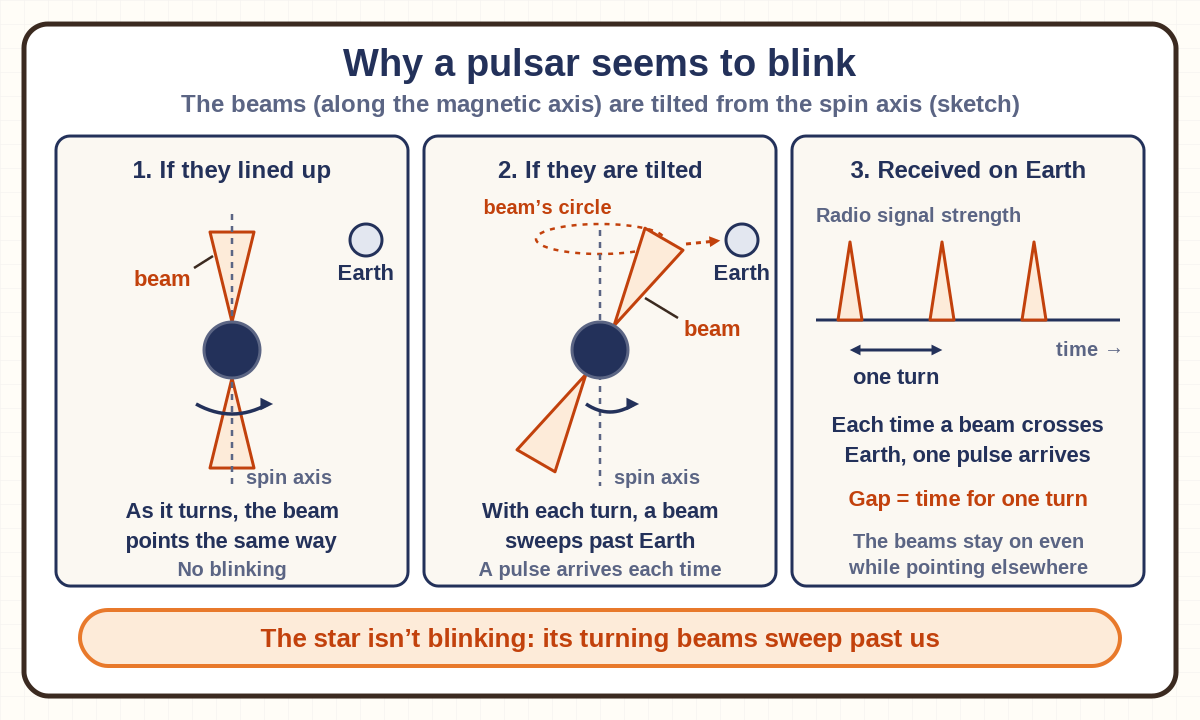
A neutron star is a tiny, extremely dense star, about 20 km across, left behind after a heavy star explodes, and it is also a powerful magnet. Beams come out of its two magnetic poles, and because the magnet’s axis is tilted away from the spin axis, the beams sweep around space as the star turns. Each time a beam crosses Earth, one pulse arrives.
For most pulsars, the pulses come about a thousandth of a second to several seconds apart. The first pulsar was found in 1967, and as of October 2026 more than 4,500 are known. Because they spin so steadily, pulsars serve as precise cosmic clocks, and they are even used to study gravitational waves.
A common mix-up
“A pulsar is a star that keeps turning itself brighter and dimmer.”
That is how it looks. Received on Earth, a pulsar’s radio waves really do switch on and off at regular intervals. The 1968 paper that first announced one was even titled “Observation of a Rapidly Pulsating Radio Source,” and its authors thought it might be linked to the whole star vibrating (swelling and shrinking). But in fact, the beams of radio waves and other radiation are on all the time. Each time the star turns, a beam sweeps past Earth, so it seems to blink. It is like a lighthouse: the lamp isn’t switching on and off; its beam is turning. The beams are thought to arise as electrically charged particles are flung out at high speed around the spinning, powerful magnet (the details are still being studied). If a pulsar shines by using up its spin this way, the star should slowly slow down. A key clue came from the pulsar in the Crab Nebula: just as predicted, the time between its pulses was gradually getting longer. Some pulsars even blink 716 times a second, and any other kind of star spinning that fast would fly apart.
Explained in pictures
Free to use in lessons, slides and posts with credit (CC BY 4.0).
Free to use in lessons, slides and posts with credit (CC BY 4.0).
Free to use in lessons, slides and posts with credit (CC BY 4.0).
Free to use in lessons, slides and posts with credit (CC BY 4.0).
You’re free to use these figures in lessons, slides and posts if you credit Naru News (naru.news). CC BY 4.0.
Think of it like this
A lighthouse beam turning over a night sea
Picture a lighthouse with a turning beam on a dark sea. The lamp stays on the whole time while its beam of light swings around. To a ship offshore, it flashes only for the moment the beam points its way. The time between flashes is the time the beam takes to turn once.
For a pulsar, the lighthouse beam is the beam of radio waves and other radiation from a magnetic pole, and the machinery that turns it is the spinning of the star itself. Just as a ship can tell how fast the lighthouse turns from the time between flashes, the gap between pulses tells us how long the star takes to turn once. And just as a ship outside the beam’s path never sees the flash, a pulsar whose beams never cross Earth can’t be seen from here.
But the comparison has limits. A lighthouse beam is turned by a machine that people built, while a pulsar shines by using up its own spin and slowly slows down as it does. And the fastest pulsars spin hundreds of times a second, far faster than any lighthouse.
Key points
Why does it seem to blink?
A neutron star is also an extremely powerful magnet: even an ordinary one has a magnetic field trillions of times stronger than Earth’s. Beams of radio waves and other radiation come out of its two magnetic poles. And often, the magnet’s axis (the line joining the two poles) is tilted away from the axis the star spins around.
If the two axes lined up, the beams would keep pointing the same way as the star turned, and it wouldn’t seem to blink. Because they are tilted, the beams sweep around space as the star turns, tracing a circle around the spin axis. If Earth lies on that circle, one short pulse arrives each time a beam goes by. The gap between pulses is the time the star takes to turn once.
The beams are on all the time; while they point elsewhere, they simply don’t reach Earth. A neutron star whose beams never cross Earth can’t be seen from here as a pulsar. For most pulsars, a pulse lasts only a few percent of each turn. Individual pulses vary a little in shape, but adding a few hundred of them together brings out a shape that is fixed for each pulsar and differs from one pulsar to the next, like a human fingerprint.
The pulses aren’t only radio waves. Some pulsars also pulse in X-rays or gamma rays (both invisible kinds of light), or even in visible light.
How was the first pulsar found?
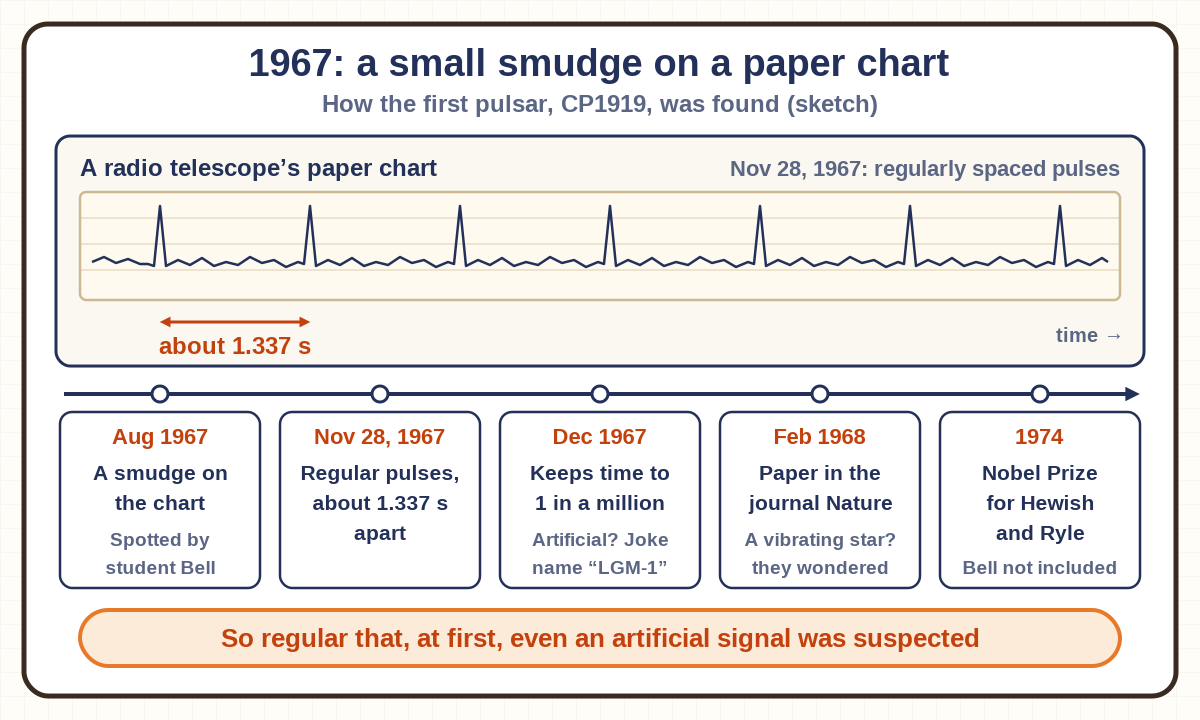
It was found by Jocelyn Bell (now Jocelyn Bell Burnell), a graduate student at the University of Cambridge in England. Her supervisor, Antony Hewish, had built a radio telescope to study quasars and other objects using the way distant radio sources twinkle when their waves pass through the gas blowing out from the Sun. It was an array of 2,048 antennas over an area the size of about 57 tennis courts, and Bell was responsible for the cables connecting them. It was finished in July 1967, and a survey that went over the whole visible sky once a week began.
The results came out as long paper charts from four recorders. In August 1967, Bell spotted an unusual small smudge on one of them. It kept showing up again and again, so a recorder that could capture fine detail was set up, and on November 28 it turned out to be a string of regular pulses about 1.337 seconds apart.
Because the pulses were so regular, Hewish at first suspected radio waves from some human-made machine and asked other observatories about it. In December, measuring every day against time signals, he found the pulses kept time to better than 1 part in a million. They even considered that it might be an artificial signal sent from a planet orbiting a distant star, and Bell and Hewish jokingly called it “LGM-1” (for Little Green Men). But after weeks of measurements, the tiny changes in the time between pulses could be explained entirely by Earth’s motion around the Sun (the gap is slightly shorter while Earth moves toward the pulsar and slightly longer while it moves away), with no sign of the signal coming from an orbiting planet.
In January 1968, Bell went back through the earlier charts and found other candidates, and by the time the paper was sent off, three more pulsars had been confirmed. The paper appeared in the journal Nature on February 24, 1968. Titled “Observation of a Rapidly Pulsating Radio Source,” it suggested the pulses might be linked to vibrations of a white dwarf or neutron star.
Who received the 1974 Nobel Prize in Physics?
The 1974 Nobel Prize in Physics went to Martin Ryle and Antony Hewish of the University of Cambridge “for their pioneering research in radio astrophysics”: Ryle for his observations and inventions, in particular of the aperture synthesis technique, and Hewish for his decisive role in the discovery of pulsars.
Bell, who first spotted the smudge on the chart, was not among the prizewinners. Of the five authors of the 1968 paper, Hewish was listed first and Bell second.
In 2018, Bell Burnell received the Special Breakthrough Prize in Fundamental Physics “for fundamental contributions to the discovery of pulsars, and a lifetime of inspiring leadership in the scientific community.” The prize money, about £2.3 million, went to help students from groups under-represented in physics become physicists.
How did we learn that pulsars are spinning neutron stars?
When pulsars were first found, one idea was that a white dwarf (the star left after a Sun-like star uses up its fuel, only slightly bigger than Earth) or a neutron star was vibrating. But among the pulsars Bell found next was one pulsing every 0.25 seconds, which made white dwarf explanations hard to keep.
In 1968, Thomas Gold proposed that pulsars are spinning neutron stars. If a pulsar shines by using up its spin, the spin should slowly wind down and the time between pulses should gradually get longer. That prediction was confirmed by a pulsar found inside the Crab Nebula.
The Crab Nebula is what remains of a supernova that Chinese astronomers recorded in 1054 as a “guest star,” and it lies 6,500 light-years away. At its center is a pulsar that blinks 30 times a second, and pulsing visible light was found coming from the same star. It is exactly where the core of an exploded heavy star should be left behind as a neutron star. On top of that, the energy the pulsar loses as its spin slows turned out to match what is needed to make the whole nebula glow.
Any other kind of star spinning that fast would fly apart. By 1974, more than 130 pulsars had been found, and the idea of a neutron star turning like a lighthouse was firmly established. Today the pulsar catalogue lists more than 4,500 of them (4,503 in its October 2026 version).
How fast do they spin?
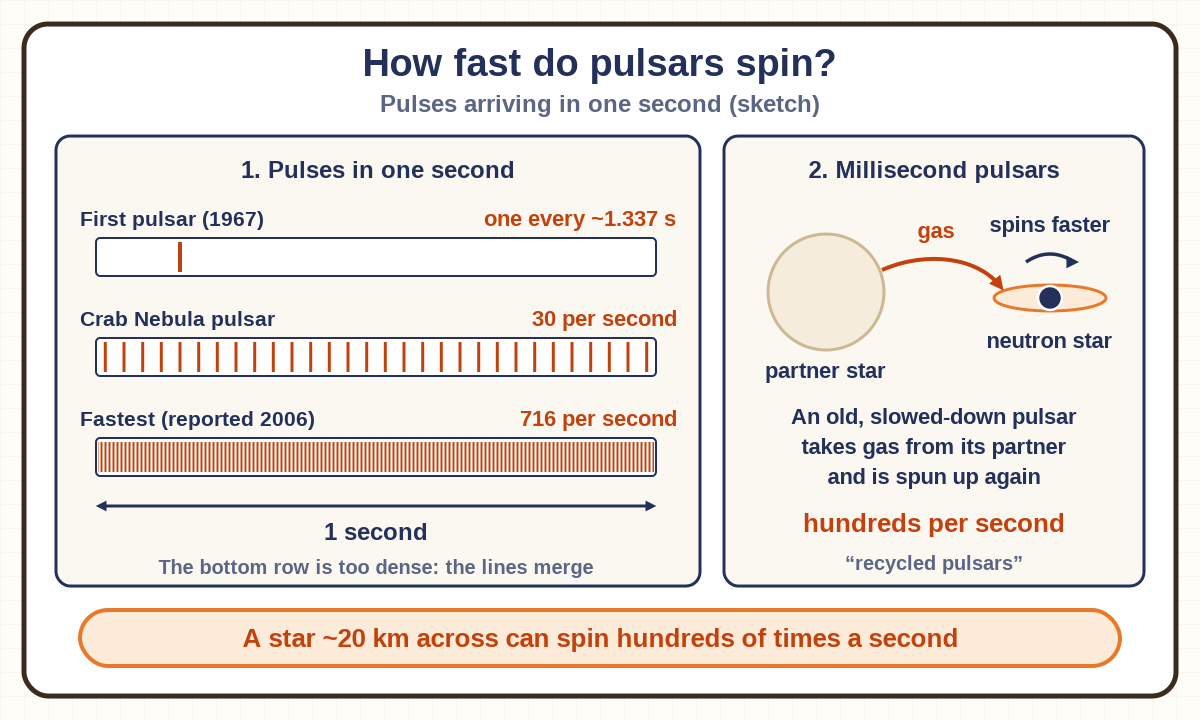
For most pulsars, the time between pulses ranges from about a thousandth of a second to several seconds. The first pulsar (CP1919) blinks about once every 1.337 seconds, and the Crab Nebula pulsar 30 times a second. A star about 20 km across is spinning that fast.
The fastest group, called millisecond pulsars (a millisecond is a thousandth of a second), spin hundreds of times a second. They are thought not to have been born that fast. When a partner star orbiting with a neutron star grows old and swells up, its gas falls onto the neutron star through a disk, giving it a push that gradually spins it faster. An old neutron star whose spin had slowed is spun back up this way and comes back to life as a pulsar, which is why these are also called “recycled pulsars.” Still, not every path by which they form is fully understood.
The fastest pulsar known, reported in 2006, lies in the globular cluster Terzan 5 (a ball-shaped swarm of many stars) and spins 716 times a second. It broke a record that had stood for 23 years, held by a pulsar spinning 642 times a second (PSR B1937+21).
How precise a clock is it, and what can it be used for?
Measured in December 1967, right after it was found, the first pulsar already kept time to better than 1 part in a million. The binary pulsar that Hulse and Taylor found in 1974 (explained below) had its period measured to 14 digits by 1993, rivaling the most accurate atomic clocks.
By comparing pulse arrival times with predictions year after year, tiny shifts reveal what is happening around a pulsar. In 1992, planets were discovered orbiting the millisecond pulsar PSR B1257+12 (which turns once every 6.2 thousandths of a second, about 160 times a second) from the way its pulses arrived. They were the first planets confirmed beyond our solar system, and three low-mass planets are now known there.
Pulsars can also guide spacecraft. In November 2017, NASA’s X-ray telescope NICER, aboard the International Space Station, tested working out its own position automatically using only the X-ray pulses of four pulsars. Within about 7.5 hours, it got its position error below 10 km.
What do pulsars have to do with gravitational waves?
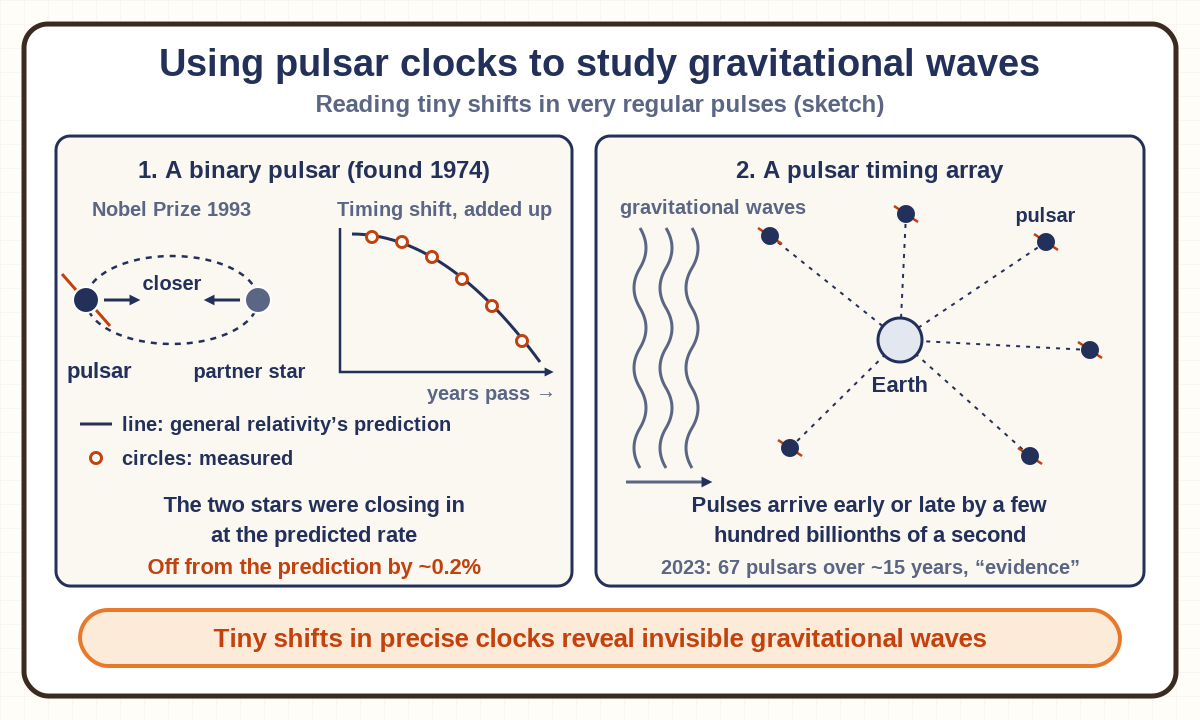
In 1974, at the Arecibo Radio Observatory in Puerto Rico, Russell Hulse and Joseph Taylor found a “binary pulsar” (PSR B1913+16): a pair of stars orbiting each other, one of which is a pulsar. It lies about 21,000 light-years from Earth. The pulsar spins about 17 times a second, and the two stars, each about as heavy as the Sun, orbit each other every 7 hours 45 minutes at a separation about the size of the Sun’s radius. With a precise clock moving fast in strong gravity, it was an ideal place to test general relativity.
Measured over many years, the two stars were drawing slowly closer at just the rate general relativity predicts for stars losing energy by giving off gravitational waves (ripples of distortion in spacetime). In a 2016 paper, the measured rate at which their orbital period shrinks differs from the predicted rate by only about 0.2%. This became the first evidence (indirect evidence) that gravitational waves exist, and in 1993 the two received the Nobel Prize in Physics “for the discovery of a new type of pulsar, a discovery that has opened up new possibilities for the study of gravitation.”
Today, many pulsars are used together to search for gravitational waves themselves, in a method called a pulsar timing array. When very slow gravitational waves, with periods of years to decades, stretch and squeeze the space between Earth and the pulsars, the pulses arrive ever so slightly early or late. If the shifts come from gravitational waves, how much any two pulsars’ shifts match should follow a set pattern that depends on how far apart they appear in the sky (the Hellings–Downs pattern). For example, pulsars that appear close together in the sky tend to shift the same way, while pulsars that appear about 90 degrees apart tend to shift in opposite ways.
In June 2023, the North American team NANOGrav announced evidence for shifts with this pattern in about 15 years of data on 67 pulsars. The shifts are a few hundred billionths of a second. Teams in Europe and India, Australia, and China reported hints of the same signal in their own data the same day. The source is thought to be the overlapping gravitational waves from many pairs of supermassive black holes orbiting each other across the universe (a gravitational-wave background), but other sources haven’t been ruled out.
Still, the paper was titled “Evidence for a Gravitational-Wave Background”; it did not claim a definite discovery. The chance of random noise producing shifts this well matched was estimated at somewhere between about 1 in 1,000 and about 1 in 20,000, depending on the method. A 2026 review also describes the field as having “evidence,” and observations continue.
Check yourself
Q1A pulsar is a fast-spinning neutron star. Why do its pulses reach Earth as regular blinks?
Answer and explanation
Answer: C A beam from the star sweeps past Earth each time it turns
Beams of radio waves and other radiation come out of a pulsar’s two magnetic poles all the time. Because the magnet’s axis is tilted from the spin axis, the beams sweep through space like a lighthouse beam as the star turns, and one pulse reaches Earth each time a beam goes by. The first paper in 1968 considered the whole star vibrating (swelling and shrinking), but it later became clear that the blinking comes from spinning. Nor are blasts repeating on its surface.
Q2Neutron stars called millisecond pulsars spin hundreds of times a second. How are they thought to have become so fast?
Answer and explanation
Answer: B They took gas from a partner star and were spun up
Millisecond pulsars are thought not to have been born that fast. Gas from a partner star falls through a disk onto an old neutron star whose spin had slowed, giving it a push that gradually spins it back up. That is why they are also called “recycled pulsars.” An ordinary pulsar shines by using up its spin, so it slowly slows down as it ages.
Q3Some researchers search for gravitational waves by measuring many pulsars all across the sky for years. When gravitational waves pass between Earth and the pulsars, what do they expect to happen?
Answer and explanation
Answer: A The pulses’ arrival time shifts slightly earlier or later
Gravitational waves are ripples of distortion in spacetime. When very slow gravitational waves, with periods of years to decades, pass by, the space between Earth and the pulsars stretches and squeezes, and the pulses arrive early or late by a few hundred billionths of a second. What researchers look for is not the pulses’ strength or direction but this shift in timing. The method is called a pulsar timing array, and in 2023, “evidence” for a gravitational-wave background was announced from about 15 years of data on 67 pulsars.
More on this → Key points: What do pulsars have to do with gravitational waves?
Related terms
- Neutron star
- Gravitational wave
- Long-period radio transient
- Atomic clock
- General relativity
- Supermassive black hole
- Quasar
- Spacetime
- Supernova
- White dwarf
- Magnetar
- Radio telescope
Sources and how we checked
- A. Hewish, S. J. Bell, J. D. H. Pilkington, P. F. Scott and R. A. Collins, “Observation of a Rapidly Pulsating Radio Source” (Nature 217, 709–713, February 24, 1968. Abstract on the Nature site: unusual signals from pulsating radio sources recorded at the Mullard Radio Astronomy Observatory, the radiation seeming to come from local objects within the galaxy and possibly being associated with oscillations of white dwarf or neutron stars. Editor’s summary on the same page: the first report of radio sources distinguished by rapid and extremely regular pulsations, now understood to be rapidly rotating, magnetized neutron stars, or pulsars. The full text could not be opened; the abstract, summary and author order were read; read November 26, 2026)
- A. Hewish, “Pulsars and High Density Physics” (Nobel Lecture, December 12, 1974; PDF read as text: planning a telescope of 2,048 dipoles over 18,000 m² to study interplanetary scintillation, graduate student Jocelyn Bell being responsible for the cables connecting the dipoles, the telescope being complete in July 1967 and surveying the sky at weekly intervals, the paper records from four recorders, Bell showing him a record of fluctuating signals around the middle of August 1967, the first evidence of regular pulses on November 28, consulting other observatories about possible interference, daily timing against time signals from December 11 showing the source kept time to better than 1 part in 10⁶, considering an artificial signal from a planet around a distant star until the Doppler shift turned out to be due to Earth’s motion alone, suggesting oscillations of a whole star, Bell finding further candidates in January 1968 and three more pulsars being confirmed before the paper was submitted on February 8, a 0.25 s pulsar making white dwarf explanations difficult, Gold [Nature 218, 1968] first suggesting rotating neutron stars and his prediction of lengthening periods being confirmed by the Crab Nebula pulsar, pulsed light from the remnant star, the loss of rotational energy matching the nebula’s light, more than 130 pulsars by 1974 giving overwhelming evidence for the lighthouse model, no other star being able to spin fast enough without fragmenting, radii of only 10 km, there being no satisfactory theory yet for the radio emission, theorists concentrating on a model in which the pulsar acts as a dynamo powered by its store of rotational energy, converting it into radiation and a flux of relativistic particles by means of the large magnetic field, and charges dragged from the stellar surface whose ordered motion generates the beamed radio waves; read November 26, 2026)
- Royal Swedish Academy of Sciences, “Antony Hewish” (prize laureate page: the 1974 Nobel Prize in Physics “for their pioneering research in radio astrophysics: Ryle for his observations and inventions, in particular of the aperture synthesis technique, and Hewish for his decisive role in the discovery of pulsars.” The Nobel Prize website’s own pages could not be opened from here; read November 26, 2026)
- University of Cambridge, “Journeys of discovery: pulsars” (interview with Jocelyn Bell Burnell: the first detection of radio signals from CP1919 on August 6, 1967, a string of pulses one and a third seconds apart on November 28, 1967, recording it as a joke as LGM for Little Green Men, the telescope being built to study radio emission from quasars and covering a space the size of 57 tennis courts, the 1974 Nobel Prize in Physics for the discovery of pulsars going to Antony Hewish and Martin Ryle, the citation for the 2018 Special Breakthrough Prize in Fundamental Physics, and the £2.3 million prize being used to help under-represented groups become physicists; read November 26, 2026)
- Rebecca Charbonneau, “Tick Tock, Pulsating Star” (National Radio Astronomy Observatory, August 6, 2018: Jocelyn Bell Burnell noticing a bit of “scruff” on the chart paper on August 6, 1967, a flash every 1.33730 seconds, the source being dubbed “LGM-1” as a joke between Hewish and Bell, the announcement in Nature the following February, and pulsars being highly magnetized, rapidly rotating neutron stars; read November 26, 2026)
- NASA Imagine the Universe!, “Neutron Stars” (NASA Goddard explainer, text updated March 2017: neutron stars forming when a massive star runs out of fuel and collapses and measuring about 20 km across, a typical neutron star’s magnetic field being trillions of times Earth’s, pulsars being rotating neutron stars observed to have pulses at very regular intervals typically ranging from milliseconds to seconds, strong magnetic fields funnelling jets of particles out along the two magnetic poles and these accelerated particles producing powerful beams of light, clouds of charged particles moving along the field lines, the magnetic field often not being aligned with the spin axis so that the beams are swept around as the star rotates, the lighthouse comparison, and gamma rays being beamed like a lighthouse beacon; read November 26, 2026)
- NASA Imagine the Universe!, “White Dwarf Stars” (a white dwarf being what stars like the Sun become after exhausting their nuclear fuel, a typical one being half as massive as the Sun yet only slightly bigger than Earth; read November 26, 2026)
- NASA Science, “Messier 1 (The Crab Nebula)” (Hubble Messier catalog, updated April 24, 2025: Chinese astronomers noticing a “guest star” in 1054 that was actually a supernova, the Crab Nebula lying 6,500 light-years away in Taurus, and a rapidly spinning neutron star, the ultra-dense core of the exploded star, at its center appearing to pulse 30 times per second as it rotates; read November 26, 2026)
- CSIRO ATNF Pulsar Catalogue, “Catalogue History” (version history of the pulsar catalogue: version 2.9.0 of October 6, 2026 listing 4,503 pulsars, with 110 new ones added; a query of that version sorted by period puts J1748−2446ad in Terzan 5 first, at about 0.001396 s [about 716 times a second]; read November 26, 2026)
- J. W. T. Hessels et al., “A Radio Pulsar Spinning at 716 Hz” (Science, 2006; arXiv abstract: the discovery with the Green Bank Telescope of a 716 Hz eclipsing binary radio pulsar in the globular cluster Terzan 5, the fastest-spinning neutron star ever found, breaking the 23-year-old record held by the 642 Hz pulsar B1937+21; read November 26, 2026)
- NASA HEASARC, “Millisecond Pulsars” (RXTE explainer, updated August 24, 2022: the fastest-spinning neutron stars being thought to gain their spin during a long accretion phase in which material is transferred from a binary companion, the material reaching the neutron star through an accretion disk and producing a torque that slowly spins it faster, up to a spin period of a few milliseconds; read November 26, 2026)
- K. Stovall, D. R. Lorimer and R. S. Lynch, “Searching for Millisecond Pulsars: Surveys, Techniques and Prospects” (Classical and Quantum Gravity, 2013; arXiv full text read as a PDF. Section 1: the evolutionary pathways leading to millisecond pulsars not being fully understood, and, in binaries that survive and where the companion evolves into a red giant, the old spun-down neutron star being revived as a pulsar by accreting matter from its companion and being spun up, such objects being called “recycled pulsars”; read November 26, 2026)
- R. A. Hulse, “The Discovery of the Binary Pulsar” (Nobel Lecture, December 8, 1993; PDF read as text: the average of a few hundred pulses having a stable shape unique to each pulsar, like a human fingerprint, reflecting its magnetic field geometry, the pulses lasting typically a few percent of the period, pulsars being extraordinarily precise clocks, with the period of PSR 1913+16 measured to 14 significant places, rivaling the most accurate atomic clocks, the discovery during the Arecibo search of a 59 ms pulsar in data taken on July 2, 1974, the binary’s orbital period of 7 h 45 min, and the system, with an orbital velocity of about 0.001 of the speed of light, an orbit about the size of the Sun’s radius and masses of about a solar mass, being a nearly ideal relativity laboratory with an accurate clock in a strong gravitational field; read November 26, 2026)
- LIGO (Caltech), “What are Gravitational Waves?” (Hulse and Taylor discovering, in 1974 with the Arecibo Radio Observatory in Puerto Rico, a binary pulsar 21,000 light-years from Earth, the change in its orbital period verifying that the stars were getting closer at the rate general relativity predicts if they radiate gravitational waves, this being the first proof that gravitational waves exist, and the two receiving the 1993 Nobel Prize in Physics “for the discovery of a new type of pulsar, a discovery that has opened up new possibilities for the study of gravitation”; read November 26, 2026)
- J. M. Weisberg and Y. Huang, “Relativistic Measurements from Timing the Binary Pulsar PSR B1913+16” (The Astrophysical Journal 829, 55, 2016; arXiv abstract: the ratio of the observed orbital period decrease due to gravitational wave damping to the general relativistic prediction being 0.9983 ± 0.0016, confirming the existence and strength of gravitational radiation; read November 26, 2026)
- A. Wolszczan and D. A. Frail, “A planetary system around the millisecond pulsar PSR1257 + 12” (Nature 355, 145–147, January 9, 1992; abstract on the Nature site: timing the 6.2 ms pulsar PSR1257+12 with the Arecibo radio telescope and concluding that at least two planet-sized bodies orbit it; read November 26, 2026)
- A. Wolszczan, “PSR B1257+12 and the first confirmed planets beyond the solar system” (Handbook of Exoplanets, Springer, 2018; abstract on the Penn State page: survey and timing observations in early 1990 with the Arecibo radio telescope leading to the discovery of the first confirmed extrasolar planetary system, consisting of three low-mass planets orbiting the 6.2 ms millisecond pulsar PSR B1257+12; read November 26, 2026)
- NASA HEASARC, “NICER Nuggets: 17 Nov 2017” (November 17, 2017: the SEXTANT team demonstrating fully autonomous, real-time X-ray pulsar navigation on board NICER on the International Space Station, in a 2.2-day experiment starting November 9, 2017, using four pulsars and reaching an error under 10 km in about 7.5 hours; read November 26, 2026)
- NANOGrav, release page for the 15-year data set (June 28, 2023: evidence for gravitational waves with periods of years to decades from 15 years of data on 68 pulsars, pulses being very stable and useful as precise cosmic timepieces, the fastest millisecond pulsars spinning hundreds of times each second, gravitational waves shifting pulse arrival times slightly, with the shifts correlated for pairs of pulsars in a way that depends on how far apart they appear in the sky, the signal possibly coming from pairs of supermassive black holes but other sources also being possible, and the Australian, Chinese and European/Indian arrays reporting hints of the same signal; read November 26, 2026)
- G. Agazie et al. [NANOGrav], “The NANOGrav 15-year Data Set: Evidence for a Gravitational-Wave Background” (The Astrophysical Journal Letters, 2023; arXiv abstract: evidence for a stochastic signal correlated among 67 pulsars, the correlations following the Hellings–Downs pattern expected for a gravitational-wave background, false-alarm probabilities of about 10⁻³ [about 3σ] or 5×10⁻⁵ to 1.9×10⁻⁴ [about 3.5–4σ] depending on the method, consistency with a population of supermassive black-hole binaries, and more exotic sources not being excluded. Section 3 of the full text, read as a PDF: the Hellings–Downs pattern crossing zero at separations of 49.2° and 121.8°, with its minimum at 82.5°; read November 26, 2026)
- U.S. National Science Foundation, “Gravitational waves from colossal black holes found using ‘cosmic clocks’” (June 29, 2023: 15 years of data and a “detector” of 67 pulsars across the sky, the stretching and squeezing of space between Earth and the pulsars making radio pulses arrive billionths of seconds earlier or later than expected, the apparent pulsar time shift measured by NANOGrav being a few hundred billionths of a second, and the likely source being pairs of close-orbiting, ultra-massive black holes; read November 26, 2026)
- C. M. F. Mingarelli et al., “Pulsar timing arrays: the emerging gravitational-wave landscape” (arXiv, 2026; abstract: pulsar timing array experiments having entered a new era with evidence for a nanohertz gravitational-wave background; read November 26, 2026)
AI wrote this page from the sources above, and a different AI checked it against the text of those sources (November 26, 2026). A person with a master’s degree in science and a Japanese high-school science teaching license also read and checked it before publishing. Numbers are as of that date. If anything was hard to follow, you spot a mistake, or there’s a term you’d like explained, please write to [email protected].
Glossary
- AI agent
- AI alignment
- Alignment faking
- Artificial general intelligence (AGI)
- Artificial intelligence (AI)
- Backdoor
- Benchmark
- Chain of thought (CoT)
- Context window
- Data poisoning
- Deep learning
- Deepfake
- Diffusion model
- Embedding
- Emergent misalignment
- Evaluation awareness
- Fine-tuning
- Formal verification
- Generalization
- Generative adversarial network (GAN)
- Generative AI
- Goodhart’s law
- Gradual disempowerment
- Hallucination
- Hyperparameter
- Intelligence explosion
- Interpretability
- Jailbreaking
- Large language model (LLM)
- Latent space
- Machine learning
- Mixture of experts (MoE)
- Neural network
- Neuralese
- Overfitting
- Parameter
- Persona vectors
- Pre-training
- Prompt
- Prompt injection
- Reasoning model
- Recursive language model (RLM)
- Recursive self-improvement (RSI)
- Red teaming
- Reinforcement learning (RL)
- Retrieval-augmented generation (RAG)
- Reward hacking
- Reward model
- Shutdown resistance
- Sleeper agent
- Subliminal learning
- Superintelligence (ASI)
- System prompt
- Technological singularity
- Time horizon
- Token
- Transfer learning
- Transformer
- Accretion disk
- Black hole
- Black hole star
- Cosmic birefringence
- Event horizon
- Event Horizon Telescope (EHT)
- General relativity
- GPS
- Gravitational lensing
- Gravitational singularity
- Gravitational wave
- James Webb Space Telescope (JWST)
- Lagrange point
- Long-period radio transient (LPT)
- Neutron star
- You are herePulsar
- Quasar
- Sagittarius A*
- Space data center
- Spacetime
- Special relativity
- Speed of light
- Supermassive black hole
- White dwarf