
Home › Glossary › Everyday science
What is a clinical trial (chiken), testing a new drug in people for approval in Japan?
Also called: Chiken

In one minute
In Japan, chiken (治験) is a clinical trial that tests the effectiveness and safety of a new drug or similar product in people and gathers the results used to apply for government approval.
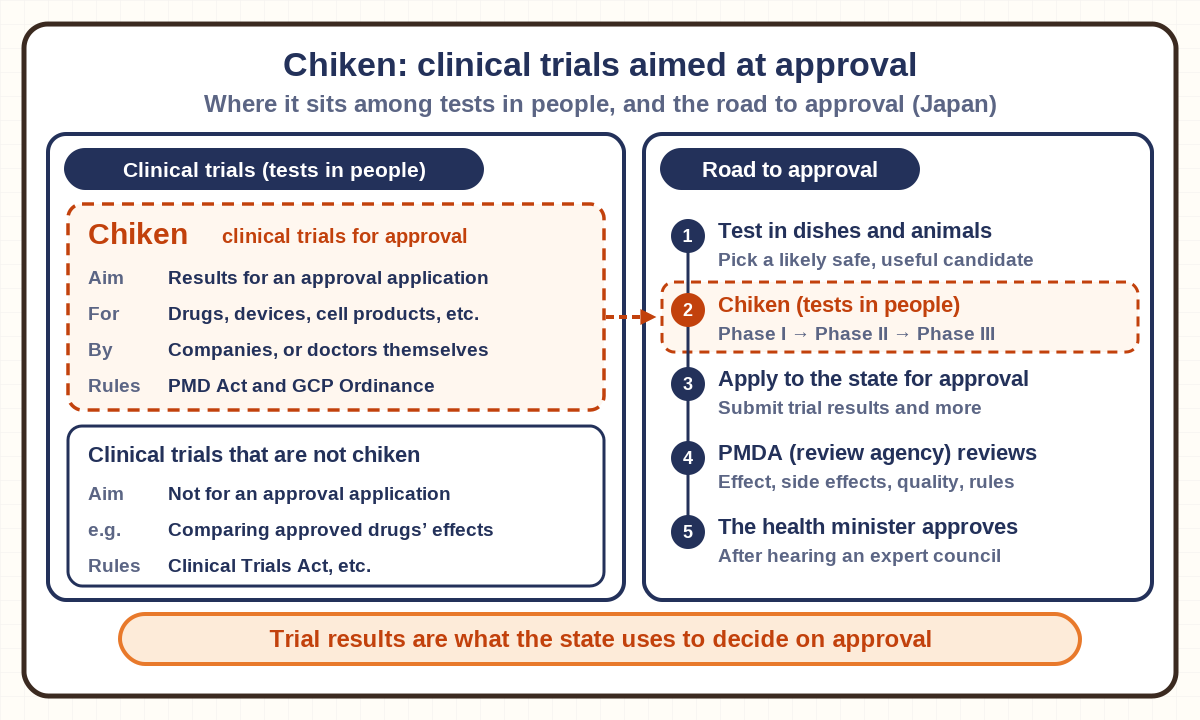
“Approval” means the government agrees that a product may be sold as a drug or the like for that disease; an “application” is the request asking for it. Any study that tries out treatments in people is called a clinical trial. Chiken means only those whose results go into an approval application. Besides drugs, it covers medical devices and regenerative medicine products (products made by growing cells and the like, for regenerative medicine and more). The drug in a chiken is still a “candidate” whose effectiveness and safety are being checked.
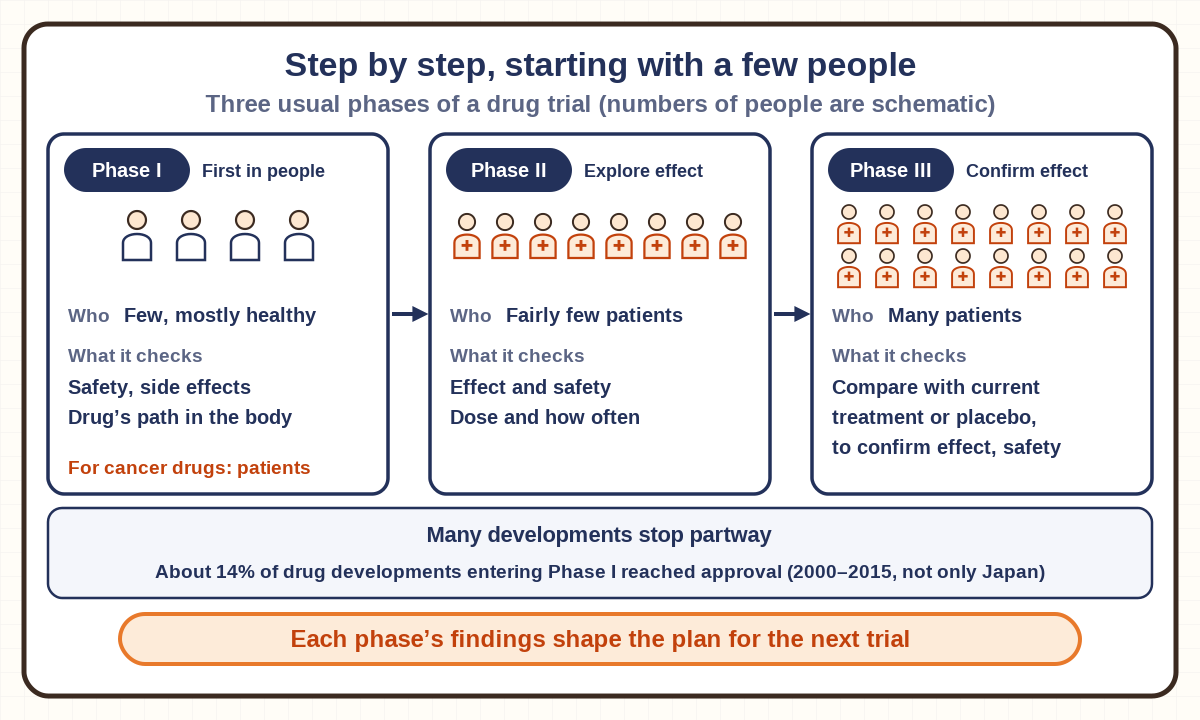
A drug trial usually moves through three phases: Phase I checks, in a few healthy people, safety and how the drug spreads through the body and leaves it; Phase II looks for effectiveness and the right dose in a relatively small number of patients; and Phase III confirms it in many patients against current treatment or a fake drug (placebo). Joining requires written consent, and people can quit at any time.
A common mix-up
“A chiken is a ‘human experiment’ that tries drugs of unknown effect on people, with no rules to protect them.”
Half right. The drug in a trial is still a candidate whose effectiveness and safety are being checked, and it is indeed tried in people; unexpected side effects can occur. But it is not an experiment without rules. The plan is filed with the government in advance, an institutional review board at the hospital or elsewhere (which must include people who are not medical experts and people with no ties to the hospital) reviews it, and the trial starts only after the person has received a written explanation and agreed in writing. Participants can quit at any time without being treated unfairly for it. Serious side effects are reported to the government, and compensation for health damage is arranged in advance.
Explained in pictures
Free to use in lessons, slides and posts with credit (CC BY 4.0).
Free to use in lessons, slides and posts with credit (CC BY 4.0).
Free to use in lessons, slides and posts with credit (CC BY 4.0).
You’re free to use these figures in lessons, slides and posts if you credit Naru News (naru.news). CC BY 4.0.
Think of it like this
A taste test with the labels hidden
Suppose you want to find out whether a new juice tastes better than the one already on sale. You could have people drink both and score them. But if they know which one is new, they may enjoy it more because they expect to, or score it more harshly.
So you write only a number on each cup and do not tell the tasters which juice is which. It is safer if the person pouring does not know either, since their face or words might give it away, or they might hand the new one to people they like. Who gets which cup is decided by lottery.
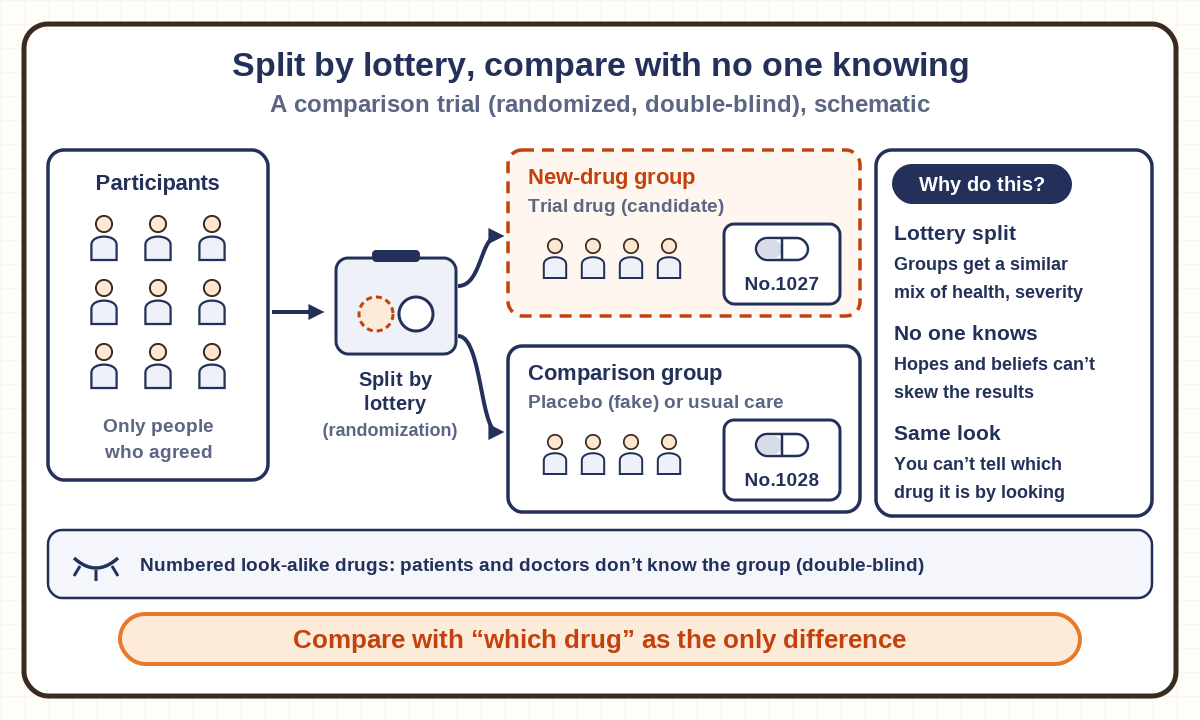
Comparing drugs in a clinical trial works the same way. A lottery decides which group each person joins (randomization), and same-looking drugs keep both the person and the doctor from knowing which is which (double-blinding). The comparison is a fake drug with no active ingredient (placebo) or the current treatment.
But the comparison has limits. Juice is safe to drink, but a drug candidate can cause unexpected side effects. That is why a trial moves step by step from a small number of people, its plan is filed with the government and reviewed by a board, and only people who understand it well and agree in writing take part. When it is truly needed for a participant’s care, the doctor can also find out which group that person is in.
Key points
How does it differ from “clinical trials” and “clinical research”?
The key is a big box and a small box. All tests in people make up the big box, “clinical trials.” Only those that collect results for a government approval application form the small box, chiken (the Japanese word for them).
Chiken is not only about new, unapproved drugs. Trials aimed at approving medical devices or regenerative medicine products, and trials to let an already approved drug be used for another disease, are chiken too.
In Japanese law (the Clinical Trials Act, in force since April 2018), “clinical research” means research that is not chiken and that uses drugs and the like in people to check their effectiveness or safety. For example, a study comparing how well approved drugs work is clinical research.
The rules differ as well. Chiken follows the PMD Act (Japan’s law on medicines, medical devices and the like) and the detailed rules the government set under it (the GCP Ordinance). Clinical research follows the Clinical Trials Act and other rules.
What do Phases I, II and III each check?
A drug candidate is first tested in test tubes and in animals to see whether it is likely to work against the disease and to be safe in people. Only candidates chosen this way move on to tests in people. A drug trial usually proceeds in three phases.
Phase I is when the candidate is used in people for the first time. With the protection of participants as the top priority, a small number of people are checked for safety and side effects, and for how the drug spreads through the body after it goes in and how it leaves. Most participants are healthy adults. But in trials of cancer drugs and the like, patients take part from Phase I, starting with a small dose and raising it bit by bit.
Phase II checks effectiveness and safety in a relatively small number of patients and settles the dose and how often to give it in the next phase. Phase III confirms effectiveness and safety in many patients by comparing the drug with current standard treatment or a fake drug (placebo). This is mainly where the results that support approval are gathered.
These three phases are a common pattern, not a fixed rule. What is learned in one phase is used to plan the next trial, and the aims of two phases may be combined in one trial. For rare cancers and other diseases with few patients, an approval application may be based on Phase II results.
Many developments stop partway. A 2019 study of clinical trial data from 2000 to 2015, not limited to Japan and covering more than 21,000 drug candidates, found that of companies’ developments that entered Phase I (each one a single drug for a single disease), about 14% reached approval. A drug that enters a trial does not necessarily become a drug that works.
How are comparisons made fair? (Placebos, lotteries and double-blinding)
Even if a disease gets better after a drug is used, that alone does not show the drug was the reason. The disease may have improved on its own, or the patient’s and doctor’s expectation that it “should work” may have changed how symptoms were felt or judged. So besides a group that gets the new drug, a comparison group is set up, and the results of the two groups are compared.
The comparison group gets either current standard treatment or a fake drug (placebo) that looks the same as the trial drug but has no active ingredient. But when a serious disease already has a treatment shown to work, people in a placebo group would miss out on that treatment, so comparing with a placebo may be considered morally wrong (unethical). In that case, comparing with the treatment that works is considered instead.
Which group each person joins is decided by chance, like a lottery. This is called randomization, and a trial that compares groups this way is called a randomized controlled trial. Splitting by chance tends to give both groups a similar share of features that may affect the results, such as how severe the disease is or a person’s constitution, whether those features are known or not. If doctors chose the groups, they might, without meaning to, put milder cases in one group.
In addition, neither the participants nor the doctors who treat or assess them know who is in which group. This is called double-blinding. In many cases, the drugs reach the hospital in identical-looking boxes marked only with numbers. Knowing the group could, even without anyone meaning to, change how symptoms are felt, how they are assessed and how people who drop out are handled, skewing the results. Japan’s guideline says randomization and blinding should be used in most comparison trials meant for approval applications.
Still, when the doctor in charge thinks that knowing the group is truly essential for a participant’s care, that person’s group can be revealed.
How are participants protected?
Chiken puts the human rights of participants first and follows Japan’s law and the government’s detailed rules. There are four main safeguards.
Hearing an explanation and agreeing in writing: The doctor hands over and explains a document describing the purpose and methods, the expected good and bad points (such as side effects), other treatments and more. The trial does not start until the person freely agrees in writing (this explanation and consent is called informed consent). People can ask questions until they are satisfied and can take the document home to talk it over with family.
Quitting at any time: Taking part is the person’s own choice, and they can quit at any time. Not joining or quitting brings no unfair treatment. During the trial, participants are told about side effects seen in other participants and asked again whether they wish to continue.
Checks by the government and a board: The plan is filed with the government in advance; the government examines it and orders changes if there are problems. An institutional review board at the hospital or elsewhere also reviews the plan before the trial starts. The board must include people who are not medical experts and people with no ties to the hospital. After the trial starts, it reviews at least once a year whether the trial may continue. If a serious unknown side effect occurs, the board reviews whether to continue, and the government is told as well.
Preparing for compensation for health damage: A company requesting a trial must arrange insurance or other measures in advance to compensate participants for health damage (compensation is not paid when, for example, a link to the trial drug can be clearly ruled out). The law also forbids revealing personal secrets learned through a trial.
Even so, the risk is not zero. The trial drug is still being checked, so unexpected side effects can occur. That is why it matters to read the explanation carefully and ask questions until everything is clear before deciding.
What is the money participants receive (the burden-reduction payment) for?
Taking part in a trial can mean more hospital visits and tests than usual treatment. So participants may receive a “burden-reduction payment” (futan keigen hi), for example each time they make a visit set out in the plan. Under hospital rules, it is money to lighten the physical, mental and financial burdens of taking part, such as travel costs.
The amount varies by hospital and trial. For example, the rules at one university hospital set it at, as a rule, 10,000 yen per visit set out in the plan. The same rules ask that care be taken so that the amount is not so large that money becomes what makes people decide to join.
In other words, the payment differs in purpose from a wage (like pay for a part-time job) based on hours worked or results. Trials with healthy volunteers are sometimes called “chiken part-time jobs” in Japan, but participants are not taking on a job; they are helping with drug development.
As for costs, the company that requested the trial may pay for tests during the period the trial drug is used and for some drugs. Some hospitals explain that there is no charge for the trial drug itself. Other medical costs are paid with health insurance as usual.
Trials newly started in Japan are listed on a government website for registering chiken and clinical research (jRCT), which anyone can view. So people can look up what trials are under way themselves, not only through hospitals’ recruitment notices.
How does approval follow the trial? What is a doctor-led trial?
When the trial is finished, the company or other developer applies to the government for approval, attaching the trial results along with material on quality, animal tests and more. Japan’s review agency (PMDA) reviews effectiveness, side effects and quality, and also checks whether the material was produced following the trial rules and other standards. After hearing an expert council, the Minister of Health, Labour and Welfare decides whether to approve. Only after approval does it become a “drug” that can be used for that disease.
There are two kinds of chiken: company-sponsored trials, which drug companies and others plan and ask hospitals to carry out, and doctor-led trials (investigator-initiated trials), which doctors plan and run themselves as researchers. Doctor-led trials are common for rare cancers and other diseases with few patients.
Checks continue after approval. The government and the company keep studying how the product is used and keep up safety measures after sales begin. For regenerative medicine products, there is also a system that grants early approval with conditions and a time limit when effectiveness can be presumed and safety confirmed from a trial with a limited number of people, and then keeps checking effectiveness.
Check yourself
Q1In a Japanese clinical trial (chiken), the hospital may pay participants a set amount for each visit set out in the plan (as a rule, 10,000 yen per visit at one university hospital). Under hospital rules, what is this money for?
Answer and explanation
Answer: B Money paid to ease burdens such as visits
This money is called the burden-reduction payment. Under hospital rules, it lightens the physical, mental and financial burdens of taking part, such as travel costs, because trials can mean more visits and tests than usual. It differs in purpose from a wage (like part-time pay), and some hospitals ask that the amount be set with care so that it does not become a reason to join. Compensation for health damage is separate: the company requesting the trial arranges it in advance through insurance and the like, and it is not money paid ahead at each visit.
Q2In a trial of a new drug, participants are split into two groups by chance, and neither the participants nor the doctors are told who is in which group. What is the main purpose of this method?
Answer and explanation
Answer: C To keep hopes and beliefs from skewing the results
Splitting by chance, like a lottery (randomization), tends to give both groups a similar share of features that may affect the results, such as disease severity and constitution. If doctors chose, they might, without meaning to, put milder cases in one group. And when neither the participants nor the doctors know the groups (double-blinding), hopes and beliefs cannot change how symptoms are felt or assessed. Keeping participants’ secrets matters too, but other rules protect that.
More on this → Key points: How are comparisons made fair? (Placebos, lotteries and double-blinding)
Q3A trial of a new drug usually moves through Phases I, II and III. In which phase do healthy people most often take part?
Answer and explanation
Answer: A Phase I, when a candidate is first given to humans
Phase I is when a drug candidate is first used in people. Most participants are a small number of healthy adults, checked for safety, side effects and how the drug is absorbed and leaves the body. But for cancer drugs and the like, patients take part from Phase I. Phase II looks for effectiveness and the dose in a relatively small number of patients, and Phase III confirms the drug in many patients against current treatment or a placebo.
More on this → Key points: What do Phases I, II and III each check?
Related terms
- Regenerative medicine
- iPS cell
- Clinical research
- Placebo
- Double-blind trial
- Randomized controlled trial
- Informed consent
- Investigator-initiated trial
Sources and how we checked
- Japan, Act on Securing Quality, Efficacy and Safety of Products Including Pharmaceuticals and Medical Devices (PMD Act; in Japanese; Act No. 145 of 1960; Article 2(18) [definition of chiken: carrying out a trial to collect data on clinical trial results among the materials to be submitted under Articles 14(3), 23-2-5(3) and 23-25(3); paragraph 18 in the version of that day] and Article 80-2 [para. 2: those who intend to request a trial or run one themselves must file the plan with the health minister in advance; para. 3: a first filer for that product may not start until 30 days after filing, during which the minister investigates to prevent harm; para. 6: reporting suspected side-effect illnesses, disabilities and deaths; para. 9: instructions to prevent harm; para. 10: not revealing personal secrets learned through the trial]; read November 21, 2026 on e-Gov Laws via its API)
- Japan, Ministerial Ordinance on Good Clinical Practice for Drugs (GCP Ordinance; in Japanese; MHW Ordinance No. 28 of 1997; Article 14 [a sponsor must arrange insurance or other measures in advance to compensate participants for health damage], Article 28 [review boards of at least five members, including people without medical or clinical trial expertise and people with no ties to the institution or the board’s founder], Article 31 [for trials lasting over a year, the head of the institution asks the review board at least once a year whether the trial may continue], Article 50 [explaining with a written document and obtaining written consent beforehand; giving chances to ask questions and full answers] and Article 51 [what the document must state: that the trial is for testing, purpose, methods, expected benefits and disadvantages, other treatments, duration, that one may quit at any time, no unfair treatment for not joining or quitting, confidentiality, compensation for health damage, the review board, costs borne by participants, plain wording]; read November 21, 2026 on e-Gov Laws via its API)
- Japan, Clinical Trials Act (in Japanese; Act No. 16 of 2017; Article 2(1) [clinical research: research that clarifies the effectiveness or safety of drugs and the like by using them in people, excluding chiken under Article 80-2(2) of the PMD Act and others] and Article 2(2) [specified clinical research: research funded by manufacturers and the like that uses their own products, or using unapproved products or products in unapproved ways, except ways set by ordinance as no riskier than the approved ones]; read November 21, 2026 on e-Gov Laws via its API)
- Ministry of Health, Labour and Welfare (MHLW), Japan, “On the Clinical Trials Act” (in Japanese; promulgated April 14, 2017 and in force April 1, 2018; covering clinical research that uses drugs and the like in people; jRCT as the system for procedures under the Act, which publishes information for transparency and to help people choose to take part, and where chiken and clinical research can be searched; read November 21, 2026)
- MHLW, Japan, “About chiken (for the general public), 1. What is chiken?” (in Japanese; drug candidates chosen from substances expected in test-tube and animal experiments to work and to be safe in people; testing effect and safety in people with the help of healthy people and patients at the final stage of development; tests in people generally called clinical trials, and the clinical trials that collect results for government approval of a drug candidate called chiken in particular; read November 21, 2026)
- MHLW, Japan, “About chiken (for the general public), 2.” (in Japanese; participants’ human rights put first; following the Pharmaceutical Affairs Act and GCP; companies filing trial protocols with the ministry, which examines them and orders changes if there are problems; review boards checking that plans protect participants’ rights and welfare and are scientifically sound, always including people who are not medical professionals and people with no ties to the hospital; written consent; reporting previously unknown serious side effects to the government; checks by monitors; read November 21, 2026)
- MHLW, Japan, “About chiken (for the general public), 3. Informed consent” (in Japanese; no trial starts without freely given written consent; this explanation and consent called informed consent; what the explanation document contains [purpose, methods, expected effects and side effects, the right to quit at any time without disadvantage, the right to claim compensation]; asking questions until satisfied and taking the document home to consult family; read November 21, 2026)
- MHLW, Japan, “About chiken (for the general public), 5. Care about side effects in chiken” (in Japanese; review boards reviewing before the start and at least once a year after; deaths and unknown serious side effects promptly reported to the board and the company, the board deciding whether to continue, and the company reporting to the government within set deadlines and revising the trial if needed; participants told of side effects seen in others and asked whether to continue; read November 21, 2026)
- MHLW, Japan, “About chiken (for the general public), 6. For patients taking part” (in Japanese; more hospital visits and tests than usual treatment; the requesting company paying for tests during the trial-drug period and some drug costs; help with travel costs within limits; read November 21, 2026)
- Osaka Prefectural Government, Japan, “What is chiken? (Basics)” (in Japanese; chiken as clinical trials that scientifically check the effect and safety of new drugs and treatments, the last stage before approval; Phase I mainly checking safety and pharmacokinetics in a small number of healthy adults and others, Phase II effect and safety in a relatively small number of patients, and Phase III effect and safety in many patients against standard drugs or placebo; read November 21, 2026)
- National Cancer Center Hospital East, Japan, “What are chiken and clinical research?” (in Japanese; chiken as clinical trials using unapproved drugs or drugs for unapproved uses with the aim of approval by the health ministry; company-sponsored trials and doctor-led trials, the latter common for rare cancers; in cancer trials, patients asked to join from Phase I, with doses raised step by step from small amounts; applications sometimes based on Phase II results for rare cancers; Phase III usually splitting patients at random into two or more groups to compare with standard treatment, or with a placebo that cannot be told apart from the trial drug if there is none; read November 21, 2026)
- National Cancer Center Hospital East, Japan, FAQ (in Japanese; no charge for the trial drug; chiken allowed alongside insured care; read November 21, 2026)
- National Cancer Center Hospital, Japan, FAQ (in Japanese; the burden-reduction payment sometimes paid for each visit for tests or exams set by the trial, to lighten costs such as travel; the sponsor sometimes paying for the trial drug and tests during dosing, with other medical costs paid by the patient according to their health insurance; a placebo as a fake drug that looks the same but has no active ingredient; in company-sponsored trials the company compensating health damage caused by the trial, except where a causal link with the trial drug can be clearly ruled out; participation being voluntary; read November 21, 2026)
- Yokohama City University Hospital, Japan, rules on paying burden-reduction payments to trial participants (in Japanese; revised September 5, 2025; Article 1 [money to lighten the mental, physical and financial burdens of taking part] and Article 9 [as a rule 10,000 yen per outpatient visit set in the protocol, and careful consideration so that excessive payments do not become a psychological inducement to take part]; read November 21, 2026 in the PDF text)
- MHLW, Japan, notice revising the General Considerations for Clinical Studies (in Japanese; notice 1223-5, December 23, 2022; ICH E8(R1); participant protection always the top priority in first-in-human use (usually called Phase 1), which may involve healthy volunteers or patients; early safety and tolerability and pharmacokinetics; exploratory and confirmatory studies (usually called Phases 2 and 3), whose aims may be combined in one or several studies; confirmatory studies providing the basis for approval; and the main purpose of a control group being to tell the treatment’s effect apart from the natural course of disease and from the expectations of assessors or patients; read November 21, 2026 in the PDF text)
- Ministry of Health and Welfare, Japan, notice on Statistical Principles for Clinical Trials (in Japanese; notice 1047, November 30, 1998; ICH E9; section 2.3 [blinding and randomization as the most important design techniques for avoiding bias, to be used in most comparative trials for approval applications, with trial drugs packed in advance and labeled only with participant numbers and treatment periods], 2.3.1 [blinding to limit conscious and unconscious bias; double-blind trials as those in which participants and the doctors and sponsor staff who treat or assess them do not know the assignment; treatments that cannot be told apart by look or taste; revealing an assignment only when the treating doctor thinks it essential for the participant’s care], 2.3.2 [randomization helping to form groups with similar distributions of known and unknown prognostic factors] and 3.3.1 [placebo-controlled trials may be considered unethical for serious diseases with proven treatments]; read November 21, 2026 in the PDF text)
- MHLW, Japan, “On speeding up reviews of new drugs and medical devices” (in Japanese; July 30, 2012; the development flow [nonclinical tests, clinical trials, application], application materials [quality, toxicity, pharmacology, absorption, distribution, metabolism and excretion, and clinical (Phases I, II and III)], approval review and reliability checks by PMDA, consultation with and report from the Pharmaceutical Affairs and Food Sanitation Council, approval by the health minister, and post-marketing safety measures and surveys; read November 21, 2026 in the PDF text)
- Pharmaceuticals and Medical Devices Agency (PMDA), Japan, “Outline of review-related work” (in Japanese; approval reviews of drugs, medical devices and regenerative medicine products; receiving trial-plan filings and side-effect and malfunction reports; reliability checks of whether application materials followed GLP, GCP and other standards; and early, conditional and time-limited approval of regenerative medicine products when effectiveness is presumed and safety confirmed; read November 21, 2026)
- MHLW, Japan, “Outline of the Act Partially Amending the Pharmaceutical Affairs Act (Act No. 84 of 2013)” (in Japanese; explanatory slides; p. 5 [non-uniform regenerative medicine products may be approved early, with conditions and a time limit, when effectiveness is presumed and safety confirmed, with effectiveness and safety verified again after approval; the time limit is in principle no more than seven years, and a new application must be made within it] and p. 12 [effectiveness presumed from a limited number of cases in a shorter time than usual]; read November 21, 2026 in the PDF text)
- MHLW, Japan, 19th meeting of the Clinical Research Committee, reference material 2, status of public release of jRCT registration data (in Japanese; January 13, 2021, as of December 1, 2020; trial registration had been split among JAPIC, JMACCT and jRCT, but under the notice accompanying the August 31, 2020 amendment of the PMD Act’s enforcement regulations, newly started chiken are registered only in jRCT; read November 21, 2026 in the PDF text)
- Wong, Siah and Lo, “Estimation of clinical trial success rates and related parameters” (Biostatistics 20(2), pp. 273–286, 2019; abstract [406,038 clinical trial records for more than 21,143 compounds from January 1, 2000 to October 31, 2015] and main text [data drawn from both US and non-US sources; counting each drug for a single indication as one development program, 13.8% of all industry programs eventually led to approval; 6.9% when phase-by-phase rates are multiplied]; full text on Europe PMC [PMC6409418], read November 21, 2026)
AI wrote this page from the sources above, and a different AI checked it against the text of those sources (November 21, 2026). A person with a master’s degree in science and a Japanese high-school science teaching license also read and checked it before publishing. Numbers are as of that date. If anything was hard to follow, you spot a mistake, or there’s a term you’d like explained, please write to [email protected].
Glossary
- AI agent
- AI alignment
- Alignment faking
- Artificial general intelligence (AGI)
- Artificial intelligence (AI)
- Backdoor
- Benchmark
- Chain of thought (CoT)
- Context window
- Data poisoning
- Deep learning
- Deepfake
- Diffusion model
- Embedding
- Emergent misalignment
- Evaluation awareness
- Fine-tuning
- Formal verification
- Generalization
- Generative adversarial network (GAN)
- Generative AI
- Goodhart’s law
- Gradual disempowerment
- Hallucination
- Hyperparameter
- Intelligence explosion
- Interpretability
- Jailbreaking
- Large language model (LLM)
- Latent space
- Machine learning
- Mixture of experts (MoE)
- Neural network
- Neuralese
- Overfitting
- Parameter
- Persona vectors
- Pre-training
- Prompt
- Prompt injection
- Reasoning model
- Recursive language model (RLM)
- Recursive self-improvement (RSI)
- Red teaming
- Reinforcement learning (RL)
- Retrieval-augmented generation (RAG)
- Reward hacking
- Reward model
- Shutdown resistance
- Sleeper agent
- Subliminal learning
- Superintelligence (ASI)
- System prompt
- Technological singularity
- Time horizon
- Token
- Transfer learning
- Transformer
- Accretion disk
- Black hole
- Black hole star
- Cosmic birefringence
- Event horizon
- Event Horizon Telescope (EHT)
- General relativity
- GPS
- Gravitational lensing
- Gravitational singularity
- Gravitational wave
- James Webb Space Telescope (JWST)
- Lagrange point
- Long-period radio transient (LPT)
- Neutron star
- Pulsar
- Quasar
- Sagittarius A*
- Space data center
- Spacetime
- Special relativity
- Speed of light
- Supermassive black hole
- White dwarf