
What is quantum entanglement (particles linked as a pair, even when far apart)?
Also called: Entanglement, Entangled state

In one minute
Quantum entanglement is when two or more particles (such as particles of light, electrons or qubits) are in a state that can’t be written down one particle at a time, only for the group as a whole.
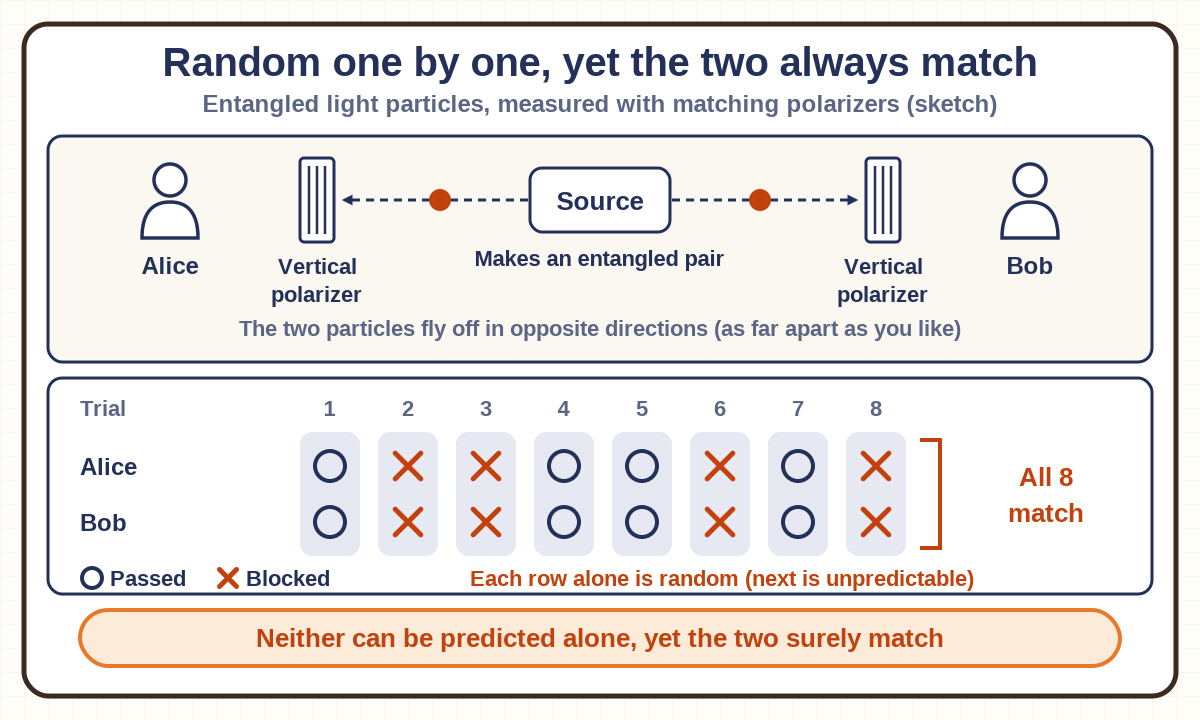
For example, measure two entangled particles of light with polarizers (plates that let light through or block it, depending on the direction the light vibrates in) set the same way on each side: whether each one passes or is blocked is random every time, yet when you compare them, they always match, however far apart they are. This is also not the same as “the answers were set from the start; we just didn’t know.” In 1964, Bell showed from quantum mechanics that when you vary the measuring directions, the results should match more strongly than any such setup could, and experiments later confirmed it.
Still, measuring one side leaves the other side’s results just as random, so no message can be sent faster than light. Entanglement is used in quantum computers and quantum cryptography, and the experiments that tested it won the 2022 Nobel Prize in Physics.
A common mix-up
“Measure one particle, and a message reaches the other instantly. So it can be used to communicate faster than light.”
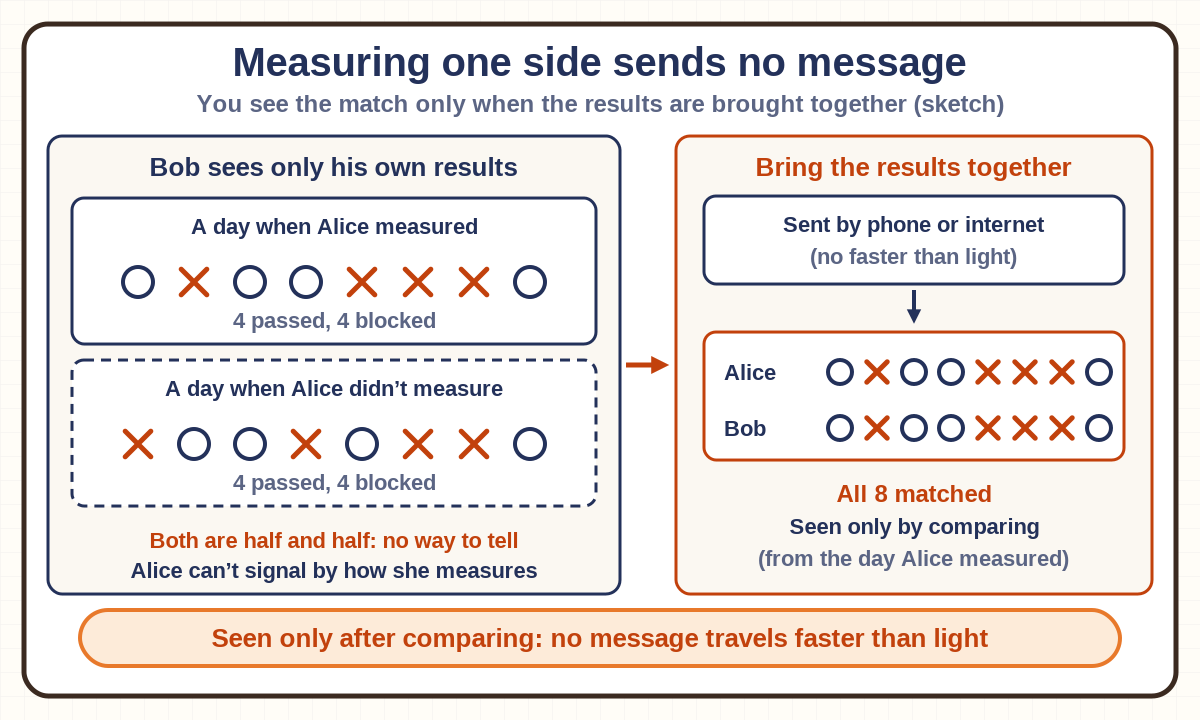
Partly right, but it misses the key point. It is true that when two entangled particles are measured the same way, the results match however far apart they are, so seeing one result tells you what the other would show if measured the same way. But this can’t be used to send a message. The person on the other side sees only their own results, and those come out just as randomly whether or not the partner measured, and whichever way. The match shows up only when the two bring their results together over an ordinary channel, like a phone or the internet (nothing faster than light), and compare them. That is why quantum mechanics shows that entanglement alone can’t send a message faster than light. So why do two faraway results match? What experiments tell us is that the view “the answers are set in advance, and distant places can’t influence each other faster than light” can’t explain it. Beyond that, what to give up (accepting a direct link between distant places, dropping the idea that the answers are set before measuring, or rethinking some other assumption) is a matter on which physicists’ views (interpretations) differ, and they haven’t agreed.
Explained in pictures
Free to use in lessons, slides and posts with credit (CC BY 4.0).
Free to use in lessons, slides and posts with credit (CC BY 4.0).
Free to use in lessons, slides and posts with credit (CC BY 4.0).
Free to use in lessons, slides and posts with credit (CC BY 4.0).
You’re free to use these figures in lessons, slides and posts if you credit Naru News (naru.news). CC BY 4.0.
Think of it like this
A pair of gloves split into two boxes
Imagine putting a pair of gloves, one in each of two boxes, without looking, and sending one box to a faraway town. Open your box and find a right glove, and you instantly know the faraway box holds the left. You learn something about a faraway place even though nothing traveled. That part is like measuring an entangled pair the same way on both sides. It is also alike in that opening your box can’t change what’s in the faraway box, so no message is sent.
But the key part is different. Each glove was right or left from the moment it was boxed; opening the box only told you which. With an entangled pair, you can choose the direction you measure in. And when you compare results over various directions, they match more strongly than any setup with “answers fixed from the start,” like the gloves, can manage.
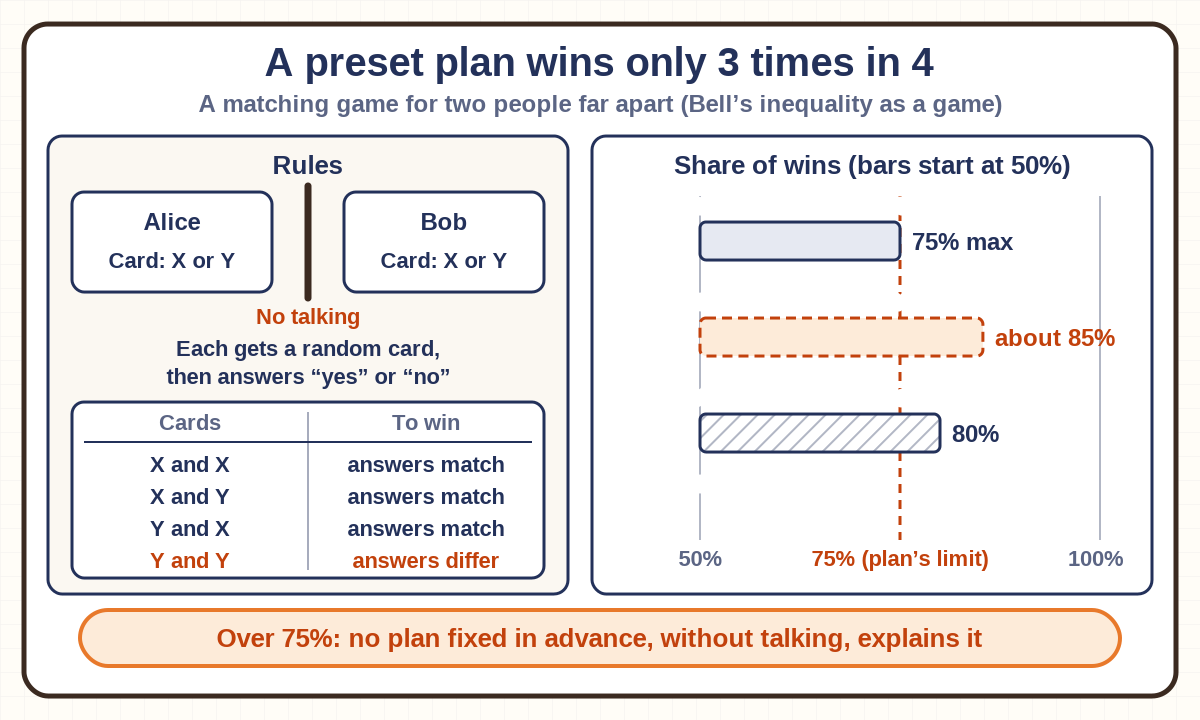
In a matching game for two people in separate rooms, for example, a glove-style plan with answers fixed in advance wins at most 3 times in 4 on average, but players holding an entangled pair win about 85% of the time (see “What is Bell’s inequality?” in the key points). Entanglement is not the same as finding out later what was in the box all along.
Key points
How do you make two entangled particles?
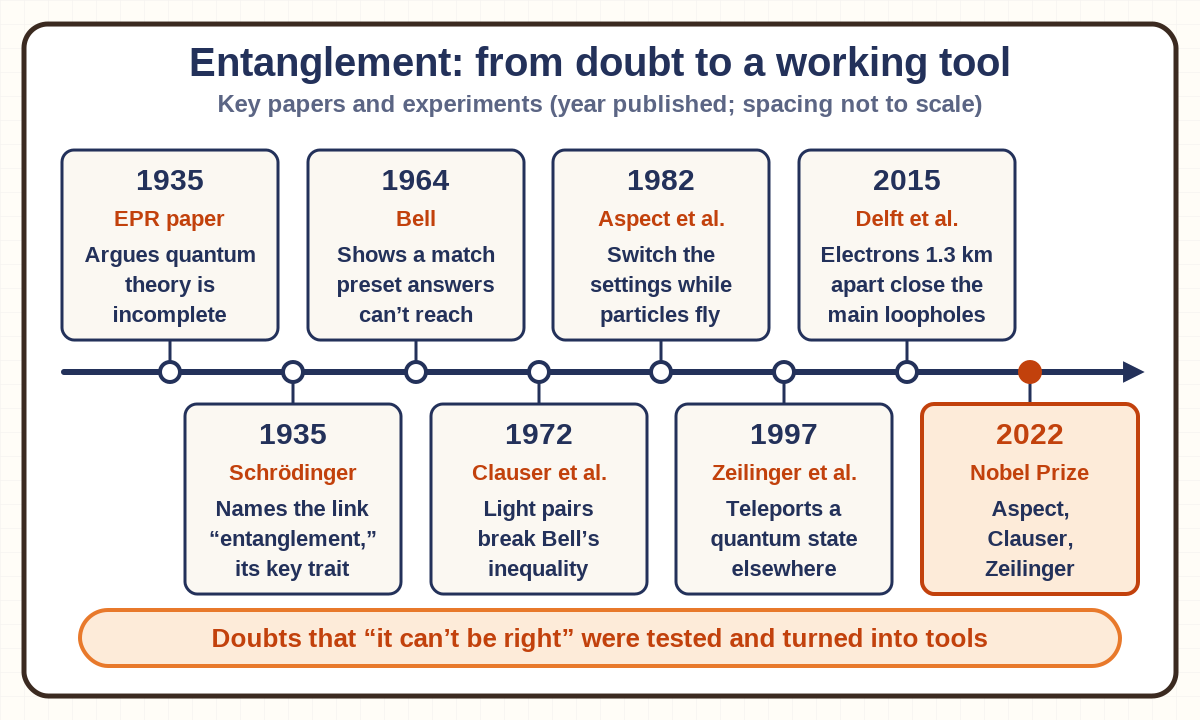
Letting two particles interact for a while can make them an entangled pair. In 1935, Schrödinger wrote that when two systems whose states are known act on each other for a time and then separate again, they can no longer be described as before, each with a state of its own, and he named this “entanglement.” The state of the pair as a whole is perfectly definite, yet it can’t be written as one state per particle. Schrödinger put it this way: the best possible knowledge of a whole does not mean the best possible knowledge of its parts.
Clauser’s 1972 experiment used pairs of light particles given off one after the other by calcium atoms.
Even particles that have never met can be entangled. Prepare two entangled pairs, bring one particle from each pair together in a particular way and measure them, and the two particles left over become an entangled pair, even though they have never met (entanglement swapping). In a 2015 experiment led by Delft University of Technology in the Netherlands, in each of two labs 1.3 km apart, an electron inside a diamond and a particle of light it gave off were made into an entangled pair. Then the two light particles were brought together at a spot in between and measured, which entangled the two distant electrons (it works only on the runs when the light particles show up in a particular way). The light particles acted as go-betweens.
What did the 1935 EPR paper say?
It is a paper that Albert Einstein, Boris Podolsky and Nathan Rosen published in 1935 under the title “Can Quantum-Mechanical Description of Physical Reality Be Considered Complete?” It is called EPR, after the three authors’ initials.
The three considered two particles that interacted for a while and then moved apart. Measure the first particle’s position, and you learn the second one’s position. Measure the first one’s momentum (how strongly it is moving), and you learn the second one’s momentum. Either way, you can predict it with certainty without touching the second particle. If you can predict something for certain without even touching it, the three reasoned, the answer must have been set in the second particle before it was measured. Then the second particle would hold answers for both its position and its momentum in advance. But quantum mechanics can’t give both of these as definite values at the same time. So the three concluded that quantum mechanics’ description falls short (is not complete), and wrote that they believed a more complete description was possible.
What they could not accept was the idea that simply choosing what to measure on the first particle would settle the answers (what values it has) for the faraway second one. Einstein later called such effects of entanglement “spooky action at a distance.” In the same year, 1935, Schrödinger gave this connection the name “entanglement” and called it not one but rather the characteristic trait of quantum mechanics.
What is Bell’s inequality?
John Bell showed it in a 1964 paper titled “On the Einstein Podolsky Rosen Paradox.” If the results were set before measuring by hidden values (hidden variables), and the setting of one faraway device didn’t affect the other side’s result, there would be a ceiling on how strongly the two people’s results could match. Quantum mechanics, however, predicts that for some choices of measuring directions, the results match more strongly than that ceiling. Bell ended the paper by writing that any hidden-variable account making the same predictions as quantum mechanics would need a mechanism by which the setting of one device influences the reading of another, however far away, and that influence would have to travel instantly.
In 1969, Clauser and three others rewrote it in a form easier to test in experiments (the CHSH inequality). It is easier to grasp as a game. Alice and Bob, in separate rooms far apart, each get a card, X or Y, dealt at random, and without talking each answers “yes” or “no.” If both got Y, they win when their answers differ; otherwise, they win when their answers are the same.
Any plan with answers fixed in advance loses for at least one of the four card combinations. For example, if you set the answers so that they match for “X and X,” “X and Y” and “Y and X,” then both players end up giving the same answer for every card. So the answers match for “Y and Y” too, and they lose. No way of answering meets all four winning conditions at once. Since the cards are dealt at random, such a plan wins at most 3 times in 4 (75%) on average. This is what Bell’s inequality says here.
But if each holds one particle of an entangled pair, picks the measuring direction by the card received, and answers with the result as it comes out, they win about 85% of the time, for every combination of cards. That is because, taking an entangled pair of light particles as an example, the smaller the gap between the directions of the two polarizers, the more likely the results are to match, and the larger the gap, closer to a right angle, the more likely they are to come out opposite (one passes, the other is blocked). So the players set a direction for each card so that the gap is small for the three “match to win” pairs and large only for “Y and Y.” But the smaller they make those three gaps, the less they can widen the gap for “Y and Y,” so every pair misses a little. The best balance gives about 85%, the highest rate quantum mechanics allows.
How did experiments show the answers weren’t simply set from the start?
In 1972, Clauser and doctoral student Stuart Freedman measured the polarization (the direction in which light vibrates) of pairs of light particles given off by calcium atoms. The results agreed with quantum mechanics and broke Bell’s inequality. But because many light particles were missed and the polarizers were set at fixed angles in advance, loopholes remained, such as “maybe only the pairs that happened to match strongly were counted.”
In 1982, Aspect and colleagues switched the measuring direction after the pair of light particles had left the source. The polarizers were only about six meters from the source, so the switch had to happen within a few billionths of a second. This way, information about the setting on one side could not reach the other side and affect its result, and the measurements broke Bell’s inequality, just as quantum mechanics predicts. The switching then, however, followed a nearly regular cycle rather than random numbers.
In 2015, a team led by Delft University of Technology reported an experiment that closed the main earlier loopholes at once, using electrons in diamonds in two labs 1.3 km (1,280 meters) apart. The measuring direction was picked on the spot by random numbers, and each side finished measuring before the other side’s choice could arrive at the speed of light. In 196 of 245 trials (80%), the results counted as a win in the Bell’s-inequality game. The chance that an account with answers fixed in advance, and with the two distant sites unable to influence each other, would produce a result this strong by luck was calculated to be 3.9% or less. The same year, two other teams also reported experiments that closed these loopholes.
Even so, the paper itself notes that, strictly speaking, no experiment can rule out every conceivable account in which things were “set in advance.” That is because no experiment can tell apart and prove whether the random numbers that picked the directions, and the results, really came into being on the spot, or were in fact set earlier.
Why can’t entanglement send messages faster than light?
For Bob, who holds one particle of an entangled pair, nothing about how his results come out (which results appear, and how often) changes, whether faraway Alice measures or not, and whichever direction she measures in. For the most strongly matching pairs, his results are always a random half and half. So Alice can’t send Bob a message by whether or how she measures. The match is seen only when the two bring their results together over an ordinary channel, which is no faster than light.
Quantum teleportation is the same. With an entangled pair, a quantum state can be moved to a faraway particle without losing any part of it. But to do that, the sender must tell the receiver, over an ordinary channel, the results (2 bits) of measuring their own particles. Only after receiving them does the receiver know how to fix the particle at hand so it becomes the original state. So teleportation doesn’t deliver messages faster than light either. Note that the original particle’s state vanishes when it is moved; an unknown quantum state can’t be copied exactly.
So do two faraway results match because something passes between them at the moment of measurement, or should we see it some other way? Here views (interpretations) differ. But as long as quantum mechanics’ predictions hold, no view lets entanglement send messages faster than light.
What is entanglement used for?
Quantum computers. A quantum computer can compute on many inputs at once, holding them in superposition. But when you measure at the end, you see only one result. That alone doesn’t make it faster than ordinary computers; by combining entanglement with interference (waves adding up or canceling out), it can solve some problems faster.
Quantum cryptography. In 1991, Artur Ekert showed a way for two people to share entangled pairs to make a secret key, and to check whether anyone is eavesdropping by testing Bell’s inequality. The paper on the 2015 experiment led by Delft also says the experiment paves the way for communication whose safety can be checked from the results of a Bell test, without having to inspect the inside of the devices.
Quantum teleportation and quantum networks. In 1997, Anton Zeilinger and colleagues first carried out quantum teleportation, and in 1998 they first showed “entanglement swapping,” which entangles two particles that have never met. Light particles can only travel so far through optical fiber, and boosting (amplifying) them along the way, as with ordinary light signals, means capturing and measuring the light, which breaks the entanglement. Entanglement swapping makes it possible to carry a quantum state farther than that. Entangled light particles have been demonstrated through tens of kilometers of optical fiber and between a satellite and a ground station.
Is entanglement fragile?
Yes. Trying to boost a light-particle signal along the way means capturing and measuring the light, which breaks the entanglement. Entangled states are so fragile and hard to handle that closing the loopholes in the experiments was difficult, too.
“Decoherence” (losing quantum nature from view) is said to be why quantum nature, such as superposition, can’t be seen in big objects. One important cause of it is entanglement with the surroundings. When an object interacts with the air and light around it, the object and its surroundings become entangled, and its quantum nature gets spread over a huge number of things around it, so that looking at the object alone, you can no longer see it. Entanglement forms not only between particles, but also between a particle and its surroundings.
Check yourself
Q1Alice and Bob, far apart, each receive one particle of an entangled pair of light particles and measure many such pairs with polarizers set the same way on both sides. When can Bob tell that their results matched?
Answer and explanation
Answer: A When he learns Alice’s results and compares them with his own
Bob can tell that the results match only after he learns Alice’s results over an ordinary channel such as a phone or the internet (nothing faster than light) and compares them, trial by trial, with his own. Looking only at his own results, he sees passes and blocks in an even, random half-and-half mix, whether or not Alice measured; the pattern doesn’t change at all. So seeing his own results come out half and half can’t reveal the match, and Alice can’t send him a message by how she measures.
More on this → Key points: Why can’t entanglement send messages faster than light?
Q2There is a game (Bell’s inequality as a game) where two people far apart each get an X or Y card, answer yes or no without talking, and win or lose depending on how their answers match. In a 2015 experiment, two players using entangled particles won 80%. Why does this result matter in physics?
Answer and explanation
Answer: C It beat the most any plan with answers fixed in advance can win
With answers fixed in advance, every plan loses for at least one of the four card combinations, so it can win at most 3 times in 4 (75%) on average. This is Bell’s inequality. In the 2015 experiment by the Delft team and others, the pair won 196 of 245 trials (80%), going over this limit (with a limited number of trials, luck can’t be ruled out entirely, but its chance was calculated to be 3.9% or less). So the view that the particles carried the answer for every card in advance (with the two distant sides unable to influence each other) can’t explain it. Also, entanglement can’t be used to send messages to each other. Each player sees only their own random results, and the match shows up only when they bring the results together.
Q3In quantum teleportation, an entangled pair of particles was used to move a quantum state to a faraway particle. When the move is done, what has happened to the state of the sender’s original particle?
Answer and explanation
Answer: B The original state on the sender’s side vanished in the move
The original particle’s state vanishes when it is moved. An unknown quantum state can’t be copied exactly, so you can’t keep the same state on the sender’s side while also making it on the receiver’s side. Nor is it split in half: the state moves to the receiver without losing any part of it. To recover the original state, though, the receiver needs the sender’s measurement results (2 bits) by an ordinary channel like a phone or the internet, so nothing is sent faster than light.
More on this → Key points: Why can’t entanglement send messages faster than light?
Related terms
- Superposition
- Qubit
- Quantum computer
- Bell’s inequality
- Hidden variables
- Quantum teleportation
- Quantum cryptography
- Polarized light
- Decoherence
- Quantum error correction
- Speed of light
- Quantum mechanics
Sources and how we checked
- Royal Swedish Academy of Sciences, “The Nobel Prize in Physics 2022” (press release, October 4, 2022; read as a PDF: the prize awarded to Alain Aspect, John Clauser and Anton Zeilinger “for experiments with entangled photons, establishing the violation of Bell inequalities and pioneering quantum information science”; in entangled states, two particles behave like a single unit even when separated; if there are hidden variables, the correlation between the results of a large number of measurements will never exceed a certain value, while quantum mechanics predicts a violation; Clauser’s measurements clearly violated a Bell inequality, so quantum mechanics cannot be replaced by a theory that uses hidden variables; Aspect switched the measurement settings after an entangled pair had left its source, closing an important loophole; Zeilinger’s group demonstrated quantum teleportation; research on quantum computers, quantum networks and secure quantum encrypted communication; prize amount of 10 million Swedish kronor, shared equally; read November 28, 2026)
- Royal Swedish Academy of Sciences, “How entanglement has become a powerful tool” (popular science background for the 2022 Nobel Prize in Physics; read as a PDF: Einstein talking about spooky action at a distance and Schrödinger calling entanglement quantum mechanics’ most important trait; Einstein, Podolsky and Rosen presenting their reasoning in 1935 that quantum mechanics does not appear to provide a complete description of reality [the EPR paradox]; under Bell’s inequality, theories with hidden variables give a correlation at most equal to a specific value, while quantum mechanics can violate it; the experiments using pairs of photons with polarization, studied with a filter that allows through polarization oriented in a particular direction, the effect used in many sunglasses; if both filters are oriented the same way and one photon slips through, the other does too, if they are at right angles one is stopped while the other goes through, and how often both get through depends on the angle between the filters; Clauser and doctoral student Stuart Freedman showing in 1972 a clear violation of a Bell inequality in agreement with quantum mechanics; loopholes remaining because the experiment was inefficient at producing and capturing particles and the filters were at fixed angles; entangled states being so fragile and difficult to manage that eliminating the loophole was difficult; Aspect switching the direction of the photons after they left the source, with the filters just six metres away so that the switch had to occur in a few billionths of a second; quantum teleportation first conducted in 1997 by Zeilinger and colleagues, the only way to transfer quantum information without losing any part of it, at the price of destroying it in the original particle; entanglement swapping, first demonstrated in 1998, in which one particle from each of two entangled pairs is brought together in a particular way so that the undisturbed particles of the two pairs become entangled despite never having been in contact; a limit to how far photons can be sent through an optical fibre, and amplifiers having to capture and measure the light, which breaks the entanglement; and entangled states demonstrated through tens of kilometres of optical fibre and between a satellite and a ground station; read November 28, 2026)
- A. Einstein, B. Podolsky and N. Rosen, “Can Quantum-Mechanical Description of Physical Reality Be Considered Complete?” (Institute for Advanced Study, Princeton; Physical Review 47, 777–780, May 15, 1935; full text read as a PDF: the criterion that if, without in any way disturbing a system, we can predict with certainty the value of a physical quantity, then there exists an element of physical reality corresponding to it; two systems allowed to interact and then separated, so that depending on what is measured on the first, either the momentum or the coordinate of the second can be predicted with certainty without disturbing it; in quantum mechanics, two quantities with noncommuting operators [momentum and coordinate] cannot both have definite values at once; the conclusion that the quantum-mechanical description of reality given by the wave function is not complete; the remark that no reasonable definition of reality could be expected to make the reality of the second system depend on the measurement carried out on the first; and the belief that a more complete theory is possible; read November 28, 2026)
- J. S. Bell, “On the Einstein Podolsky Rosen Paradox” (University of Wisconsin; Physics 1, 195–200, 1964; full text read as a PDF: the EPR paradox advanced as an argument that quantum mechanics could not be a complete theory but should be supplemented by additional variables; that idea, formulated mathematically, shown to be incompatible with the statistical predictions of quantum mechanics; the essential difficulty created by the requirement that the result of a measurement on one system be unaffected by operations on a distant system with which it has interacted in the past; the example of Bohm and Aharonov [a pair of spin-one-half particles in the singlet state]; the conclusion that in a theory in which parameters are added to quantum mechanics to determine the results of individual measurements, the setting of one measuring device must influence the reading of another instrument, however remote, with the signal propagating instantaneously; and experiments in which the settings are changed during the flight of the particles being crucial; read November 28, 2026)
- Stuart J. Freedman and John F. Clauser, “Experimental Test of Local Hidden-Variable Theories” (University of California, Berkeley; Physical Review Letters 28, 938, April 3, 1972; abstract: the linear polarization correlation of photons from an atomic cascade of calcium measured, a generalized form of Bell’s inequality used, and data in agreement with quantum mechanics violating the restrictions of local hidden-variable theories with high statistical confidence; read November 28, 2026)
- Alain Aspect, Jean Dalibard and Gérard Roger, “Experimental Test of Bell’s Inequalities Using Time-Varying Analyzers” (Physical Review Letters 49, 1804, December 20, 1982; abstract: correlations of linear polarizations of pairs of photons measured with time-varying analyzers, each made of an acousto-optical switch followed by two linear polarizers and switching at incommensurate frequencies near 50 MHz, each equivalent to a polarizer switched faster than the transit time of the photons; results in good agreement with quantum-mechanical predictions, violating Bell’s inequalities by 5 standard deviations; read November 28, 2026)
- B. Hensen et al., “Experimental loophole-free violation of a Bell inequality using entangled electron spins separated by 1.3 km” (Delft University of Technology and others; Nature 526, 682–686, 2015; arXiv full text [August 2015 version] read as a PDF: Bell proving that no theory of nature that obeys locality and realism can reproduce all the predictions of quantum theory; all earlier experiments requiring additional assumptions, leaving loopholes; NV-centre electron spins in diamond placed in labs A and B 1,280 m apart; each spin entangled with a photon, and the photons overlapped and detected at location C in between to entangle the distant spins [entanglement swapping]; fast random basis selection, with each side’s readout completed before any signal traveling at the speed of light could bring the other side’s choice; 245 trials testing the CHSH inequality S ≤ 2, finding S = 2.42 ± 0.20, with k = 196 trials meeting the condition on inputs and outputs, and a probability p ≤ 0.039 that a local-realist model would produce a violation at least this large; strictly, no Bell experiment can exclude every conceivable local realist theory, because it is impossible to prove when and where the random inputs and outputs came into existence; and a path to device-independent quantum-secure communication. That this condition is a win in the game, and that 196 ÷ 245 ≈ 80%, were worked out for this page; read November 28, 2026)
- Artur K. Ekert, “Quantum cryptography based on Bell’s theorem” (University of Oxford; Physical Review Letters 67, 661, August 5, 1991; abstract: a practical application of the generalized Bell’s theorem to key distribution in cryptography, based on the Bohm version of the Einstein–Podolsky–Rosen thought experiment, with Bell’s theorem used to test for eavesdropping; read November 28, 2026)
- Ronald de Wolf, “Quantum Computing: Lecture Notes” (University of Amsterdam course notes, arXiv 1907.09415, version 6; full text read as a PDF. Section 1.1: spatially separated quantum systems may be entangled with each other and operations may have “non-local” effects because of this, though they won’t signal faster than the speed of light. Section 1.3: the 2-qubit state (|00⟩+|11⟩)/√2, called an EPR-pair, in which neither qubit initially has a classical value, but measuring the first and observing 0 collapses the whole state to |00⟩; a bipartite state is called entangled if it cannot be written as a tensor product of states of the two parts. Section 1.5: in teleportation, the sender measures and sends 2 classical bits over a classical channel, which tell the receiver which operation to apply to regain the original qubit; the sender’s qubit is destroyed, and copying an unknown qubit is impossible. Section 2.3: computing on a superposition of all inputs still gives just one result when observed, and quantum parallelism must be combined with interference and entanglement to do better than classical. Section 17.1: Einstein calling such effects of entanglement “spooky action at a distance”; from Bob’s perspective there being no difference between the situation where Alice measured and where she didn’t, so no information is transferred; entanglement cannot replace communication; Bell devising entanglement-based experiments whose behavior cannot be reproduced by any local realist theory, with experiments by Aspect and others giving the outcomes quantum mechanics predicted; and this disproving the conjunction of locality and realism, so at least one of the two has to fail. Section 17.2: in the CHSH game, a deterministic strategy can’t satisfy all four conditions at once [summing them gives 0 = 1], so no classical strategy wins with probability better than 3/4, such upper bounds being known as Bell inequalities [this one the CHSH inequality]; with an entangled pair, the chance that the outputs agree is cos² of the combined rotation angle, which is π/8 for the three “agree” input pairs and 3π/8 for the remaining one, so the players win with probability cos²(π/8) ≈ 0.85 for all four inputs [describing these angles as the gap between the directions of two polarizers for light particles was done for this page], the best quantum strategies can do [Tsirelson]; read November 28, 2026)
- Jeffrey Bub, “Quantum Entanglement and Information” (Stanford Encyclopedia of Philosophy, first published August 13, 2001, substantively revised May 2, 2023: Schrödinger coining the term “entanglement” to describe this peculiar connection between quantum systems [1935, Proceedings of the Cambridge Philosophical Society 31, p. 555]; his statement that when two systems whose states are known enter into temporary physical interaction and then separate, they can no longer be described by endowing each with a representative of its own, the two representatives having become entangled; his calling it not one but rather the characteristic trait of quantum mechanics; his remark that the best possible knowledge of a whole does not necessarily include the best possible knowledge of all its parts; the EPR argument being designed to show that the theory is incomplete; entanglement providing a way of solving the key distribution problem, for example by a protocol originally proposed by Artur Ekert; and, in teleportation, Bob knowing only after Alice communicates the outcome of her operation; read November 28, 2026)
- Wayne Myrvold, Marco Genovese and Abner Shimony, “Bell’s Theorem” (Stanford Encyclopedia of Philosophy, first published July 21, 2004, substantively revised January 25, 2024: Bell publishing a paper in 1964 in the short-lived journal Physics; no theory satisfying the condition that correlations between distant events be explicable in local terms can reproduce the probabilistic predictions of quantum mechanics; Clauser, Horne, Shimony and Holt deriving the CHSH inequality in 1969; the first test performed by Freedman and Clauser in 1972; Aspect and colleagues making the analyzer choices so rapidly that they were events with space-like separation, though the choices of orientation were not random but quasiperiodic; three papers appearing in 2015 claiming a conclusive test of Bell inequalities; quantum correlations cannot be exploited to send signals superluminally; and at least one of the assumptions having to be rejected, with a number of options left open [local causality, unique outcomes, measurement independence and others]; read November 28, 2026)
- L. Hackermüller et al., “Decoherence of matter waves by thermal emission of radiation” (University of Vienna; Nature 427, 711–714, 2004; arXiv abstract: one important cause of decoherence being the interaction of a quantum system with its environment, which entangles the two and distributes the quantum coherence over so many degrees of freedom as to render it unobservable; read November 28, 2026)
- RIKEN and Keio University, “A new mechanism for the area law of quantum entanglement” (press release in Japanese, September 8, 2020: the property of producing correlations impossible in classical mechanics, such as the spins of two particles as far apart as the Earth and the Moon always both being found pointing up, being called 量子もつれ or 量子エンタングルメント [quantum entanglement]; and, in the glossary, quantum entanglement being a state in which the states of different particles have correlations impossible in classical mechanics, playing an essential role in quantum computation; read November 28, 2026)
- RIKEN, Osaka University, the University of Tokyo and JST, “Nonlocal quantum entanglement demonstrated in a solid” (press release in Japanese, July 1, 2015: one entangled electron pair taken from a Cooper pair in a superconductor, with the two electrons shown to keep their もつれ状態 [entangled state]; and, in the glossary, quantum entanglement being a state in which several particles are bound by special correlations explained by quantum mechanics [quantum correlations]; read November 28, 2026)
AI wrote this page from the sources above, and a different AI checked it against the text of those sources (November 28, 2026). A person with a master’s degree in science and a Japanese high-school science teaching license also read and checked it before publishing. Numbers are as of that date. If anything was hard to follow, you spot a mistake, or there’s a term you’d like explained, please write to [email protected].
Glossary
- AI agent
- AI alignment
- Alignment faking
- Artificial general intelligence (AGI)
- Artificial intelligence (AI)
- Backdoor
- Benchmark
- Chain of thought (CoT)
- Context window
- Data poisoning
- Deep learning
- Deepfake
- Diffusion model
- Embedding
- Emergent misalignment
- Evaluation awareness
- Fine-tuning
- Formal verification
- Generalization
- Generative adversarial network (GAN)
- Generative AI
- Goodhart’s law
- Gradual disempowerment
- Hallucination
- Hyperparameter
- Intelligence explosion
- Interpretability
- Jailbreaking
- Large language model (LLM)
- Latent space
- Machine learning
- Mixture of experts (MoE)
- Neural network
- Neuralese
- Overfitting
- Parameter
- Persona vectors
- Pre-training
- Prompt
- Prompt injection
- Reasoning model
- Recursive language model (RLM)
- Recursive self-improvement (RSI)
- Red teaming
- Reinforcement learning (RL)
- Retrieval-augmented generation (RAG)
- Reward hacking
- Reward model
- Shutdown resistance
- Sleeper agent
- Subliminal learning
- Superintelligence (ASI)
- System prompt
- Technological singularity
- Time horizon
- Token
- Transfer learning
- Transformer
- Accretion disk
- Black hole
- Black hole star
- Cosmic birefringence
- Event horizon
- Event Horizon Telescope (EHT)
- General relativity
- GPS
- Gravitational lensing
- Gravitational singularity
- Gravitational wave
- James Webb Space Telescope (JWST)
- Lagrange point
- Long-period radio transient (LPT)
- Neutron star
- Pulsar
- Quasar
- Sagittarius A*
- Space data center
- Spacetime
- Special relativity
- Speed of light
- Supermassive black hole
- White dwarf
- Cat qubit
- Instanton
- Logical qubit
- Quantum computer
- You are hereQuantum entanglement
- Qubit