
What is a logical qubit (one error-resistant qubit built from a group of many qubits)?
Also called: Logical qubits, Encoded qubit

In one minute
A logical qubit is a group of many error-prone qubits (physical qubits) that keeps finding and fixing its own errors, so that the whole group works as one qubit.
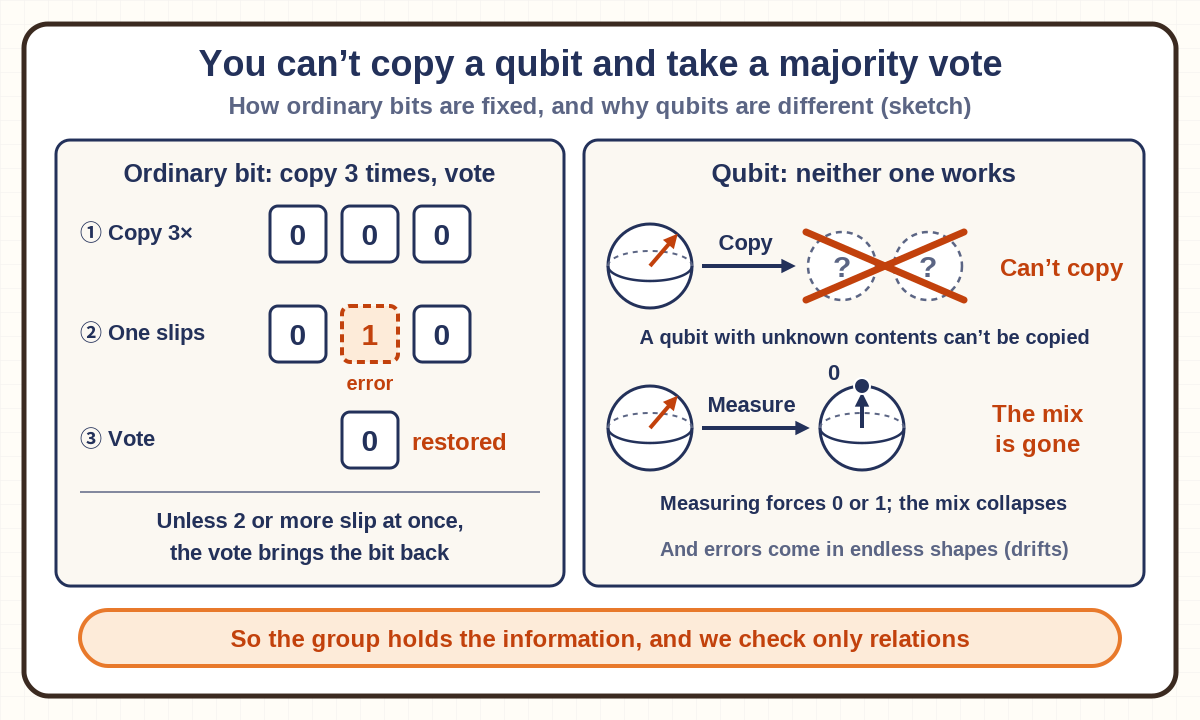
The usual fix of copying and taking a vote doesn’t work for qubits: a qubit with unknown contents can’t be copied, and measuring it ends its superposition (a state that mixes 0 and 1 in set proportions). Instead, the whole group holds one piece of information, and checker qubits measure only whether nearby qubits still keep their relation, not the contents; the mismatches show where an error probably happened.
If the parts’ error rate is well below a certain line (the threshold), bigger groups make fewer errors. In 2024, Google built one logical qubit from 101 qubits. There is no fixed number per logical qubit; it depends heavily on the code and on how accurate the parts are.
A common mix-up
“A logical qubit never makes mistakes.”
Half right. If the parts are accurate enough, a logical qubit can make far fewer errors than its parts, and a bigger group cuts errors further. In an experiment Quantinuum announced in October 2026, a group of 73 qubits brought the error per check round (the chance that the logical qubit goes wrong during one round of checks) down to about 1 in 200,000 (a number from an experiment that did no calculation and only kept information safe). But it never reaches zero. If several errors happen to pile up, the checkers see them as a different error, and the group may make the wrong fix (in the card stunt under “Think of it like this,” it is like a whole row ending up flipped). When the group is fooled this way, the logical qubit gets it wrong too. Even Google’s 101-qubit group from 2024 errs about 0.14% of the time per check round (about 1 in 700). How few errors a useful calculation needs depends on the calculation, but the example target Quantinuum gives is 1 in a trillion, still a long way off. And grouping qubits doesn’t always help: if the parts make more errors than the threshold, a bigger group actually makes more errors.
Explained in pictures
Free to use in lessons, slides and posts with credit (CC BY 4.0).
Free to use in lessons, slides and posts with credit (CC BY 4.0).
Free to use in lessons, slides and posts with credit (CC BY 4.0).
Free to use in lessons, slides and posts with credit (CC BY 4.0).
You’re free to use these figures in lessons, slides and posts if you credit Naru News (naru.news). CC BY 4.0.
Think of it like this
A card stunt checked four people at a time
Picture a stadium card stunt: many people each hold up a card, white or black side out, and together they make one big pattern. The pattern belongs to the whole section of seats, so you can’t tell what it is from one person’s card. A logical qubit is the same: the information belongs to the whole group, not to any single qubit.
The organizers never look at the pattern from afar. For each fixed group of four (two at the edges), they only check, “Is the number of black cards even?” If one person shows the wrong side by mistake, only the groups around that person turn odd, so the organizers know who slipped and can fix it without ever seeing the pattern. To change the whole pattern without anyone noticing, you would need many mistakes lined up, like a whole row flipped from one end of the section to the other. The bigger the section, the less likely that is.
But the comparison has limits. Looking at a real card stunt from afar changes nothing, but measuring a qubit’s contents ends its superposition, so the checks have to be designed with care. Besides the card-flip-like swap of 0 and 1, qubit errors include a swap of plus and minus in how 0 and 1 are combined (the shares of 0 and 1 stay the same; only the way they are combined is turned around), which needs its own separate checkers. And the organizers (the checker qubits) make mistakes too, so the checks are repeated many times and the results are read together.
Key points
How is it different from a physical qubit?
Each actual qubit part (a superconducting circuit, a trapped ion and so on) is called a physical qubit. A logical qubit is what you get when many physical qubits share one piece of information and the whole group works as a single qubit. It isn’t a single part sitting somewhere; it exists as the state of the whole group.
Calculations are done on logical qubits, too. But if you took the contents out of the group to work on them and then put them back, they would be unprotected from errors while outside. So logical operations are built from operations on the parts while everything stays encoded, and the checking and fixing keep going throughout the calculation.
When you see a quantum computer’s qubit count, check which number it is. Google’s Willow chip, announced in 2024, carries 105 physical qubits and used 101 of them to make one logical qubit. According to the company’s plans, IBM aims to build a machine that can run 100 million operations on 200 logical qubits by 2029, and has set a goal of one that can run 1 billion operations on 2,000 logical qubits by 2033.
Why can’t you just copy a qubit and take a vote?
An ordinary computer can copy the bit it wants to protect three times and take a majority vote, so if one copy slips, the bit can be put back. This works unless two or more slip at once, so if each copy rarely slips, the overall error rate falls sharply.
For qubits, this doesn’t work as it is, for three reasons. First, a qubit with unknown contents can’t be copied exactly (this has been shown from the rules of the quantum world). Second, if you measure the contents to check them, you get 0 or 1, and the superposition collapses. Third, the errors themselves: an ordinary bit’s only error is a swap of 0 and 1, but a qubit’s errors come in countless shapes, such as the way 0 and 1 are combined slowly drifting.
Even so, in 1995 Shor showed the first way to correct qubit errors. His code makes one logical qubit out of 9 physical qubits and can fix an error on any one of the 9 (15 qubits if you count the helper qubits that find where the error is). Today, a code that needs only 5 qubits to fix a single error is also known.
How can errors be found without looking inside?
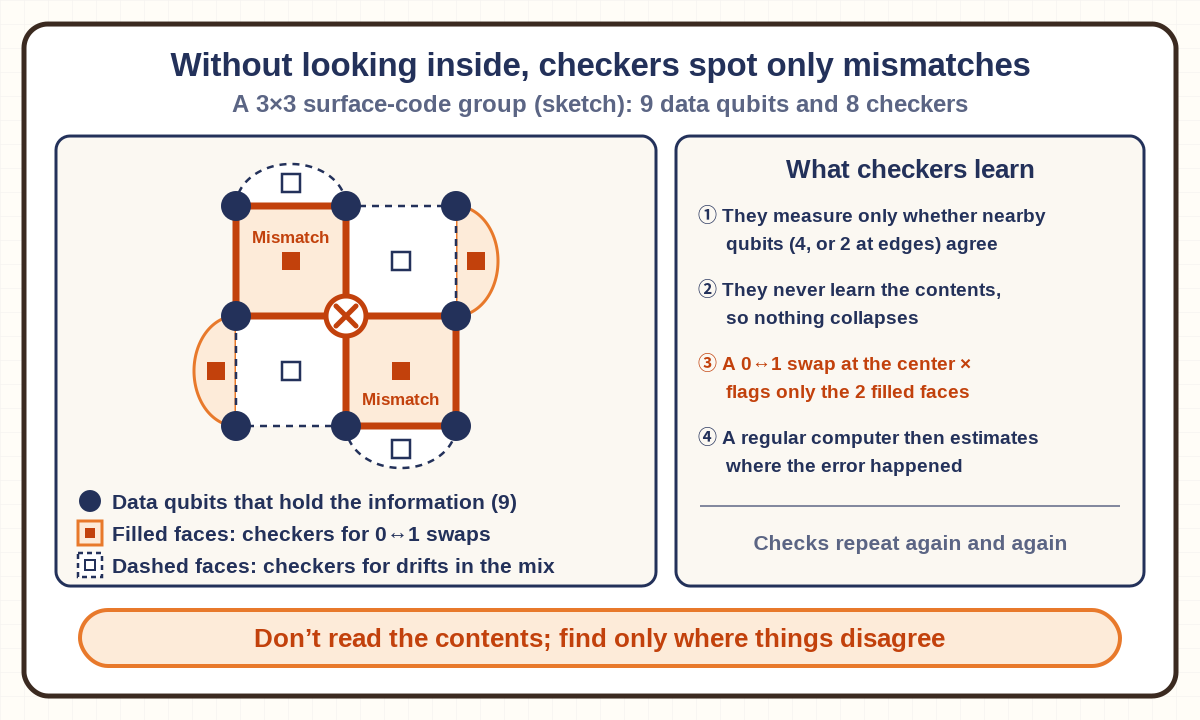
Besides the data qubits that hold the information, a logical qubit’s group includes checker qubits. A checker measures only whether its neighbors (4 qubits, or 2 at the edges) still keep their set relation (something like whether a count among them is even or odd). All it learns is whether there is a mismatch; it learns nothing about the protected contents (0 or 1, and how they are combined), so the superposition doesn’t collapse.
Qubit errors come in countless shapes, but every one of them can be written as a combination of a swap of 0 and 1 (a bit flip), a swap of plus and minus in how they are combined (a phase flip: the shares of 0 and 1 stay the same, and only the way they are combined is turned around), or both. So it is enough to check for these two kinds with separate checkers. What’s more, even a slight drift becomes either “it happened” or “it didn’t” once the checkers are measured. That is because, in the quantum world, a measurement always settles on one single result. So a fixed set of corrections is enough.
A 3×3 surface-code group (the surface code lays qubits out flat) has 9 data qubits and 8 checkers, 17 in all. If 0 and 1 swap on the center qubit, only the two checkers around it that look for that kind of swap show a mismatch, which reveals where it happened.
Checking isn’t done once; it is repeated over and over. In Google’s 2024 experiment, one round of checks took about 1.1 microseconds (1.1 millionths of a second). An ordinary computer reads the check results and estimates where errors probably happened. Google showed this decoding on a 5×5 group while the experiment was running, with an average delay of 63 microseconds. In Quantinuum’s October 2026 experiment, the decoding was all done afterward.
Why does a bigger group make fewer errors?
A bigger group has more parts, so there are more places where errors can happen. Even so, the bigger the group, the more errors have to pile up to fool it into making the wrong fix. If each error is rare enough, many errors piling up becomes far less likely. That difference is what lowers the overall error rate.
But this works only when the parts’ error rate is well below a certain line, called the threshold. If the parts make more errors than the threshold, the extra parts’ errors win, and a bigger group actually makes more errors. The threshold isn’t one fixed number; it changes with the code and with the assumptions about how errors happen.
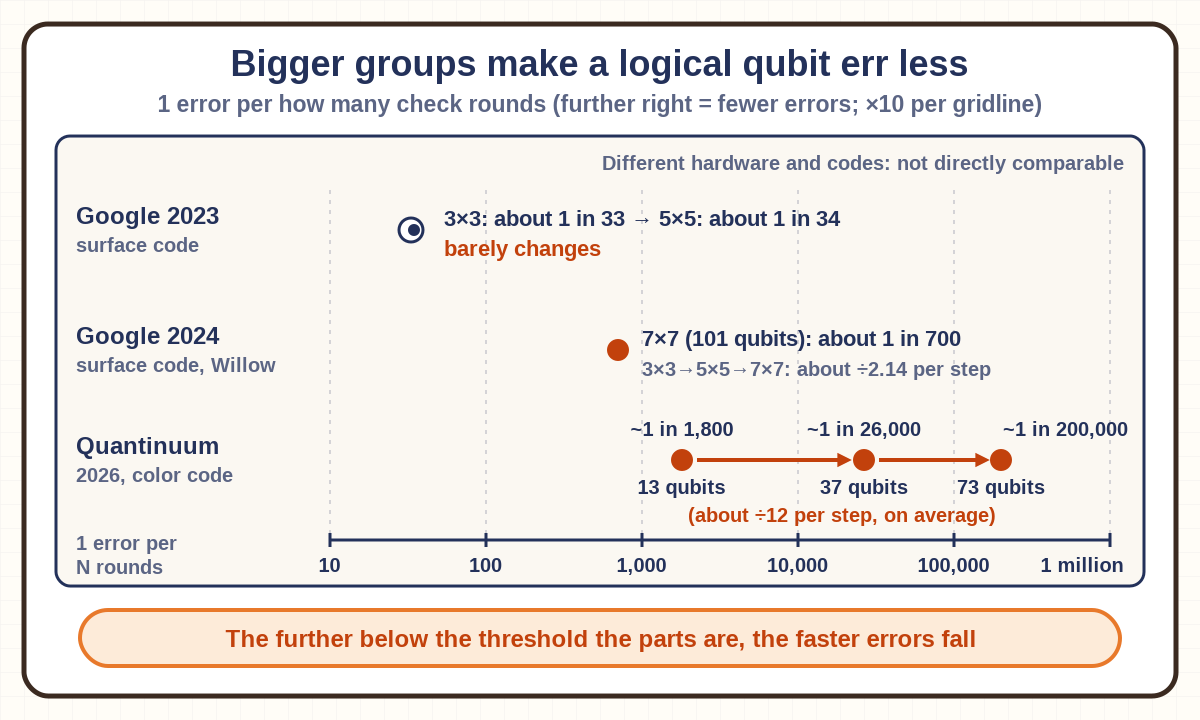
How much each step up (for Google’s groups, from 3×3 to 5×5, and from 5×5 to 7×7) cuts the errors depends on how far below the threshold the parts are. Roughly: in Google’s 2023 experiment errors barely fell, with Willow in 2024 each step left a little less than half, and in Quantinuum’s 2026 experiment each step cut them to about one-twelfth.
The detailed numbers compare the error per check round (the chance that the logical qubit goes wrong during one round of checks). In the experiment Google announced in 2023, the parts were close to the threshold, so growing the group from 3×3 to 5×5 only nudged the error from about 3.03% (about 1 in 33) to about 2.91% (about 1 in 34). With Willow in 2024, each step from 3×3 to 5×5 to 7×7 cut errors by about 2.14 times, reaching about 0.14% (about 1 in 700) at 7×7 (101 qubits).
In October 2026, Quantinuum announced that on Helios, its machine that uses ions, it grew a different kind of group (a color code) from 13 to 37 to 73 qubits, and the error per check round went to about 1 in 1,800, about 1 in 26,000 and about 1 in 200,000. That is about 12 times fewer per step on average (the hardware and codes differ, so this can’t be compared directly with Google’s result). A researcher at Sandia National Laboratories in the United States who was not involved in the study called it “a logical qubit nearly 100x better than its component physical qubits.”
How many physical qubits does one take?
There is no fixed number. It varies a lot with the code, with how accurate the parts are and with how far you want to push errors down. The more accurate the parts, the smaller the group you need for the same low error rate.
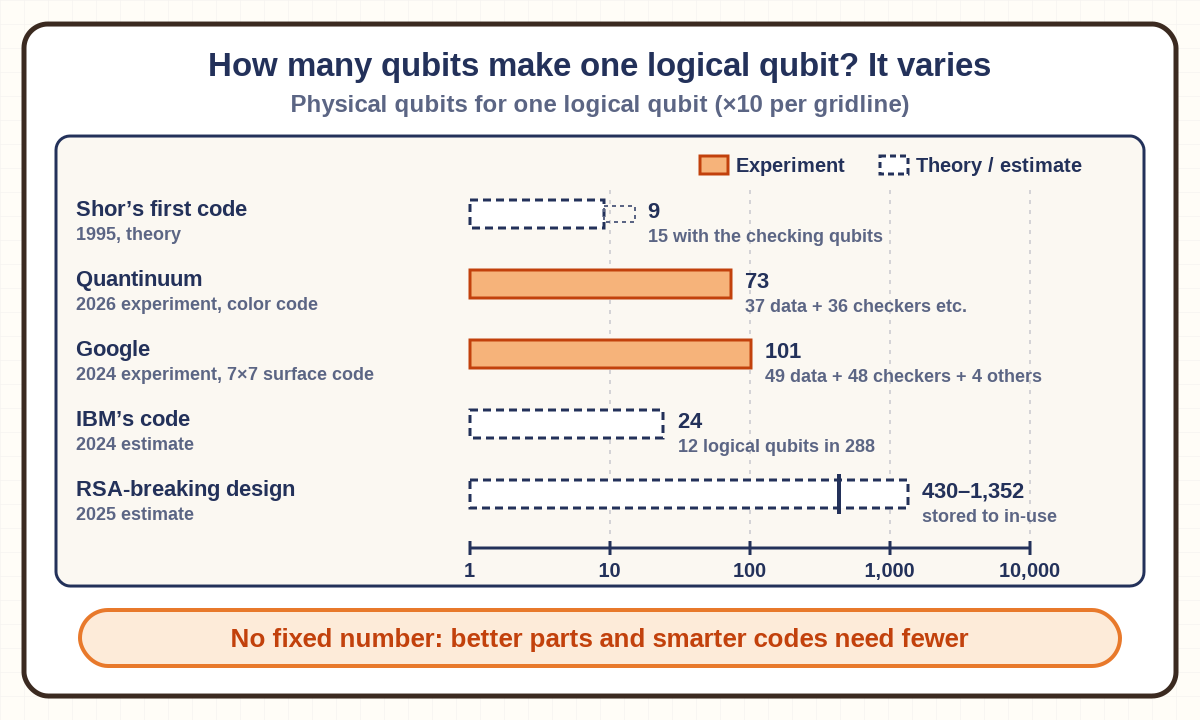
In experiments, Google’s 2024 7×7 group used 101 qubits for one logical qubit: 49 data qubits, 48 checkers and 4 qubits that remove a kind of error called leakage (a qubit slipping out into a state with more energy than both 0 and 1). Quantinuum’s largest group in 2026 used 73 qubits for one: 37 data qubits plus checkers and other helpers.
Research on smarter codes that need fewer qubits is also moving ahead. In 2024, IBM researchers presented a code that, in a calculation assuming the parts err 0.1% of the time (1 in 1,000), could protect 12 logical qubits for about a million check rounds with 288 qubits including checkers (24 each). They estimate the surface code would need nearly 3,000 to protect them as well. Another idea, as with cat qubits, is to make the parts’ errors lean heavily toward one kind, so that fewer qubits are needed.
It can even vary within one machine. A 2025 estimate for breaking a code (see the next question) uses 1,352 physical qubits for each logical qubit in active use and, with a different code, 430 for each logical qubit kept in storage.
How many logical qubits would a useful calculation need?
It depends on the calculation, and for now there are only estimates for machines that haven’t been built. A well-known example is breaking a 2048-bit key of RSA, a widely used code, with a calculation based on Shor’s method. In 2025, Google researcher Craig Gidney estimated that a machine with fewer than 1,600 logical qubits and about 900,000 physical qubits (under a million, with some slack) could do it in about 5 days (under a week, with some slack). The calculation assumes, among other things, that operations on the parts err 0.1% of the time and that one round of checks takes 1 microsecond. A similar estimate in 2019 needed 20 million physical qubits and 8 hours.
Meanwhile, what the 2024 Google and 2026 Quantinuum experiments confirmed, with errors falling as the group grew, was storing the information of one logical qubit and, in Quantinuum’s case, basic operations between two logical qubits. Running long calculations on many logical qubits while correcting errors still lies ahead. According to the company’s plans, Quantinuum intends to release Apollo, an error-resistant machine, in 2029.
Check yourself
Q1An ordinary computer can fix errors by copying the bit it wants to protect three times and taking a majority vote. Which is the reason this method doesn’t work as it is for qubits?
Answer and explanation
Answer: A A qubit with unknown contents can’t be copied exactly
It has been shown from the rules of the quantum world that a qubit with unknown contents can’t be copied exactly. On top of that, if you measure the contents to check them, you get 0 or 1, and the superposition collapses. So a logical qubit doesn’t make copies; the whole group of qubits holds one piece of information, and checker qubits look only at the relations between neighboring qubits to find errors. Since no copies can be made in the first place, the method fails before it matters whether copies break down faster or whether three copies would end up with different values.
More on this → Key points: Why can’t you just copy a qubit and take a vote?
Q2In a logical qubit, checker qubits are placed next to the data qubits that hold the information and are measured again and again. What do the checker qubits measure?
Answer and explanation
Answer: B Whether the nearby qubits keep their relation
A checker measures only whether its neighbors (4 qubits, or 2 at the edges) still keep their set relation. It learns only whether there is a mismatch, not the protected contents (0 or 1, and how they are combined), so the superposition doesn’t collapse. From where the mismatches show up, an ordinary computer estimates where an error probably happened. Measuring each nearby qubit as 0 or 1 would collapse the superposition you want to protect, and the checkers don’t check where the qubits are, either.
More on this → Key points: How can errors be found without looking inside?
Q3In October 2026, Quantinuum announced that as it grew its groups from 13 to 37 to 73 qubits, the logical qubit’s errors fell. What condition is essential for a bigger group to make fewer errors?
Answer and explanation
Answer: B Each part is more accurate than a certain level
A bigger group has more parts, so there are more places where errors can happen. Still, if the parts’ error rate is well below a certain line (the threshold), the fact that more errors must pile up to fool the group wins out, and a bigger group makes fewer errors. If the parts make more errors than the threshold, a bigger group actually makes more errors. In Quantinuum’s experiment, each step up cut the error per check round by about 12 times on average. The size of the parts or the spacing between them isn’t this condition.
More on this → Key points: Why does a bigger group make fewer errors?
Related terms
- Qubit
- Quantum error correction
- Physical qubit
- Surface code
- Color code
- Cat qubit
- Quantum computer
- No-cloning theorem
- Superposition
- Decoherence
- Shor’s algorithm
- RSA encryption
Related explainer videos
Sources and how we checked
- Ronald de Wolf, “Quantum Computing: Lecture Notes” (University of Amsterdam course notes, arXiv 1907.09415, version 6 [August 2026]; full text read as a PDF. Section 21.2: the classical repetition code repeating a bit three times and taking the majority, reducing the error rate from p to less than 3p². Section 21.3: repetition not being available in the quantum world because of the no-cloning theorem, quantum errors being continuous with infinitely many possibilities, measurements that test whether a state is correct possibly collapsing it, and every single-qubit error being a combination of bit-flip and phase-flip errors and their product, so that correcting those corrects all errors. Section 21.4: quantum error-correcting codes encoding “logical qubits” into a larger number of “physical qubits,” Shor’s 9-qubit code as the first example, encoding 1 logical qubit into 9 physical qubits and correcting an error on any one of them, writing the error syndrome into auxiliary qubits, measuring it and correcting, 15 qubits counting the 6 auxiliary ones, syndrome measurement discretizing continuous errors into a finite set, and the shortest code that protects one logical qubit against one error having five physical qubits. Section 21.5: decoding logical qubits to operate on them leaving them unprotected, so operations are done while encoded, and error-correction steps possibly introducing errors themselves. Section 21.6: the threshold theorem, the threshold depending on the noise model, gate set and code rather than being one number, rigorous lower bounds of around 0.1%, and numerical evidence that a few percent might be tolerable; read November 26, 2026)
- Google Quantum AI and collaborators, “Quantum error correction below the surface code threshold” (Nature 638, 920–926, 2025; arXiv full text [August 2024 version] read: on a 105-qubit processor, the distance-7 surface code comprising 49 data qubits, 48 measure qubits and 4 additional leakage removal qubits, 101 in all, leakage being leakage to higher excited states of the transmon qubits, 0.143% error per cycle of error correction at distance 7, the logical error rate being suppressed by a factor of about 2.14 when the code distance increases by two, Λ = εd/εd+2 ≈ pthr/p, this exponential suppression only occurring if the physical error rate is below a critical threshold, the logical memory exceeding its best physical qubit’s lifetime [119 µs] by a factor of about 2.4, a 1.1 µs cycle time, real-time decoding at distance 5 with an average latency of 63 µs, and measure qubits extracting parity information from the data qubits to be sent to the decoder; read November 26, 2026)
- Hartmut Neven, “Meet Willow, our state-of-the-art quantum chip” (Google blog, December 9, 2024; a company announcement: Willow having 105 qubits, the error rate being cut in half at each step when scaling up from a grid of 3x3 encoded qubits to 5x5 to 7x7, being below threshold meaning being able to drive errors down while scaling up the number of qubits, quantum error correction having been introduced by Peter Shor in 1995 and pursued for almost 30 years, and calling Willow the most convincing prototype for a scalable logical qubit built to date; read November 26, 2026)
- Google Quantum AI, “Suppressing quantum errors by scaling a surface code logical qubit” (Nature 614, 2023; arXiv abstract and full text read: implementing the surface code on an expanded Sycamore device with 72 superconducting qubits, the distance-5 code using 49 qubits [25 data and 24 measure qubits] and each distance-3 code 17 qubits [9 data and 8 measure qubits], periodically measuring X and Z parities of adjacent clusters of data qubits to detect errors without disturbing the logical qubit state, the distance-5 logical qubit’s error of 2.914% per cycle modestly outperforming the distance-3 value of 3.028%, and the device being close to threshold; read November 26, 2026)
- Nature Japan, Japanese highlight “Quantum physics: quantum error correction improved by increasing the number of qubits” (February 23, 2023, introducing the Nature 614 paper: describing quantum error correction as encoding quantum information in a collection of physical qubits, that is, forming a logical qubit, and using the Japanese wording “ronri kyūbitto”; read November 26, 2026)
- Ali Lavasani et al., “Quantum error correction well below the color code threshold” (Quantinuum; arXiv 2610.24077, version 1, October 16, 2026; no journal reference. Abstract and full text read: quantum error correction encoding quantum information redundantly across multiple physical qubits, this redundancy introducing additional opportunities for failure, below-threshold operation of triangular color codes at distances 3, 5 and 7 on the Helios trapped-ion processor, distances 3, 5 and 7 requiring 13, 37 and 73 qubits per memory experiment, the code parameters [[(3d²+1)/4, 1, d]] with one logical qubit, logical error rates of 5.5×10⁻⁴, 3.8×10⁻⁵ and 5×10⁻⁶ per syndrome extraction cycle with a suppression factor of about 12 per distance step, encoded two-qubit Clifford randomized benchmarking at distance 5 giving about 7×10⁻⁵ per Clifford with a suppression factor of about 9, an average physical two-qubit gate infidelity of 8.4×10⁻⁴, 20 rounds of syndrome extraction per shot, and all decoding having been done offline; read November 26, 2026)
- Quantinuum, “Quantinuum closes in on one million error-free operations” (company blog, October 19, 2026; the company’s own account: a failure probability of 5×10⁻⁶ per syndrome-extraction cycle at distance 7, the logical failure rate falling by an average factor of 12 each time the code distance increased, giving 10⁻¹² as an example of a “utility scale” error rate, and longer-distance codes using more physical qubits per logical qubit; read November 26, 2026)
- Quantinuum press release, “Quantinuum Breaks Error-Correction World Record by 10x, Validating Its Leading Path to Fault-Tolerant Quantum Computing by 2029” (PR Newswire, October 19, 2026; full text read on StockTitan. A company announcement: using a color code on its Helios commercial computer, each increase in code distance reducing the remaining logical errors by a factor of 12, Robin Blume-Kohout of Sandia National Laboratories, who was not involved in the study, describing “a logical qubit nearly 100x better than its component physical qubits,” and Apollo, a planned universal fault-tolerant quantum computer, being expected by 2029; read November 26, 2026)
- Sergey Bravyi et al., “High-threshold and low-overhead fault-tolerant quantum memory” (IBM, Nature 627, 778–782, 2024; arXiv abstract and part of the full text read: 12 logical qubits being preserved for nearly one million syndrome cycles using 288 physical qubits in total at a 0.1% physical error rate, the surface code needing nearly 3,000 physical qubits to achieve the same level of error suppression on 12 logical qubits, an error threshold of 0.8%, and these codes requiring 2n physical qubits in total, n data qubits and n ancillary check qubits used to record the syndromes [n = 144 for the 288-qubit example]; read November 26, 2026)
- Craig Gidney, “How to factor 2048 bit RSA integers with less than a million noisy qubits” (arXiv 2505.15917, May 21, 2025; abstract and full text read: a 2048-bit RSA integer being factorable in less than a week by a quantum computer with less than a million noisy qubits, the 2019 estimate having been 20 million noisy qubits and eight hours, the assumptions including a uniform 0.1% gate error rate, a 1-microsecond surface code cycle and a 10-microsecond control reaction time, fewer than 1,600 logical qubits including idle ones, a total of 897,864 physical qubits reported as one million for slack, an estimate of 4.96 days per factoring rounded up to a week, and hot storage using distance-25 surface code patches with 2(d+1)² [1,352] physical qubits per logical qubit while cold storage uses 430 per logical qubit; read November 26, 2026)
- IBM press release, “IBM Sets the Course to Build World’s First Large-Scale, Fault-Tolerant Quantum Computer at New IBM Quantum Data Center” (June 10, 2025; a company announcement: IBM Quantum Starling to be delivered by 2029 in Poughkeepsie, New York, running 100 million quantum operations using 200 logical qubits, its successor Blue Jay executing 1 billion quantum operations over 2,000 logical qubits, and its new code cutting the physical qubits needed for error correction by about 90 percent compared with other leading codes; read November 26, 2026)
- IBM, Japanese page “What is quantum computing?” (IBM Think, Josh Schneider and Ian Smalley, June 10, 2025, updated October 15, 2026; a company explainer using the Japanese term “ronri ryōshi bitto” and stating IBM’s plans to introduce a system of 200 logical qubits able to run 100 million quantum gates by 2029 and its long-term goal of a 2,000-logical-qubit system running 1 billion gates by 2033; read November 26, 2026)
- H. Putterman et al., “Hardware-efficient quantum error correction via concatenated bosonic qubits” (AWS and others, Nature 638, 927–934, 2025; arXiv abstract read: the large physical-qubit overhead typically associated with error correction, bosonic cat qubits being passively protected against bit flips by a stabilizing circuit, and the remaining phase flips being corrected by a repetition code that uses ancilla qubits; read November 26, 2026)
- Peter W. Shor, “Scheme for reducing decoherence in quantum computer memory” (Physical Review A 52, R2493, October 1, 1995; received May 17, 1995. Abstract: showing how to reduce the effects of decoherence for information stored in quantum memory; read November 26, 2026)
AI wrote this page from the sources above, and a different AI checked it against the text of those sources (November 26, 2026). A person with a master’s degree in science and a Japanese high-school science teaching license also read and checked it before publishing. Numbers are as of that date. If anything was hard to follow, you spot a mistake, or there’s a term you’d like explained, please write to [email protected].
Glossary
- AI agent
- AI alignment
- Alignment faking
- Artificial general intelligence (AGI)
- Artificial intelligence (AI)
- Backdoor
- Benchmark
- Chain of thought (CoT)
- Context window
- Data poisoning
- Deep learning
- Deepfake
- Diffusion model
- Embedding
- Emergent misalignment
- Evaluation awareness
- Fine-tuning
- Formal verification
- Generalization
- Generative adversarial network (GAN)
- Generative AI
- Goodhart’s law
- Gradual disempowerment
- Hallucination
- Hyperparameter
- Intelligence explosion
- Interpretability
- Jailbreaking
- Large language model (LLM)
- Latent space
- Machine learning
- Mixture of experts (MoE)
- Neural network
- Neuralese
- Overfitting
- Parameter
- Persona vectors
- Pre-training
- Prompt
- Prompt injection
- Reasoning model
- Recursive language model (RLM)
- Recursive self-improvement (RSI)
- Red teaming
- Reinforcement learning (RL)
- Retrieval-augmented generation (RAG)
- Reward hacking
- Reward model
- Shutdown resistance
- Sleeper agent
- Subliminal learning
- Superintelligence (ASI)
- System prompt
- Technological singularity
- Time horizon
- Token
- Transfer learning
- Transformer
- Accretion disk
- Black hole
- Black hole star
- Cosmic birefringence
- Event horizon
- Event Horizon Telescope (EHT)
- General relativity
- GPS
- Gravitational lensing
- Gravitational singularity
- Gravitational wave
- James Webb Space Telescope (JWST)
- Lagrange point
- Long-period radio transient (LPT)
- Neutron star
- Pulsar
- Quasar
- Sagittarius A*
- Space data center
- Spacetime
- Special relativity
- Speed of light
- Supermassive black hole
- White dwarf
- Cat qubit
- Instanton
- You are hereLogical qubit
- Quantum computer
- Quantum entanglement
- Qubit