
What is an instanton (in particle physics, quantum tunneling by a field)?
Also called: QCD instanton, BPST instanton

In one minute
In a word, an instanton is quantum tunneling done by a “field” in particle physics.
Quantum tunneling means slipping through a wall to the far side without enough energy to get over it. For example, a particle inside an atomic nucleus slips through a wall and escapes. What slips through in an instanton isn’t a particle but the shape of a field spread through space (a field has a value at each spot, like the temperature in a room). The field of the strong force (the force that binds particles called quarks together) has endlessly many lowest-energy states, or vacua, told apart by how the field is wound, with hills between them. An instanton is the field’s shape moving into the next vacuum without climbing the hill.
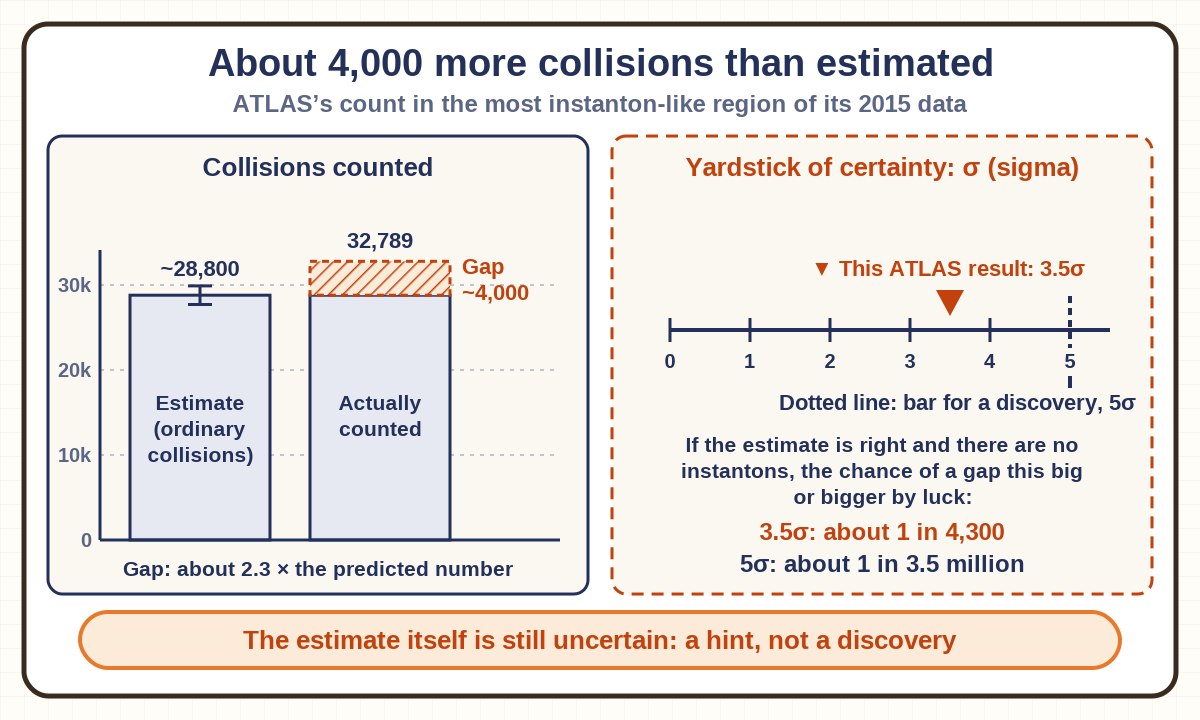
In proton collisions, an instanton should send particles flying out nearly evenly in all directions. In November 2026, the ATLAS experiment reported at 3.5σ that collisions with this round pattern turned up more often than estimated. But that falls short of the 5σ bar for calling something a discovery, so it is only a hint.
A common mix-up
“An instanton is the name of a newly found particle, like the electron or the photon.”
No. The “-on” at the end is the same as in electron and photon, but an instanton is not a particle. The word names an event: the field moving from one vacuum valley to another. Seen in imaginary time, the trick used to calculate it, the event is packed into one small spot in space and time. The title of the 1975 paper by the four physicists who found it called it a “pseudoparticle” (a sort of fake particle). The name instanton was coined the next year, 1976, by the physicist Gerard ’t Hooft; it is explained as coming from the event being packed into one instant of time. Instantons also haven’t been confirmed by experiment yet. The 2026 ATLAS report isn’t about finding a new particle either; it is a hint that the collision patterns expected from instantons turned up more often than estimated.
Explained in pictures
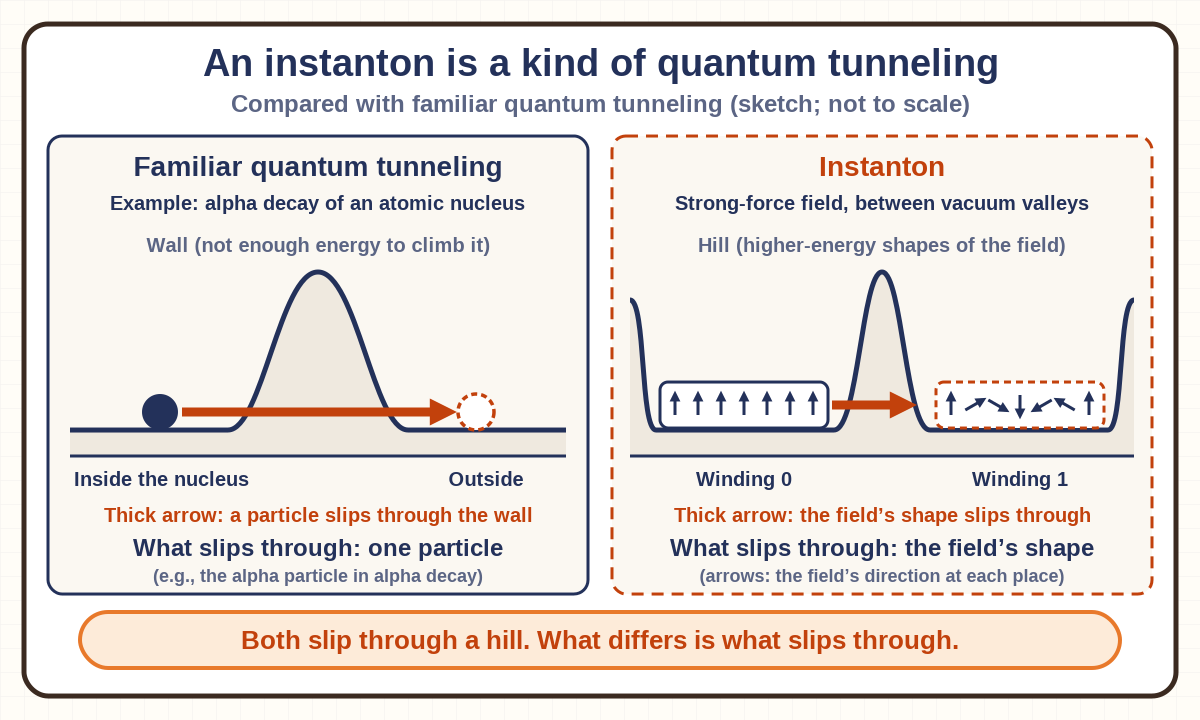
Free to use in lessons, slides and posts with credit (CC BY 4.0).
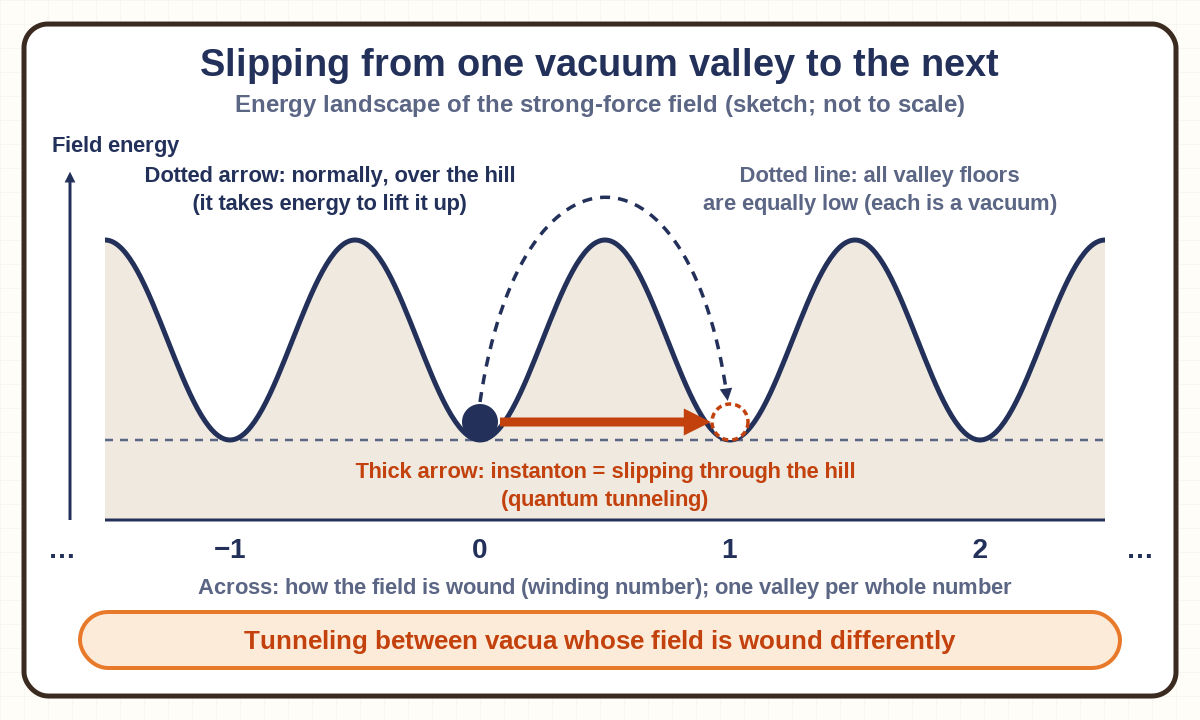
Free to use in lessons, slides and posts with credit (CC BY 4.0).
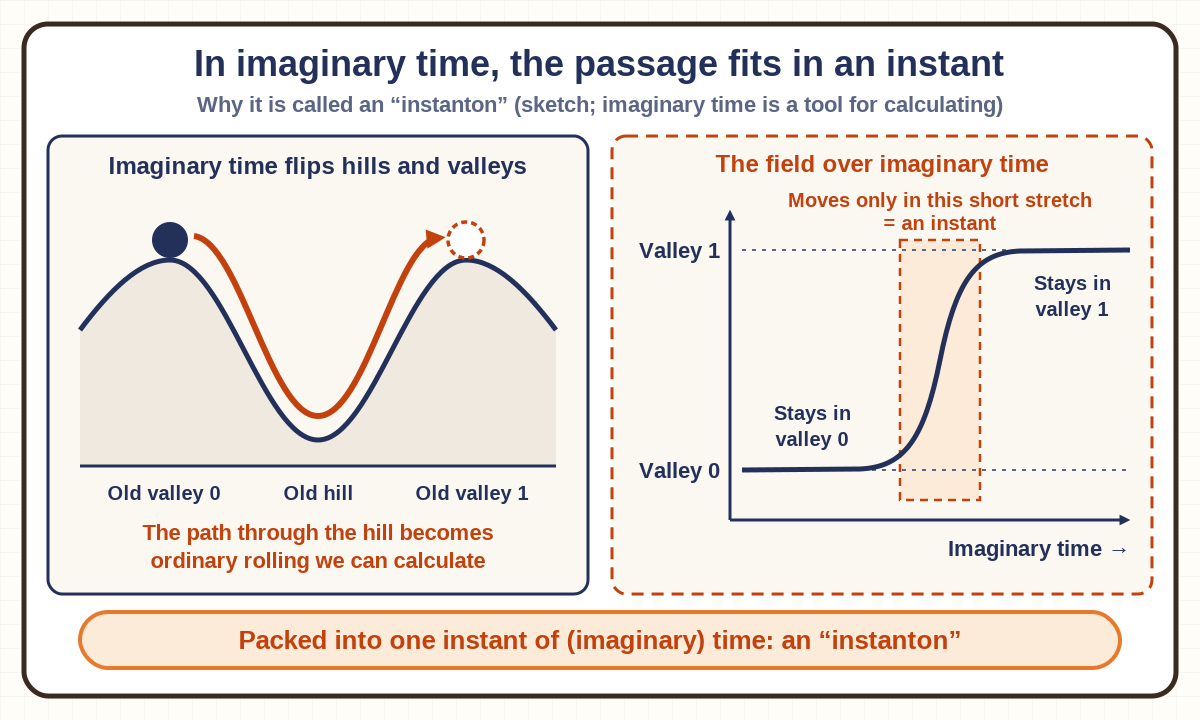
Free to use in lessons, slides and posts with credit (CC BY 4.0).
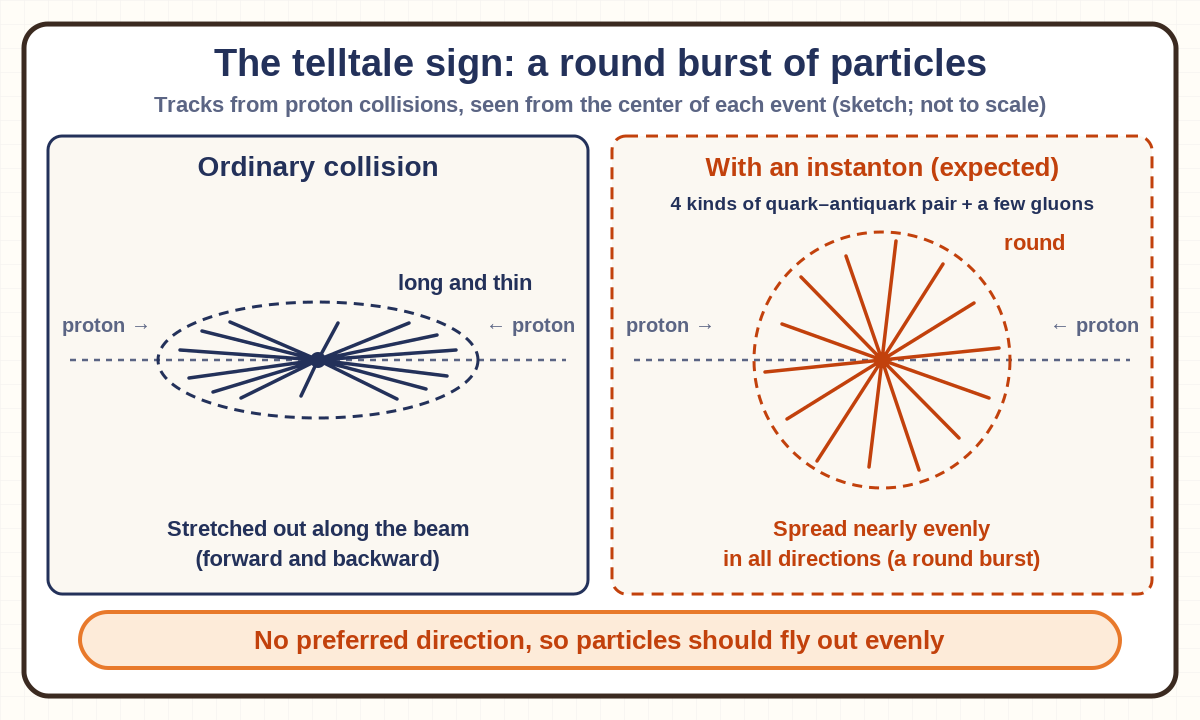
Free to use in lessons, slides and posts with credit (CC BY 4.0).
Free to use in lessons, slides and posts with credit (CC BY 4.0).
You’re free to use these figures in lessons, slides and posts if you credit Naru News (naru.news). CC BY 4.0.
Think of it like this
A row of equally deep valleys, and a ball that slips through the hill
Picture land where valleys of the same depth go on and on, with a hill between each pair. A ball sits at the bottom of one valley. To move it to the next valley, you would normally have to push it up to the top of the hill. Without enough push, the ball stays in the same valley forever.
In the quantum world, though, the ball can turn up in the valley beyond the hill even without the push to get over it. That is quantum tunneling. For the strong-force field, each valley stands for a vacuum in which the field is wound differently, and an event like the ball slipping through the hill into the next valley is an instanton. The bigger the hill, the more sharply such slipping becomes rare.
In this picture, the ball’s position stands for the “shape” of a field spread through space. The shape of a field means the whole pattern of its values from place to place, like the pattern of which way the wind arrows point at each place on a weather map. Each valley stands for a vacuum shape with a different winding, and each hill for a higher-energy shape that has to be passed through between them; the ball moving to the next valley stands for the pattern of values changing into one with a different winding. What matches is that the hill stands in the way, and that in the quantum world the hill can be slipped through. What differs is that what changes isn’t the position of a single ball but a pattern of values spread through space.
Key points
Is an instanton the same thing as quantum tunneling?
Almost. An instanton is one kind of quantum tunneling. Quantum tunneling is something turning up on the far side of a hill (a wall) in the quantum world, even without enough energy to get over it. In the late 1920s, the physicist George Gamow used it to explain how an atomic nucleus breaks apart by giving off alpha rays (alpha decay). The bigger the hill, the more sharply the chance of slipping through drops. Inside a nucleus, a decay that looks as if it could happen in a tiny fraction of a second can be held back by the hill for even millions of years.
What differs is what slips through. In alpha decay, it is a single particle inside the nucleus (the alpha particle). In an instanton, it is the shape of the strong-force field spread through space (the whole pattern of its values from place to place), which moves from one vacuum into the next, wound differently.
What the words name differs a little, too. Quantum tunneling is the name of the phenomenon of slipping through. An instanton is the name of the path of that slipping, worked out with a calculating trick called imaginary time (explained a little further down, along with the name), and of the event it describes. That is why, even in a quantum mechanics calculation of a single particle slipping through a simple landscape with two valleys, the path is called an instanton. In particle physics, instantons are thought to occur in both the strong-force field and the weak-force field, but slipping through in the weak-force field is said to be so rare that it can be ignored. This page is about instantons in the strong-force field.
What does it mean for the vacuum to have many “valleys”?
In physics, the vacuum is less an empty place than the state in which a field’s energy is lowest. For the strong-force field (the field of gluons, the particles that carry the strong force), which binds quarks together, there is thought to be not one but endlessly many states that all share this lowest energy.
These vacua are told apart by a whole number (the winding number) that counts how the field is wound in space. The winding number is like the number of times a string is wound around a pole. Shifting the string a little doesn’t change that number; changing it takes a big move, like slipping the string off the end of the pole. The field’s winding number is the same: it doesn’t change when the field’s shape changes a little. To change the winding number, the field has to pass once through a higher-energy shape (a hill) on the way; there is no low path around it that stays on the valley floors. That gives a landscape of valleys (vacua) and hills side by side.
In 1976, Jackiw and Rebbi, and Callan, Dashen and Gross, made clear that an instanton describes tunneling between these vacua.
Why is it called an “instanton”?
Tunneling can’t be described with the ordinary equations of motion, because in them a ball without enough energy just stops on the slope of the hill and turns back, so no path into the hill comes out. So physicists use a trick: purely for calculating, they replace time with “imaginary time” (named so because it uses the “imaginary numbers” of mathematics). In the imaginary-time equations, the landscape is turned upside down: the old hill becomes a dip, and the old valleys become peaks. Since the inside of the old hill is now a dip, a ball can simply roll through it. That way, the path through the hill can be worked out as ordinary rolling.
On the path found this way, the field spends almost all of the imaginary time sitting in one valley or the other and moves to the next valley only during one short stretch. Because the event is packed into one instant of time, it is called an instanton.
Instantons in fields like that of the strong force were found in 1975 by four physicists, Belavin, Polyakov, Schwartz and Tyupkin, as solutions of the field equations (the Yang–Mills equations) in four-dimensional spacetime using imaginary time. From their initials, they are also called “BPST instantons.” The name instanton was given the next year, 1976, by ’t Hooft. Note that imaginary time is a tool for calculating, so this doesn’t mean the event happens in an instant on a real clock.
What comes out when an instanton happens?
From ’t Hooft’s work in 1976, we know that when a strong-force instanton happens, a quark and an antiquark (a particle with the opposite electric charge and other properties of a quark) always come out together, one pair for each light kind of quark.
When protons are smashed together at the Large Hadron Collider (LHC), gluons inside them can collide and set off an instanton. Calculations say this makes one quark–antiquark pair each of the up, down, strange and charm kinds, plus a few gluons. These quickly turn into particles such as mesons and fly out.
An instanton has no preferred direction, so the particles that fly out are thought to spread nearly evenly in all directions, seen from the center of the event. Theorists called such events, in which many particles of relatively low energy scatter out like a ball, “soft bombs.” In ordinary collisions, particles tend to scatter widely forward and backward along the beam line, so this roundness is a key telltale sign.
Still, calculating how often instantons happen is very hard, and the range of predictions spans several orders of magnitude. When the event energy drops below a certain level, the calculations become less and less reliable.
What did the ATLAS experiment look at, and what did it see?
ATLAS is one of the detectors at the Large Hadron Collider (LHC) at CERN, the European Organization for Nuclear Research. In a paper posted on November 17, 2026, it reported the first search at the LHC for collisions set off by strong-force instantons (the paper has been submitted to a journal). It used part of the data from protons collided in 2015, collected under conditions where collisions happened very rarely, so that other collisions would not overlap.
What it examined were the tracks left by electrically charged particles flying out of the collisions. The number of tracks and how widely they were spread in each direction were shown to a neural network (a kind of AI) to tell instanton-like collisions from ordinary ones. The search was narrowed to relatively low-energy collisions. How many ordinary collisions to expect was estimated not just with computer models but also with other parts of the real data.
In the most instanton-like region, 32,789 collisions were counted, about 4,000 more than the estimate for ordinary collisions (about 28,800). The certainty of this gap is 3.5σ. The size of the gap is about 2.3 times (give or take about 0.6) the number of instanton events the theory predicted. The collisions behind the gap left a smaller number of tracks (in the energy range studied, collisions with an instanton are calculated to leave fewer tracks than ordinary ones) and were more common among collisions whose tracks spread out in a round shape.
The method itself was checked, too. When it was tried on higher-energy collisions, where instantons should hardly ever happen, the instanton share came out consistent with zero, and the data were described well. In other words, it was confirmed that the method finds nothing where there should be nothing.
Why isn’t 3.5σ called a “discovery”?
σ (sigma) is a yardstick for how clearly a gap you see can be told apart from a mere chance fluctuation. In particle physics, the widely used bar is that only at 5σ or more do you call something a “discovery.” 5σ means that the chance of a gap this big or bigger turning up by luck, with nothing really there, is about 1 in 3.5 million. 3.5σ means that even if the estimate is right and there are no instantons, the chance of a gap this big or bigger turning up by luck is about 1 in 4,300.
On top of that, the σ calculation assumes that the estimate for ordinary collisions is right. The ATLAS paper itself says that no model without instantons can fully describe the data, but that how to read the excess is limited by how well ordinary collisions are modeled. In other words, low-energy strong-force processes need to be understood better. It also says that to check whether these are instantons, more work is needed on whether particles containing heavy quarks such as charm show up as expected, and on how the energies of the events are spread.
In the past, many 3σ and 4σ gaps have vanished once more data came in. For example, an excess of collisions producing pairs of particles of light (photons), seen by both ATLAS and CMS in the LHC’s 2015 data, was gone in the larger 2016 data.
Has anyone looked before? What happens next?
Instantons have been predicted by theory since the 1970s, but they have never been confirmed by experiment. At HERA, an accelerator that collided electrons with protons, two experiments, H1 and ZEUS, searched for them. In H1’s 2016 result, no instanton-like events were found; it set an upper limit on how often they happen that was about ten times tighter than before, challenging theory predictions. ATLAS is the first to search for them at the LHC.
Researchers at the University of Bonn say the next challenge is to find out whether the same explanation holds for other kinds of collisions and with different analysis methods, and they plan to widen the search to other kinds of collisions, such as those in which one or both protons come out intact. One of them, Professor Matthias Schott, says that if an instanton could be detected in a collision, “we could begin to measure the topological structure of empty space.” The topological structure here means the way the vacuum has many valleys side by side, each with a different winding.
What would finding them tell us?
Instantons are predicted by the Standard Model of particle physics (today’s theory of the elementary particles and of every force except gravity), yet they have not been confirmed. Finding them would give a way to test in experiments that the vacuum, which looks empty, has many valleys side by side, each with a different winding.
This row of valleys is also tied to a big puzzle about the strong force. Because the valleys are there, the theory of the strong force gains one number that works like a dial (θ, theta). If that number weren’t zero, particles and antiparticles (particles with the opposite electric charge and other properties) should behave differently. Yet experiments find the number to be smaller than one billionth, almost zero. The puzzle of why it is so small is called the “strong CP problem.”
Check yourself
Q1In particle physics, what kind of event does the word “instanton” mean for the strong-force field?
Answer and explanation
Answer: B The field passes straight through the inside of the hill to move from one vacuum valley to the next
An instanton is an event in which the field slips between vacua (valleys) of equal energy by quantum tunneling, without climbing over the hill (a higher-energy shape of the field) between them. It doesn’t leap over the hilltop. The “instant” in the name, too, means that the event looks packed into an instant in imaginary time, a tool for calculating. And there is no low path around the hills between the valleys.
Q2When a strong-force instanton happens in a collision between protons, what telltale sign is expected in the tracks of the particles that fly out?
Answer and explanation
Answer: C The particles spread out nearly evenly in all directions from the center
Since an instanton has no preferred direction, the particles that fly out are expected to spread nearly evenly in all directions as seen from the center of the event, like a ball. Spreading long and thin, forward and back along the beam, is a shape often seen in ordinary collisions, which helps tell the two apart. Spreading flat only in the plane at right angles to the beam wouldn’t be even in all directions.
More on this → Key points: What comes out when an instanton happens?
Q3In November 2026, the ATLAS experiment reported at 3.5σ that the collisions it selected in its search for instantons showed up more often than estimated. What reason did the paper give for why this excess (the extra collisions) can still be read only in a limited way?
Answer and explanation
Answer: A The calculation of how many ordinary collisions occur is still uncertain
The paper says that no model without instantons can fully describe the data, but that how to read the excess is limited by how well ordinary collisions are modeled. The σ calculation, too, assumes that the estimate of how many ordinary collisions occur is right. It can’t yet tell whether instantons are really there or the estimate of ordinary collisions simply falls short. The collisions in the excess left fewer tracks, as calculated, and spread out in a round shape, matching the shape the theory predicted. And the data were collected under conditions where collisions happened very rarely, so that other collisions would not overlap.
More on this → Key points: Why isn’t 3.5σ called a “discovery”?
Related terms
- Quantum tunneling
- Quantum chromodynamics
- Strong force
- Gluon
- Quark
- Vacuum
- Theta vacuum
- Strong CP problem
- Sphaleron
- Standard Model
- Large Hadron Collider (LHC)
- Superposition
- Neural network
Sources and how we checked
- ATLAS Collaboration, “Search for the low-mass isotropic signature of QCD instantons in pp collisions at √s = 13 TeV using the ATLAS detector” (CERN, arXiv 2611.22092, November 17, 2026; submitted to Physical Review Letters; full text read as a PDF: the first search for QCD instanton-induced events at the LHC; instantons as semi-classical solutions of the Euclidean-space Yang–Mills equations, corresponding to quantum mechanical tunneling between topologically distinct vacuum states; the multi-vacuum structure giving rise to the θ-vacuum and the strong CP problem; the ’t Hooft vertex involving a quark–antiquark pair of each active flavor; the instanton having no preferred orientation, so an approximately isotropic final state is expected; the calculated gluon-induced transition to up, down, strange and charm quark–antiquark pairs plus a mean of 5.5 to 6.8 gluons for instanton masses of 20 to 50 GeV; predictions becoming increasingly unreliable below about 20 GeV; cross-section uncertainty spanning orders of magnitude; 1.6 nb⁻¹ of data collected in 2015 under very low instantaneous luminosity, with mean pileup 0.028; five track-based observables and a deep neural network; a data-driven background estimate; the selection 10 < S_T < 20 GeV; 32,789 data events in the signal region, background (2.88 ± 0.11)×10⁴ and signal (3.9 ± 1.1)×10³; observed (expected) significance 3.5σ (1.5σ); signal strength μ = 2.3 ± 0.6 times the predicted cross-section; track reconstruction uncertainties having negligible impact on the signal extraction; signal strength compatible with zero in the 20–30 and 30–40 GeV intervals; the excess characterized by low track multiplicity and greater isotropy in sphericity-D; no background-only model fully describing the data, the interpretation being limited by background modeling and highlighting the need to better understand low-energy QCD processes; further characterization of the heavy-flavor signature and mass spectrum being required; and previous searches by H1 and ZEUS at HERA; read November 28, 2026)
- University of Bonn, “ATLAS finds hints of the hidden structure of the vacuum” (Phys.org, November 27, 2026; a University of Bonn release: quantum chromodynamics describing the force that holds quarks together inside protons and neutrons; the strong-force field having distinguishable twisted configurations even in empty space, with tunneling letting it switch between them; a neural network used to separate ordinary collisions from nearly isotropic ones; the result being a hint rather than a confirmed observation; Professor Matthias Schott of the University of Bonn saying “we could begin to measure the topological structure of empty space”; the researchers planning further checks with other collision types and analysis methods and extending the search to collisions in which one or both protons emerge intact; and QCD instanton processes themselves leaving the relative amounts of matter and antimatter unchanged; read November 28, 2026)
- A. A. Belavin, A. M. Polyakov, A. S. Schwartz and Yu. S. Tyupkin, “Pseudoparticle solutions of the Yang-Mills equations” (Physics Letters B 59, 85–87, 1975; abstract read in the INSPIRE record: regular solutions of the four-dimensional Euclidean Yang–Mills equations, which locally minimize the action, finite in this case, and their topological nature; read November 28, 2026)
- G. ’t Hooft, “Symmetry breaking through Bell-Jackiw anomalies” (Harvard University, Physical Review Letters 37, 8, July 5, 1976; abstract read: in models of fermions coupled to gauge fields, nonperturbative effects can give rise to interactions that violate charge conservation laws that look conserved in perturbation theory, leading to baryon and lepton number nonconservation in V−A gauge theories and to a nonzero mass squared for the η meson; read November 28, 2026)
- T. Schäfer and E. V. Shuryak, “Instantons in QCD” (University of Washington and State University of New York at Stony Brook, Reviews of Modern Physics 70, 323–426, 1998, arXiv hep-ph/9610451; full text read as a PDF. Section I.C: the instanton solution discovered by Polyakov and coworkers in 1975, with Jackiw and Rebbi and Callan, Dashen and Gross clarifying its meaning as tunneling between degenerate classical vacua and introducing θ-vacua; ’t Hooft’s paper implying that every instanton absorbs one left-handed fermion of every species and emits a right-handed one; the tunneling rate in electroweak theory being negligible; and ’t Hooft coining the term instanton, while Polyakov had called it a pseudo-particle [footnote 6]. Section II.A: tunneling discovered by George Gamow in the late 1920s in the context of alpha decay, explaining how a nuclear time scale of 10⁻²² s could lead to lifetimes of millions of years; imaginary momentum in the classically forbidden region; continuing to imaginary time changing the sign of the potential so that classically forbidden regions become allowed; the double-well solution being called the instanton because it is localized in time; the tunneling amplitude being proportional to exp(−S₀); and the true ground state being a combination of the two states. Section II.C: an infinite set of classical gauge-field vacua enumerated by an integer winding [Chern–Simons] number, with no path between them at zero energy; the tunneling path being the solution of minimal Euclidean action [the BPST instanton]; and the QCD ground state being a superposition of all vacua [θ-vacua]; the θ term violating CP, neutron electric dipole measurements implying θ < 10⁻⁹, and the question of why θ is so small being known as the strong CP problem; read November 28, 2026)
- V. V. Khoze, F. Krauss and M. Schott, “Large effects from small QCD instantons: making soft bombs at hadron colliders” (Durham University and others, Journal of High Energy Physics 04 (2020) 201, arXiv 1911.09726; full text read as a PDF: instanton-induced processes being a consequence of the non-trivial vacuum structure of the Standard Model and of quantum tunneling, and never yet observed; instantons violating baryon plus lepton number in the electroweak sector but being exponentially suppressed in normal circumstances; QCD instantons being less suppressed because the strong coupling is larger; QCD instanton processes in proton collisions producing “soft bombs,” very high-multiplicity spherically symmetric distributions of relatively soft particles; H1’s upper limits of 1.5 to 6 pb; and, for an instanton of topological charge Q = 1, exactly one right-handed quark and one anti-left-handed quark for each light flavor in the final state; read November 28, 2026)
- H1 Collaboration, “Search for QCD instanton-induced processes at HERA in the high-Q² domain” (European Physical Journal C 76, 381, 2016, arXiv 1603.05567; abstract read: a search for QCD instanton-induced processes in neutral-current deep-inelastic scattering at HERA in about 351 pb⁻¹ of data, finding no evidence for them, with upper limits of 1.5 to 6 pb at 95% confidence level, about an order of magnitude better than earlier publications and now challenging theory predictions; read November 28, 2026)
- Louis Lyons, “Five sigma revisited” (CERN Courier, July 3, 2023: a 5σ discrepancy with the Standard Model being the standard criterion for claiming a discovery in particle physics; the chance of such an effect from a statistical fluctuation being at most 3×10⁻⁷; systematic uncertainties being harder to assess than statistical ones and possibly underestimated; numerous 3σ and 4σ effects having gone away when more data was collected; and the 750 GeV diphoton excess seen in ATLAS and CMS data from 2015 being absent in the larger 2016 data sets; read November 28, 2026)
- ATLAS Experiment, “CP symmetry / CP violation” (glossary of CERN’s ATLAS experiment: CP symmetry being preserved when the laws of physics remain unchanged if a particle’s electric charge is inverted [charge conjugation, C] and its spatial coordinates are mirrored [parity, P]; read November 28, 2026)
- CERN, “The Standard Model” (CERN explainer page: the strong force being carried by the gluon; read November 28, 2026)
AI wrote this page from the sources above, and a different AI checked it against the text of those sources (November 28, 2026). A person with a master’s degree in science and a Japanese high-school science teaching license also read and checked it before publishing. Numbers are as of that date. If anything was hard to follow, you spot a mistake, or there’s a term you’d like explained, please write to [email protected].
Glossary
- AI agent
- AI alignment
- Alignment faking
- Artificial general intelligence (AGI)
- Artificial intelligence (AI)
- Backdoor
- Benchmark
- Chain of thought (CoT)
- Context window
- Data poisoning
- Deep learning
- Deepfake
- Diffusion model
- Embedding
- Emergent misalignment
- Evaluation awareness
- Fine-tuning
- Formal verification
- Generalization
- Generative adversarial network (GAN)
- Generative AI
- Goodhart’s law
- Gradual disempowerment
- Hallucination
- Hyperparameter
- Intelligence explosion
- Interpretability
- Jailbreaking
- Large language model (LLM)
- Latent space
- Machine learning
- Mixture of experts (MoE)
- Neural network
- Neuralese
- Overfitting
- Parameter
- Persona vectors
- Pre-training
- Prompt
- Prompt injection
- Reasoning model
- Recursive language model (RLM)
- Recursive self-improvement (RSI)
- Red teaming
- Reinforcement learning (RL)
- Retrieval-augmented generation (RAG)
- Reward hacking
- Reward model
- Shutdown resistance
- Sleeper agent
- Subliminal learning
- Superintelligence (ASI)
- System prompt
- Technological singularity
- Time horizon
- Token
- Transfer learning
- Transformer
- Accretion disk
- Black hole
- Black hole star
- Cosmic birefringence
- Event horizon
- Event Horizon Telescope (EHT)
- General relativity
- GPS
- Gravitational lensing
- Gravitational singularity
- Gravitational wave
- James Webb Space Telescope (JWST)
- Lagrange point
- Long-period radio transient (LPT)
- Neutron star
- Pulsar
- Quasar
- Sagittarius A*
- Space data center
- Spacetime
- Special relativity
- Speed of light
- Supermassive black hole
- White dwarf
- Cat qubit
- You are hereInstanton
- Logical qubit
- Quantum computer
- Quantum entanglement
- Qubit