
What is the speed of light (about 300,000 km per second, the universe’s speed limit)?
Also called: Light speed

In one minute
The speed of light is how fast light travels in a vacuum: about 300,000 km per second (exactly 299,792,458 m).
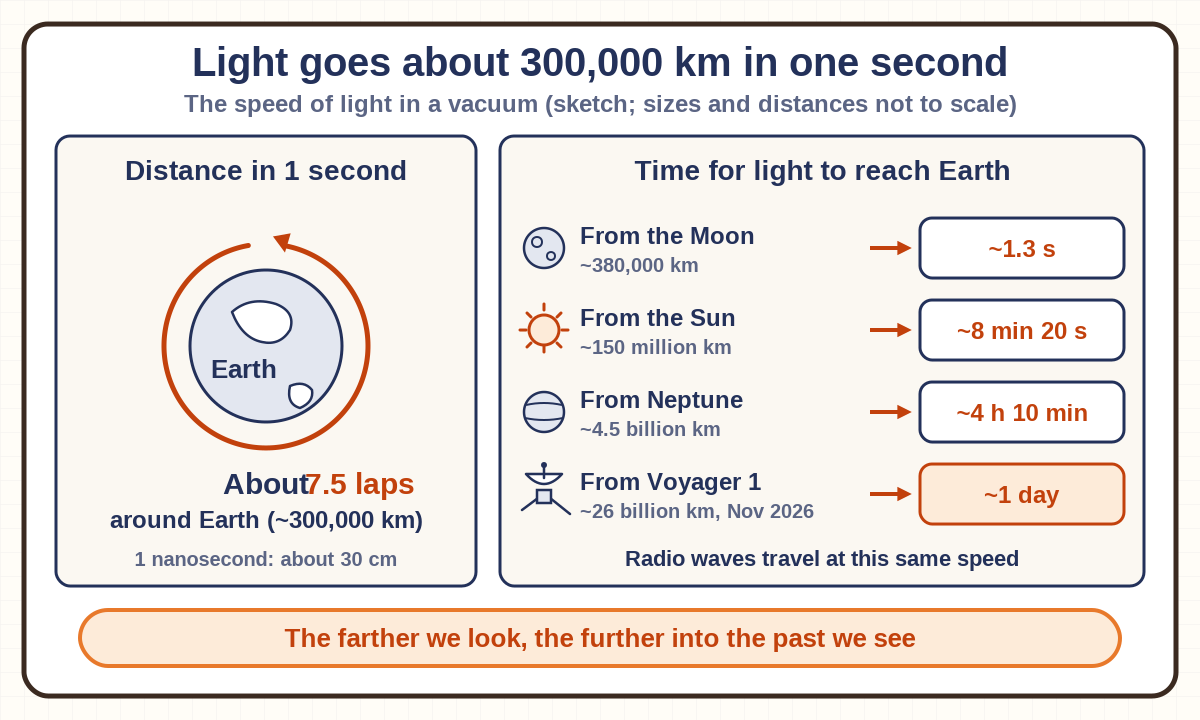
That is fast enough to circle Earth about 7.5 times in one second, so in daily life light seems to arrive instantly, but its speed has a limit. Light from the Moon takes about 1.3 seconds to reach Earth, and light from the Sun about 8 minutes 20 seconds, so looking far away also means seeing the past. Radio waves and light’s other relatives travel at the same speed in a vacuum. The speed is written with the symbol c.
Since 1983, this value has been a fixed number rather than a measured one, and the length of the meter is defined using light. Light slows down in water and glass, but its speed in a vacuum is the same for everyone who measures it. No object and no message can travel faster than it.
A common mix-up
“Light arrives instantly, so there is no limit to its speed.”
Half right. In daily life, light really does arrive almost instantly. It covers 1 m in about 3.3 billionths of a second, so when you switch on a room light, the whole room seems to light up at once. In the past, some scholars, such as Descartes, thought light took no time at all to travel, and when Galileo tried to time it with two people showing lights to each other, he could see no delay at a distance of about 1.6 km (a mile). But the speed of light does have a limit. Even light from the Moon and the Sun takes time to reach Earth. The first to show that light’s speed is limited was Rømer, in 1676, by studying how a moon of Jupiter appeared. At everyday distances the delay is just too small to notice; at the distances of space, it shows clearly.
Explained in pictures
Free to use in lessons, slides and posts with credit (CC BY 4.0).
Free to use in lessons, slides and posts with credit (CC BY 4.0).
Free to use in lessons, slides and posts with credit (CC BY 4.0).
You’re free to use these figures in lessons, slides and posts if you credit Naru News (naru.news). CC BY 4.0.
Think of it like this
Lightning and thunder
After lightning flashes, it takes a little while before you hear the rumble of thunder. That’s because sound travels only about 340 m each second through air. If you count the seconds between the flash and the sound, you can tell roughly how far away the lightning is: about 3 seconds means about 1 km. The light from the flash, on the other hand, arrives almost instantly over that kind of distance. Light is about 880,000 times faster than sound.
In space, light plays the part of the thunder. Light’s speed has a limit too, so the farther away a star is, the longer its light takes to arrive. Just as the lightning has already finished flashing by the time you hear the thunder, by the time you see a star’s light, the star may look different from when it sent that light. The Sun you see now, too, is the Sun of about 8 minutes 20 seconds ago.
But the comparison has limits. Sound travels through air, but light can travel even through empty space, a vacuum. Also, the speed of sound changes with things like the air’s temperature, but the speed of light in a vacuum is the same for everyone who measures it, however the light source or the observer is moving. And no object or message can go faster than the speed of light in a vacuum.
Key points
How fast is the speed of light?
The speed of light in a vacuum is exactly 299,792,458 m per second, or roughly 300,000 km per second. That is fast enough to go around Earth’s equator about 7.5 times in one second, and about 880,000 times the speed of sound in air (about 340 m per second). Even in a billionth of a second (1 nanosecond), it covers about 30 cm.
It seems instant in daily life, but over larger distances the travel time becomes clear. On the Moon’s surface are reflectors that Apollo 11 astronauts set up in 1969. By shining laser light from Earth at these reflectors, about 380,000 km away, and timing its return (a little over 2.5 seconds for the round trip), scientists can find the distance to the Moon. At first this was accurate to some tens of centimeters; today it is measured to the millimeter. That is also how we learned that the Moon is moving away from Earth by about 3.8 cm a year.
Much farther out, on November 18, 2026, the space probe Voyager 1, launched in 1977, became the first human-made object to reach a distance from Earth that light takes a full day to cover (about 26 billion km).
Radio waves, ultraviolet light, X-rays and others are light’s relatives, together called electromagnetic waves. All of them travel at the same speed as light in a vacuum. This speed is written with the symbol c.
How did people in the past measure the speed of light?
Light is so fast that, in the past, some scholars thought it traveled in no time at all. Descartes argued strongly that light travels instantly. Galileo tried to time light with two people far apart showing lights to each other, but at a distance of about 1.6 km (a mile) he could see no delay.
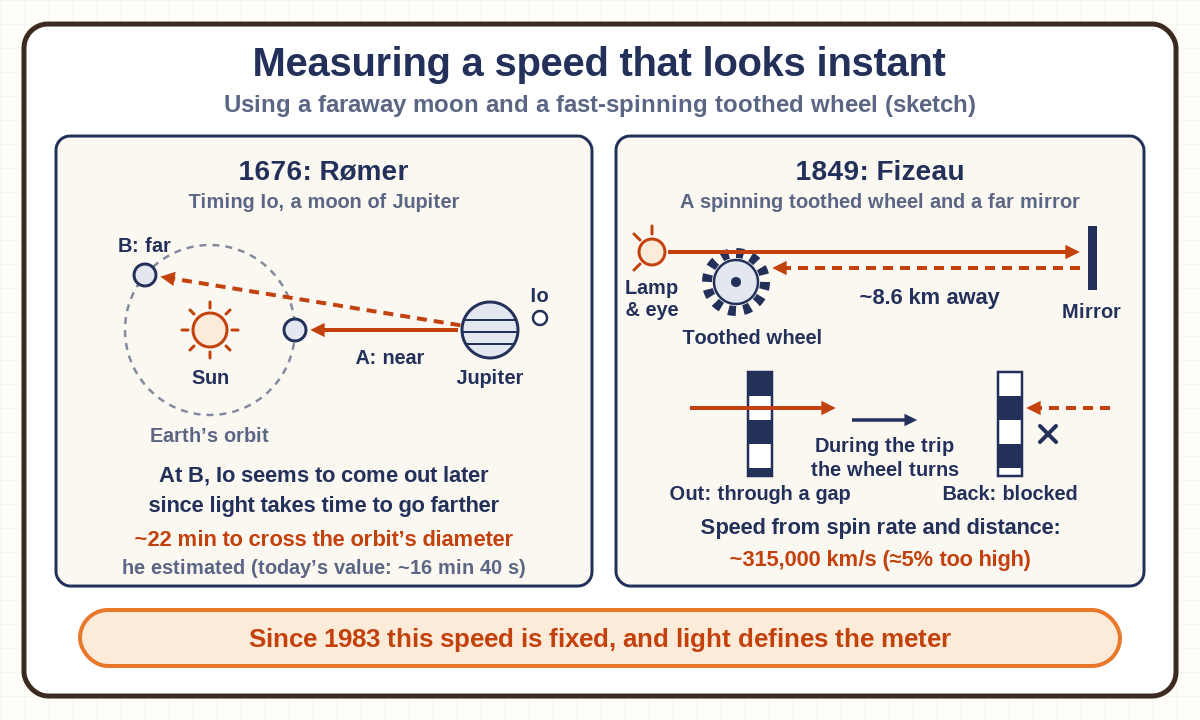
The first to show that the speed of light has a limit was the Danish astronomer Rømer. Jupiter’s moon Io circles the planet and, at regular intervals, passes into Jupiter’s shadow and disappears from view. This is called an eclipse. Rømer noticed that while Earth was moving away from Jupiter, the times when Io came out of the shadow fell more and more behind the predictions. That is because light takes time to travel the longer way. In 1676, he announced ahead of time that the eclipse of Io on November 9 would come about 10 minutes later than predicted, and it did. Rømer estimated that light takes about 22 minutes to cross the diameter of Earth’s orbit (its path around the Sun). Today’s value is about 16 minutes 40 seconds, so his estimate was too large, but he used a faraway world to show that the speed of light has a limit.
The first to measure the speed of light on the ground was Fizeau, in 1849. At two places in and near Paris, about 8.6 km apart, he put a fast-spinning toothed wheel at one and a mirror at the other, and sent light through a gap between the teeth to bounce off the mirror. With the wheel turning slowly, the returning light passes through the same gap and can be seen. But when the wheel spins fast, it turns while the light makes the round trip, and the returning light is blocked by the next tooth and disappears. From the spin rate at which the light disappeared and the distance, he worked out a speed of about 315,000 km per second, about 5% higher than today’s value.
Measurements kept getting finer, and in 1972, at the US National Institute of Standards and Technology (NIST), a laser stabilized to give off light of a set frequency was used to measure 299,792,456.2 m per second (with an uncertainty of ±1.1 m). That was about 100 times more accurate than before.
Why is it now a fixed number rather than a measured one?
In 1983, the international conference that decides units such as those for length and weight changed how the meter is defined. The new definition is: “one meter is the distance light travels in a vacuum in 1/299,792,458 of a second.” This makes the speed of light exactly 299,792,458 m per second.
The reason is that people had become so good at measuring the speed of light that the way the meter was defined at the time was no longer precise enough. The meter was first set as 1/10,000,000 of the distance from the North Pole to the equator, and until 1960 metal bars were sent out as the standard for length. From 1960, it was defined by the wavelength of light given off by a certain kind of atom. But with lasers, the speed of light could be measured so finely that the meter, the yardstick being used, was too rough to give a finer value. So the speed of light was made the fixed number instead, and length came to be defined from time, which can be measured extremely accurately.
So the value of the speed of light no longer comes from measurements; it is an exact number with no uncertainty. Today, the speed of light is fixed first at 299,792,458 m per second, the length of a second is set very precisely using a property of atoms, and the length of the meter follows from these. However the speed of light is measured again, this value will not change.
Does light slow down in water and glass?
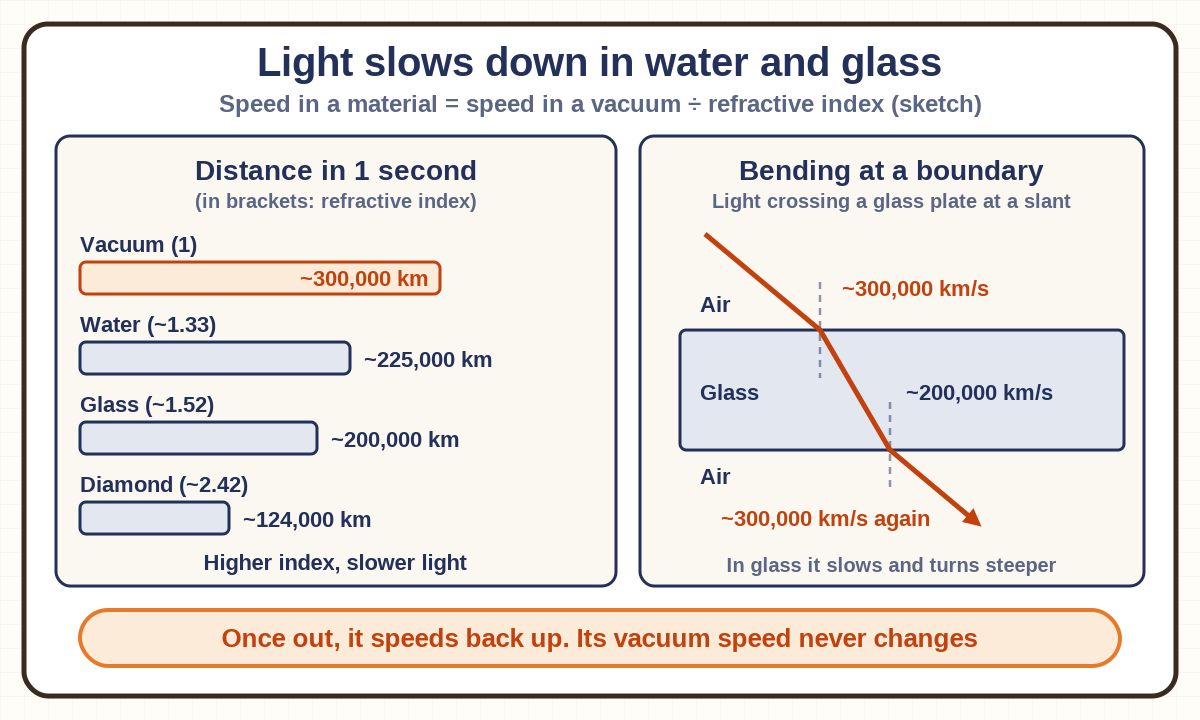
Yes. The speed of light in a clear material such as water or glass is its speed in a vacuum divided by the material’s refractive index. The refractive index is a number for how much a material slows light: about 1.0003 for air, about 1.33 for water, about 1.52 for common glass and about 2.42 for diamond. So light covers only about 225,000 km a second in water (about three-quarters of its vacuum speed), about 200,000 km in glass and about 124,000 km in diamond.
When light enters, at a slant, a boundary between materials with different light speeds, its direction bends. This is refraction. When light enters a slower material, it bends closer to the direction perpendicular to the boundary. Refraction is also how lenses and our eyes form images. In 1850, Foucault was the first to show by experiment that light slows down in water, and Fizeau confirmed it seven weeks later.
Light is slower only while it is inside the material. Once it passes back out into a vacuum or air, it travels at its earlier speed again. The rule that “the speed of light is the same for everyone who measures it” is about the speed of light in a vacuum.
Why can’t anything go faster than light?
The faster an object goes, the harder it becomes to speed it up further. Reaching exactly the speed of light would take an infinitely strong force. So nothing with mass (the amount behind an object’s weight), however long it is pushed, can reach or pass the speed of light.
Not just objects but energy and messages (information) can’t be sent faster than light either. An event in a faraway place cannot affect us here until at least the time it takes light to arrive has passed.
This follows from the rule that the speed of light in a vacuum is the same however the light source or the observer is moving. The detailed reasons are explained on the special relativity page.
Is it true that looking far away means seeing the past?
Yes. Because light takes time to arrive, the farther away something is, the older the view we see: how it looked when the light left it.
Large distances in space are sometimes given in a unit called the light-year. One light-year is the distance light travels in a vacuum in one year, about 9.46 trillion km. Despite the word “year,” it is a unit of distance, not of time. The star nearest the Sun is about 4.2 light-years away, so the light from it you see now left the star about 4 years ago.
When talking with Voyager 1, which is a full light-day away, a command sent from Earth takes a full day to arrive, and its reply takes another full day to reach Earth. When we exchange messages with faraway places, the speed of light becomes a waiting time we cannot shorten.
Check yourself
Q1On the Moon’s surface is a reflector that Apollo 11 astronauts set up in 1969. If laser light is sent from Earth to this reflector and the time it takes to bounce back to Earth is measured, about how long is it?
Answer and explanation
Answer: A It comes back in about 2.5 seconds
Light travels about 300,000 km each second, but the Moon is about 380,000 km away, so the round trip takes a little over 2.5 seconds. Timing this trip now gives the distance to the Moon down to the millimeter. Light may seem to arrive instantly in daily life, but its speed has a limit, so over the distances of space, the travel time shows up clearly.
Q2How is the value of the speed of light in a vacuum (about 300,000 km per second) decided?
Answer and explanation
Answer: B By fixing it first and using it to define the meter
Since 1983, one meter has been defined as “the distance light travels in a vacuum in 1/299,792,458 of a second.” The speed of light is a number fixed in advance at exactly 299,792,458 m per second, and the length of the meter follows from it. It is neither an average of measurements nor calculated from the meter and the second. Before that, scientists measured the speed of light, but measuring skills improved so much that the way the meter was defined at the time was no longer precise enough, so the speed of light was made the fixed number instead.
More on this → Key points: Why is it now a fixed number rather than a measured one?
Q3When light passes at a slant from air into water, its direction bends. How does the speed of light in the water compare with the speed of light in a vacuum?
Answer and explanation
Answer: C About 3/4 of its speed in a vacuum
The speed of light in water or glass is its speed in a vacuum divided by the material’s refractive index (a number for how much a material slows light). Water’s refractive index is about 1.33, so light in water travels at about three-quarters of its vacuum speed, about 225,000 km per second. The 1.33 isn’t how many times faster light becomes; it is the number the vacuum speed is divided by. Because light enters a material with a different light speed at a slant, its direction bends (refraction). Once out of the water, light travels at its earlier speed again.
More on this → Key points: Does light slow down in water and glass?
Related terms
- Special relativity
- Spacetime
- Light cone
- E=mc² (mass–energy equivalence)
- Gravitational wave
- Event horizon
- GPS
- Light-year
- Refraction
- Electromagnetic wave
- Atomic clock
- Cherenkov radiation
Sources and how we checked
- International Bureau of Weights and Measures (BIPM), “Resolution 1 of the 17th CGPM (1983): Definition of the metre” (the metre as the length of the path travelled by light in vacuum during 1/299 792 458 of a second, abrogating the 1960 definition based on krypton 86, and keeping the value c = 299 792 458 m/s recommended by the 15th CGPM in 1975. Considerations: the earlier definition not being precise enough, stabilized lasers giving more reproducible radiation than the krypton-86 lamp, and measurements of the speed of light being limited mainly by the realization of the metre; read November 22, 2026)
- International Bureau of Weights and Measures (BIPM), “SI base unit: metre (m)” (today’s definition: the metre defined by taking the fixed numerical value of the speed of light in vacuum c to be 299 792 458 when expressed in m s⁻¹, the second being defined by the caesium frequency, and the exact relation c = 299 792 458 m s⁻¹, the effect being that one metre is the length of the path travelled by light in vacuum during 1/299 792 458 of a second; read November 22, 2026)
- NIST, “CODATA Value: speed of light in vacuum” (US National Institute of Standards and Technology: the speed of light in vacuum, 299 792 458 m s⁻¹, with the standard uncertainty listed as “exact”; read November 22, 2026)
- NIST, “Meter” (SI redefinition page: the meter first set at 1/10,000,000 of the distance between the North Pole and the equator, the length standard disseminated with platinum-iridium meter bars until 1960, the 1960 definition as 1,650,763.73 wavelengths of radiation from krypton 86, the meter being redefined by international agreement in 1983, enabled by the ability to measure the speed of light reliably and precisely, the 1972 record measurement at NIST Boulder with a novel laser stabilized to a specific frequency giving c = 299,792,456.2 ± 1.1 m/s, a hundredfold improvement in the accepted value, and length no longer being an independent standard but derived from the extremely accurate standard of time; read November 22, 2026)
- Kotobank, Japanese dictionary entries for kōsokudo, “speed of light” (Digital Daijisen: the speed at which light travels, 299,792,458 m per second in a vacuum, written c, also called kōsoku; Nipponica [Ryozo Tamagaki and Tsuneo Uematsu]: also simply called kōsoku, the speed of light in vacuum being constant regardless of frequency and written c, light being an electromagnetic wave and electromagnetic waves also traveling at c, light in a material traveling at c divided by the refractive index, slower than c, particles with mass being unable to exceed the speed of light, the Danish astronomer Rømer first finding a value for the speed of light in 1676 from changes in the eclipse periods of Jupiter’s moons, the decision in 1983 to define the unit of length from the unit of time and the speed of light, making c a defined value, and 1 m as the distance light travels in a vacuum in 1/299,792,458 of a second; MyPedia: Fizeau’s rotating toothed wheel in 1849 and Foucault’s rotating plane mirror in 1850; Britannica Japan: the speed of light in a material being c/n [n the absolute refractive index], smaller than in a vacuum; read November 22, 2026)
- NASA Science, “Introduction to the Electromagnetic Spectrum” (electromagnetic energy traveling in waves and spanning a broad spectrum from very long radio waves to very short gamma rays, with gamma rays, X-rays and some ultraviolet waves among them; read November 22, 2026)
- Patricia Daukantas, “Ole Rømer and the Speed of Light” (Optics & Photonics News, Optica, July 1, 2009: Descartes arguing strenuously for the instantaneous transmission of light, Galileo proposing a lantern experiment between two people and trying it about a mile from his assistant without a measurable delay, Io’s apparent period being shorter while Earth approached Jupiter and its emergence from Jupiter’s shadow being increasingly delayed while Earth moved away, the forecast that the next eclipse of Io, due on November 9 at 5:25:45 a.m., would be 10 minutes late, and its observation about ten minutes late, Rømer telling the Academy that light took about 22 minutes to cross the diameter of Earth’s annual orbit, and Rømer never actually giving a value for the velocity of light. Today’s value of about 16 minutes 40 seconds was found by dividing twice the average Sun–Earth distance [the astronomical unit] by the speed of light; read November 22, 2026)
- Olivier Morizot et al., “A modern Fizeau experiment for education and outreach purposes” (European Journal of Physics, 2011; Section 1 of the arXiv:1011.1770 text: Fizeau being the first to measure the speed of light in a terrestrial experiment in 1849, light passing a half-mirror and a rotating cogwheel, reflecting off a mirror some 8.633 km away and passing the cogwheel again, the light passing the same gap out and back at low rotation rates but being cut by the next tooth at higher rates, with total extinction when the open-gate time equals the round trip, the speed found from the distance, the number of teeth and the rotation rate, and Fizeau obtaining 315,000 km/s with the cogwheel at Montmartre and the reflector at Suresnes; read November 22, 2026)
- J. J. O’Connor and E. F. Robertson, “Armand-Hippolyte-Louis Fizeau” (MacTutor History of Mathematics, University of St Andrews, updated July 2008: his parents’ home in Suresnes and Montmartre being 8633 metres apart, a rapidly rotating toothed wheel between them and finding the rotation speed at which the light’s travel time matched the wheel turning by one tooth, the first successful terrestrial measurement of the speed of light, with an error of about 5%, Foucault first showing in April 1850 that light travels more slowly in water than in air, and Fizeau confirming this with his apparatus seven weeks later; read November 22, 2026)
- HyperPhysics, “Index of Refraction” (R. Nave, table on the Georgia State University site: vacuum 1.00000, air at STP 1.00029, water at 20 °C 1.33, typical crown glass 1.52, diamond 2.417. The speeds of about 225,000, 200,000 and 124,000 km per second were found by dividing the speed of light by these values; read November 22, 2026)
- HyperPhysics, “Refraction of Light” (R. Nave, Georgia State University site: refraction as the bending of a wave when it enters a medium where its speed is different, the index of refraction as the speed of light in vacuum divided by the speed of light in the medium, light passing from a fast medium to a slow one bending toward the normal, the speed of light being reduced in the slower medium, and refraction being responsible for image formation by lenses and the eye; read November 22, 2026)
- NASA Science, “What Is a Light-Day?” (updated November 19, 2026: Voyager 1 becoming the first human-made object to reach one light-day from Earth on November 18, 2026, at 5:16:07 a.m. EST, a light-day being the distance light travels in 24 hours, 25,902,068,356 km, a radio signal now taking an entire day to reach the spacecraft, 49 years, two months and 11 days since its launch on September 5, 1977, light moving about 186,000 miles every second, sunlight taking about 8 minutes 20 seconds to reach Earth, light crossing the distance to the Moon in 1.3 seconds, Neptune being four light-hours and 10 light-minutes away, and Proxima Centauri about 4.24 light-years away. The distance to Neptune of about 4.5 billion km was found by multiplying 4 hours 10 minutes by the speed of light; read November 22, 2026)
- NASA Scientific Visualization Studio, “How Far Away Is Voyager 1? One Light-Day, Explained” (NASA Goddard Space Flight Center video page, November 12, 2026: Voyager 1 reaching one light-day from Earth on November 18, 2026, a command sent from Earth taking 24 hours to reach the spacecraft, and another 24 hours for a response to return; read November 22, 2026)
- IAU Office of Astronomy for Education, “Glossary term: Light Year” (multilingual astronomy glossary: the light year as a unit of length used in astronomy for large distances, the distance light travels in vacuum in one year, 9.46 trillion km, the nearest star to the Sun being 40 trillion km or 4.25 light years away, and the parsec [about 3.26 light years] being the preferred measure in research; read November 22, 2026)
- NASA NSSDCA, “Earth Fact Sheet” (David R. Williams, updated November 15, 2024: Earth’s equatorial radius of 6378.137 km and orbital semimajor axis of 149.598 million km. “About 7.5 times around Earth in one second” was found by dividing the speed of light by the length of the equator [about 40,075 km from the radius], about 7.48 times; read November 22, 2026)
- NASA Goddard Space Flight Center (eclipse website), “Measuring the Moon’s Distance” (from LPI Bulletin No. 72, August 1994: the first laser ranging retroreflector placed on the Moon by the Apollo 11 astronauts in 1969, beaming laser pulses from Earth to determine the round-trip travel time and measuring the Moon’s distance to an accuracy of about 3 cm [as of 1994], and measurements showing the Moon receding from Earth at about 3.8 cm per year; read November 22, 2026)
- James E. Faller, “Lunar Laser Ranging” (JILA, University of Colorado, and NIST, among others; paper on the International Laser Ranging Service [ILRS] website: Apollo 11 astronauts placing an array of 100 retroreflectors on the lunar surface on July 20, 1969, and the true mean distance to the Moon of some 380,000 km making the round-trip travel time for a pulse of light a bit over 2.5 seconds, the Earth–Moon distance being measured at first to some tens of centimeters and, 40 years later, to millimeters, and the group at Apache Point Observatory moving lunar laser ranging from the centimeter to the millimeter level; read November 22, 2026)
- Einstein Online, “Special relativity / Elementary Tour part 4: The speed of light” (general-audience explanation by the Max Planck Institute for Gravitational Physics [Albert Einstein Institute]: any light signal moving through empty space with the same constant speed, no object, however strong the forces acting on it, ever being accelerated to light speed, light speed defining the absolute speed limit for the transfer of energy, matter and information, and the clocks of a spaceship moving fast relative to an observer running more slowly than the observer’s own; read November 22, 2026)
- Einstein Online, “Special relativity / Elementary Tour part 6: E=mc²” (the faster an object already is, the more difficult any further acceleration becomes, reaching light speed exactly requiring an infinitely strong force acting on the body, and this enforcing special relativity’s speed limit, that no material object can be accelerated to light speed; read November 22, 2026)
- Einstein Online, “Special relativity / Elementary Tour part 5: Spacetime” (light speed as the absolute upper limit for the transmission of energy, matter and information, any influence of an event A on an event B that happens before A’s light arrives having to travel faster than light, and events outside the light cone being able neither to influence A nor to be influenced by A; read November 22, 2026)
- NASA Glenn Research Center, “Speed of Sound Interactive” (the speed of sound at sea level on a standard day being about 761 mph, or 1100 feet per second, and the speed of sound in air depending on the type of gas and its temperature. “About 340 m per second” was converted from 761 mph, and “about 880,000 times the speed of sound” was found by dividing the speed of light by 340 m per second; read November 22, 2026)
- US National Weather Service, Melbourne office, “Lightning Rules” (counting the seconds between seeing the lightning flash and hearing the thunder to tell how far away a lightning stroke is, with five seconds approximating one mile. “About 3 seconds for about 1 km” was converted from this; read November 22, 2026)
AI wrote this page from the sources above, and a different AI checked it against the text of those sources (November 22, 2026). A person with a master’s degree in science and a Japanese high-school science teaching license also read and checked it before publishing. Numbers are as of that date. If anything was hard to follow, you spot a mistake, or there’s a term you’d like explained, please write to [email protected].
Glossary
- AI agent
- AI alignment
- Alignment faking
- Artificial general intelligence (AGI)
- Artificial intelligence (AI)
- Backdoor
- Benchmark
- Chain of thought (CoT)
- Context window
- Data poisoning
- Deep learning
- Deepfake
- Diffusion model
- Embedding
- Emergent misalignment
- Evaluation awareness
- Fine-tuning
- Formal verification
- Generalization
- Generative adversarial network (GAN)
- Generative AI
- Goodhart’s law
- Gradual disempowerment
- Hallucination
- Hyperparameter
- Intelligence explosion
- Interpretability
- Jailbreaking
- Large language model (LLM)
- Latent space
- Machine learning
- Mixture of experts (MoE)
- Neural network
- Neuralese
- Overfitting
- Parameter
- Persona vectors
- Pre-training
- Prompt
- Prompt injection
- Reasoning model
- Recursive language model (RLM)
- Recursive self-improvement (RSI)
- Red teaming
- Reinforcement learning (RL)
- Retrieval-augmented generation (RAG)
- Reward hacking
- Reward model
- Shutdown resistance
- Sleeper agent
- Subliminal learning
- Superintelligence (ASI)
- System prompt
- Technological singularity
- Time horizon
- Token
- Transfer learning
- Transformer
- Accretion disk
- Black hole
- Black hole star
- Cosmic birefringence
- Event horizon
- Event Horizon Telescope (EHT)
- General relativity
- GPS
- Gravitational lensing
- Gravitational singularity
- Gravitational wave
- James Webb Space Telescope (JWST)
- Lagrange point
- Long-period radio transient (LPT)
- Neutron star
- Pulsar
- Quasar
- Sagittarius A*
- Space data center
- Spacetime
- Special relativity
- You are hereSpeed of light
- Supermassive black hole
- White dwarf