
What is the James Webb Space Telescope (JWST, the largest space telescope, seeing the early universe in infrared)?
Also called: Webb, Webb Space Telescope

In one minute
The James Webb Space Telescope (JWST) is the largest space telescope ever launched, and it looks at the universe in infrared light: invisible light with longer waves than red light.
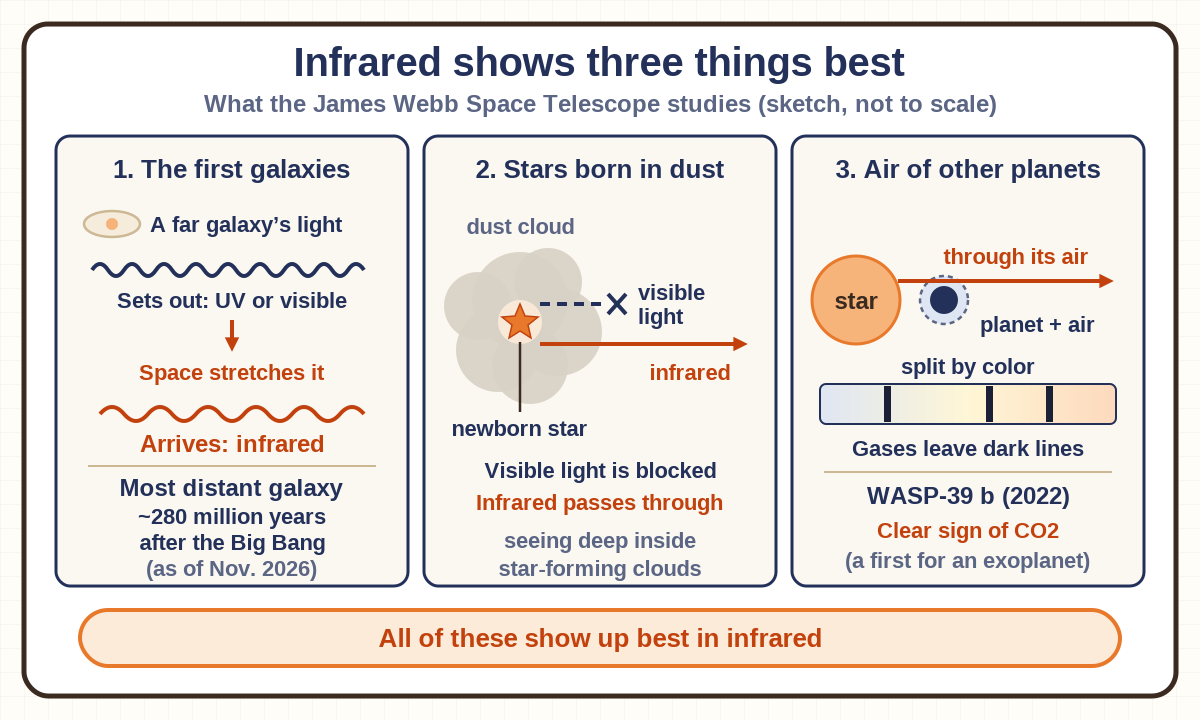
It studies galaxies from when the universe was young, stars and planets forming inside clouds of dust, and the air of planets circling other stars. Light from distant galaxies gets stretched as the universe expands and arrives as infrared, and infrared also passes through dust.
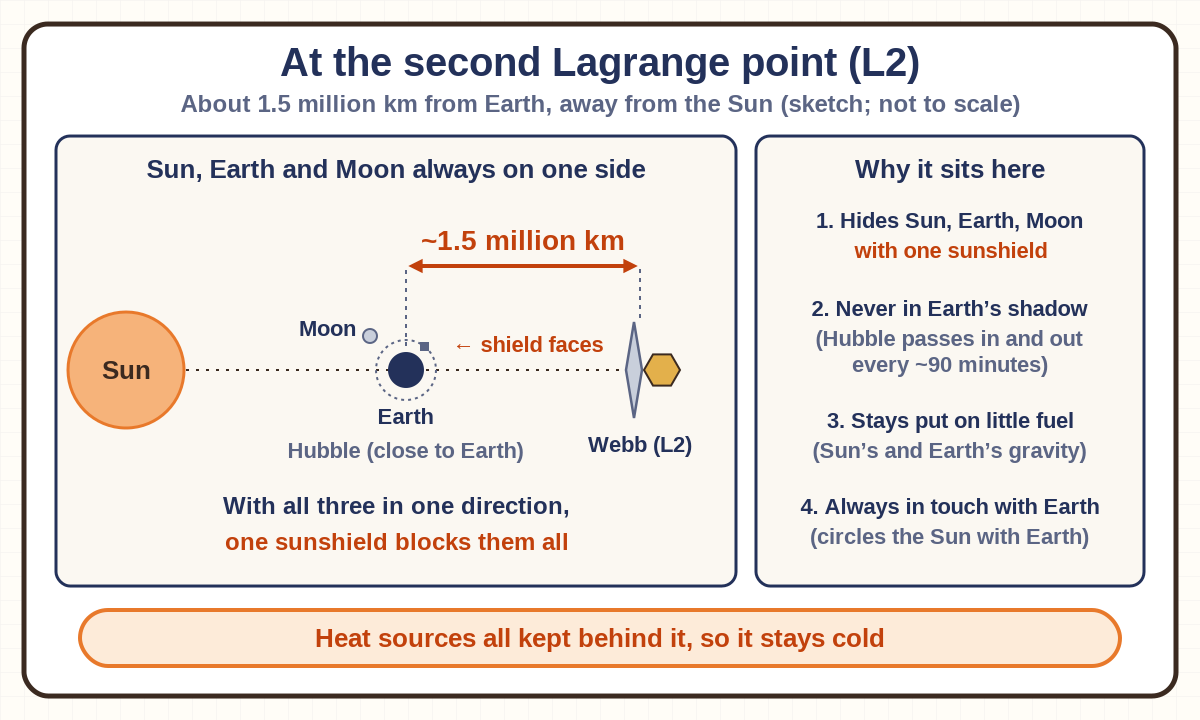
Infrared is heat radiation, and warm things give it off themselves. So Webb sits about 1.5 million km from Earth, at a spot called a Lagrange point, where a sunshield the size of a tennis court blocks the light and heat of the Sun, Earth and Moon, keeping it colder than −223°C. Its gold-coated mirror is 6.5 m across. Launched on December 25, 2021, it is led by NASA together with the European Space Agency (ESA) and the Canadian Space Agency (CSA).
A common mix-up
“Webb is Hubble’s successor: it takes the same kind of pictures, just sharper.”
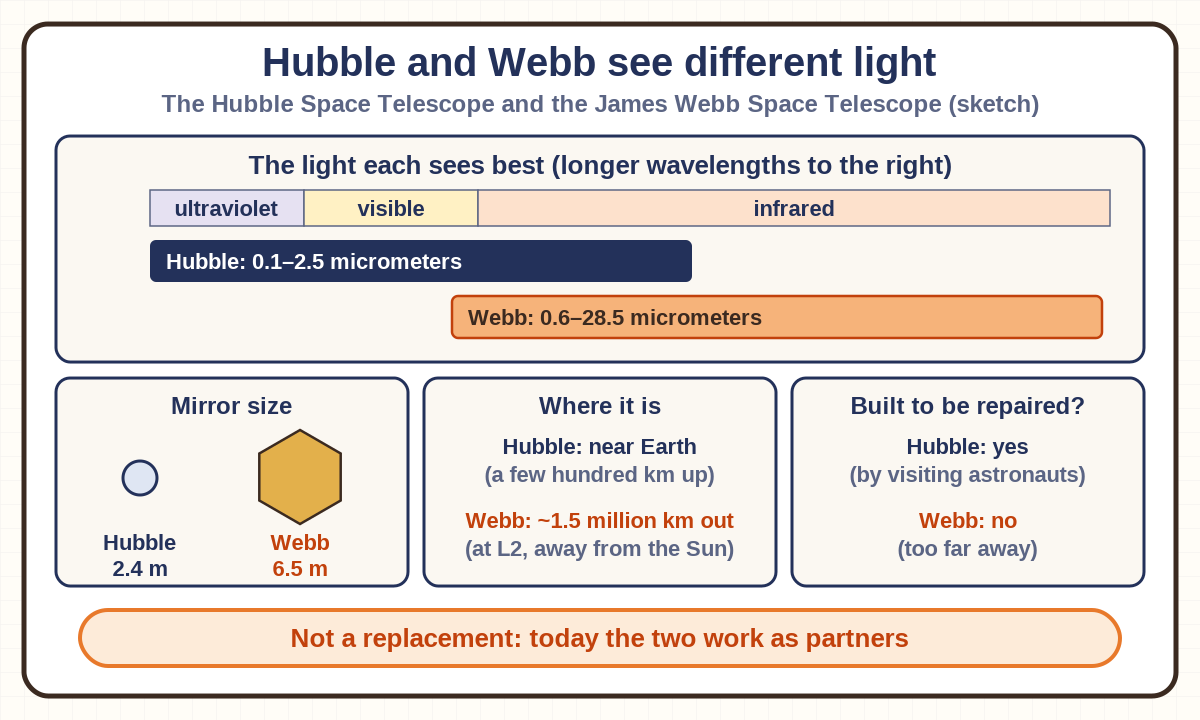
That’s half right. NASA calls Webb the “scientific successor” to the Hubble Space Telescope. Its mirror is about 2.7 times as wide as Hubble’s, with more than six times the light-collecting area. But the two are best at different light. Hubble sees mainly ultraviolet and visible light, while Webb sees mainly infrared. The wavelengths (lengths of the light waves) they see are 0.1 to 2.5 micrometers for Hubble and 0.6 to 28.5 micrometers for Webb (a micrometer is a thousandth of a millimeter). So Webb can see things Hubble struggles with, like the inside of dust clouds and distant galaxies whose light has been stretched into the infrared. On the other hand, Webb can’t see ultraviolet. Hubble is still observing today, in 2026, and rather than one replacing the other, the two work together, each covering the light it handles best.
Explained in pictures
Free to use in lessons, slides and posts with credit (CC BY 4.0).
Free to use in lessons, slides and posts with credit (CC BY 4.0).
Free to use in lessons, slides and posts with credit (CC BY 4.0).
Free to use in lessons, slides and posts with credit (CC BY 4.0).
You’re free to use these figures in lessons, slides and posts if you credit Naru News (naru.news). CC BY 4.0.
Think of it like this
Stargazing: get away from the city lights and switch off your flashlight
When you want to see faint starlight, like the Milky Way, you head to the mountains far from bright cities and switch off the flashlight in your hand. With lights all around, or your own light on, the faint light gets drowned out.
For the infrared that the Webb telescope sees, the “lights” are heat. The Sun, Earth and Moon give off heat radiation (infrared), so Webb sits about 1.5 million km from Earth and hides them behind its sunshield. That is getting away from the city lights. The telescope itself would give off infrared if it were warm, so it is kept colder than −223°C. That is switching off your flashlight.
But the comparison has limits. On the ground, night comes if you wait, but where Webb is, night never comes and the Sun always shines. So the sunshield is always kept facing the Sun. And light from distant galaxies is stretched on its way here, arriving as infrared. The starlight you see while stargazing doesn’t change color like that along the way.
Key points
Why does it look in infrared?
Light is a wave, and its color depends on the length of the wave (the wavelength). Within visible light, bluer light has shorter waves and redder light has longer ones. Invisible light with waves longer than red is infrared. There are three main reasons Webb looks in infrared.
First, light from distant galaxies arrives as infrared. Because the universe is expanding, light traveling through it gets its waves stretched along the way, shifting it toward longer, redder wavelengths (redshift). The farther the light has come, the more it is stretched. Ultraviolet and visible light given off by galaxies when the universe was young has become infrared by the time it reaches us. That is why seeing the most distant galaxies takes a telescope that looks in infrared.
Second, infrared passes through dust. Stars and planets are born inside clouds of gas and dust. Visible light is blocked by the fine dust, but infrared, with its longer waves, is much less hindered, so it can see deep into the clouds.
Third, warm things give off infrared. Infrared is heat radiation, and everything warm gives it off. Even the warm glow of dusty regions where stars and planets are forming can be seen in mid-infrared, the longer-wavelength part of the infrared.
Why put it so far away and keep it cold?
Because infrared is heat radiation, a warm telescope would give off infrared itself. The faint infrared from distant galaxies would then be lost in the telescope’s own glow. So Webb works at a temperature less than about 50 degrees above absolute zero (the temperature nothing can get colder than, about −273°C): colder than −223°C. Its mid-infrared instrument (MIRI) is chilled further by a cooling machine and works at −266°C.
To stay cold, it blocks the heat and light coming from the Sun and Earth. Webb circles a spot called L2 (the second Lagrange point), about 1.5 million km from Earth in the direction away from the Sun. There, the Sun, Earth and Moon, which give off heat radiation, always lie in the same direction, so a single sunshield the size of a tennis court can block them all at once. At L2, the combined pull of the Sun’s and Earth’s gravity can nearly hold a spacecraft in place, so it takes little fuel to stay there. And because Webb circles the Sun in step with Earth, its position relative to Earth doesn’t change, so it can always stay in touch.
Webb took about a month after launch to get there, arriving around L2 on January 24, 2022. It doesn’t sit exactly at L2: it travels around it in a big loop, about the size of the Moon’s orbit around Earth, going once around about every six months. The Hubble Space Telescope, which circles Earth a few hundred kilometers up, passes in and out of Earth’s shadow about every 90 minutes, but Webb never enters a shadow and can observe while staying cold and steady. The trade-off is that it is too far away to repair: unlike Hubble, which was built so astronauts could visit and fix it, Webb can’t be reached.
How are the mirror and sunshield built?
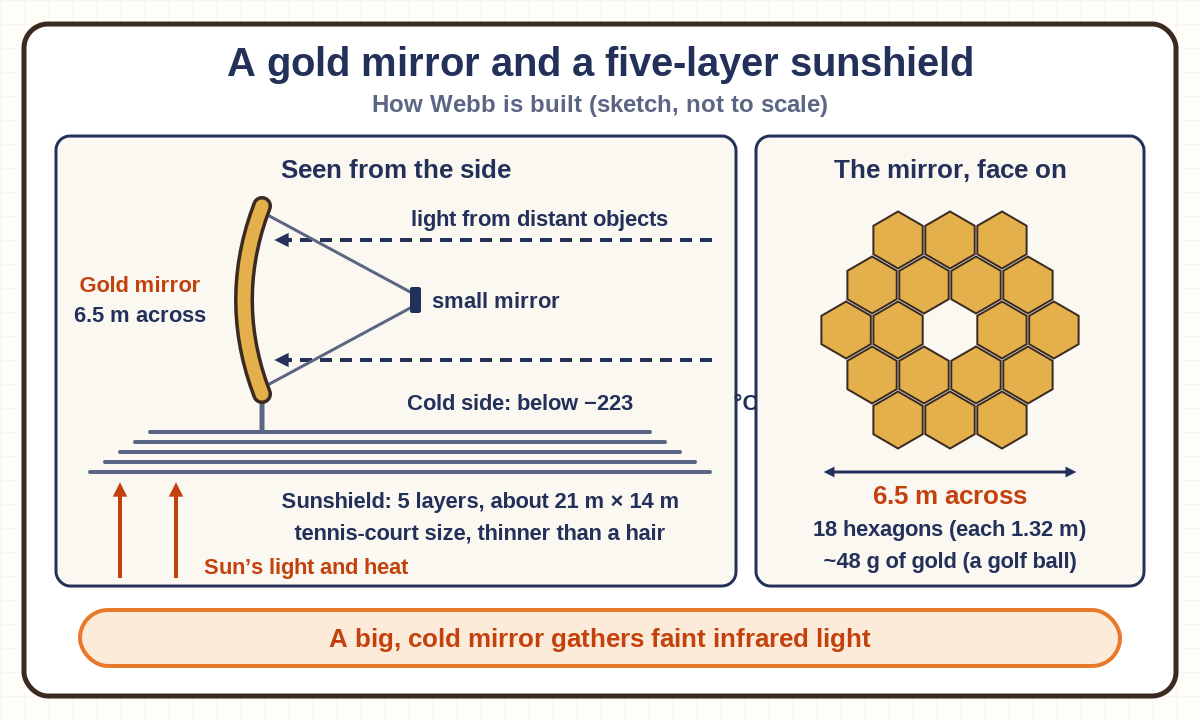
The biggest mirror, which gathers the light (the primary mirror), is 6.5 meters across. Because that is wider than the rocket, it is made of 18 hexagonal mirrors, each 1.32 meters across, so that it could be folded for launch. The mirrors are made of a metal called beryllium, which is very strong for its weight and holds its shape even when extremely cold. Light gathered by the primary mirror bounces off a small round mirror 0.74 meters across held in front of it (the secondary mirror), then passes other mirrors on its way to the instruments.
The mirror’s surface is covered with a film of gold, which reflects infrared well, just 0.0001 millimeters (100 nanometers) thick. It is so thin that all the gold used adds up to about 48 grams, roughly a golf ball’s worth. The gold is protected by a thin layer of glass on top.
The sunshield is five layers of film, each thinner than a hair, and unfolded it measures about 21 m × 14 m, about the size of a tennis court. The film is a tough plastic called Kapton, coated with a reflective metal. Each layer is colder than the one on the Sun side of it, and the empty gaps between the layers keep heat from passing through.
Both the mirror and the sunshield were folded up like origami to fit inside the cover at the tip of the rocket, five meters across, and were unfolded in space. The unfolding took place in the first two weeks after launch.
Who built it, when, and where does the name come from?
It is an international project led by NASA, joined by the European Space Agency (ESA) and the Canadian Space Agency (CSA). ESA provided an instrument that splits light by color (NIRSpec), part of the mid-infrared instrument (MIRI) and the launch rocket. CSA provided a device for holding the telescope precisely on target (the Fine Guidance Sensor, FGS) and an observing instrument (NIRISS).
It was launched on December 25, 2021, on an Ariane 5 rocket from Europe’s Spaceport in French Guiana, in South America. The first full-color images were released on July 12, 2022. It carries enough fuel, by estimate, for about 20 years of observing.
It is named after James E. Webb (1906–1992), NASA’s second administrator, who led the agency from February 1961 to October 1968. He headed NASA in the Apollo era and is known for championing science alongside sending people into space. Early on, the project was called the Next Generation Space Telescope (NGST).
How can it study the air of planets around other stars?
It uses the moments when a planet, seen from Earth, crosses in front of its star. Then part of the starlight is blocked by the planet, and some of the rest passes through the air (atmosphere) around the planet before reaching us.
Each kind of gas in the air absorbs light of particular colors (wavelengths). So by splitting the light that arrives by color and checking which colors got dimmer and by how much, astronomers can tell which gases are in the air.
In August 2022, Webb was announced to have found clear evidence of carbon dioxide in the air of WASP-39 b, a hot giant gas planet circling a Sun-like star about 700 light-years away. It was the first clear evidence of carbon dioxide on a planet outside the solar system. The result came from infrared at wavelengths of 3 to 5.5 micrometers, studied with the instrument that splits light by color (NIRSpec).
What has it found so far?
One of the first images, released in July 2022, captured the galaxy cluster SMACS 0723 over about 12.5 hours in total and showed thousands of galaxies. Thanks to gravitational lensing by the cluster’s mass (the gravity of something heavy bends the path of light, so things behind it look bigger, as through a magnifying glass), more distant galaxies behind it appear magnified.
It has also been breaking records for the earliest galaxies. As of November 2026, when this was checked, the most distant confirmed galaxy is MoM-z14, seen as it was about 280 million years after the universe began (redshift 14.44: redshift is a number for how much the waves have stretched, and they stretch by that number plus 1, so its light waves arrived stretched to about 15 times their original length). The paper first came out as a preprint in May 2025 and was published in a journal in January 2026. Bright galaxies like this have turned up about 100 times more often than theoretical studies predicted before launch. A researcher has said the gap between theory and observation is growing.
Webb has also found many objects in the distant universe that look like small red dots. They are called “little red dots,” and they seem to be everywhere in the early universe but have all but vanished by today. A 2023 paper reported that black holes seem to be growing at the centers of some of them. One candidate for what they are is a growing black hole wrapped completely in dense gas (a black hole star). Gas falling into the black hole glows, and that light comes out through the dense gas around it, so from outside it shines like a single star. What they really are is still being worked out.
Check yourself
Q1The James Webb Space Telescope searches for distant galaxies from when the universe was young using infrared rather than visible light. Why?
Answer and explanation
Answer: C The light waves get stretched on the way and arrive as infrared
Because the universe is expanding, light traveling through it gets its waves stretched along the way, shifting toward longer, redder wavelengths (redshift). The more distant the galaxy, the more the light is stretched, so ultraviolet and visible light given off by galaxies when the universe was young has become infrared, with waves longer than red, by the time it reaches us. Squeezed waves would shift the other way, toward shorter, bluer wavelengths. And light doesn’t turn into infrared by slowing down on the way.
Q2The James Webb Space Telescope, which looks at space in infrared, sits about 1.5 million km from Earth, blocks the Sun’s light and heat with a big sunshield, and is kept colder than −223°C. Why is it kept cold?
Answer and explanation
Answer: A If warm, the telescope itself would give off infrared light
Infrared is heat radiation, and everything warm gives it off. If the telescope were warm, the faint infrared from distant galaxies would be lost in the infrared the telescope gives off itself. That is why it uses a sunshield far from Earth and is kept colder than −223°C, less than about 50 degrees above absolute zero. The gold film on the mirror is there to reflect infrared well. Keeping it cold isn’t about how the mirror reflects, or about its link with Earth.
More on this → Key points: Why put it so far away and keep it cold?
Q3In 2022, the James Webb Space Telescope found clear evidence of carbon dioxide in the air of WASP-39 b, a planet circling a star about 700 light-years away. As the planet passed in front of its star, what was examined?
Answer and explanation
Answer: B The colors of starlight partly absorbed by the planet’s air
When a planet crosses in front of its star, some of the starlight passes through the air around the planet before reaching us. Each kind of gas absorbs light of particular colors (wavelengths), so splitting the arriving light by color and checking which colors got dimmer reveals which gases are there. For WASP-39 b, infrared at wavelengths of 3 to 5.5 micrometers was studied, and clear evidence of carbon dioxide turned up. What was examined was how bright each color was, not the direction or speed of the light.
More on this → Key points: How can it study the air of planets around other stars?
Related terms
- Hubble Space Telescope
- Infrared
- Redshift
- Lagrange point
- Exoplanet
- Little red dots
- Black hole star
- Quasar
- Supermassive black hole
- Gravitational lensing
- Sagittarius A*
- Big Bang
Sources and how we checked
- NASA, “James Webb Space Telescope” (NASA Science mission page, updated November 23, 2026: launch on December 25, 2021, arrival at L2 on January 24, 2022, orbiting the Sun 1.5 million kilometers [1 million miles] from Earth at the second Lagrange point [L2], a 5-layer sunshield protecting the telescope from the infrared radiation of the Sun, Earth and Moon, a joint NASA/ESA/CSA mission, and a powerful infrared space telescope able to peer back in time over 13.5 billion years to see the first galaxies; read November 26, 2026)
- NASA, “Webb FAQ” (NASA Science, Webb frequently asked questions: Webb complementing and extending Hubble’s discoveries, a primary mirror 2.7 times larger in diameter and about 6 times larger in area than Hubble’s with longer wavelength coverage, infrared being heat radiation so that all warm things, including telescopes, emit infrared light, near-infrared light being less hindered by dust so that astronomers can see into dust clouds where stars form, light from the earliest galaxies being redshifted into the infrared by the expansion of the Universe so that studying the earliest star formation requires infrared observations, mid-infrared light showing the glow of star and planet formation in dusty regions, an operating temperature of less than 50 degrees above absolute zero, 50 K [−223°C], near-infrared instruments at about 39 K and MIRI at 7 K [−266°C] using a cryocooler, Webb being placed at L2 where its sunshield can block both the Sun and Earth, L2 being a semi-stable point where the combined gravity of the Sun and Earth can nearly hold a spacecraft so that it takes little fuel to stay there, the trip taking about a month, a sunshield about the size of a tennis court in which each successive layer is cooler and the vacuum between layers insulates, a primary mirror of about 6.5 meters made of 18 beryllium segments, a gold coating 100 nanometers thick using 48.25 g of gold, about equal to a golf ball, over-coated with glass [SiO2], launch on December 25, 2021 from French Guiana on an Ariane 5, enough propellant estimated for more than a 20-year science lifetime, Webb being beyond the reach of any crewed vehicle and so not serviceable, and the telescope being named after James E. Webb [1906–1992], NASA’s second administrator, and first called the Next Generation Space Telescope [NGST]; read November 26, 2026)
- NASA, “Webb’s Mirrors” (NASA Science, updated March 17, 2026: a 6.5-meter primary mirror with 18 hexagonal segments, each 1.32 meters flat to flat, beryllium being very strong for its weight and holding its shape across a range of temperatures, including cryogenic ones, gold improving the mirror’s reflection of infrared light, with a layer 100 nanometers thick, the mirror being segmented and designed to fold because it is larger than the diameter of the rocket, and a round 0.74-meter secondary mirror at the end of the booms, onto which the primary focuses light before it is reflected on toward the instruments; read November 26, 2026)
- NASA, “Webb’s Sunshield” (NASA Science, updated March 17, 2026: a sunshield roughly the size of a tennis court, with actual dimensions of 21.197 m × 14.162 m, five membrane layers, each thinner than a human hair, made of Kapton, a tough, high-performance plastic coated with a reflective metal, and Webb’s mirrors and sensors needing to be kept extremely cold because it is an infrared telescope; read November 26, 2026)
- NASA, “Webb Orbit” (NASA Science, updated April 30, 2025: orbiting the Sun 1.5 million km from Earth at L2, the sunshield working only when the Sun, Earth and Moon are in the same direction, the orbit letting the telescope stay in line with Earth as it moves around the Sun, continuous communications through the Deep Space Network as Earth rotates, roughly 30 days to reach L2, Webb orbiting around L2 rather than sitting stationary precisely at it, in an orbit similar in size to the Moon’s orbit around Earth that takes about 6 months to complete once,and Hubble orbiting only a few hundred miles up and going in and out of Earth’s shadow every 90 minutes; read November 26, 2026)
- NASA, “Hubble vs. Webb” (NASA Science, updated August 5, 2026: Hubble being optimized for ultraviolet and visible light [0.1 to 2.5 microns] and Webb seeing in infrared [0.6 to 28.5 microns], primary mirrors of 2.4 m for Hubble and 6.5 m for Webb, giving Webb more than six times the light-collecting area, Hubble orbiting Earth 483 km up and Webb orbiting the Sun 1.5 million km from Earth, their observations complementing each other, and Hubble being designed around Space Shuttle servicing missions, its serviceable design and modular parts enabling upgrades, while there is no current servicing capability or plan for Webb; read November 26, 2026)
- NASA, “What Is Cosmological Redshift?” (NASA Science, Webb explainer, March 21, 2019, updated September 18, 2025: the expansion of the universe stretching light traveling through space, the greater the redshift, the greater the distance the light has traveled, and telescopes with infrared detectors being needed to see light from the first, most distant galaxies; read November 26, 2026)
- NASA, “Webb Science Overview” (NASA Science, updated November 16, 2026: Webb’s four main science themes being the early universe, galaxies over time, the star lifecycle from star birth and planet formation to star death, and other worlds, including planets orbiting other stars; read November 26, 2026)
- NASA, “Who is James Webb?” (NASA Science, updated August 22, 2024: James Webb running NASA from February 1961 to October 1968, backing science alongside human spaceflight, many believing he did more for science than perhaps any other government official, and it being fitting that Hubble’s successor be named in his honor; read November 26, 2026)
- NASA, Japanese-language Webb card (read as a PDF: the Japanese names “Jēmuzu Webbu uchū bōenkyō” and “Webbu uchū bōenkyō,” Webb being the scientific successor to the Hubble Space Telescope, an international project led by NASA with its partners ESA and CSA, launch on December 25, 2021 and the first full-color images released on July 12, 2022, the largest telescope ever launched into space, folded for launch and unfolded during the first two weeks, orbiting the Sun at L2, 1 million miles from Earth, following Earth, and carrying enough fuel for up to 20 years; read November 26, 2026)
- ESA, “Webb factsheet” (European Space Agency: a joint project of NASA, ESA and the Canadian Space Agency, ESA’s contributions being NIRSpec, the MIRI optical bench assembly, the launcher and operations staff, launch on December 25, 2021 on an Ariane 5 ECA from Europe’s Spaceport in French Guiana, an orbit around L2 about 1.5 million kilometers from Earth, a 6.5-meter primary mirror collecting almost six times more light than Hubble, a five-layer sunshield, a launch fairing five meters across, and the name honoring James E. Webb, NASA’s second administrator from February 1961 to October 1968, the telescope previously being called the Next Generation Space Telescope [NGST]; read November 26, 2026)
- Canadian Space Agency, page about the James Webb Space Telescope (modified December 14, 2023: the CSA providing the Near-Infrared Imager and Slitless Spectrograph [NIRISS] and the Fine Guidance Sensor [FGS], and Canadian scientists being guaranteed observing time on Webb; read November 26, 2026)
- NASA, “NASA’s Webb Delivers Deepest Infrared Image of Universe Yet” (NASA Science, July 12, 2022: Webb’s First Deep Field being galaxy cluster SMACS 0723, teeming with thousands of galaxies, the cluster’s combined mass acting as a gravitational lens that magnifies more distant galaxies behind it, observations totaling 12.5 hours, and the full set of first full-color images and spectra being released on July 12; read November 26, 2026)
- NASA, “NASA’s Webb Detects Carbon Dioxide in Exoplanet Atmosphere” (NASA Science, August 25, 2022: a spectrum of WASP-39 b, a hot gas giant orbiting a Sun-like star 700 light-years away, presenting the first clear, detailed evidence for carbon dioxide ever detected in a planet outside the solar system, NIRSpec covering the 3 to 5.5-micron range, and, as the planet crosses in front of its star, some starlight being blocked by the planet and some filtering through its atmosphere, so that differences in brightness across wavelengths reveal the gases there; read November 26, 2026)
- NASA, “NASA Webb Pushes Boundaries of Observable Universe Closer to Big Bang” (NASA Science, January 28, 2026: Webb’s NIRSpec confirming a redshift of 14.44 for the galaxy MoM-z14, which existed 280 million years after the big bang and is Webb’s current most distant galaxy, the result being published in the Open Journal of Astrophysics, such bright galaxies being 100 times more than theoretical studies predicted before Webb’s launch, and a researcher saying there is a growing chasm between theory and observation; read November 26, 2026)
- Naidu et al., “A Cosmic Miracle: A Remarkably Luminous Galaxy at z_spec=14.44 Confirmed with JWST” (arXiv, version 1 May 16, 2025, version 2 January 28, 2026, published in the Open Journal of Astrophysics; abstract and Section 1: the redshift of 14.44 for MoM-z14 confirmed with NIRSpec, a mere 280 million years after the Big Bang, the most distant spectroscopically confirmed source to date, and the number density of such bright galaxies being more than 100 times larger than pre-JWST models; read November 26, 2026)
- Matthee et al., “Little Red Dots: an abundant population of faint AGN at z~5 revealed by the EIGER and FRESCO JWST surveys” (arXiv, June 2023; version 3, February 2024; abstract: 20 objects at redshifts 4.2 to 5.5 with broad hydrogen lines found in JWST data and interpreted as accretion onto supermassive black holes, and early black hole growth being highly obscured; read November 26, 2026)
- MIT News, “Astronomers discover a brand-new type of astrophysical object: A black hole star” (Massachusetts Institute of Technology, August 12, 2026: little red dots being extremely common in James Webb Space Telescope images, seeming to be everywhere in the early universe but essentially disappearing by the present day, and the researchers proposing that they may be black hole stars, wrapped in a dense, star-like cocoon of gas; read November 26, 2026)
- STScI, “Building a Roadmap for Hubble Science into the 2030s” (Space Telescope Science Institute, April 24, 2026: Hubble remaining an indispensable resource for astronomy and planetary science as it approaches the end of its fourth decade in operations, its capabilities being complementary and synergistic with JWST and other missions, and its unparalleled high-resolution, high-sensitivity ultraviolet-optical capabilities; read November 26, 2026)
- National Astronomical Observatory of Japan, Japanese release on Webb observations of star formation at the far edge of the Milky Way (September 13, 2024: the Japanese names “Jeimuzu Webbu uchū bōenkyō (JWST)” and “Jeimuzu Webbu bōenkyō”; read November 26, 2026)
- Japan Science and Technology Agency, Science Portal, Japanese article on the launch of the James Webb Space Telescope (Takeo Kusaka, January 20, 2022: the Japanese spelling “Jēmuzuwebbu uchū bōenkyō”; read November 26, 2026)
AI wrote this page from the sources above, and a different AI checked it against the text of those sources (November 26, 2026). A person with a master’s degree in science and a Japanese high-school science teaching license also read and checked it before publishing. Numbers are as of that date. If anything was hard to follow, you spot a mistake, or there’s a term you’d like explained, please write to [email protected].
Glossary
- AI agent
- AI alignment
- Alignment faking
- Artificial general intelligence (AGI)
- Artificial intelligence (AI)
- Backdoor
- Benchmark
- Chain of thought (CoT)
- Context window
- Data poisoning
- Deep learning
- Deepfake
- Diffusion model
- Embedding
- Emergent misalignment
- Evaluation awareness
- Fine-tuning
- Formal verification
- Generalization
- Generative adversarial network (GAN)
- Generative AI
- Goodhart’s law
- Gradual disempowerment
- Hallucination
- Hyperparameter
- Intelligence explosion
- Interpretability
- Jailbreaking
- Large language model (LLM)
- Latent space
- Machine learning
- Mixture of experts (MoE)
- Neural network
- Neuralese
- Overfitting
- Parameter
- Persona vectors
- Pre-training
- Prompt
- Prompt injection
- Reasoning model
- Recursive language model (RLM)
- Recursive self-improvement (RSI)
- Red teaming
- Reinforcement learning (RL)
- Retrieval-augmented generation (RAG)
- Reward hacking
- Reward model
- Shutdown resistance
- Sleeper agent
- Subliminal learning
- Superintelligence (ASI)
- System prompt
- Technological singularity
- Time horizon
- Token
- Transfer learning
- Transformer
- Accretion disk
- Black hole
- Black hole star
- Cosmic birefringence
- Event horizon
- Event Horizon Telescope (EHT)
- General relativity
- GPS
- Gravitational lensing
- Gravitational singularity
- Gravitational wave
- You are hereJames Webb Space Telescope (JWST)
- Lagrange point
- Long-period radio transient (LPT)
- Neutron star
- Pulsar
- Quasar
- Sagittarius A*
- Space data center
- Spacetime
- Special relativity
- Speed of light
- Supermassive black hole
- White dwarf