
Home › Glossary › Everyday science
What is H-mode (the state in which a fusion plasma suddenly holds its heat much better)?
Also called: High-confinement mode

In one minute
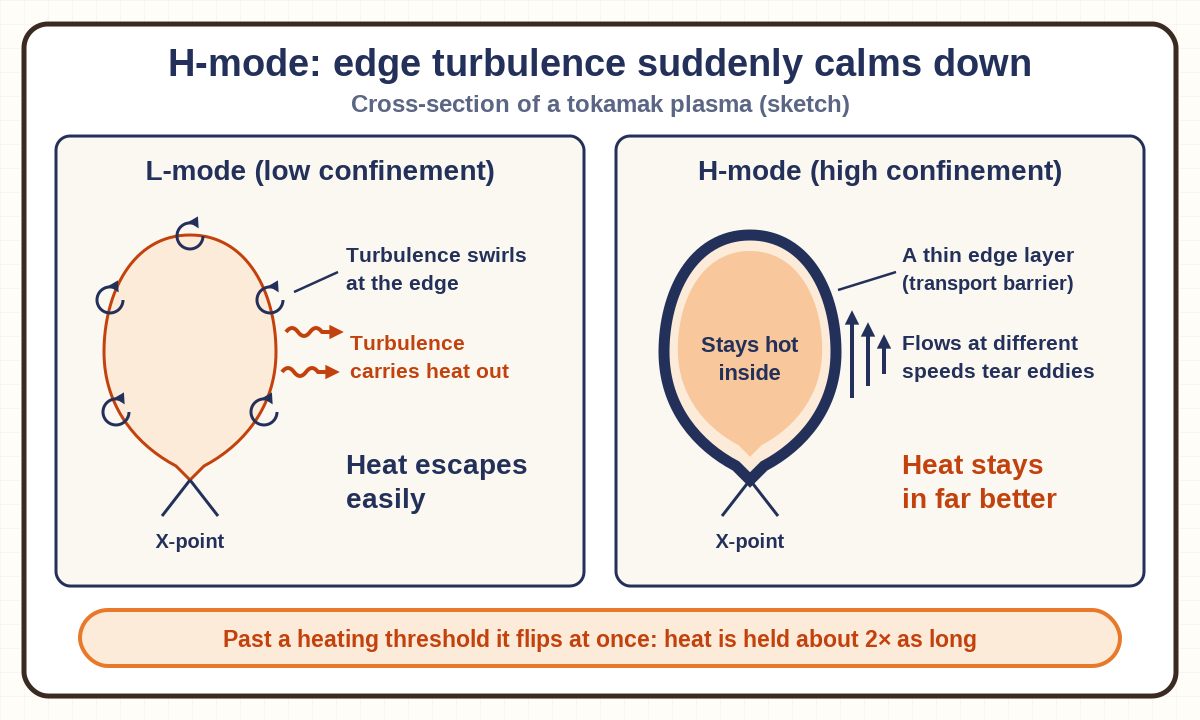
H-mode (high-confinement mode) is a state in a tokamak, a fusion experiment, in which, once the heating passes a certain strength, the turbulence at the plasma’s edge suddenly calms down and the time the plasma holds its heat roughly doubles.
A tokamak holds a very hot plasma (150 million °C in ITER) with magnetic fields, but heat leaks out, carried by turbulence swirling at the edge. In H-mode, flows moving at different speeds form at the edge and tear the eddies apart, creating a thin layer that lets little heat through (a transport barrier, or pedestal). H-mode was discovered in 1982 on the ASDEX machine in Germany, and upcoming machines such as ITER, now being built, are designed to run in it.
Two problems remain: the edge layer sometimes collapses and throws out heat (ELMs), and the heating needed to switch is hard to predict. In November 2026, a Swiss team published a theory that derives it from the flows that turbulence itself creates.
A common mix-up
“The harder you heat a plasma, the better it holds its heat.”
Half right. It is true that switching to H-mode takes heating above a certain strength. But confinement does not get better little by little as you heat harder. In the 1970s, when researchers heated plasmas strongly by firing in fast particles, the temperature rose, but heat escaped more easily than before. It was like heating a room hard with the windows open. Today this state is called L-mode (low-confinement mode). But once the heating passes a certain strength (the threshold), the turbulence at the edge suddenly calms down and the time the plasma holds its heat roughly doubles. H-mode is not a gradual change: it switches on suddenly at one point. The H stands for high confinement.
Explained in pictures
Free to use in lessons, slides and posts with credit (CC BY 4.0).
Free to use in lessons, slides and posts with credit (CC BY 4.0).
Free to use in lessons, slides and posts with credit (CC BY 4.0).
Free to use in lessons, slides and posts with credit (CC BY 4.0).
You’re free to use these figures in lessons, slides and posts if you credit Naru News (naru.news). CC BY 4.0.
Think of it like this
An “air curtain” at a shop door that forms by itself
In winter, some shop entrances have an “air curtain” that blows a strong stream of air down from above. Even with the door open, the layer of fast-moving air keeps the warm air inside from mixing with the cold air outside, so the warmth escapes less.
An L-mode plasma is like an entrance left wide open with no air curtain. Turbulence swirling at the edge stirs the hot plasma inside together with the colder region outside, and heat keeps escaping. In H-mode, a layer of flows moving at different speeds forms at the edge and stretches and tears the eddies apart. As if an air curtain had formed at the door, the inside stays hot.
But the comparison has limits. A shop’s air curtain is blown by a machine, while the flows at a plasma’s edge are made by the turbulence itself. Until the heating passes a certain strength the flows do not grow, but once it does, the flows suppress the turbulence, and weaker turbulence lets the flows grow even stronger, so the switch happens suddenly. Also, the plasma’s layer sometimes collapses and throws heat out all at once (ELMs).
Key points
How does a tokamak hold a plasma?
Fusion is a reaction in which light atomic nuclei collide and join into one, releasing a large amount of energy. To do this, the fuel is made extremely hot, turning it into a plasma in which nuclei and electrons have come apart. In ITER, the plasma has to reach 150 million °C.
No container can hold something that hot. So in a tokamak, strong magnetic fields form a cage inside a doughnut-shaped vacuum chamber, holding the plasma away from the walls. Because a plasma is a collection of electrically charged particles, magnetic fields can control its shape and position. The name tokamak comes from a Russian phrase meaning “toroidal chamber with magnetic coils.”
Even so, heat slowly leaks out. Swirling turbulence is always going on inside the plasma, carrying particles and heat from hot regions to colder regions farther out. The plasma cools unless it is heated continuously, so how long it can hold its heat largely decides how well the machine performs.
What is the difference between L-mode and H-mode?
L-mode (low-confinement mode) is a state in which turbulence is strong all the way to the edge and heat escapes easily. Even if you heat harder and raise the temperature, heat escapes more easily too. H-mode (high-confinement mode) is the state that forms when the heating passes a certain strength (the threshold) and the turbulence at the edge suddenly calms down. The time the plasma holds its heat roughly doubles.
The switch is not gradual but sudden. Just as water suddenly turns to ice at 0 °C, the plasma’s behavior changes completely at one point. It is also known that once a plasma is in H-mode, it can stay there with less heating than it took to get in. The boundary for getting in and for falling back out is not the same.
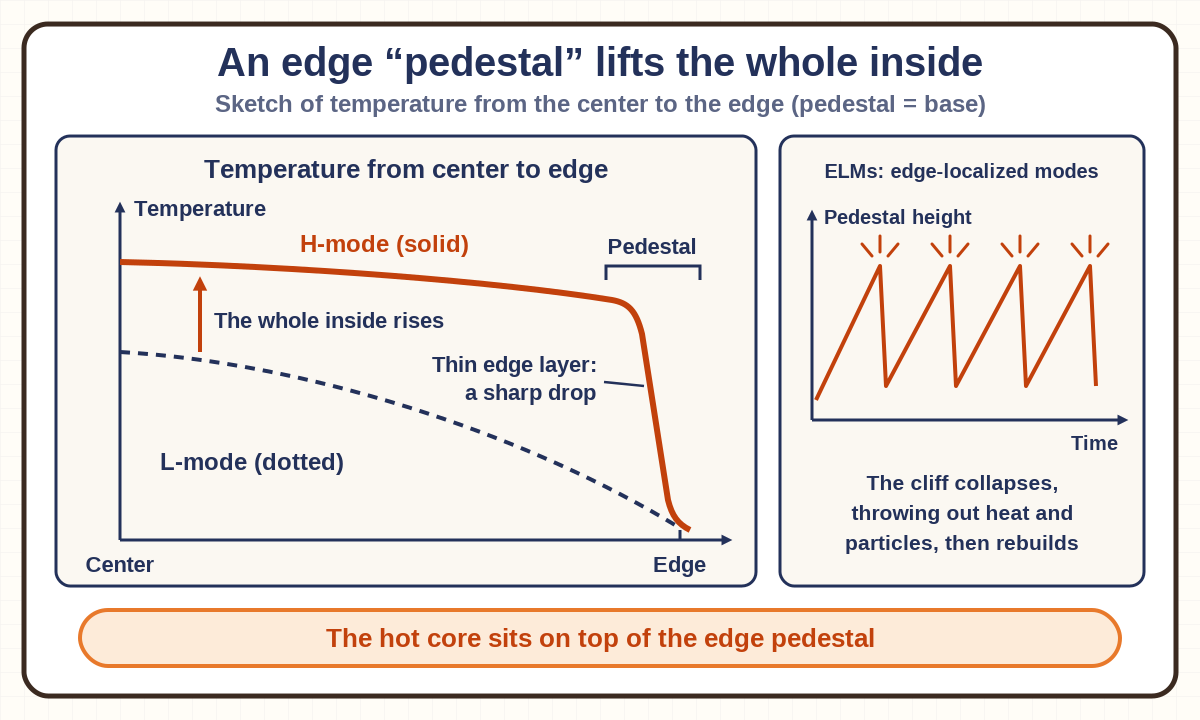
In H-mode, the fluctuations measured at the plasma’s edge suddenly shrink, and the pressure starts changing sharply across the edge. The hot inside ends up sitting on top of a steep cliff at the edge.
How was H-mode discovered?
On February 4, 1982, Friedrich Wagner and his colleagues found it on the ASDEX tokamak at the Max Planck Institute for Plasma Physics (IPP) in Garching, Germany. They had been heating plasmas by firing in beams of fast, electrically neutral particles (neutral beams) when, in the middle of a series of experiments, the plasma’s key figures suddenly changed. Confinement had roughly doubled, and the turbulence at the edge had all but vanished. At first, many thought these were just “dirty” discharges spoiled by impurities, or another familiar wobble in the core.
The results appeared in Physical Review Letters on November 8, 1982. The paper says this state appeared only when the heating was at least 1.9 MW, the plasma was denser than a certain level, among other conditions, and the plasma’s cross-section was shaped into a point (a shape with an X-point). When the plasma’s edge was set by pressing it against a part sticking out from the wall, confinement did not improve. The shape with an X-point is now standard in fusion devices that confine plasma with magnetic fields.
Researchers in other countries doubted the result at first, but they were soon able to create the same state in their own machines. H-mode was confirmed in tokamaks such as PDX, DIII-D, JET and JT-60, and in 1993 it even appeared in a machine of a different design (the W7-AS stellarator). H-mode turned out to be something that happens widely in doughnut-shaped magnetic devices.
What is the edge “transport barrier” (pedestal)?
In H-mode, a thin layer that lets little heat or particles out forms at the plasma’s edge. This is called a transport barrier. Because the turbulence that carries heat outward almost stops in this layer, the temperature inside and outside the layer differs by several million degrees.
If you graph the temperature or pressure from the center to the edge, in H-mode it drops like a cliff at the edge, and everything inside is lifted up. Because the hot inside looks as if it sits on a base, this part is also called the pedestal. The pressure at the center is proportional to the pressure of the pedestal, so how high the pedestal can be made greatly changes how much fusion power ITER can produce.
Why the turbulence stops has been studied for a long time. It is now known that at the edge the plasma flows at different speeds in different places, and that this difference in speed (a shear flow), which stretches and tears the turbulent eddies apart, is what matters. But questions remain, such as how thick the layer becomes.
Why are ELMs (edge-localized modes) a problem?
The pedestal at the edge in H-mode is like a steep cliff, and when the difference in pressure gets too large, it sometimes collapses. When it does, a few percent of the plasma’s energy is thrown out all at once as heat and particles. This is called an ELM (edge-localized mode), and the edge collapses, builds up and collapses again, over and over. ELMs appeared together with H-mode from the time it was discovered.
Today’s machines can withstand them, but large machines cannot. ITER has a vessel radius four times that of ASDEX Upgrade in Germany, and its ELMs are expected to be about 10 to 15 times as energetic. Left alone, they are thought likely to wear away the divertor (the part that catches the escaping heat and particles) and wall parts that touch the plasma quickly, strongly enough to melt the vessel wall.
So ITER is preparing two ways to tame ELMs. One uses 27 coils inside the vessel to slightly distort the otherwise evenly doughnut-shaped magnetic field; at best this removes ELMs, but it is said to shorten the time the plasma holds its heat by 10 to 20 percent. The other fires small frozen deuterium pellets into the plasma to trigger small ELMs on purpose, so each one releases less heat. In the US machine DIII-D, this cut the heat flow per ELM to less than a tenth, but ITER may need it cut to about a thirtieth.
What decides the heating needed to switch to H-mode?
Whether the plasma switches depends on whether the heat flowing out through the plasma’s edge (the heating put in, minus what leaves as light and so on) exceeds the threshold. The threshold varies a lot with the machine and the conditions. According to an empirical formula built from data collected on many machines, the denser the plasma, the stronger the magnetic field and the larger the plasma’s surface (the bigger the machine), the more heating is needed.
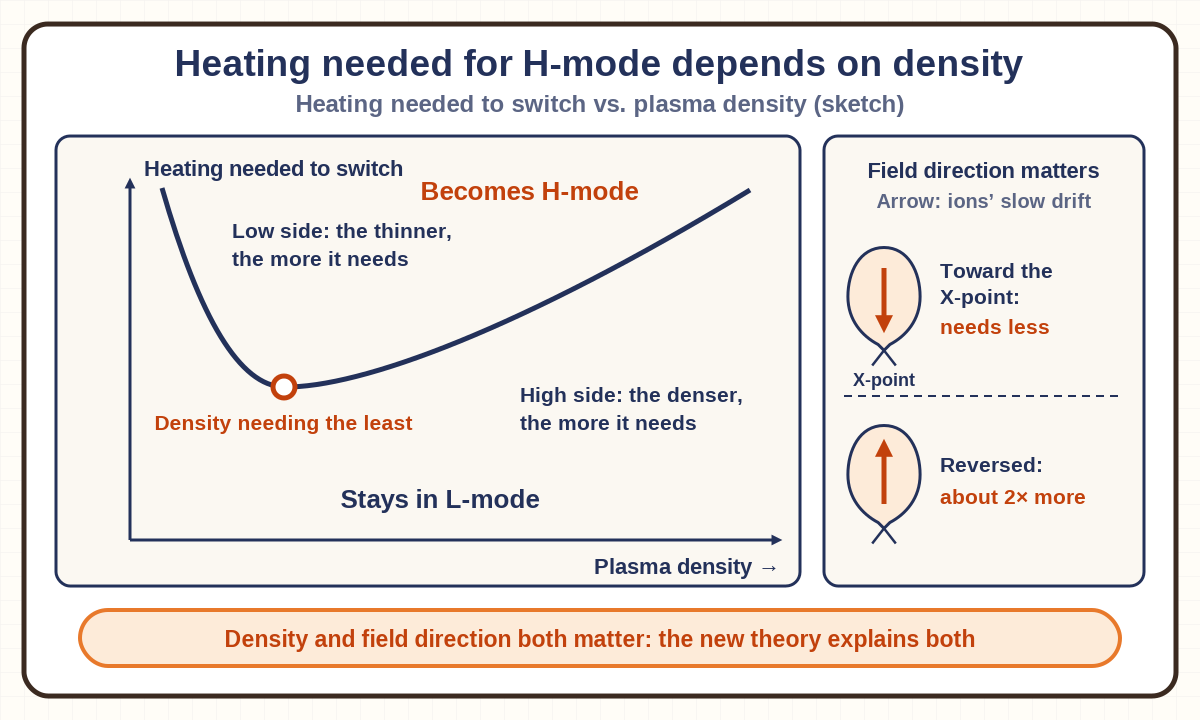
But at least two things were known that this formula cannot capture. One is density. On the high-density side, denser plasmas need more heating, but below a certain density, thinner plasmas need more instead. In between lies a density that needs the least heating, and the empirical formula works only on the denser side. The other is the direction of the magnetic field. Ions in the magnetic field slowly drift sideways, in a direction set by the field’s direction. If that drift points toward the X-point (the pointed corner of the cross-section), less heating is needed than in the reverse direction. Reversing the direction typically roughly doubles the heating needed.
Forty years after H-mode was found, how to explain the switch from the underlying physics was still an open question. So when large machines were designed, estimates of the heating needed to switch carried considerable uncertainty.
What did the new 2026 theory explain?
Brenno De Lucca and his colleagues at the Swiss Plasma Center of the Swiss Federal Institute of Technology in Lausanne (EPFL) published it in Physical Review Letters on November 13, 2026. First, they used supercomputers to simulate the plasma at the edge of a tokamak with an X-point, starting from L-mode turbulence and raising the heating by about 1.4 times. The turbulence itself then created flows moving at different speeds (shear flows), these flows suppressed the turbulence at the edge, and the time the plasma held its heat briefly roughly doubled, then settled at about 1.5 times. When only these flows were removed from the simulation, heat right away began escaping easily again, evidence that the flows had been holding the turbulence down. Also, no barrier formed unless the pressure of the edge plasma exceeded a certain fraction of the pressure of the magnetic field.
The simulations also reproduced, for the first time, the difference made by the field direction. With the same heating, the plasma switched when the drift pointed toward the X-point, but not in the reverse direction. In the reverse direction, it switched only once the heating was raised to about twice its L-mode level. The theory’s calculation also gives about twice the heating for the reverse direction, matching experiments. The team showed that for the direction to matter, collisions between particles are needed, in addition to things like the cross-section being lopsided top to bottom (with the X-point on only one side). When particles collide, reversing the field no longer leaves unchanged how strongly the turbulence builds up the flows, so a difference appears.
They then wrote formulas for the heating needed to switch, separately for the high-density and low-density sides. On the high-density side, a type of turbulence shaped by collisions between particles dominates. The denser the plasma, the more collisions there are, so the edge must get hotter before it switches, and more heating is needed. On the low-density side, a different type of turbulence, shaped by how hard electrons are to get moving, takes over; here, the thinner the plasma, the hotter the edge must get before it switches, so the thinner it is, the more heating is needed. Where the two sides meet is the density that needs the least heating. The forms of the formulas were derived from the mechanism rather than fitted to data; only the remaining constants were fitted to data from today’s machines. On high-density data, they did as well as or slightly better than the existing empirical formula. On the other hand, gaps remain: with data from the Swiss machine TCV, for example, the least heating came out larger than predicted (the authors think this may be because heat lost as light was not subtracted).
Can ITER and SPARC get into H-mode?
ITER, being built in southern France, is the world’s largest fusion experiment. It aims to produce ten times as much power in its plasma as the heating put in (500 MW from 50 MW of heating), and it is designed to run in H-mode. Without H-mode, ITER would have had to be twice as large and would have cost twice as much. SPARC, being built by the US company Commonwealth Fusion Systems, is a machine made compact by using a very strong magnetic field. It too is expected to need H-mode for its best performance. For heating from outside, it is designed to use only radio waves, up to 25 MW.
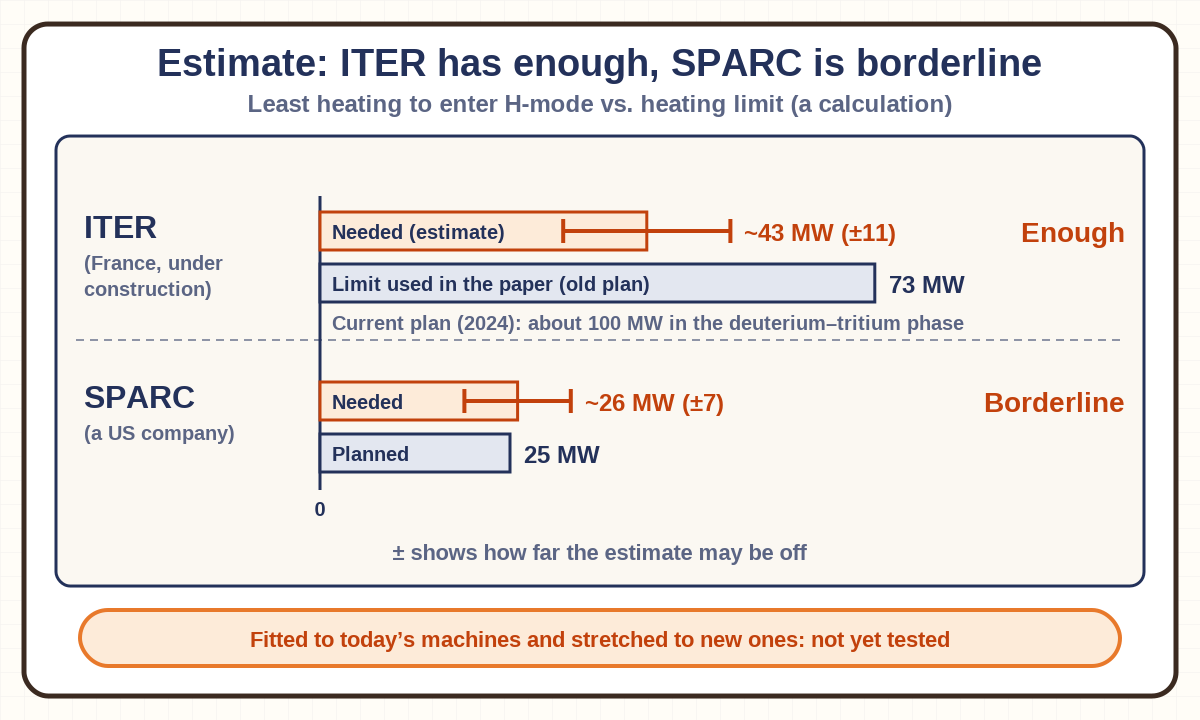
Applying the 2026 theory’s formulas, as fitted to today’s machines, to the conditions of ITER and SPARC running at their strongest magnetic fields gives the following estimates. The least heating ITER needs to switch to H-mode is about 43 MW (give or take about 11 MW), within the 73 MW heating limit the paper compared it with. That 73 MW matches the total outside heating in ITER’s earlier plan, set in 2016. The current plan, updated in 2024, aims for about 100 MW of heating in the phase that uses deuterium and tritium, so on this estimate the margin is even larger. For SPARC it is about 26 MW (give or take about 7 MW), slightly above its planned 25 MW, leaving almost no margin. SPARC’s thin margin had already been pointed out from empirical formulas, and this theory derives it again from the underlying physics.
These are calculated estimates and have not yet been tested on ITER or SPARC. Because formulas fitted to today’s machines are being stretched to future machines that are larger or have stronger fields, whether these machines really switch at this heating will be known only once they run.
Check yourself
Q1In a tokamak, a fusion experiment, the heating is raised past a certain strength and the plasma switches from L-mode to H-mode. What happens?
Answer and explanation
Answer: C Edge turbulence suddenly calms and heat stays inside
In H-mode, the turbulence that was swirling at the plasma’s edge suddenly calms down, and a thin layer that lets little heat through (a transport barrier) forms at the edge. As a result, the time the plasma holds its heat roughly doubles. Turbulence in the core does not grow, and the magnetic field does not suddenly get stronger. What triggers the switch is heating above a certain strength.
More on this → Key points: What is the difference between L-mode and H-mode?
Q2In H-mode in a tokamak, a fusion experiment, events called ELMs are said to be a problem in a large machine like ITER. What is an ELM?
Answer and explanation
Answer: A Sudden collapses that throw out heat and particles
The edge layer is where the temperature and pressure fall like a steep cliff, and when it gets too high it sometimes collapses, throwing a few percent of the plasma’s energy out all at once as heat and particles. This is an ELM (edge-localized mode). In a large machine like ITER, left alone, ELMs could quickly wear away or even melt the wall and divertor parts, so ITER plans to tame them with coils that slightly distort the magnetic field or by firing in frozen fuel pellets.
More on this → Key points: Why are ELMs (edge-localized modes) a problem?
Q3In a tokamak, if everything else, such as the strength of the magnetic field, is kept the same and only the plasma’s density is changed, from thin to dense, how does the heating needed to switch from L-mode to H-mode change?
Answer and explanation
Answer: B Least at one density; more if denser or thinner
On the high-density side, the denser the plasma, the more heating it needs. But below a certain density, the thinner the plasma, the more heating it needs instead. In between lies a density that needs the least heating. The 2026 theory explains this as turbulence shaped by collisions between particles dominating on the dense side, and a different turbulence shaped by how hard electrons are to get moving dominating on the thin side, and it estimates the least heating ITER needs at about 43 MW.
More on this → Key points: What decides the heating needed to switch to H-mode?
Related terms
- Nuclear fusion
- Tokamak
- Plasma
- ITER
- L-mode
- Edge-localized mode (ELM)
- Pedestal
- Stellarator
- Divertor
Sources and how we checked
- B. De Lucca, P. Ricci, B. Labit, D. Mancini, L. N. Stenger and Z. Tecchiolli, “Theory for the Power Threshold of the L−H Transition in Tokamaks,” Physical Review Letters 137, 205101 (November 13, 2026; Swiss Plasma Center, EPFL; title, authors, date and abstract read on the journal page: simulations of a diverted tokamak showing a confinement transition once a critical heating threshold is exceeded, electromagnetic drift-wave turbulence spontaneously generating a sheared E×B flow that suppresses edge transport, the toroidal-field asymmetry reproduced in simulations for the first time and arising from time-reversal symmetry breaking by finite collisionality, and scaling laws for the high- and low-density branches, the density minimum and the minimum power matching or surpassing existing empirical scalings; read November 24, 2026)
- Preprint of the same paper (arXiv:2605.00624, version 3, October 26, 2026; checked in the text: above a threshold input power, edge turbulence being rapidly suppressed with a factor ∼2 increase in the energy confinement time, this being considered essential for burning plasmas in ITER and SPARC, the non-monotonic dependence of the threshold on density, the threshold being generally lower when the ion ∇B drift points toward the X-point (favourable configuration), the empirical ITPA scaling (2008) describing densities above the density minimum, GBS power-ramp simulations in which a ∼1.4 times increase in power triggers a transition in the favourable configuration (the confinement time rising by a factor ∼2, then settling at ∼1.5) while the unfavourable one does not transition at matched power but does when the ramp is repeated at roughly twice the L-mode input power, removing the flux-surface-averaged E×B flow immediately restoring high transport, a barrier forming only when the edge plasma beta exceeds a critical value with no transition at beta = 0, the asymmetry requiring up–down asymmetry, E×B shear, magnetic shear and finite collisionality at once, collisions breaking time-reversal invariance, a power ratio of ∼2 consistent with experiments, resistive drift waves at high density and inertial drift waves at low density, the threshold rising with density on the high-density branch and falling on the low-density branch, exponents derived without regression and only constants fitted, R² = 0.87 on high-density data versus 0.83 for the empirical scaling, TCV’s measured minimum power exceeding the prediction, plausibly from unsubtracted radiative losses, and extrapolations calibrated on present devices: for ITER (15 MA, 5.3 T) a density minimum of (5.8 ± 1.0)×10¹⁹ m⁻³ and minimum power of (43 ± 11) MW, within its 73 MW auxiliary heating limit, and for SPARC (8.7 MA, 12.2 T) (2.6 ± 0.4)×10²⁰ m⁻³ and (26 ± 7) MW, leaving little margin over its planned 25 MW, a concern raised earlier from empirical scalings, with uncertainties given by the root-mean-square errors of the scalings, and simulations run on supercomputers such as Daint; read November 24, 2026)
- EPFL (Nik Papageorgiou), “Theory explains how fusion plasmas enter a state of improved energy confinement, solving a 40-year puzzle” (Phys.org, November 20, 2026; the university’s news release: the 1982 finding that raising heating beyond a threshold suddenly reduces edge turbulence and improves energy retention, turbulence generating flows at different speeds that suppress it, a density at which the heating requirement is lowest, ITER needing at least 43 MW against a planned 73 MW, and SPARC needing 26 MW, close to its planned 25 MW; read November 24, 2026)
- F. Wagner et al., “Regime of Improved Confinement and High Beta in Neutral-Beam-Heated Divertor Discharges of the ASDEX Tokamak,” Physical Review Letters 49, 1408 (November 8, 1982; abstract read on the journal page: a new operating regime in neutral-injection-heated divertor discharges on ASDEX, reached when the injected power is at least 1.9 MW, the mean electron density exceeds about 3×10¹³ cm⁻³ and the edge safety factor is at least 2.6, with confinement not improved outside these limits or in discharges limited by a material limiter; read November 24, 2026)
- Max Planck Institute for Plasma Physics (IPP), press release “This discovery made ITER possible” (October 26, 2022: H-mode found on ASDEX on February 4, 1982, first taken for “dirty discharges” and internal relaxations, the paper published on November 8, 1982, neutral-beam heating in the 1970s raising temperatures at the cost of energy confinement, like heating a room while opening the windows, now called L-mode, initial doubts that it was a measurement error before others reproduced it, ASDEX being the first to shape the plasma not round but pointed, with an X-point, now standard in magnetic-confinement devices, H-mode confining energy twice as well as L-mode, with an insulating edge layer across which the temperature differs by several million degrees Celsius, ELMs occurring at regular intervals, ITER having four times the vessel radius of ASDEX Upgrade with ELM energies probably ten to 15 times as strong, enough to melt the vessel wall, the L–H transition and the barrier’s thickness still being open questions, flow shears at the edge playing a decisive role in forming the edge transport barrier by reducing turbulence, and weak magnetic perturbation fields eliminating ELMs at the cost of a 10 to 20 percent shorter energy confinement time; read November 24, 2026)
- ITER Organization (Robert Arnoux), “How Fritz Wagner ‘discovered’ the H-Mode” (June 19, 2009: H-mode appearing on February 4, 1982 during a neutral-beam heating experiment on ASDEX, confinement suddenly improving by a factor of two with edge turbulence all but disappearing, instabilities later called ELMs appearing along with it, H-mode being reproduced in machines such as PDX, DIII-D, JET and JT-60 and achieved in 1993 in the W7-AS stellarator, all tokamaks today being designed to operate in H-mode, and ITER otherwise needing to be twice as large and twice as expensive; read November 24, 2026)
- ITER Organization, “How does it work?” (the tokamak as an experimental machine to harness fusion energy, in which a plasma is created and confined by strong magnetic fields, its doughnut-shaped vacuum chamber, the plasma needing to reach 150,000,000 °C for fusion, the name coming from a Russian phrase for “toroidal chamber with magnetic coils,” and magnetic fields confining the hot plasma away from the vessel walls; read November 24, 2026)
- ITER Organization, “What will ITER do?” (ITER designed to yield a ten-fold return on power in its plasma (Q = 10), 500 MW of fusion power from 50 MW of input heating power, and the updated project baseline of 2024; read November 24, 2026)
- A. Loarte et al., “The new ITER baseline, research plan and open R&D issues,” Plasma Physics and Controlled Fusion 67, 065023 (2025; in the 2024 baseline, 40 MW of electron cyclotron heating and 10 MW of ion cyclotron heating in the first phase (SRO), and 33 MW of neutral beams, 60–67 MW of electron cyclotron heating and 10–20 MW of ion cyclotron heating in the deuterium–tritium phase (DT-1), versus 33 MW of neutral beams, 20 MW of electron cyclotron heating and 20 MW of ion cyclotron heating (73 MW in total) for DT-1 in the 2016 baseline, with a maximum coupled additional heating power of 103 MW (about 100 MW) in DT-1 without upgrades; full text read November 24, 2026)
- ITER Organization (A. Loarte, G. Huijsmans and S. Futatani), “Progress on ELM physics and ELM control” (ITER Newsline, March 4, 2013: H-mode plasmas forming steep edge pressure gradients that cause ELMs, each expelling a small percentage of the total plasma energy, ELMs eroding ITER’s divertor and first wall so that ELM control is required, ELM avoidance in ITER with a set of 27 in-vessel coils applying 3-D magnetic perturbations, and frozen deuterium pellets triggering ELMs, which in DIII-D reduced the heat flux per ELM by more than a factor of ten, with a factor of 30 possibly required in ITER; read November 24, 2026)
- Ahmed Diallo, “Introduction to H-mode plasmas: L-H transition, pedestal, ELMs” (lecture slides, 10th ITER International School, January 21, 2019: a bifurcation to an improved confinement state when heating passes a threshold, the H-mode pedestal as the edge transport barrier, a region of reduced radial transport at the plasma boundary, reduced edge density fluctuations and steeper pressure gradients at the transition, phenomenology akin to a phase transition, the transition occurring when the loss power across the plasma surface exceeds a threshold that is proportional to the surface and depends on density and toroidal field, hysteresis with the L–H power above the H–L power, sheared E×B velocity decorrelating turbulent eddies, core pressure proportional to pedestal pressure with ITER’s fusion power relying on it, and steep gradients driving ELMs in a cycle of ELM, loss of density and temperature, and reheating; read November 24, 2026)
- A. J. Creely et al. (the SPARC Team), “Overview of the SPARC tokamak,” Journal of Plasma Physics 86, 865860502 (2020: SPARC designed to have up to 25 MW of ion cyclotron resonance heating as its sole source of auxiliary heating, peak performance likely requiring operation in H-mode, and the physics of the L–H transition still being an area of active research, with considerable uncertainty in predictions of the power required to transition; read November 24, 2026)
AI wrote this page from the sources above, and a different AI checked it against the text of those sources (November 24, 2026). A person with a master’s degree in science and a Japanese high-school science teaching license also read and checked it before publishing. Numbers are as of that date. If anything was hard to follow, you spot a mistake, or there’s a term you’d like explained, please write to [email protected].
Glossary
- AI agent
- AI alignment
- Alignment faking
- Artificial general intelligence (AGI)
- Artificial intelligence (AI)
- Backdoor
- Benchmark
- Chain of thought (CoT)
- Context window
- Data poisoning
- Deep learning
- Deepfake
- Diffusion model
- Embedding
- Emergent misalignment
- Evaluation awareness
- Fine-tuning
- Formal verification
- Generalization
- Generative adversarial network (GAN)
- Generative AI
- Goodhart’s law
- Gradual disempowerment
- Hallucination
- Hyperparameter
- Intelligence explosion
- Interpretability
- Jailbreaking
- Large language model (LLM)
- Latent space
- Machine learning
- Mixture of experts (MoE)
- Neural network
- Neuralese
- Overfitting
- Parameter
- Persona vectors
- Pre-training
- Prompt
- Prompt injection
- Reasoning model
- Recursive language model (RLM)
- Recursive self-improvement (RSI)
- Red teaming
- Reinforcement learning (RL)
- Retrieval-augmented generation (RAG)
- Reward hacking
- Reward model
- Shutdown resistance
- Sleeper agent
- Subliminal learning
- Superintelligence (ASI)
- System prompt
- Technological singularity
- Time horizon
- Token
- Transfer learning
- Transformer
- Accretion disk
- Black hole
- Black hole star
- Cosmic birefringence
- Event horizon
- Event Horizon Telescope (EHT)
- General relativity
- GPS
- Gravitational lensing
- Gravitational singularity
- Gravitational wave
- James Webb Space Telescope (JWST)
- Lagrange point
- Long-period radio transient (LPT)
- Neutron star
- Pulsar
- Quasar
- Sagittarius A*
- Space data center
- Spacetime
- Special relativity
- Speed of light
- Supermassive black hole
- White dwarf