
What is Sagittarius A* (the black hole at the center of our Milky Way)?
Also called: Sgr A*

In one minute
Sagittarius A* (“A-star”) is the black hole at the center of our own Milky Way galaxy, with about 4 million times the Sun’s mass.
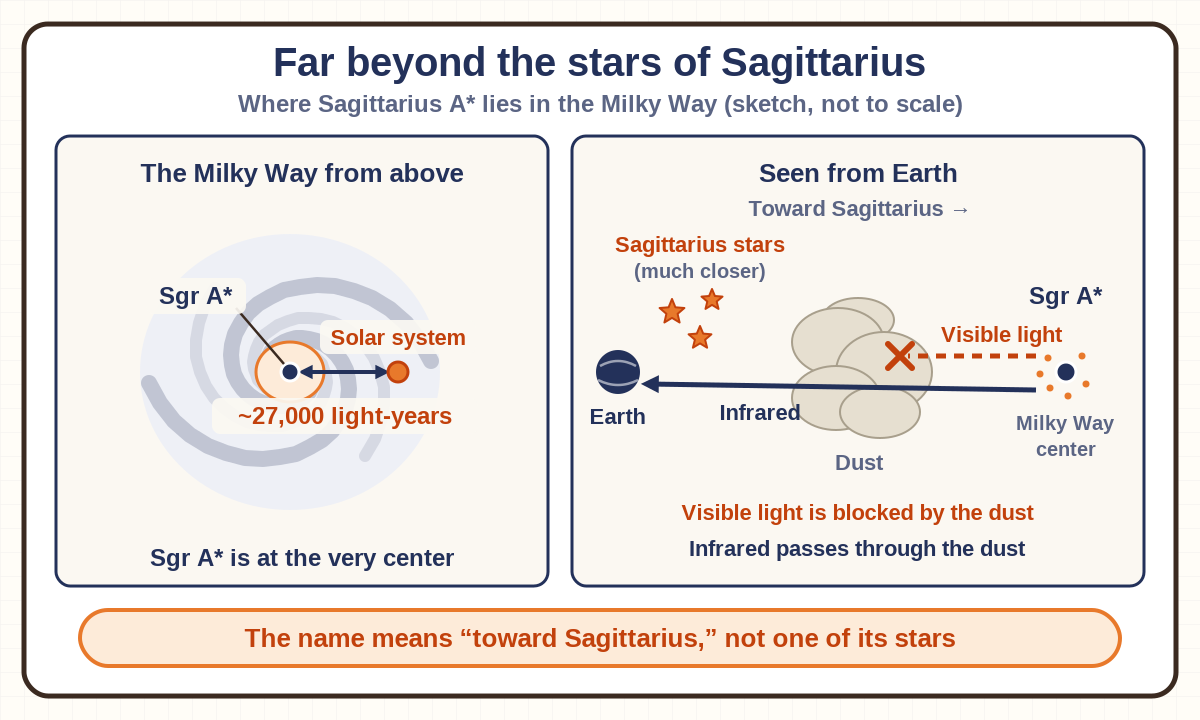
It lies about 27,000 light-years away (the distance light travels in 27,000 years), making it the closest supermassive black hole to Earth. It gets its name because, seen from Earth, it lies in the direction of the constellation Sagittarius, but it isn’t one of the stars you can see in that constellation.
It gives off no light, so it can’t be seen directly. But stars race around it at tremendous speeds, and the way they move showed that about 4 million times the Sun’s mass is packed into a very small space. In 2022, an image was released showing a ring of glowing gas around it with a dark “shadow” inside.
It takes in only a tiny amount of gas and is usually very quiet. Even so, its brightness flickers without rest, and it flares up several times a day.
A common mix-up
“The black hole at the center of the Milky Way is swallowing everything around it, one thing after another, and someday it will swallow Earth too.”
No. Sagittarius A*’s gravity becomes far stronger than other objects’ only close to it. The gravity it sends out to far-off places is the same as that of any other object with the same mass; a black hole doesn’t pull in faraway things like a vacuum cleaner. Even S2, a star circling right next to Sagittarius A*, isn’t swallowed: it goes once around a long, thin path in about 16 years, and then keeps going around in the same way. Earth is far, far beyond S2, about 27,000 light-years away. What’s more, Sagittarius A* is taking in only a tiny amount of gas right now. For a supermassive black hole, it is a quiet one that is hardly “eating” at all.
Explained in pictures
Free to use in lessons, slides and posts with credit (CC BY 4.0).
Free to use in lessons, slides and posts with credit (CC BY 4.0).
Free to use in lessons, slides and posts with credit (CC BY 4.0).
You’re free to use these figures in lessons, slides and posts if you credit Naru News (naru.news). CC BY 4.0.
Think of it like this
A glowing ball swung in the dark
Imagine someone in a pitch-dark square at night, swinging a string with a glowing ball on the end round and round. The person swinging it is dressed in black and can’t be seen. Even so, if the ball is racing around a small circle, you can tell that a hand in the middle is pulling hard on the string. Measure the size of the circle and the time for one lap, and you can even estimate how strong the pull is.
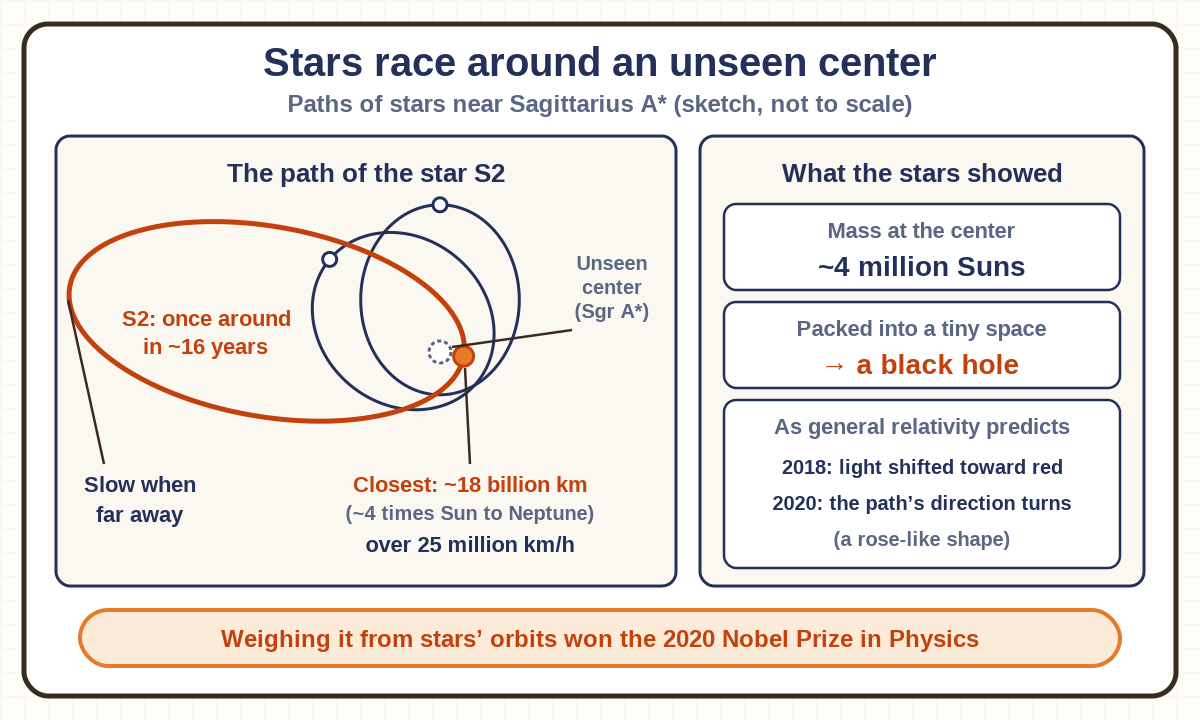
For Sagittarius A*, the glowing ball is the star S2, the unseen person’s hand is Sagittarius A*, and the pull of the string is gravity. S2 travels a path that takes about 16 years per lap, moving at more than 25 million km per hour at its closest. From the size of that path and the time for one lap, the mass in the middle was weighed at about 4 million times the Sun’s.
But the comparison has limits. Gravity needs no string and reaches far-off places. The ball’s circle is round, but S2’s path is very long and thin; S2 speeds up as it nears the middle and slows down as it moves away. And the real Sagittarius A* is very small compared with S2’s path; that very smallness is why it is thought to be a black hole.
Key points
Where is it, and how big is it?
Sagittarius A* sits at the center of our Milky Way, the huge group of stars that includes our solar system. It is about 27,000 light-years from Earth, the closest to us of all the supermassive (extremely heavy) black holes. Its mass is about 4 million times the Sun’s, and a more precise measurement using the motions of several stars gives about 4.3 million times.
Heavy as it is, it is very small for its mass. A black hole has a boundary, and once inside it, not even light can get back out; this boundary is called the event horizon. For Sagittarius A*, its radius works out to about 12 million km: although it has about 4 million times the Sun’s mass, that is only about 17 times the Sun’s radius today. Seen from Earth, even with the ring of glowing gas around it, it looks only about as big as a doughnut placed on the Moon.
Between Earth and the center of the Milky Way lies a lot of dust (extremely fine grains), so the region around the center can’t be seen in visible light. That is why astronomers study the stars near the center in infrared light (a kind of light our eyes can’t see), which can pass through the dust. Sagittarius A* itself was found as an object giving off radio waves.
If we can’t see it, how do we know it’s a black hole?
Sagittarius A* itself gives off no light, but the stars circling close to it can be seen in infrared light. From the 1990s, Reinhard Genzel’s team in Germany, using telescopes of the European Southern Observatory (ESO) in Chile, and Andrea Ghez’s team in the United States, using the telescopes of the Keck Observatory in Hawaii, followed the motions of stars around the center for more than 20 years.
One star, S2, travels a long, thin path once every 16 years or so, and at its closest it passes about 18 billion km from the center (about 4 times the distance from the Sun to Neptune) at more than 25 million km per hour (almost 3% of the speed of light). Making a star go around this fast requires about 4 million times the Sun’s mass packed into a very small space. Only a black hole is thought to fit, and the two won the 2020 Nobel Prize in Physics (the prize was “for the discovery of a supermassive compact object at the centre of our galaxy,” meaning an object that is extremely heavy yet packed into a very small space).
What’s more, in 2018, when S2 came closest, astronomers caught its light shifting toward red. Light coming out from deep in strong gravity gets its wavelength (the length from one wave crest to the next) stretched, so it shifts toward red light, which has longer waves (gravitational redshift). In 2020, they also saw the direction of S2’s path turn a little with each lap, so that the ellipses, each slightly turned from the last, trace out a shape like a rose. Both matched the predictions of Einstein’s general relativity, the theory that explains gravity as a warping of space and time.
What does the 2022 image show?
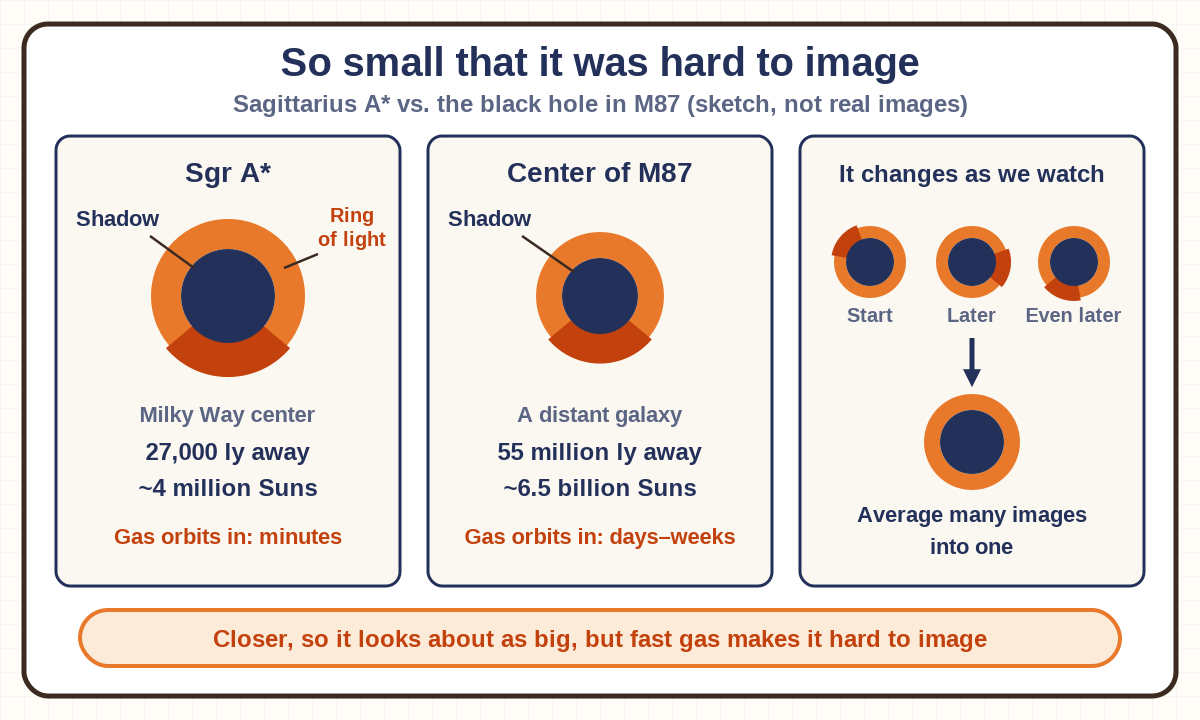
In May 2022, the international Event Horizon Telescope (EHT) team released an image of Sagittarius A*. Eight radio telescopes around the world observed it together in 2017, working like a single telescope the size of Earth. The image shows a bright ring of light and a dark area inside it (the shadow). The black hole itself gives off no light, so it appears as a dark shadow outlined by the hot, glowing gas around it. The image was called unshakable evidence that Sagittarius A* is a black hole.
Compared with the black hole at the center of the distant galaxy M87, whose image was released in 2019, Sagittarius A* has less than a thousandth of the mass, but because it is much closer, its ring looks about the same size. But Sagittarius A* is much smaller, so the gas around it circles it in just minutes (days to weeks around M87). The brightness and pattern of the gas changed rapidly even during the observations, which made it hard to image, and many images made from the observation data were averaged into one.
In March 2024, an image showing the direction in which the light waves vibrate (polarization) was also released. Its pattern revealed strong magnetic fields (the space where magnetic forces act), lined up in one direction and swirling around the edge of the black hole, shaped much like those around M87’s black hole. M87’s black hole clearly sends out a narrow, powerful stream of gas (a jet). Sagittarius A* may also have a hidden jet that hasn’t been found yet.
Is it always quiet?
Sagittarius A* takes in only a tiny amount of gas from around it. Even among supermassive black holes, it is a textbook example of one that is hardly “eating” at all, and it is usually dim and quiet.
But its brightness isn’t steady. In infrared observations by the James Webb Space Telescope, published in 2025, the disk of gas that circles Sagittarius A* while slowly falling in (the accretion disk) kept changing its brightness without rest. There were faint flickers lasting only seconds, and five to six big brightenings (flares) a day.
In X-rays (invisible light, the kind used for X-ray pictures at a hospital), it sometimes brightens even more. In September 2013, NASA’s Chandra X-ray Observatory caught an X-ray flare 400 times brighter than its usual, quiet state. Such flares are thought to involve the magnetic fields in the gas around it, among other ideas, but how they work is still not clear.
Where does its gas “food” come from?
Many young, heavy stars circle around Sagittarius A*. Heavy stars blow gas off their surfaces at high speed (stellar winds), and Sagittarius A* is thought to feed mainly on this gas.
In 2012, a gas cloud was found falling toward Sagittarius A* on a very long, thin path, and in 2014 it passed close by Sagittarius A*. About 13 years before that, a similar cloud had traveled almost the same path. Then a study published in 2026 found that a third cloud is also moving along almost the same path (the three clouds are called G1, G2 and G2t).
With paths this closely matched, the three seem to come from the same place. If a star were hidden inside each cloud, three separate stars would have to be traveling such closely matched paths just by chance. The odds of that are less than 1 in 500,000, so the idea of hidden stars was judged very unlikely.
The research team named as the most likely source a pair of heavy stars (a binary star) circling near Sagittarius A*. The two stars circle each other so closely that they touch. The small shifts in the directions of the three clouds’ paths also matched the way this pair moves along its own orbit. In computer simulations, when the pair’s wind was on the slow side, the gas was squeezed where the wind hits the surrounding gas and formed clumps, and some of them headed toward Sagittarius A*.
If each cloud weighs about as much as Earth, one falling in every 10 years is enough to supply all the gas Sagittarius A* takes in today. So the team thinks such clouds may be the main source of its “food” right now. But they say how the clumps form still needs closer study.
Why is it called “Sagittarius A*”?
Because, seen from Earth, it lies in the direction of the constellation Sagittarius. Constellations divide the whole sky into 88 regions, and any object seen in that direction is counted as being in that constellation. The region around the center of the Milky Way can’t be seen in visible light, so the stars of Sagittarius you can see with your eyes are all much closer than the center.
Radio waves come from a spot in the direction of Sagittarius that overlaps with the center of the Milky Way. The object giving off these radio waves (a radio source) is called Sagittarius A. The “A” marks it as the first and brightest radio source found in that constellation. In 1974, Bruce Balick and Robert Brown found a very small radio source inside Sagittarius A. That is Sagittarius A*.
Brown added the asterisk (*) to set it apart from the other parts. In physics, an atom that has taken in energy and is in a raised state is called an “excited” atom and is written with an asterisk. Brown thought of this radio source as what was making the gas around it glow, and he recalled naming it by analogy with that mark. The name is read “Sagittarius A-star.”
Check yourself
Q1Sagittarius A* lies in the direction of the constellation Sagittarius in the night sky. Compared with the stars of Sagittarius you can see with your eyes, how far from Earth is it?
Answer and explanation
Answer: B Much farther than them, at the center of the Milky Way
Sagittarius A* is a black hole at the center of the Milky Way, about 27,000 light-years from Earth. It is named for lying in the direction of Sagittarius as seen from Earth, but it isn’t one of the constellation’s stars lined up at the same distance. The region around the center of the Milky Way can’t be seen in visible light because dust blocks it, so the stars of Sagittarius you can see are all much closer. Nor is it just outside the solar system.
Q2Sagittarius A*, whose image was released in 2022, was harder to image than the black hole in the distant galaxy M87, whose image was released in 2019. What was the main reason?
Answer and explanation
Answer: C Its gas circles fast, so it changed while observed
Sagittarius A* is much smaller than M87’s black hole, so the gas around it circles it in just minutes (days to weeks around M87). So the brightness and pattern of the gas changed rapidly even during the observations, and many images were averaged into one. Sagittarius A* has less than a thousandth of the mass of M87’s black hole, but it is much closer, so its ring looks about the same size. Its bright ring shows clearly in the image, too.
Q3Three gas clouds are falling toward Sagittarius A* along almost the same path. According to a study published in 2026, where did they come from?
Answer and explanation
Answer: A Gas blown off by a nearby pair of heavy stars
The three clouds travel almost the same path, so they seem to come from the same place. If a star were hidden inside each cloud, separate stars would have to be traveling such closely matched paths by chance, and the odds of that are very small, so this idea was judged very unlikely. The most likely source was not a single star but a pair of heavy stars (a binary star) circling near Sagittarius A*. In computer simulations, the gas was squeezed where the pair’s wind hits the surrounding gas and formed clumps.
More on this → Key points: Where does its gas “food” come from?
Related terms
- Black hole
- Event horizon
- General relativity
- Supermassive black hole
- Milky Way
- Event Horizon Telescope
- Gravitational redshift
- Accretion disk
Sources and how we checked
- National Astronomical Observatory of Japan, Japanese press release on the first image of the black hole at the center of the Milky Way (May 12, 2022: the Japanese name いて座A* with the reading “A-star” and the spelling いて座Aスター in a note, its mass of 4 million Suns and distance of about 27,000 light-years, its apparent size being only about that of a doughnut [about 8 cm across] on the Moon, the dark central region [the shadow] outlined by a bright ring-like structure, the earlier indirect evidence of stars orbiting a heavy, compact, unseen object, its mass being less than a thousandth of the giant black hole in M87 while looking very similar, gas taking days to weeks to circle M87’s black hole but only minutes around Sagittarius A*, so the brightness and pattern of the gas changed rapidly during observations, the image being an average of many images from the 2017 data, the eight radio telescopes linked around the world, and the image being called unshakable evidence that the object is a black hole; read November 22, 2026)
- The Event Horizon Telescope Collaboration, “First Sagittarius A* Event Horizon Telescope Results. I. The Shadow of the Supermassive Black Hole in the Center of the Milky Way” (The Astrophysical Journal Letters 930, L12, May 12, 2022; arXiv abstract: observations in 2017 with eight telescopes at a wavelength of 1.3 mm, a compact emission region with intrahour variability, a bright, thick ring 51.8 ± 2.3 microarcseconds across with a dim interior, consistency with a spinning black hole of about 4 million solar masses, as found earlier from stellar orbits and other data, and direct evidence for a supermassive black hole at the center of the Milky Way; read November 22, 2026)
- National Astronomical Observatory of Japan, Japanese press release on the first image of a black hole in the galaxy M87 (April 10, 2019: the M87 black hole lying 55 million light-years from Earth with 6.5 billion times the Sun’s mass; read November 22, 2026)
- ESO, “Astronomers unveil strong magnetic fields spiraling at the edge of Milky Way’s central black hole” (eso2406, March 27, 2024: the new image in polarized light showing strong, organized magnetic fields spiraling from the edge of Sagittarius A*, the polarization pattern forming perpendicular to the field, the field structure being strikingly similar to that of the black hole in M87, this hinting at a hidden jet in Sagittarius A*, while a jet is clearly imaged in M87 but has yet to be found in Sagittarius A*, its distance of about 27,000 light-years, and the results appearing in two papers in The Astrophysical Journal Letters [First Sagittarius A* Event Horizon Telescope Results VII and VIII]; read November 22, 2026)
- ESO, “Unprecedented 16-Year Long Study Tracks Stars Orbiting Milky Way Black Hole” (eso0846, December 10, 2008: the interstellar dust that fills the Galaxy blocking our direct view of the central region in visible light, so infrared wavelengths that can penetrate the dust were used, the distance to the center measured as 27,000 light-years, the motions of 28 stars tracked, and the central concentration of 4 million solar masses having to be a black hole beyond any reasonable doubt; read November 22, 2026)
- Max Planck Institute for Extraterrestrial Physics (MPE), Infrared/Submillimeter group, “The Galactic Center” (research overview page: the stars in the Galactic Center being visible only at infrared wavelengths because of the high extinction, the group pioneering infrared observations for three decades, Sgr A* being the compact radio source associated with the black hole, and its mass of about 4 million solar masses; read November 22, 2026)
- ESO, “First Successful Test of Einstein’s General Relativity Near Supermassive Black Hole” (eso1825, July 26, 2018: S2 orbiting the black hole every 16 years on a highly eccentric orbit, its closest approach in May 2018 at less than 20 billion km from the black hole, moving at more than 25 million km per hour [almost 3% of the speed of light], the black hole’s mass of 4 million Suns, the detection of gravitational redshift, infrared observations with GRAVITY, SINFONI and NACO, the result as the climax of a 26-year campaign with ESO’s telescopes, and the closest supermassive black hole to Earth lying at the center of the Milky Way; read November 22, 2026)
- GRAVITY Collaboration, “Detection of the gravitational redshift in the orbit of the star S2 near the Galactic centre massive black hole” (Astronomy & Astrophysics 615, L15, 2018; arXiv abstract: S2’s 16-year orbit, its pericenter at 120 AU [about 1,400 Schwarzschild radii] at about 7,650 km/s, the detection of the combined gravitational redshift and transverse Doppler effect, the data being inconsistent with pure Newtonian dynamics and matching general relativity, and 26 years of monitoring; read November 22, 2026)
- ESO, “ESO Telescope Sees Star Dance Around Supermassive Black Hole, Proves Einstein Right” (eso2006, April 16, 2020: S2’s orbit being shaped like a rosette [Schwarzschild precession], not an ellipse as predicted by Newton’s theory of gravity, exactly matching general relativity, S2 completing an orbit every 16 years and coming within less than 20 billion km, the mass of 4 million Suns, and the result as the culmination of 27 years of observations; read November 22, 2026)
- GRAVITY Collaboration, “A geometric distance measurement to the Galactic center black hole with 0.3% uncertainty” (Astronomy & Astrophysics, 2019; arXiv abstract: the distance to the Galactic Center measured from the motion of S2 as 8,178 parsecs. At about 3.26 light-years per parsec, this is about 26,700 light-years, in line with about 27,000 light-years; read November 22, 2026)
- GRAVITY Collaboration, “The mass distribution in the Galactic Centre from interferometric astrometry of multiple stellar orbits” (Astronomy & Astrophysics, 2022, DOI 10.1051/0004-6361/202142465; arXiv abstract: the mass of Sgr A* found from the orbits of S2, S29, S38, S55 and other stars as 4.30 million solar masses [to about 0.25%], and very little extended mass spread out within S2’s orbit; read November 22, 2026)
- ESO, “2020 Nobel Prize in Physics awarded for research with ESO telescopes on Milky Way’s supermassive black hole” (eso2017, October 6, 2020: the citation for Genzel and Ghez, “for the discovery of a supermassive compact object at the centre of our galaxy,” Genzel’s team starting in 1992 with the SHARP instrument on ESO’s NTT and later using the VLT and GRAVITY to track the orbits of stars in the Sagittarius A* region, and in particular catching the gravitational redshift and the Schwarzschild precession of S2; read November 22, 2026. The Nobel Foundation’s pages could not be opened from here)
- American Physical Society, “Nobel Prize in Physics Recognizes Black Hole Discoveries” (October 6, 2020: the prize citation for Genzel and Ghez, the two providing some of the strongest evidence to date that the compact object at the center of the Milky Way is a supermassive black hole, and nearly 30 years of observations of S2 showing that it orbits in the shape of a rosette rather than an ellipse; read November 22, 2026)
- UCLA, “Andrea Ghez wins 2020 Nobel Prize in physics” (University of California, Los Angeles, October 6, 2020: Ghez’s team studying stars orbiting the supermassive black hole at the center of the Milky Way at the W.M. Keck Observatory in Hawaii, using adaptive optics, which corrects the distorting effects of Earth’s atmosphere in real time, and having studied it for 24 years as of 2019; read November 22, 2026)
- NASA, “NASA’s Chandra Detects Record-Breaking Outburst from Milky Way’s Black Hole” (January 5, 2015: an X-ray flare from Sagittarius A* 400 times brighter than its usual, quiet state on September 14, 2013, another flare 200 times brighter on October 20, 2014, Sagittarius A* normally consuming only a mere trickle of infalling matter, and the two proposed causes, an asteroid being torn apart or tangled magnetic field lines in the infalling gas, with the jury still out; read November 22, 2026)
- NASA, “Webb Reveals Rapid-Fire Light Show From Milky Way’s Central Black Hole” (NASA Science, February 18, 2025: Webb observations showing the accretion disk around Sagittarius A* emitting a constant stream of flares with no periods of rest, five to six big flares per day with smaller sub-flares in between, some faint flickers lasting mere seconds, and the researcher attributing the faint flickers to turbulence in the disk and the big flares to magnetic reconnection, while the processes are not yet fully understood; read November 22, 2026)
- S. Gillessen et al., “The gas streamer G1–2–3 in the Galactic center” (Astronomy & Astrophysics 707, A79, 2026; accepted January 16, 2026. Main text read as a PDF [the journal version, posted at Leiden Observatory]. Abstract: Sgr A* as prototypical of ultra-low-fed galactic nuclei, gas clumps of a few Earth masses providing a reservoir sufficient to power Sgr A*, G2 passing at about 100 AU and G1 passing on a similar orbit 13 years earlier, the orbit of a third clump, the very low probability of finding three stars on such similar orbits strongly arguing against stellar source models, and G1–2–3 plausibly originating from the stellar wind of the massive binary IRS 16SW. Section 1: G2’s pericenter in 2014 and its gas mass estimated at no more than 3 Earth masses, and IRS 16SW being a contact binary in the clockwise disk of young stars. Section 2: observations with SINFONI and ERIS on the VLT. Section 3.1: a chance probability of 2 in a million [1 in 500,000] for 15 degrees, reduced further by other similarities, G2t reaching pericenter 17.6 years after G2, in mid 2031, the orientation of the orbits shifting at a rate close to IRS 16SW’s motion, and IRS 16SW as the most likely candidate. Section 4: simulations with a slower wind of 300 to 400 km/s in which the bow shock in front of IRS 16SW fragments into clumps, some entering orbits toward Sgr A*, including clumps above 3 Earth masses, with the robustness of this result still to be checked, the accretion of one G2-like clump of about 1 Earth mass per decade sufficing to explain Sgr A*’s inferred accretion rate, so G1–2–3 could be the main current source of gas, in agreement with the generally accepted view that Sgr A* is mostly fed by hot plasma from stellar winds. Section 5: G1–2–3 most likely originating from the winds of that star; read November 22, 2026)
- Max Planck Institute for Extraterrestrial Physics (MPE), “Tracing the Origins of Mysterious Gas Clouds near the Galactic Center” (April 8, 2026: G2 found in 2012, G1, G2 and G2t moving on orbits with almost identical orientation and shape, which is very unlikely to be chance, the contact binary IRS 16SW as a viable source, simulations in which gas is compressed where the binary’s stellar winds collide with the surrounding medium and detaches as clumps moving inward, infall of roughly one Earth mass every decade possibly being enough to sustain Sgr A*’s current activity, and observations with SINFONI and ERIS on the VLT; read November 22, 2026. News reports on this study from around November 2026 were not used)
- ESO, “New look at the stars around the Milky Way’s centre” (Picture of the Week potw2610a, March 9, 2026: a new gas cloud, G2t, found with ERIS on the VLT orbiting the supermassive black hole some 27,000 light-years away, G1, G2 and G2t being on almost identical orbits and probably sharing the same origin, the slim odds of each cloud hiding a star, and the source most likely being IRS16SW, a pair of massive stars expelling an enormous amount of gas, ejecting each cloud into a slightly different orbit as it moves; read November 22, 2026)
- W. M. Goss, R. L. Brown and K. Y. Lo, “The Discovery of Sgr A*” (Astronomische Nachrichten 324, S1, 2003; main text read as a PDF. Section 1: Sgr A* discovered on February 13 and 15, 1974, by Balick and Brown with the Green Bank 35-km radio link interferometer, and Sagittarius A identified as a radio source coinciding with the Galactic Center by Piddington and Minnett [1951] and McGee and Bolton [1954]. Section 3: Brown inventing the name Sgr A* in a 1982 paper to distinguish the compact source from the other components and emphasize its unique nature, and Brown’s own account that he thought of the radio source as the “exciting source” for the surrounding ionized gas and was reminded of the atomic physics notation for excited-state atoms, such as He*; read November 22, 2026)
- IAU Office of Astronomy for Education (OAE) Multilingual Glossary, “Sagittarius A*” (the Japanese name いて座A*, “Sagittarius” referring to the constellation where it appears from Earth, the letter A meaning that it is the brightest and first extrasolar radio source discovered in the constellation, the asterisk coming from the physics notation for atoms in excited states, and its distance of about 27,000 light-years; read November 22, 2026)
- IAU Office of Astronomy for Education (OAE) Multilingual Glossary, “Constellation” (the International Astronomical Union dividing the whole sky into 88 regions, the constellations, so that every celestial object, from stars to galaxies to nebulae, can be associated with one, and the star patterns in constellations being as seen from Earth; read November 22, 2026)
- NASA, “Black Holes” (NASA Science, updated November 17, 2026: black holes not sucking in other matter, their gravitational effects from far enough away being just like those of other objects of the same mass, and our galaxy’s black hole being called Sagittarius A*, with 4 million times the Sun’s mass; read November 22, 2026)
- Nature Japan, Japanese research highlight on a star sensitive to the spin of the Milky Way’s black hole (August 20, 2026: the Milky Way’s central black hole written 射手座A*, another Japanese spelling; used only to check this name; read November 22, 2026)
- NASA, “Sun Fact Sheet,” “Earth Fact Sheet” and “Neptune Fact Sheet,” and NIST, “CODATA Value: speed of light in vacuum” (the Sun’s GM of 132,712×10^6 km³/s², the Sun’s radius of 695,700 km, Earth’s semimajor axis of 149.598 million km [used as 1 AU], Neptune’s semimajor axis of 4,514.953 million km, and the speed of light in vacuum of 299,792,458 m/s. Calculations: the event horizon radius 2GM/c² is about 2.95 km per Sun’s mass, so about 11.8 million km [about 12 million km] for 4 million Suns, about 17 times the Sun’s radius; S2’s closest approach of 120 AU is about 18 billion km, about 4 times the Sun–Neptune distance; read November 22, 2026)
AI wrote this page from the sources above, and a different AI checked it against the text of those sources (November 22, 2026). A person with a master’s degree in science and a Japanese high-school science teaching license also read and checked it before publishing. Numbers are as of that date. If anything was hard to follow, you spot a mistake, or there’s a term you’d like explained, please write to [email protected].
Glossary
- AI agent
- AI alignment
- Alignment faking
- Artificial general intelligence (AGI)
- Artificial intelligence (AI)
- Backdoor
- Benchmark
- Chain of thought (CoT)
- Context window
- Data poisoning
- Deep learning
- Deepfake
- Diffusion model
- Embedding
- Emergent misalignment
- Evaluation awareness
- Fine-tuning
- Formal verification
- Generalization
- Generative adversarial network (GAN)
- Generative AI
- Goodhart’s law
- Gradual disempowerment
- Hallucination
- Hyperparameter
- Intelligence explosion
- Interpretability
- Jailbreaking
- Large language model (LLM)
- Latent space
- Machine learning
- Mixture of experts (MoE)
- Neural network
- Neuralese
- Overfitting
- Parameter
- Persona vectors
- Pre-training
- Prompt
- Prompt injection
- Reasoning model
- Recursive language model (RLM)
- Recursive self-improvement (RSI)
- Red teaming
- Reinforcement learning (RL)
- Retrieval-augmented generation (RAG)
- Reward hacking
- Reward model
- Shutdown resistance
- Sleeper agent
- Subliminal learning
- Superintelligence (ASI)
- System prompt
- Technological singularity
- Time horizon
- Token
- Transfer learning
- Transformer
- Accretion disk
- Black hole
- Black hole star
- Cosmic birefringence
- Event horizon
- Event Horizon Telescope (EHT)
- General relativity
- GPS
- Gravitational lensing
- Gravitational singularity
- Gravitational wave
- James Webb Space Telescope (JWST)
- Lagrange point
- Long-period radio transient (LPT)
- Neutron star
- Pulsar
- Quasar
- You are hereSagittarius A*
- Space data center
- Spacetime
- Special relativity
- Speed of light
- Supermassive black hole
- White dwarf