
What is the VP ≠ VNP conjecture (P ≠ NP for addition and multiplication)?
Also called: Valiant’s conjecture, Valiant’s hypothesis, VP vs VNP

In one minute
The VP ≠ VNP conjecture says that the permanent of a matrix can’t be computed by any small circuit built from additions and multiplications.
The permanent and the determinant are look-alike formulas: pick one number from each row of a square table, never using a column twice, multiply them, and add up the products over every way of picking. They differ only in their signs (+ and −). Yet the determinant is quick to compute, while even the best known add-and-multiply method for the permanent takes work that keeps doubling as the table grows. In 1979, Leslie Valiant conjectured that VP, the formulas that can be built quickly, differs from VNP, the formulas that add up all cases, like the permanent. It is the version of P ≠ NP for a world of only addition and multiplication.
On November 23, 2026, Anthropic released a proof that it says an internal research Claude model found, as a paper and in Lean (software that checks proofs by machine). As of November 25, no human mathematician has checked it. Even if it is right, it does not settle P ≠ NP.
A common mix-up
“VP ≠ VNP has been proved, so P ≠ NP is solved too.”
Wrong on two counts. First, what came out in November 2026 is a claim of a proof, and as of November 25, 2026, no human mathematician has checked it. Second, even if the proof is right, it does not settle P ≠ NP. VP ≠ VNP is about circuits that build the formula itself using only addition and multiplication, and such a circuit must produce the right formula whatever numbers are put in, not just 0 and 1. The ordinary computers of P ≠ NP can handle strings of 0s and 1s in any way they like, so they have far more freedom to find shortcuts. Between the two, only one direction is known. The direction “if P ≠ NP is proved in its circuit form, then VP ≠ VNP is true too” is known (for some kinds of numbers, assuming another conjecture as well). But the direction “if VP ≠ VNP is true, then P ≠ NP is true too” is not known. The paper itself says it does not settle P ≠ NP.
Explained in pictures
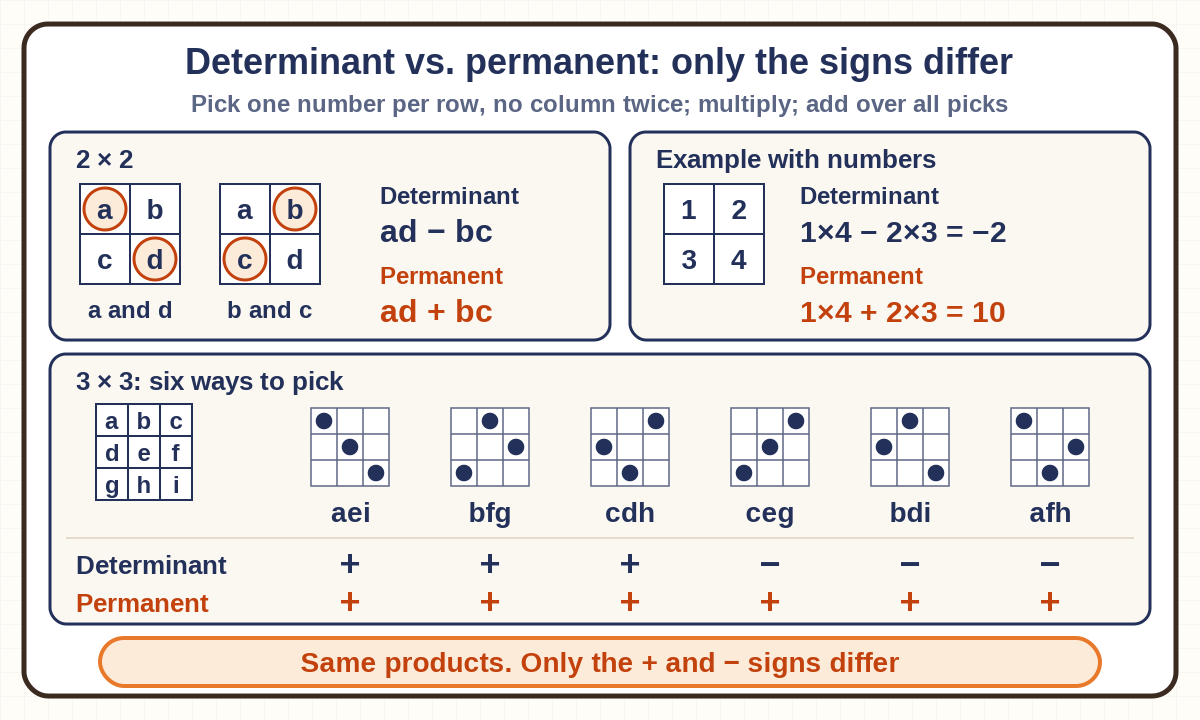
Free to use in lessons, slides and posts with credit (CC BY 4.0).
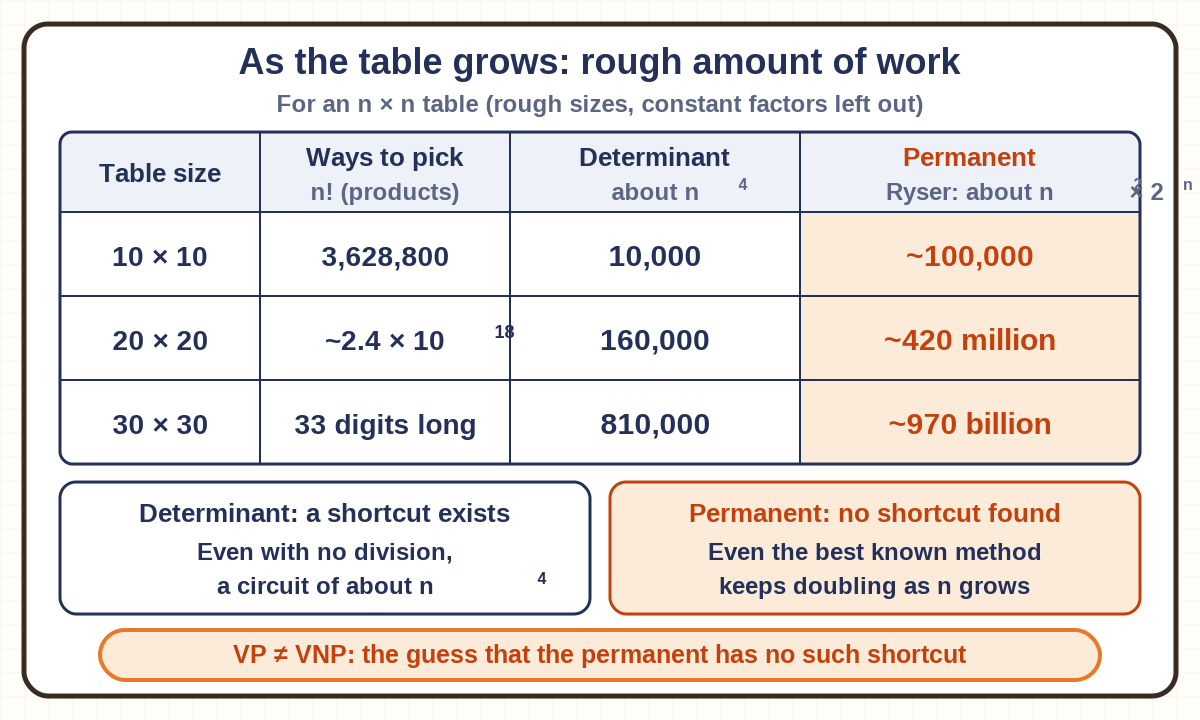
Free to use in lessons, slides and posts with credit (CC BY 4.0).
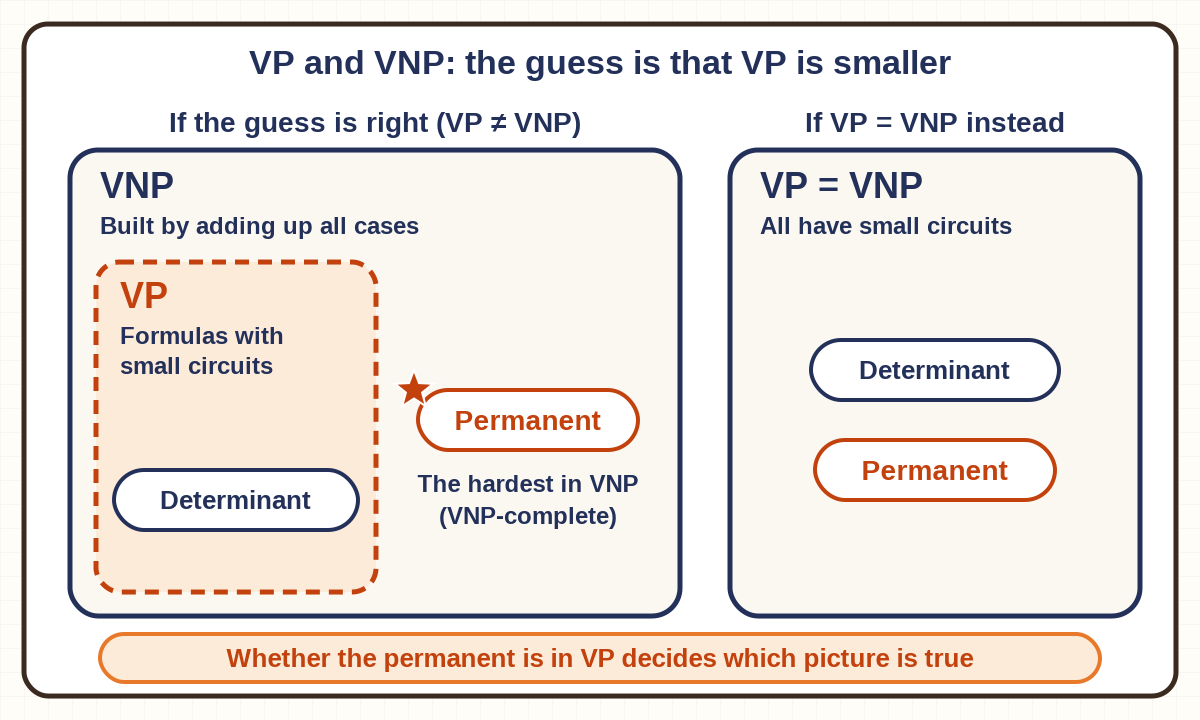
Free to use in lessons, slides and posts with credit (CC BY 4.0).
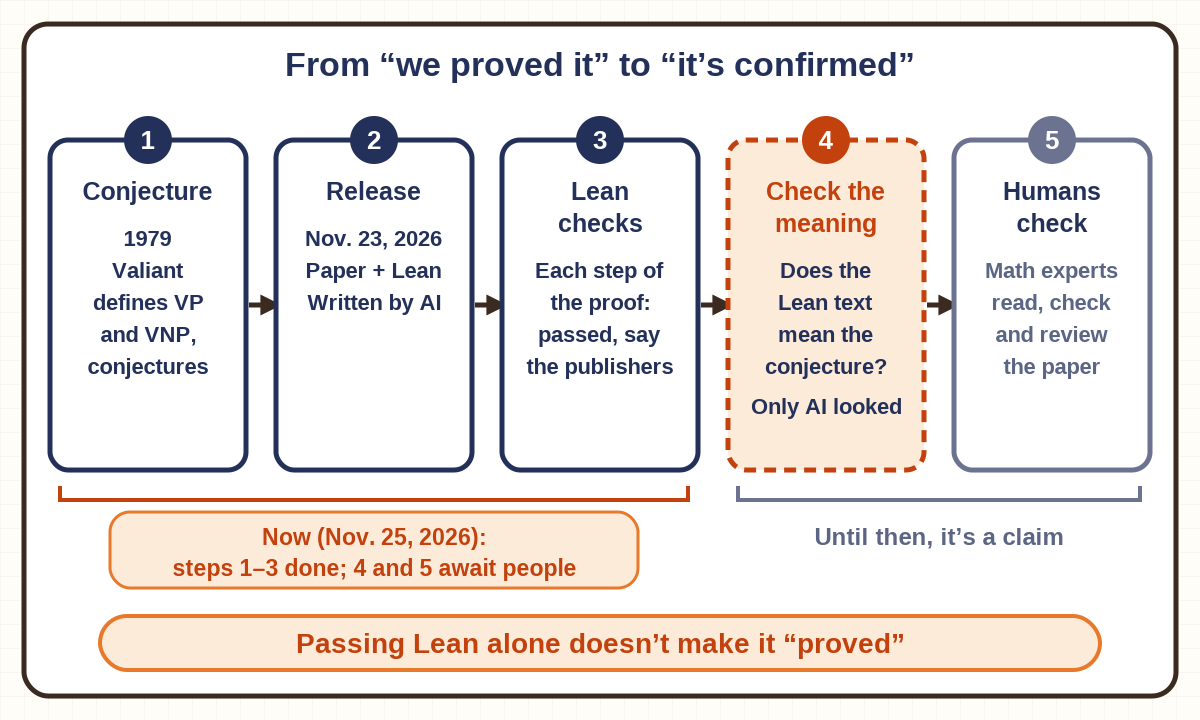
Free to use in lessons, slides and posts with credit (CC BY 4.0).
You’re free to use these figures in lessons, slides and posts if you credit Naru News (naru.news). CC BY 4.0.
Think of it like this
Counting every way to fill the seats
Say four people each take one of four seats. Each person has certain seats they are allowed to sit in. How many ways are there for everyone to be seated? Make a table with people as rows and seats as columns, and write 1 where a person may sit and 0 where they may not. The permanent of this table is exactly that number. It is the same as going through the seatings one by one and adding 1 if everyone is in an allowed seat, or 0 if even one person is not.
With four people there are only 24 seatings, so you can check them one by one. But the number of seatings explodes as the group grows: with 20 people there are about 2.4 quintillion (2.4 × 10¹⁸). There is a known quick way to check whether at least one seating works for everyone, but no shortcut has been found for counting how many there are. On the other hand, if you give each seating a + or − sign before adding (the determinant), the number is quick to find however many people there are. The sign depends on how many swaps of two people’s seats it takes to reach that seating, starting from person 1 in seat 1, person 2 in seat 2, and so on: + if the number of swaps is even, − if it is odd. Just adding signs opens up a shortcut, yet adding everything with + hides it. That gap is the heart of the conjecture.
But the comparison has limits. Whether you can quickly get the number for a table of 0s and 1s is a question about ordinary computers, closer to P ≠ NP (in fact, computing the permanent of a 0-1 table is one of the hardest counting problems). The VP ≠ VNP conjecture asks about the size of circuits made only of additions and multiplications that build the right formula whatever numbers or letters are in the table.
Key points
How do the permanent and the determinant differ?
Both are formulas built from a square table of numbers (a matrix). You pick one number from each row, never picking from the same column twice, and multiply the picked numbers. Then you add up these products over every way of picking. For a 2 × 2 table with a and b in the top row and c and d in the bottom row, there are two ways to pick, “a and d” and “b and c,” so the permanent is ad + bc and the determinant is ad − bc. For example, with 1 and 2 in the top row and 3 and 4 in the bottom row, the permanent is 1×4 + 2×3 = 10 and the determinant is 1×4 − 2×3 = −2.
A 3 × 3 table has six ways to pick: the determinant adds three products with + and three with −, while the permanent adds all six with +. An n × n table has n factorial (n! = 1 × 2 × … × n) ways: 3,628,800 for 10 × 10, about 2.4 × 10¹⁸ for 20 × 20, and a 33-digit number for 30 × 30.
The determinant can be computed quickly with tricks like the elimination used to solve simultaneous equations (Gaussian elimination). It is known that even a circuit with only additions and multiplications, and no division, can build it at a size of about n⁴ (for example, Berkowitz’s 1984 method). By contrast, the fastest known add-and-multiply methods for the permanent are based on Ryser’s formula from 1963. Building it from this formula takes work of about n² × 2ⁿ. For n = 10, 20 and 30, n⁴ is 10,000, 160,000 and 810,000, but n² × 2ⁿ is about 100,000, about 420 million and about 970 billion. The signs are the only difference, yet whether the permanent truly lacks a shortcut like the determinant’s had gone unproved for a long time.
What are circuit size, VP and VNP?
A circuit here is not an electronic circuit but a recipe for a calculation. Starting from letters (such as x and y) and numbers, you line up steps (gates) of the form “add two things made earlier” or “multiply two things made earlier,” ending with the formula you want. The number of gates is the size of the circuit. For example, (x + y) × (x + y) takes one addition and one multiplication starting from x and y. Building the same formula in its expanded form, x² + 2xy + y², takes more multiplications and additions.
VP and VNP deal not with a single formula but with a sequence of formulas, one for each size n. For example, the determinants of the 1 × 1, 2 × 2, 3 × 3 … tables, lined up in order, make one sequence of formulas. VP is the set of sequences of formulas for which, as n grows, the number of letters, the degree (how many letters are multiplied together) and the circuit size all stay at about n to some fixed power. It stands for formulas that can be built quickly, and the determinant is in VP.
VNP is the set of formulas you can get by taking a formula in VP, putting every combination of 0s and 1s into some of its letters, and adding all the results. Here is a small example. The 2 × 2 permanent ad + bc comes from the formula (1 − e) × ad + e × bc, which has one extra letter e, by putting 0 and then 1 into e and adding: e = 0 gives ad, e = 1 gives bc, and together they make ad + bc. Since (1 − e) × ad + e × bc can be built by a small circuit, ad + bc has the form of VNP. The permanent of a bigger table also adds up every way of picking, so it is in VNP (Ryser’s formula also shows this). A formula in VP is also in VNP if you add nothing up, so VP is contained in VNP. The conjecture is that VNP is truly larger.
Why is the permanent the star?
In his 1979 paper, Valiant showed that any formula in VNP can be made from a permanent of not much larger size just by putting other letters or numbers into its letters. This is what it means for the permanent to be VNP-complete. “Complete” means it is the hardest representative of VNP, one that every formula in VNP can be made from. So if the permanent could be built by a small circuit, every formula in VNP could be too, and VP = VNP. If it can’t, VP ≠ VNP. The conjecture is the same as asking whether the permanent can be built by a small circuit.
But this is about ordinary number worlds, where 1 + 1 is not 0. There are also number worlds where 1 + 1 = 0. Just as a clock calls 4 hours after 10 o’clock “2 o’clock,” some arithmetic keeps only the remainder after dividing. Keeping only the remainder after dividing by 2, odd numbers become 1 and even numbers become 0, and since odd + odd is even, 1 + 1 = 0. In such a world, −1 and +1 are the same, so the permanent and the determinant become the same formula, and the permanent can be built quickly too. There, a different formula, the Hamiltonian cycle polynomial, takes the starring role. It counts the routes through a graph that visit every point once and return to the start, and it is VNP-complete in every number world.
In the same year, 1979, Valiant also showed that computing the permanent of a table of only 0s and 1s is among the hardest representatives of the counting problems, #P (#P-complete). It was a surprising result: you can quickly tell whether at least one seating works for everyone, yet counting how many there are is hard. Valiant received the 2010 Turing Award, recognized in part for this theory of algebraic computation. The conjecture has been called the “holy grail” of the field that studies how much work it takes to build formulas with addition and multiplication (algebraic complexity theory).
How is it related to P ≠ NP?
The P ≠ NP conjecture says that some problems whose answers are easy to check are still hard to solve (the question of whether P and NP are the same, P vs NP, is one of the Millennium Prize Problems). VP and VNP carry P and NP over into the world of building formulas with addition and multiplication. The mathematician Volker Strassen called this conjecture “Valiant’s hypothesis” and pointed out how it mirrors P ≠ NP.
But the two are not the same. A circuit of additions and multiplications must build the formula itself, working correctly for any numbers put in (and even numbers from extended number worlds), not just 0 and 1. Ordinary computers can handle strings of 0s and 1s in any way they like. So the direction “if VP ≠ VNP is true, then P ≠ NP is true too” is not known.
On the other hand, the direction “if the circuit version of P ≠ NP is true, then VP ≠ VNP is true too” is known. That is because, in number worlds such as the one where 1 + 1 = 0, it has been shown that if VP = VNP, then a circuit version of P ≠ NP (one that allows a special circuit for each problem size) would fail. For complex numbers and others, the same holds if part of the generalized Riemann hypothesis is assumed. In other words, to prove P ≠ NP in its circuit form, you first need to prove VP ≠ VNP.
What does the November 2026 announcement claim?
On November 23, 2026, the AI company Anthropic posted on GitHub a 70-page paper titled “VP ≠ VNP over every field,” along with its proof written in Lean. The author is listed as “Claude (Anthropic),” and the result is said to have been found by an internal research Claude model. The repository also says it is a research artifact, not maintained and not accepting contributions.
The claim is that, for all large enough m, any circuit that builds the permanent of an m × m matrix of real numbers needs more gates than any fixed power of m, such as m², m³ or m¹⁰⁰. Still, this bound grows more slowly than doubling growth like 2 to the power m. Written as a formula, there is a positive number c such that the number of gates is more than m multiplied by itself c × (cube root of log₂ m) times (that number of times slowly grows with m, so it eventually overtakes any fixed power). The paper says the same holds in every number world where 1 + 1 is not 0, and for the Hamiltonian cycle polynomial in every number world. It also includes a stronger form: the same holds for circuits that only come arbitrarily close (approximation).
Until then, no lower bound larger than about m² × log m had been known for the permanent with circuits under no restrictions. On the other hand, the best known way to build it still has a size growing like 2 to the power m, so even if the claim holds, a large gap remains between the lower and upper bounds. The proof splits into two cases. It is not known which case actually holds, even for real numbers, but the argument reaches the conclusion either way.
How far has it been checked?
The paper and the README (the description at the place it was posted) say plainly that the proofs were found and written by AI and that no human mathematician has checked them. The paper also says that whether the file stating the claims (Statement.lean) correctly says what is meant was judged only by AI readers.
According to the publishers, the Lean proof relies only on Mathlib (Lean’s library of mathematics) and the three standard axioms (propext, Classical.choice and Quot.sound), and it was re-checked by two checkers: Lean’s kernel and a separately written one, nanoda. They say every numbered statement in the paper is written in Lean except one consequence about comparison with the determinant.
So what Lean checks is whether the steps of the proof follow the rules, and that check passed, according to the publishers. But Lean does not check whether the claim written in Lean means the same as the original conjecture. The README also says that Lean checks the proofs, but no machine checks that the file stating the claims says what is claimed. If the definitions of circuits, VP or VNP drifted from what mathematicians usually mean, the proof could be of a different, easier problem. So as of November 25, 2026, this is the stage where “a machine-checked proof claiming VP ≠ VNP has come out,” and human mathematicians reading the file’s statements and the paper to check them is still to come.
Check yourself
Q1The “permanent” and the “determinant” are two very similar formulas built from a matrix (a square table of numbers). Where do the two differ?
Answer and explanation
Answer: B In the sign put on each product before adding
The two use exactly the same rule for picking numbers (one from each row, never the same column twice) and add up exactly the same products; only the signs differ. The determinant puts + or − on each product before adding, while the permanent adds them all with +. For a 2 × 2 table, the determinant is ad − bc and the permanent is ad + bc. For an n × n table, both add n! (n factorial) products, so the number of products is the same too.
More on this → Key points: How do the permanent and the determinant differ?
Q2The VP ≠ VNP conjecture, posed by Valiant in 1979, is said to be the same question as whether the “permanent” of a matrix can be built by a small circuit of additions and multiplications. What kind of formula is the permanent within VNP (the formulas built by adding up all cases), that makes this so?
Answer and explanation
Answer: C One that becomes any formula in VNP by replacing letters
Valiant showed that any formula in VNP can be made from a permanent of not much larger size just by putting other letters or numbers into its letters (replacing them). This is VNP-completeness: the permanent is the hardest representative of VNP. So if the permanent can be built by a small circuit, VP = VNP; if not, VP ≠ VNP. VNP also includes easy formulas, such as the single letter x, so the permanent cannot need a smaller circuit than every formula in it. And formulas in VNP come in all shapes and sizes, so they do not all add the same number of products as the permanent. Number worlds where 1 + 1 = 0 are an exception: there, the Hamiltonian cycle polynomial takes the starring role.
Q3In November 2026, the AI company Anthropic released a Lean proof that it says proves the VP ≠ VNP conjecture. Even when the Lean software accepts a proof, which of these does that alone not check?
Answer and explanation
Answer: A Whether the proof’s claim means the same as the original conjecture
Lean checks by machine whether each step of a proof follows the rules. Which axioms a proof relies on can also be checked by machine (according to the publishers, only Mathlib and the three standard axioms). But Lean does not check whether the statement written in Lean means the same as the original VP ≠ VNP conjecture. The README also says that no machine checks whether the file stating the claim says what it is meant to say. As of November 25, 2026, only AI has looked at that, and checking by human mathematicians is still to come.
Related terms
- P vs NP
- Permanent
- Determinant
- Arithmetic circuit
- Algebraic complexity theory
- Lean
- Formal verification
- Autoformalization
- Millennium Prize Problems
- Riemann Hypothesis
Sources and how we checked
- Anthropic, README of “vp-vnp” in the “formal-math” repository (GitHub: the claim that over every field, circuits for the Hamiltonian cycle polynomial, and for the permanent outside characteristic 2, need more than m^(c (log m)^(1/3)) gates for all large m, that the same holds for approximating circuits, so that VP is a proper subset of VNP and VNP is not contained in the closure of VP, that this does not settle P vs NP, that the result was discovered by an internal research Claude model, that the paper and its Lean 4 formalization were both written by AI models and no human mathematician has checked the proof, that it is a research artifact, not maintained and not accepting contributions, that Lean checks the proofs but no machine checks that the file Statement.lean says what is claimed, that the only axioms used are propext, Classical.choice and Quot.sound, and that Comparator re-checks the proofs with a second, independently written kernel, nanoda. That the folder was added on November 23, 2026 was checked in the GitHub commit history [“vp-vnp: VP != VNP, paper and Lean proof”]; read November 25, 2026)
- Claude (Anthropic), “VP ≠ VNP over every field” (paper.pdf in vp-vnp of formal-math, 70 pages. Abstract [every arithmetic circuit computing the permanent of an m×m matrix over the reals has more than m^(c(log m)^(1/3)) gates, for some c > 0 and all large m; this is the algebraic analogue of P ≠ NP but does not settle it; algebraic circuits must work for all inputs in the field and its extensions, not just 0 and 1], Section 1 [the VP vs VNP problem being equivalent to whether the permanent and the Hamiltonian cycle polynomial have polynomial-size arithmetic circuits; VP = VNP over an appropriate field implying P/poly = NP/poly, with no implication known in the other direction; the lower bound being quasipolynomial while the best upper bounds, such as Ryser’s formula, are exponential], Section 1.1 [Theorem 1.1, Corollary 1.2, Theorem 1.4; in characteristic two the permanent coincides with the determinant], Section 1.2 [the determinant being computable with polynomially many additions and multiplications (Berkowitz, 1984); no lower bound of larger order than m² log m having been known for the permanent], Section 1.3 [the definitions of circuits, VP and VNP; the permanent being in VNP by Ryser’s formula (1963); its VNP-completeness outside characteristic 2 being a theorem of Valiant; NP ⊄ P/poly implying VP ≠ VNP over C if the Riemann hypothesis for Dedekind zeta functions holds], Section 2.1 [the proof splitting into two cases, without knowing which holds, even over R], Section 3 and Appendix Q [the proofs found and written by AI and not checked by any human mathematician; every numbered statement except Remark N.6 having a Lean counterpart; whether the statements say what is meant having been judged only by AI readers]; read November 25, 2026)
- P. Bürgisser, “Completeness classes in algebraic complexity theory” (arXiv, June 2024; an overview of Valiant’s 1979 paper, full text read as a PDF. Section 1 [the short 1979 conference paper “Completeness classes in algebra” introducing VP and VNP as algebraic analogues of P and NP and proving the permanent VNP-complete; VP = VNP over F₂ implying P/poly = NP/poly, with a similar implication over general fields, so that proving P ≠ NP nonuniformly requires showing VP ≠ VNP first; the 0-1 permanent being #P-complete, which was surprising because the corresponding decision problem, perfect matching, is solvable in polynomial time]. Section 2 [the permanent of a bipartite graph’s adjacency matrix being its number of perfect matchings; the fastest known algebraic algorithms for the permanent relying on Ryser’s formula, which gives O(n²2ⁿ), with membership of the permanent in VP unknown; Valiant’s conjecture being widely open and considered the holy grail of algebraic complexity theory, named “Valiant’s hypothesis” by Strassen, who pointed out the analogy with P ≠ NP; the determinant having division-free circuits of size O(n⁴) (Berkowitz); reduction by substitution (projection); permanent and determinant coinciding in characteristic two; the Hamilton cycle polynomials being VNP-complete over any field and counting Hamilton cycles of a digraph; nobody knowing how to prove a lower bound of order n² log n for the n×n determinant or permanent]; read November 25, 2026)
- M. Mahajan, “Algebraic Complexity Classes” (arXiv, 2013; full text read as a PDF: the algebraic complexity framework proposed by Valiant in 1979, the permanent differing from the determinant only in the sign term, the determinant of a given matrix being efficiently computable by methods such as Gaussian elimination, the permanent being VNP-complete over fields of characteristic other than 2 and equal to the determinant in characteristic 2, and the completeness proof needing the inverse of 2; read November 25, 2026)
- MacTutor (University of St Andrews), “Leslie Valiant receives the 2010 A M Turing Award” (a version of the commentary accompanying ACM’s announcement: Valiant receiving the 2010 Turing Award, his theory of algebraic computation establishing a framework for understanding which algebraic formulas can be evaluated efficiently, and characterizing its difficulty in terms of the determinant and the permanent, the determinant being easy to compute while the permanent is much harder despite the superficial similarity; read November 25, 2026)
- Clay Mathematics Institute, “P vs NP” (one of the Millennium Prize Problems, asking whether a problem whose solution is easy to check is also easy to solve, formulated independently by Stephen Cook and Leonid Levin in 1971; read November 25, 2026)
AI wrote this page from the sources above, and a different AI checked it against the text of those sources (November 25, 2026). A person with a master’s degree in science and a Japanese high-school science teaching license also read and checked it before publishing. Numbers are as of that date. If anything was hard to follow, you spot a mistake, or there’s a term you’d like explained, please write to [email protected].
Glossary
- AI agent
- AI alignment
- Alignment faking
- Artificial general intelligence (AGI)
- Artificial intelligence (AI)
- Backdoor
- Benchmark
- Chain of thought (CoT)
- Context window
- Data poisoning
- Deep learning
- Deepfake
- Diffusion model
- Embedding
- Emergent misalignment
- Evaluation awareness
- Fine-tuning
- Formal verification
- Generalization
- Generative adversarial network (GAN)
- Generative AI
- Goodhart’s law
- Gradual disempowerment
- Hallucination
- Hyperparameter
- Intelligence explosion
- Interpretability
- Jailbreaking
- Large language model (LLM)
- Latent space
- Machine learning
- Mixture of experts (MoE)
- Neural network
- Neuralese
- Overfitting
- Parameter
- Persona vectors
- Pre-training
- Prompt
- Prompt injection
- Reasoning model
- Recursive language model (RLM)
- Recursive self-improvement (RSI)
- Red teaming
- Reinforcement learning (RL)
- Retrieval-augmented generation (RAG)
- Reward hacking
- Reward model
- Shutdown resistance
- Sleeper agent
- Subliminal learning
- Superintelligence (ASI)
- System prompt
- Technological singularity
- Time horizon
- Token
- Transfer learning
- Transformer
- Accretion disk
- Black hole
- Black hole star
- Cosmic birefringence
- Event horizon
- Event Horizon Telescope (EHT)
- General relativity
- GPS
- Gravitational lensing
- Gravitational singularity
- Gravitational wave
- James Webb Space Telescope (JWST)
- Lagrange point
- Long-period radio transient (LPT)
- Neutron star
- Pulsar
- Quasar
- Sagittarius A*
- Space data center
- Spacetime
- Special relativity
- Speed of light
- Supermassive black hole
- White dwarf
- Autoformalization
- Formal proof
- Four color theorem
- Generalized Riemann Hypothesis (GRH)
- Lean
- Millennium Prize Problems
- Prime number
- Riemann Hypothesis
- You are hereVP ≠ VNP conjecture
- Zeta function